The time for our December holidays have finally arrived, and we kick of our summer vacation at beautiful Umlalazi Nature Reserve on the north coast of Kwazulu-Natal Province!


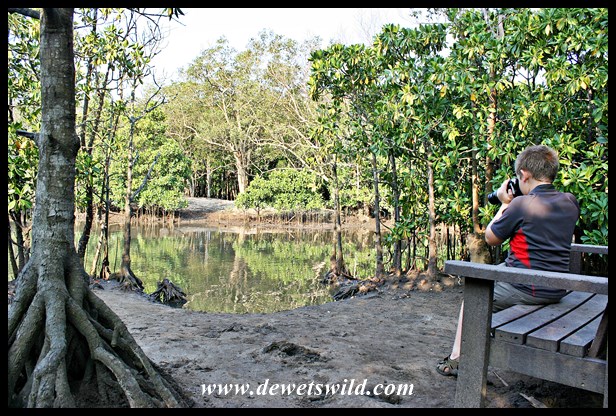
The time for our December holidays have finally arrived, and we kick of our summer vacation at beautiful Umlalazi Nature Reserve on the north coast of Kwazulu-Natal Province!
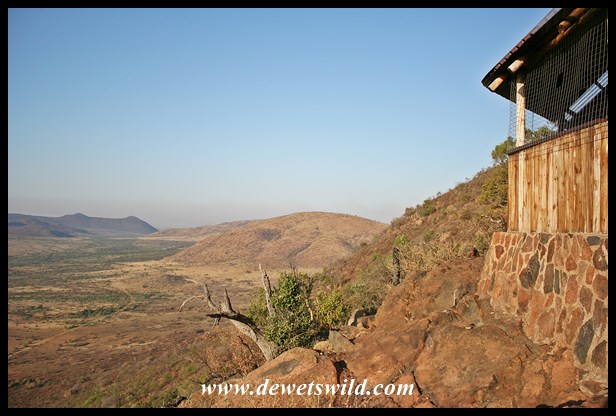
Early on this past Saturday morning Joubert and I headed for the Pilanesberg National Park’s Kwa Maritane Gate. Our plan was to spend all of Saturday, most of Sunday morning and the night between in one of South Africa’s most easily accessible wildlife destinations, enjoying a bit of father-son company and shared hobbies in the beautiful surroundings far from the city’s distractions. When the Gate opened at 05:30 we set off, enjoying some thrilling encounters with the Park’s wildlife right from the start.


While we were enjoying the Pilanesberg’s sights and sounds from the coolness of the photographic hide at Makorwane Dam, Joubert suggested that we head for Bakgatla Resort to go setup camp before the day got any hotter.


With our tent pitched and our camping chairs unpacked, we could enjoy our lunch, a few glasses of cold drink and an ice-cream treat surrounded by a selection of Bakgatla’s permanent residents of the feathered variety.


The first stop on our afternoon drive was Rathlogo Hide, just a few kilometers from Bakgatla.


At Tilodi Dam we laughed at the antics of a male African Black Duck that was most impressed with himself for having chased off a White-faced Whistling Duck from “his” shoreline.


There was much more wildlife to be seen as we traveled through the southeastern portions of the Park.


At Lengau Dam a group of baboon youngsters were having great fun roughhousing in a dead tree and occasionally dropping into the water below – no doubt enjoying great relief from the oppressive heat but I was surprised that they weren’t more afraid of the crocodiles!


With the sun setting it was time to head towards Bakgatla.


On Sunday morning we packed up our camp and headed for the Lenong Viewpoint to enjoy our morning tea and rusks from a beautiful vantage point high on top of one of Pilanesberg’s mountains. The rest of the morning we spent visiting more of our favourite spots in the Park, until the day started getting really hot again. We enjoyed a quick lunch at Fish Eagle Picnic Spot and then headed for Kwa Maritane Gate and home…


Pilanesberg National Park is an easy 160km drive from our home in Pretoria.

Today we celebrate a major milestone for us here at de Wets Wild – our 1,000th post!

A huge word of thanks must go to our all our friends and followers for their support and encouragement over the course of the past 6 years! Thank you for sharing our love and passion for South Africa’s wild places and the creatures that find a home there with us – we hope you’ll continue to do so for many years to come!
Seems fitting now to have a look at some of the most popular posts and other highlights we enjoyed on this journey. (Clicking on the links provided should open the posts in a new window without closing this post).
Perhaps unsurprisingly, our “About” page (home page) is by far the most visited.


But how and why the post about South African Hornbills come in second place, I have no explanation!? That they’re fascinating birds we won’t argue about.


South Africa’s vultures are getting some well-deserved attention as well.


Another post about a bird that got a lot of attention is that about the black heron and its fascinating hunting technique.
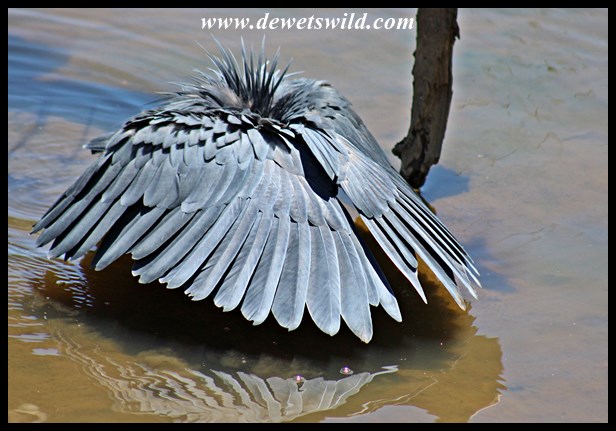
Black Heron “canopy feeding”
Early into our blogging “career” we took part in a few photo challenges – the image we posted of dew droplets caught in a spider’s web was the best received of those.

The post we did on the Kruger National Park’s Selati Line, with thanks to my sister for the use of her photos, has been a perennial favourite.
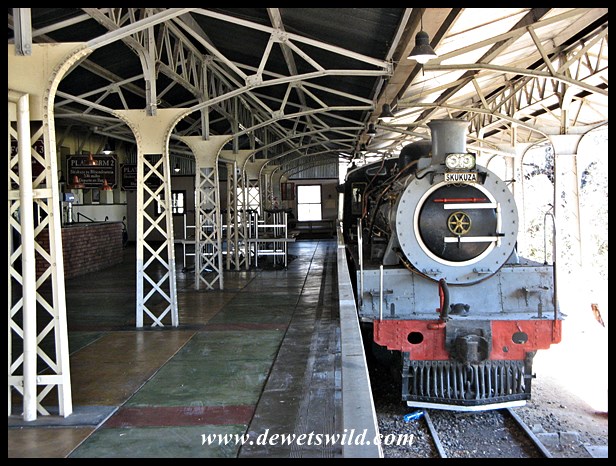
Steam engine at Skukuza “station”
The features we did on Pafuri Border Camp (in Kruger) and Nyathi Rest Camp (in Addo) when they opened are still very popular – people are obviously very eager to explore new destinations and we’re glad that de Wets Wild could help so many of them plan their visits!


But it is not only the new destinations that people are interested in, as the posts about familiar favourites like Skukuza in the Kruger Park, Loskop Dam and Golden Gate Highlands National Park prove.


Plains Zebras seem to be the most popular mammal featured here at de Wets Wild, as a few posts about these beautiful animals feature at the top of the charts!


But the world’s cutest bouncing baby rhino will not be outdone!
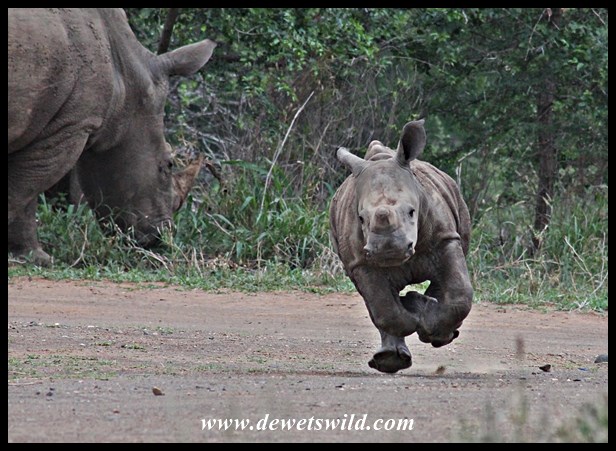
You’ll never catch me!
Of course we cannot talk about highlights and forget how your support helped us feature in the honours at the SA Blog Awards – from finishing as runners up in both the Best Travel Blog and Best Environmental Blog Categories in 2014, 2015 and 2016 to finally winning in both in 2017!

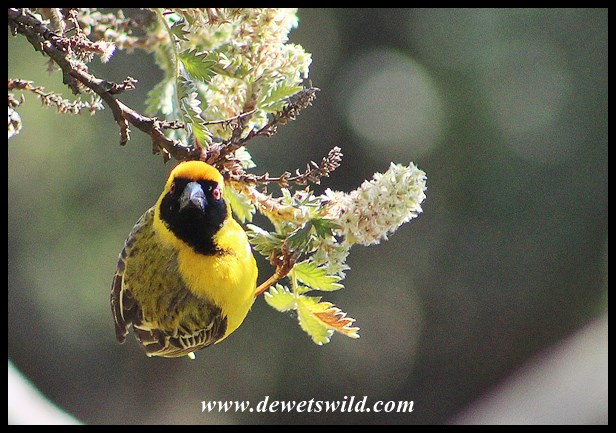
With the spring season now in glorious swing here in South Africa we headed to the Walter Sisulu National Botanical Garden again for a jolly day out in nature this past Sunday. The recently fledged Verreaux’s Eagle chick and its parents were the stars of the show, as always, and yet again we were amazed at the variety of wildlife finding a home here in suburban Johannesburg. The gardens are hugely popular with the citizens of South Africa’s biggest city, and not without reason, as we hope these photos will convince.


Have a look here for all our posts on the Walter Sisulu National Botanical Garden if you’d like to learn more about this fantastic place.
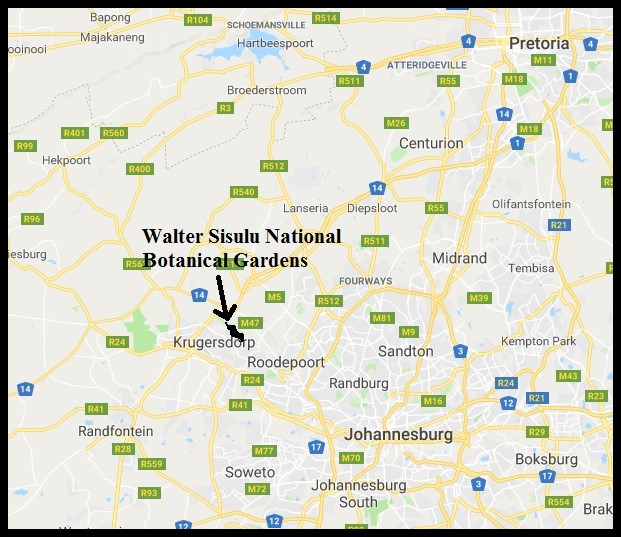
Walter Sisulu National Botanical Gardens is located on the outskirts of Johannesburg on the borders of Krugersdorp and Roodepoort

This past Women’s Day long weekend afforded us the opportunity to make a long overdue return visit to one of our favourite South African wild places – the Ithala Game Reserve in northern Kwazulu-Natal. We’ve been singing the praises of this little known yet exceptionally scenic reserve for as long as this blog’s been running and if you’d like to see all our posts about Ithala and learn more about it please follow this link.
While the weekend’s weather ranged from cold, wet and blustery to glorious sunshine, that didn’t curtail our explorations in the least. How could it, when the majestic scenery is so rewarding!?


And, when the sun came out, so did the butterflies and various kinds of reptiles!


Ithala has a rich variety of bird species and many of them are easily seen and photographed in Ntshondwe, the reserve’s main camp.


And of course, what would a “game reserve” be without a rich assortment of large animals? Ithala never disappoints in its variety of mammals, and especially the giraffes (Ithala’s emblem) were out in force!


We spent three nights at Ithala, staying in comfort in Ntshondwe’s chalet #20. Ithala’s a relaxed 6 hour drive on good tarred roads from our home in Pretoria.
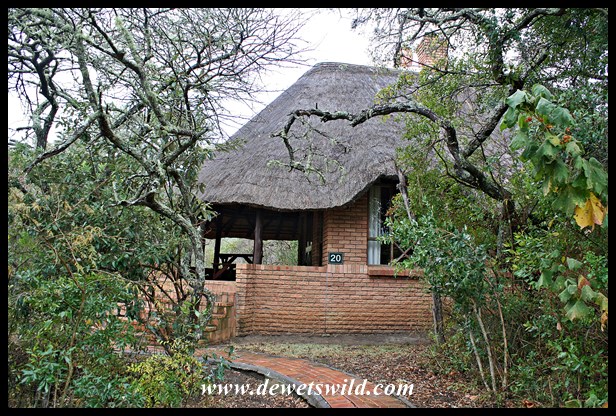
Ntshondwe Chalet #20, Ithala Game Reserve, August 2018
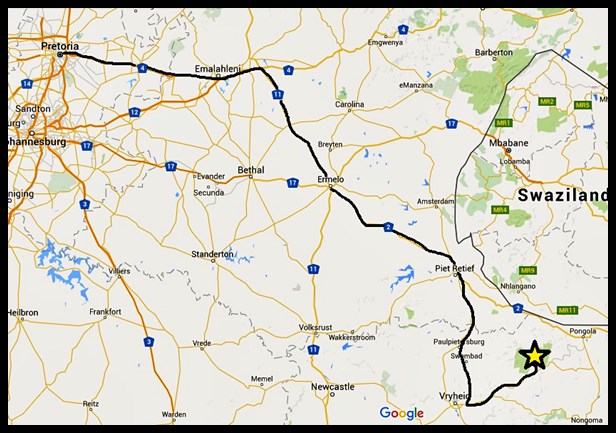
Pretoria to Ithala
(drawn with Google Maps)

For such an arid area – average rainfall measures around 200mm per annum – the Kgalagadi Transfrontier Park is home to an astonishing variety of wildlife. Apart from a wide variety of desert-adapted plants and invertebrates, the Park’s lists boast 62 kinds of mammals, 274 species of bird (of which 78 are resident throughout the year), 48 sorts of reptiles (including 17 snake species) and seven kinds of frogs.
There’s three kinds of plants that really are characteristic of the Kalahari. The first is the Camel Thorns – huge trees growing in the beds of the Auob and Nossob River and about which we’ll be sharing more soon. Then, there’s the Gemsbok Cucumbers and Tsamma Melons; the fruits of which are made up of around 90%+ of water and both an invaluable source of moisture to all kinds of wildlife (including some carnivores).


At the one end of the scale there’s a multitude of invertebrates and small reptiles and mammals taking up their respective positions in the food pyramid. The Kgalagadi Transfrontier Park allows a glimpse into their natural cycles and behaviours uniquely adapted to their arid environs.


The Kalahari might best be known for the grand variety of raptors that soar its airways, but birdwatchers will not be disappointed by the variety of other, less fearsome but equally fascinating, feathered fauna that find a home here.


The Rest Camps of the Kgalagadi Transfrontier Park are excellent places to look for owls, by day or night!


Predators, both large and small, abound in the Kalahari. Africa’s three species of big cat are often seen (though the leopard eluded us when we visited in June 2018), and is one of the main reasons people undertake the long journey to visit here.


The Gemsbok is so iconic of the Kalahari that both parks that today make up the Kgalagadi Transfrontier Park (Botswana’s Gemsbok National Park and South Africa’s Kalahari Gemsbok National Park) was named after it. These beautiful animals are of the most commonly encountered large mammals in the Park.


And while there may not be as great diversity among the large herbivores in the Kgalagadi Transfrontier Park as in some of Africa’s other great conservation areas, the antelope, giraffe and warthogs occur in such numbers that it belies the harshness of their environment.


We’ll dedicate the next few posts on our blog to discover some of the Kalahari’s residents in more detail.


Wedged into a remote corner of South Africa’s Northern Cape, between Namibia and Botswana, lies a very special piece of the Kalahari Desert. Here a wilderness of dunes, pans and dry, sandy river beds is a safe refuge to a rich variety of natural life, and one of the last fully functional ecosystems remaining on earth. The beds of the Auob and Nossob Rivers very rarely boast flowing water – the Auob perhaps once in ten years, the Nossob only once or twice in a century.


When the First World War broke out over a 100 years ago, the British Colonial government of the Union of South Africa and British Bechuanaland considered the beds of the Auob and Nossob Rivers a strategic access into German South West Africa and started sinking boreholes in the rivers to supply advancing troops. After the war, the area was divided into farms by a Scotsman, Roger Jackson, explaining how many of the waterholes today carry very Scottish-sounding names. The newly settled farmers however found it tough going – the fascinating museum at Auchterlonie providing a glimpse into this hard life – and had to turn their rifles on the herds of game moving through the area in order to make a living.
With the game population falling drastically, and shortly after South Africa’s first national park was proclaimed (the Kruger in the then Transvaal) two influential men from the region invited then Minister of Lands, Piet Grobler, on a “hunting trip” in the Kalahari and deliberately took him to an area denuded of wildlife. So disturbed was the minister by the lack of game that he immediately set about the process of proclaiming the area between the Auob and Nossob Rivers South Africa’s second national park – the Kalahari Gemsbok National Park coming into official existence on 31 July 1931. Soon more land to the southwest of the Auob and its confluence with the Nossob were added, bringing the size of the Park to 9,600km². Then, in 1938 the government in neighbouring Bechuanaland (today Botswana) proclaimed an even bigger piece of land on the other side of the Nossob (the unfenced international boundary between the two countries) the Gemsbok National Park. Informally the two conservation areas were managed as a single unit ever since, but it wasn’t until 1999 when the leaders of the two countries signed a treaty to formalise the arrangement. The Kgalagadi Transfrontier Park, covering over 34,500km², was officially opened on 12 May 2000 and is one of the biggest, and most unspoiled, conservation areas on the planet.


On the South African side of the Kgalagadi Transfrontier Park guests have a choice of three “traditional” rest camps offering basic amenities like accommodation, camping, a shop, fuel station, swimming pools, and guided walks and drives. Twee Rivieren is the main entrance, biggest camp and administrative centre of the Park (it also has a restaurant and border control) and offered the first tourist accommodation in the Park in 1940, while Mata Mata (on the Auob River, opened 1955) and Nossob (on the Nossob River, opened 1966) lie deeper into the Park, about 120m and 160km away from Twee Rivieren respectively. Union’s End marks the point where the borders of South Africa, Botswana and Namibia meet and is one of 6 rustic picnic sites available on the South African side of the Park. Six smaller Wilderness Camps are also spread throughout the Park – these offer only accommodation to overnight visitors. Between Twee Rivieren and Mata Mata lie the Kalahari Tent Camp, Urikaruus and Kieliekrankie, between Nossob and Mata Mata is located Bitterpan while Gharagab and Grootkolk is located north of Nossob on the way to Union’s End. While there’s around 500km of prepared roads (very sandy and corrugated in places, not recommended for sedans) to explore the Park in relative comfort, there is also a selection of guided and self-guided 4×4 trails available.


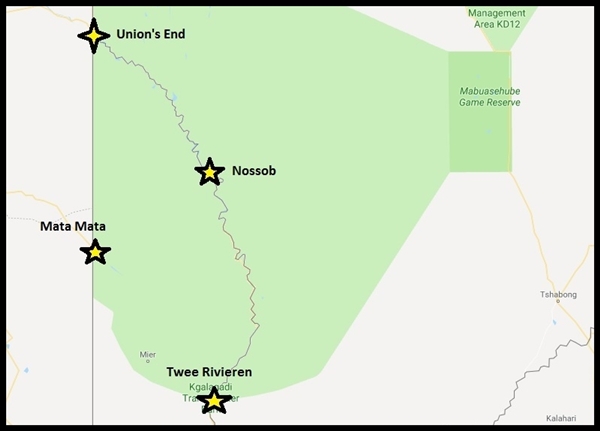
Relative locations of Twee Rivieren, Mata Mata, Nossob and Union’s End in the Kgalagadi Transfrontier Park
The Kgalagadi Transfrontier Park must be one of South Africa’s most out-of-the-way tourist attractions, lying about 1060km from Pretoria and 1040km from Cape Town. The nearest major airport with daily flights is at Upington, about 250km away from Twee Rivieren.

The location of the Kgalagadi Transfrontier Park
In the next installment, we’ll be showing you the marvelous wildlife spectacle the Kgalagadi Transfrontier Park has to offer.
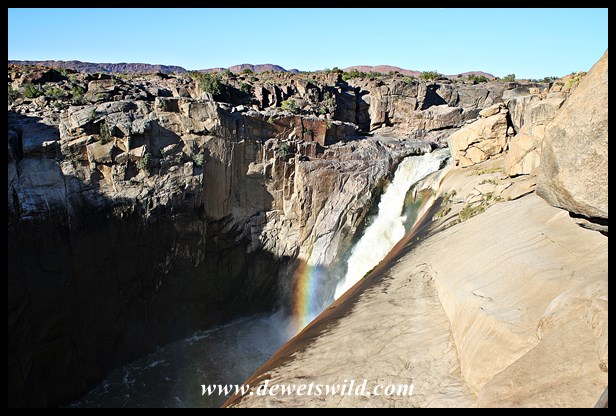
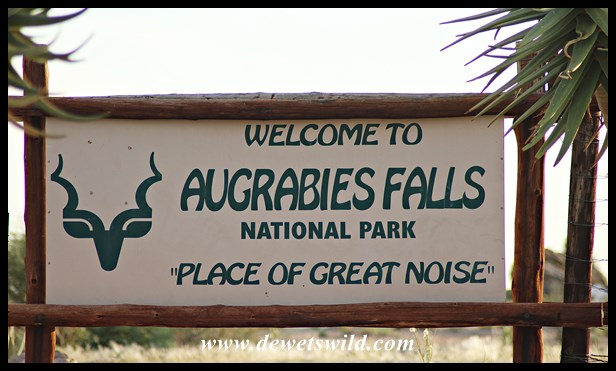
The Orange River, South Africa’s biggest and longest (running 2,200km from its source in Lesotho to its mouth at the Atlantic Ocean) is, for the most part, a lazy, slow-flowing waterway. That changes however when it is forced through a narrow granitic channel in the arid Northern Cape, plunges 56m over the impressive Augrabies Falls and continues through a dramatic gorge for another 18km before again returning to its more placid ways.
After years of political wrangling, a small 5,400 hectare area around the Falls was proclaimed the Augrabies Falls National Park in August 1966. Subsequently surrounding areas have been incorporated, and today the Park covers over 51,000 hectares.
Visitors can enjoy the best views of the Falls from several vantage points connected by easily negotiated boardwalks.
Consider that these photos taken during our visit in June 2018 saw the river flowing at a below average 38 cubic meters per second, and then imagine what it must look like when a flood of approximately 7,800 cumec, as happened in 1988, thunders down the Falls, to understand exactly why the Khoi named this place “Aukoerebis“, meaning “the place of great noise“!


Although the Falls is a worthy focal point of the National Park, there’s still lots more to see further afield when exploring this arid rocky desert landscape (the Park receives only about 120mm of rain annually). Places like Oranjekom, Ararat, Echo Corner and the Moon Rock are well worth the visit for spectacular views and fascinating geology. Quiver Trees and Namaqua Porkbush, both of which we’ll feature in more detail soon, are conspicuous plants and brilliantly adapted to life in this harsh environment. Rocky hills and arid plains where animals and birds abound add to the attraction.


Among the fauna finding protection in the Augrabies Falls National Park counts 49 species of mammal, 181 recorded bird species, around 50 species of reptile, 6 kinds of frog and 12 species of indigenous fish.


Guests can be accommodated overnight in the rest camp’s chalets or the very neat camping area, all within easy walking distance from the Falls (illuminated until 10pm each evening). At the camp there’s four swimming pools (including one for day visitors), a shop, restaurant, fuel station and a little bird-watching hide. The Oranjekom Gorge Cottage is located about 10km from the main camp, and offers privacy and magnificent views over the ravine and river. Provision is also made for day visitors with picnic sites in the camp and along the game viewing loop. Visitors are welcome to explore the Park’s roads in their own vehicle (some roads are only accessible to 4×4 vehicles) or on mountain bikes, and there’s several hiking trails to choose from ranging in length from 2 to 33km (the latter being the Klipspringer Trail which includes two overnight stops). Guided drives (both day and night) in open vehicles can be booked at reception.


The Augrabies Falls National Park is in one of the remotest corners of South Africa’s Northern Cape Province; roughly 930km from Pretoria and 870km from Cape Town. The nearest major airport with daily flights is at Upington, about 125km away. We enjoyed a wonderful two-night visit to Augrabies at the end of June 2018, during which all these photos were taken.
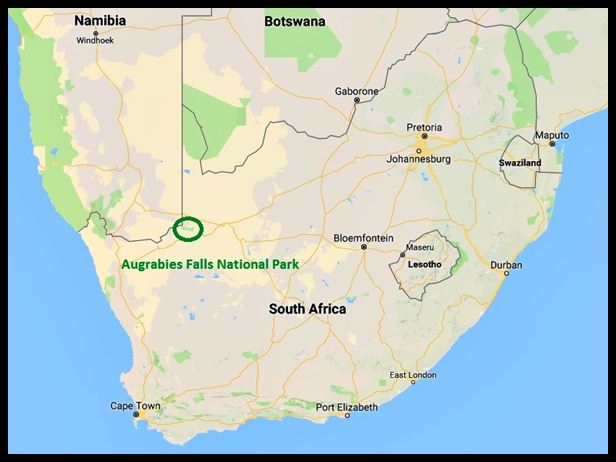
Location of Augrabies Falls National Park

We’ve just arrived home after a little more than a week spent exploring two of South Africa’s most remote national parks – the Augrabies Falls National Park and the Kgalagadi Transfrontier Park. Here’s a little selection of the thousands of pictures we came back home with for you to enjoy while we work at answering all the comments you left for us on the scheduled posts that published during our absence. Of course there’ll be many more pictures from these two magnificent destinations in the weeks to come!


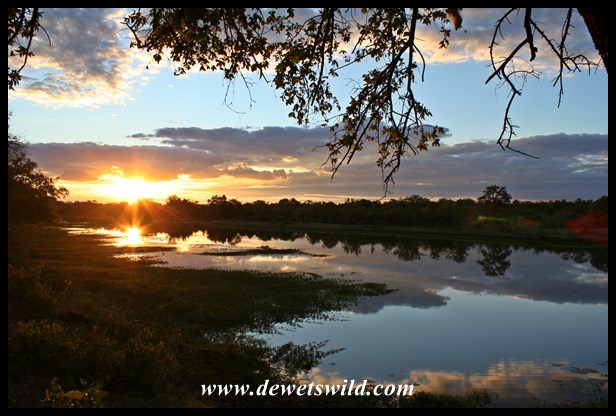
Middle-May presented an opportunity to visit one of my favourite corners of the Kruger National Park with three very good friends. We set off early on the Friday morning and returned the following Monday, having had a thoroughly enjoyable time exploring the wilds around Mopani Rest Camp. I’ve already shared with you some of what we saw – the exhilarating waterbuck fight, a towering elephant bull owning the road and the love of a mother hyena for her cubs – but of course in a paradise like Kruger there’s still much more to be seen, and shared!
When going to northern Kruger, apart from Impalas, there are three things you just KNOW you are going to see: Elephants, Buffaloes and Hippos!


Among all the beautiful elephants we saw, our most prized sightings were of Masasana and Ndlovane, two of the big tuskers that call the Kruger National Park home.


Early on the Saturday morning we thought we were going to be extremely lucky and see a pride of Lions take down a Blue Wildebeest at Tinhongonyeni waterhole. A passing rain shower however dampened the lions’ appetites and they went off to search for a drier spot among the dense mopane trees close-by.


Apart from the lions there were several predators in evidence around Mopani on this visit, with Black-backed Jackals and Spotted Hyenas being especially common.


And of course all those hungry meat-eater mouths rely on a steady supply of herbivores, which Mopani has no shortage of, especially around Tinhongonyeni and Mooiplaas Waterholes and in the marshland along the course of the Nshawu stream.


Kruger is always a paradise to birdwatchers, even now that most of the summer migrants have departed for warmer climes.


We always try to pay special attention to the interesting world of smaller creatures so often overlooked in a wild place like Kruger.


And then on the other side of the scale is the Park’s magnificent scenery!


The Kruger National Park is such a special place, and what a wonderful experience it was to share a piece of it with good friends!
 DeWetsWild