Tag Archives: travel

Back from the Kalahari

We’ve just arrived home after a little more than a week spent exploring two of South Africa’s most remote national parks – the Augrabies Falls National Park and the Kgalagadi Transfrontier Park. Here’s a little selection of the thousands of pictures we came back home with for you to enjoy while we work at answering all the comments you left for us on the scheduled posts that published during our absence. Of course there’ll be many more pictures from these two magnificent destinations in the weeks to come!

Wrapping up the “Dads Trip to Mopani”

Middle-May presented an opportunity to visit one of my favourite corners of the Kruger National Park with three very good friends. We set off early on the Friday morning and returned the following Monday, having had a thoroughly enjoyable time exploring the wilds around Mopani Rest Camp. I’ve already shared with you some of what we saw – the exhilarating waterbuck fight, a towering elephant bull owning the road and the love of a mother hyena for her cubs – but of course in a paradise like Kruger there’s still much more to be seen, and shared!

When going to northern Kruger, apart from Impalas, there are three things you just KNOW you are going to see: Elephants, Buffaloes and Hippos!

Among all the beautiful elephants we saw, our most prized sightings were of Masasana and Ndlovane, two of the big tuskers that call the Kruger National Park home.

Early on the Saturday morning we thought we were going to be extremely lucky and see a pride of Lions take down a Blue Wildebeest at Tinhongonyeni waterhole. A passing rain shower however dampened the lions’ appetites and they went off to search for a drier spot among the dense mopane trees close-by.

Apart from the lions there were several predators in evidence around Mopani on this visit, with Black-backed Jackals and Spotted Hyenas being especially common.

And of course all those hungry meat-eater mouths rely on a steady supply of herbivores, which Mopani has no shortage of, especially around Tinhongonyeni and Mooiplaas Waterholes and in the marshland along the course of the Nshawu stream.

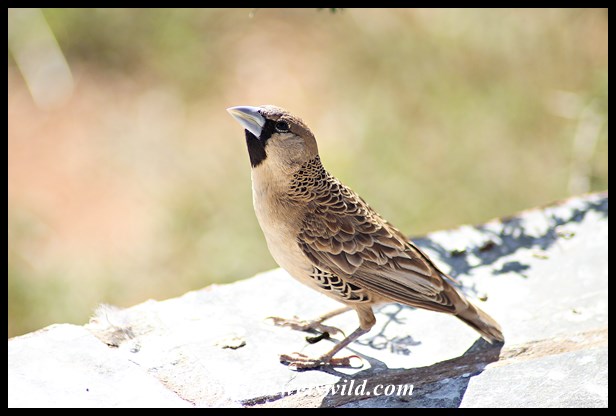
Kruger is always a paradise to birdwatchers, even now that most of the summer migrants have departed for warmer climes.

We always try to pay special attention to the interesting world of smaller creatures so often overlooked in a wild place like Kruger.

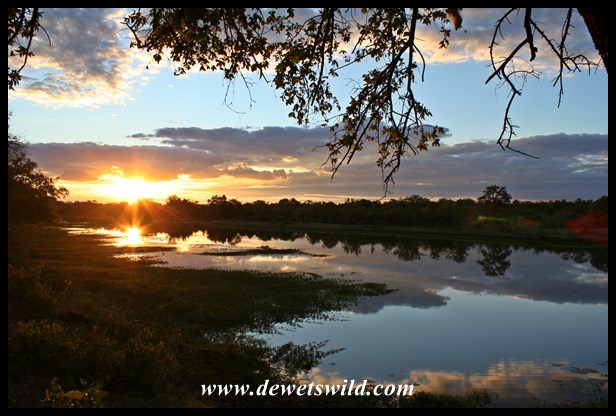
And then on the other side of the scale is the Park’s magnificent scenery!

The Kruger National Park is such a special place, and what a wonderful experience it was to share a piece of it with good friends!


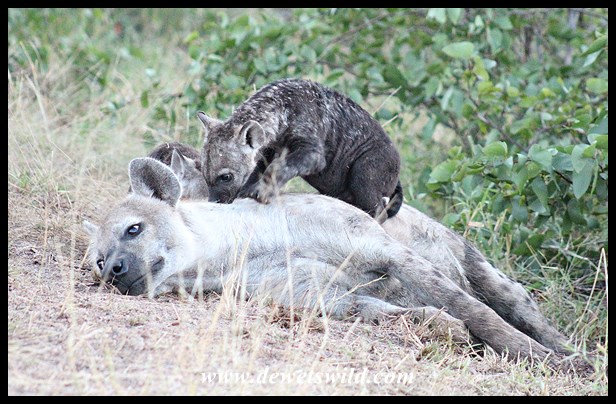
Even hyenas need a loving family

These tender moments shared by a Spotted Hyena female and her two small cubs, seen on a recent weekend visit to the Mopani region of the Kruger National Park, is another one of the reasons why we keep going back to the Park as often as we can. It also made the four dads in the car really miss their own “cubs” back home…

Elephants have right of way. Are you going to argue?

Just after sunrise last Sunday, while driving in the Mopani area of the Kruger National Park, we encountered this enormous Elephant bull in musth staking his claim to the narrow road. He was on his way to Mooiplaas waterhole and did not have any intention of letting four humans in a tiny (by his standards) metal cocoon derail his plans. In the end he made us reverse for over a kilometer before veering off towards the water.

Waterbuck Duel at Dusk

While visiting the Mopani area of the Kruger National Park this past weekend, we (myself and three very good friends) came across these waterbuck bulls involved in a massive fight about a patch of the Nshawu Vlei (marsh) and the eligible cows that inhabit it. As is the case with several antelope species in the Park, their rutting season will be coming to an end soon and these bulls are quite desperate to sire their share of the calves that will be born towards the end of the year.

Back from the bush, again

Fresh back from a self-made long weekend in the Kruger National Park again. Lots more photos coming your way in the days to follow!

Mokala Scenery

We’ve already shown you so many of the animals and birds that call Mokala home that you must by now be convinced of the fact that this National Park is one of South Africa’s conservation gems. That sensational faunal diversity however would not have existed had it not been for the wide range of vegetation, habitats and landscapes that Mokala comprises, and now in this final post about our April 2018 visit it is fitting that we showcase that aspect.

One of our highlights from this trip was having a front row seat to one of the most awe-inspiring experiences one could hope to have in Africa: a powerful thunderstorm rolling over the parched plains, smelling the red dust rise into the air as big drops of cool rainwater smacks into the dry soil. Soul stirring stuff.

And finally a few shots of our favourite place to stay while visiting Mokala: the rustic Haak-en-Steek Cottage.

If you’d like to learn more about Mokala National Park, why not have a read through the detailed post we did about the Park in 2016.

A rich assortment of animals at Mokala

Just as with the birds we showed you 2 days ago, Mokala National Park has an incredible variety of four and six legged creatures on show.

The large mammals are the easiest to see and photograph. During our 4 day visit in April 2018 we recorded over 750 different sightings of 30 different kinds of mammals!

The white rhino is the biggest of the animals in Mokala. Here they are shy and elusive and we were very happy to see a few of these endangered creatures.

Remember those mud-loving buffaloes we showed you a few days ago? Well that wasn’t our only encounter with Mokala’s growing population of African buffalo and we were very fortunate to come across several more herds and a few loners while exploring the Park.

Mokala’s giraffes are shown off to great effect in the open landscape dotted with their favourite Camel Thorn and Umbrella Thorn trees.

Mokala is certainly one of the reserves with the greatest variety of antelope in South Africa, many of which are rare in other national parks. Amongst others we managed to see black and blue wildebeest, blesbok, eland, gemsbok, grey duikerimpala, kudu, mountain reedbuckred hartebeest, steenbokwaterbuck, tsessebe, sable and roan antelope.

Not forgetting that we’ve already shown you loads of photos of Mokala’s springbok and plains zebras.

Mokala also has a wide variety of smaller mammals that are easier to overlook; Baboons and vervet monkeys, ground squirrels, warthogs, meerkats and yellow mongooses all crossed our path from time to time.

Mokala’s insects, amphibians and reptiles make you work harder for sightings of them, but for those who go to the effort there’s an astonishing variety of less conspicuous creatures waiting to entertain and enthrall!

If you’d like to learn more about Mokala National Park, why not have a read through the detailed post we did about the Park in 2016.

Bird Watching at Mokala

Mokala National Park owes its diversity of bird species both to its location at the transition between South Africa’s arid west and wetter eastern regions, as well as the diversity of habitats protected within its borders. To date, more than 200 species of birds have been recorded within this relatively new Park and we, not considering ourselves very proficient birders (yet) managed to tick a respectable 70 of those. These are just a few of the feathered friends we made at Mokala during our visit in April 2018.

If you’d like to learn more about Mokala National Park, why not have a read through the detailed post we did about the Park in 2016.

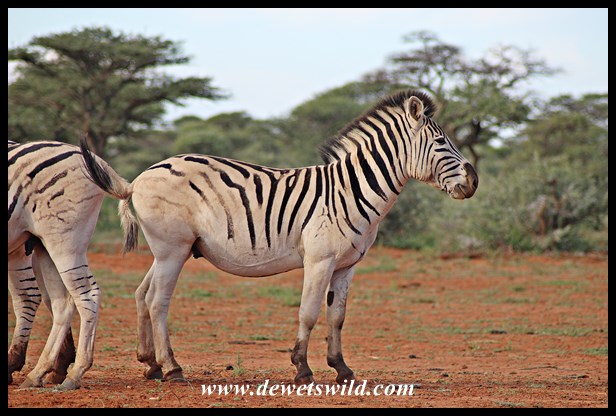
Mokala’s Pale Zebras

When the last Quagga mare died in Amsterdam Zoo in 1883, it was thought that this uniquely South African species of zebra was hunted into extinction, never to be seen again. Where once thousands of Quaggas, with their striped forequarters and brown backs and buttocks roamed the Karoo their distinct “kwa-ha-ha” calls would never be heard again. Over a century later however it was realised, through DNA analysis, that the Quagga was a localised race of the still extant Plains Zebra, and the Quagga Project came into being to try and bring them back through selective breeding. With each subsequent generation showing more and more Quagga-like characteristics, one day we may again see true-to-form Quaggas roaming their native country in vast numbers.

The area in which Mokala National Park is located would have been populated by zebras that were intermediate in appearance between the Quaggas and more “traditionally” patterned Plains Zebras, and thus when the Park was proclaimed it was decided to specifically stock it with zebras that had a lesser degree of striping, especially on their backs and haunches. These pale-rumped zebras are certainly an endearing feature of the Park.

If you’d like to learn more about Mokala National Park, why not have a read through the detailed post we did about the Park in 2016.