Tag Archives: wildlife

Karoo Scrub Robin

Tychaedon coryphoeus

A common inhabitant of Karoo scrublands and fynbos, the Karoo Scrub Robin grows to around 15cm in length and 20g in weight. They feed mainly on insects and spiders.

Karoo Scrub Robins are usually encountered in territorial pairs, which are often assisted at their nest by helpers from a previous brood. They breed in spring and summer, when the female builds a cup-shaped nest in a large heap of twigs placed at the base or in the foliage of a dense shrub, ably assisted in the provision of building materials (dry grass, leaves, fur and so on) by her mate and helpers. The female incubates the clutch of 2-4 eggs for around 2 weeks, during which time the male regularly provides food to her. The chicks fledge before they are 3 weeks old, but often stay with their parents to assist in the rearing of the next brood.

The Karoo Scrub Robin occurs only in southern Namibia, western Lesotho, and South Africa’s western provinces (Northern, Western and Eastern Cape as well as drier western parts of the Free State). The IUCN lists it as being of least concern.

Meerkat (or Suricate)

Suricata suricatta

The Meerkat, or Suricate, is one of the best known mongoose species, thanks to the lovable character Timon in Disney’s The Lion King and the long-running documentary Meerkat Manor on Animal Planet. Adults average about 50cm long and can weigh up to 960g.

Meerkats inhabit open, dry areas, usually with a hard substrate. They feed mainly on invertebrates, but will also consume small amphibians, reptiles (including venomous snakes, to which they appear to have a high degree of immunity), eggs, rodents and succulent plants, which provides their required intake of water.

Suricates are diurnal in habits, though confining most of their activity to the cooler hours of the day. They live in colonies with up to 40 members of both sexes and all ages, with the adult males aggressively defending the group’s territory. Within this home range there are several nesting burrows as well as hundreds of bolt-holes, into which they flee at the slightest sign of danger. Nesting burrows are often shared with springhares, yellow mongooses and ground squirrels. While the group is out foraging they take turns to act as sentry, climbing into trees and bushes up to 7m high for a better vantage point. Meerkats love to bask in the sun on cold mornings.

In small colonies only the dominant female will breed, but in larger groups there may be two or three females with babies. Females give birth at any time of year (though mostly in summer) to litters of 2-7 pups, and can raise up to 3 litters annually in favourable conditions. While out foraging, the mother will leave the babies in the care of a babysitter at the nesting burrow until they start foraging with the group at about a month old. All the group members help to look after young and sick or injured troopmates. Meerkats have a life expectancy of up to 12 years in the wild.

The IUCN considers the Meerkat of least concern. They occur from south-western Angola through Namibia and Botswana to South Africa, where they are found in all provinces except Limpopo and Kwazulu-Natal.

Karoo Korhaan

Heterotetrax vigorsii

As its name suggests, the Karoo Korhaan is a species that favours arid scrublands, preferring areas with a good ground cover and stony ground where its camouflage renders it very difficult to detect. It has also recently adapted to parts of the fynbos-biome as well the as planted croplands in that area. They follow an omnivorous diet, consuming flowers, fruit, leaves, bulbs and a wide range of invertebrates. Adult Karoo Korhaans weigh up to 2kg, with males quite a bit larger than the females.

These small bustards move around in pairs or small groups of up to 5. Breeding attempts have been recorded through most of the year, but summer appears to be the peak breeding season for the Karoo Korhaan. Pairs are monogamous and stay together throughout the year. The nest is a shallow scrape in the ground, usually hidden between shrubs and rocks. They lay a single egg, incubated by the female alone. Chicks leave the nest soon after hatching to forage along with their parents.

Thanks to a large and apparently increasing population and no apparent threats despite most of the population occurring outside formal conservation areas, the IUCN considers the Karoo Korhaan to be of Least Concern. They occur only in southern Namibia and parts of the Northern, Western and Eastern Cape Provinces in South Africa.

Bush Karoo Rat

Myotomys (Otomys) unisulcatus

The Bush Karoo Rat occurs in the drier parts of South Africa’s south-west (Northern, Western and Eastern Cape) and marginally into extreme southern Namibia. Their preferred habitat is areas with good vegetation coverage, such as that found along drainage lines, in the arid Karoo scrublands and semi-desert of the west coast. They feed on the seeds, berries, flowers, leaves and bulbs of a wide variety of plants (up to 60 species have been recorded for some populations), with succulents providing their required water intake. Including their relatively short tails, Bush Karoo Rats grow to an average of 24cm in length and weigh around 125g.

Bush Karoo Rats are mainly diurnal in nature, living in family groups numbering up to 11 rats that share a “lodge” – a large structure built of sticks, twigs, grass, kelp, bones, fur, and even shells and human litter, usually in or under the protection of a thorny bush. From the lodge a network of paths used to gather food radiate into the surrounding vegetation, with family members often bringing food back to store at the lodge. They will also readily climb into trees and bushes to reach food and to sun themselves. Bush Karoo Rats breed throughout the year, with litters of 1-5 young born after a 38 day gestation. They have a short life expectancy of less than 2 years in the wild.

The IUCN lists the Bush Karoo Rat as being of least concern, describing it as abundant in suitable habitat.

Camdeboo National Park

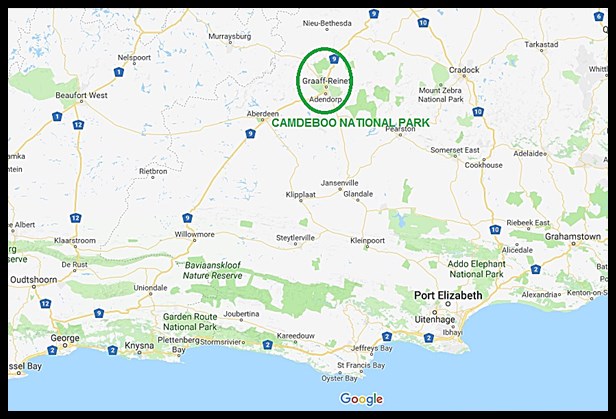
In 1975 the Southern African Nature Foundation (today WWF-SA) established the 165km² Karoo Nature Reserve virtually all around the historic town of Graaff-Reinet. It was only in 2005 that the Karoo Nature Reserve was transferred to the stewardship of South African National Parks, and officially proclaimed as the Camdeboo National Park. Additional land was incorporated into the new Park, enlarging it to 194km². Some parts of the reserve consists of inspiring mountain topography, and yet others of wide open arid plains. The Nqweba Dam, previously known as the Van Rhyneveld’s Pass Dam and built in the early 1920’s, occupies a large section of the Park (up to 1000 hectares when full). The vegetation of the Park is a mix of Karoo scrub, grasslands, thorn savannas and succulent thickets, consisting of over 330 species.

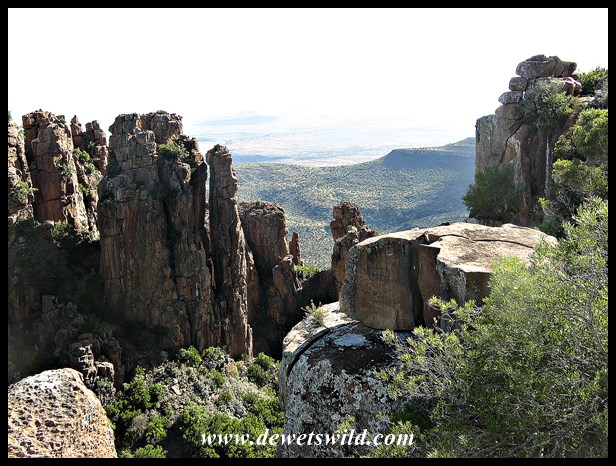
Camdeboo National Park’s most celebrated natural feature, and a declared scenic national monument, is the Valley of Desolation, an awesome cleft over 100m deep, bordered by imposing pillars of stone and cut by natural forces over a period of 240-million years into the side of the mountain looming over Graaff-Reinet. A tarred road leads to the toposcope and viewpoints right at the top, where visitors have an opportunity to enjoy the magnificent vistas over the expansive Great Karoo and the small frontier town situated in an oxbow bend of the Sundays River below.

The Karoo Nature Reserve and later Camdeboo National Park was stocked with several large game animals that used to occur here historically, and today Cape Buffalo and Cape Mountain Zebra count among the 43 kinds of mammals that can be seen here. All told, there’s no less than 225 kinds of birds, 34 reptile species and 8 varieties of frogs and toads that has been recorded within the Park’s borders.

Overnight guests have a choice between the four basic two-bed safari tents at the Lakeview Tented Camp, which make use of a communal ablution block, kitchen and lounge, or the Nqweba Campsite which has fifteen sites for caravans and tents (each with a braai stand (barbeque) picnic table and electric point). There’s a limited network of gravel game-viewing roads available to sedans, a few more 4×4 trails, hiking trails, fishing and other watersports on the Nqweba Dam, a bird-watching hide (unfortunately really only of use when the dam is full), and rustic picnic sites. Graaff-Reinet has shops, restaurants, fuel stations and more.

Camdeboo National Park was the final stop on our December 2017 holiday tour through eight of South Africa’s national parks. The easiest access to Camdeboo’s Nqweba Campsite, Lakeview Tented Camp and the main game-viewing area is from the gate on the N9, just a few kilometres north of Graaff-Reinet, while the gate to the Valley of Desolation lies on the R63 to Murraysburg.

Grey-winged Francolin

Scleroptila afra

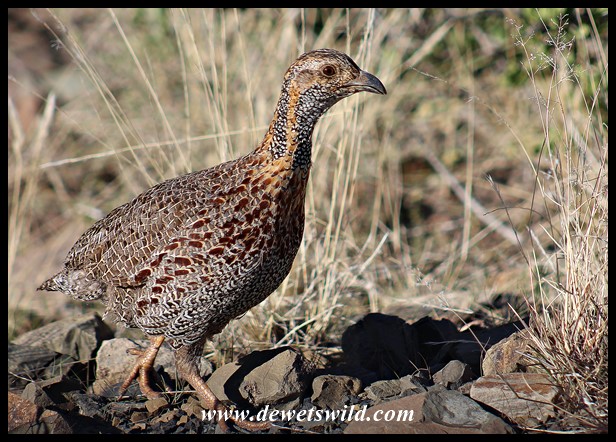
A fairly common inhabitant of fynbos and mountain grasslands and scrub to elevations as high as 2750m above sea level, Grey-winged Francolins move around in groups of up to 25 birds, but more usually between 3 and 8. Insects and bulbous plants make up the majority of its diet. Adults grow to 33cm with a weight of up to 520g.

The breeding season in Grey-winged Francolins spans spring and summer, reaching a peak between August and November. Females lie 4-8 eggs, though nests with up to 15 eggs have been noted and must be the result of 2 or more females sharing a nest. The hen incubates the eggs for 3 weeks and the chicks start moving around with their parents soon after hatching.

The Grey-winged Francolin occurs only in Lesotho and South Africa, where it is distributed through most of the Western and Eastern Cape and into portions of the Northern Cape, Free State, Kwazulu-Natal and Mpumalange where suitable habitat is found. The IUCN considers the Grey-winged Francolin of least concern despite it being a popular hunting bird in parts of its range.

Double-banded Courser

Smutsornis africanus

The mainly nocturnal Double-banded Courser inhabits rocky and sparsely vegetated semi-arid scrublands and grasslands as well as desert plains, where they subsist on a diet comprised of insects, particularly ants and termites. Adults weigh up to 100g and have a wingspan of about 45cm.

Double-banded Coursers are usually seen singly or in pairs, with larger groups of adults being a very rare occurrence. This species breeds throughout the year with a peak in the summer months. No nest is built and instead the well camouflaged single egg is laid directly on the ground, surrounded by pebbles, plant material or antelope droppings. Both parents take short turns to incubate the egg over a period of 3 weeks. The chick fledges when it is 5 to 6 weeks old.

The IUCN considers the conservation status of the Double-banded Courser as of least concern, with a stable population. The species occurs in two seperate parts of the African continent: one in East Africa and the other in the arid west of Southern Africa. In South Africa they are found in the Northern, Western and Eastern Cape, Free State and North West Province.

Namaqua Sand Lizard

Pedioplanis namaquensis

Without their tails, Namaqua Sand Lizards grow to around 5cm and weigh only about 4g. They inhabit arid savannas, scrubland and semi-deserts, and specifically open sandy or gravelly areas. These diurnal lizards are extremely active, constantly dashing around at great speed in search of food, which is mainly small insects. At night and during cold spells they stay in burrows dug at the base of bushes. Females lie 3-5 eggs in early summer. Namaqua Sand Lizards occur from the Eastern Cape Province northwards through South Africa’s arid western parts, as well as Botswana and Namibia to southern Angola.

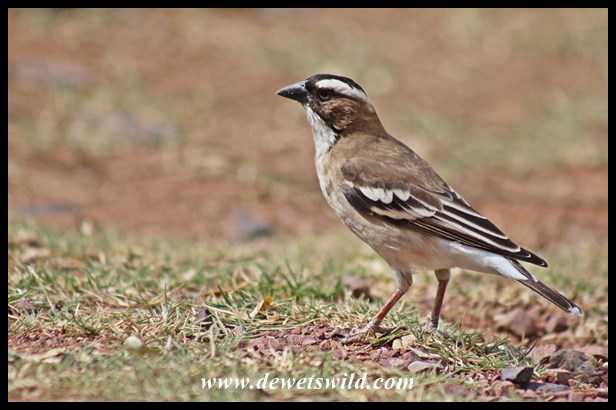
White-browed Sparrow-Weaver

Plocepasser mahali

The White-browed Sparrow Weaver is a dominant and conspicuous inhabitant of drier woodlands, thornveld, savannas and grasslands. They usually move around in small flocks of 4-10 birds, feeding on a wide variety of fruit, seeds, leaves and insects on the ground. Adults grow to 19cm in length and weigh around 50g.

White-browed Sparrow-Weavers nest in small colonies, building untidy grass nests in taller trees (including exotics) or artificial structures (like utility poles), in which they stay throughout the year. Families of White-browed Sparrow-Weavers aggressively defend their territories against intruding neighbours. Each bird in the group has its own nest, and only the dominant, monogamous, pair in the group breed. While breeding has been recorded throughout the year in response to rain, there is a definite peak in the warm summer months. Sleeping nests can be identified by having two entrances, while breeding nests have a single opening. The dominant female is responsible for incubating the clutch of 1-3 eggs for 2 weeks but the entire group assists her in the feeding of the chicks as they grow. The chicks fledge when they’re about 3 weeks old.

The IUCN describes the White-browed Sparrow-Weaver as being common to abundant and lists it is “least concern“. They occur from Ethiopia south to Angola and South Africa. In South Africa, White-browed Sparrow-Weavers are found mainly in the drier north-western parts of the country – the provinces of the Northern Cape, North West, Free State, Gauteng and Limpopo and parts of Mpumalanga and the Eastern Cape – and it would appear that they are expanding their range and increasing their numbers.

Mountain Zebra National Park

Historically, the Cape Mountain Zebra occurred widely in the mountainous areas of what today is South Africa’s Eastern, Western and Northern Cape Provinces. With the settlement of Europeans in these areas, and the consequent increase in competition for grazing with their livestock as well as uncontrolled hunting, the numbers of the zebras started plummeting. With their plight finally brought to public awareness, the National Parks Board (today SANParks) proclaimed the farm Babylons Toren in the Cradock district the Mountain Zebra National Park in 1937. At 1,432 hectares in extent, the newly established Park was hopelessly too small, and the founding herd of 5 stallions and 1 mare entirely inadequate to save the species from certain doom, and by 1950 the world population of Cape Mountain Zebra had dwindled to only 91 animals, of which only 2 were in the national park that carried their name. That same year a local farmer donated 11 zebras to the park, but it was only in 1964 that the Park was expanded to 6,536 hectares with the addition of neighbouring properties. This proved very much to the zebras’ liking, and by 1969 the Park’s herd stood at 98 head and by 1978 had grown to 200. Today, the Mountain Zebra National Park protects around 500 of these beautiful animals, and several hundred more have been reintroduced to areas in their historic distribution range.

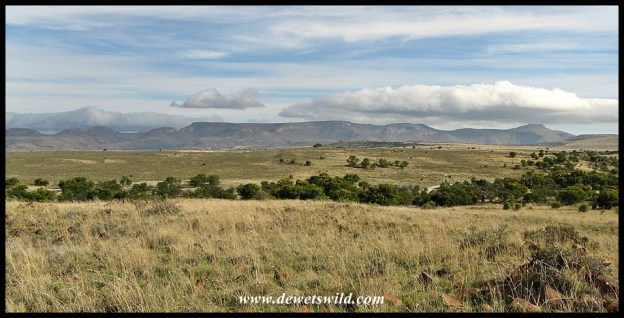
The Mountain Zebra National Park lies at the transitional zone between the arid western Karoo-scrublands and the moister, eastern grasslands, and protects a wide variety of habitats and landscapes within its borders. Given its amazing topographical diversity it should come as no surprise that over 700 plant species occur in the Park. With the future of the Cape Mountain Zebra secured, the focus of the Park could be shifted to biodiversity conservation, and with the help of wildlife artist David Shepherd and several corporate sponsors, enough funds were collected to enlarge the Park to over 28,000 hectares, which allowed the introduction of several large game species – notably lion, cheetah, buffalo and black rhino – to their former haunts.

Sharing the Mountain Zebra National Park with its most celebrated inhabitants is 65 other kinds of mammals…

… and to date 257 bird species have been recorded in the Park.

There’s also a multitude of smaller, less noticeable animals in the Park, including 45 kinds of reptiles, 10 species of frogs, and giant 4m long earthworms!

In recent years, Mountain Zebra has become one of South Africa’s most popular national parks, and recently the number of accommodation units at the Park’s rest camp (which also boasts a small shop, restaurant and swimming pool) had to be substantially increased to cater for the demand. Doornhoek Guest House is a historic homestead restored to its former glory and now converted to luxurious overnight accommodation in a secluded corner of the Wilgerboom River valley. There’s also a terrific camping site, two picnic sites, an extensive network of game-viewing roads, three 4×4 trails, a guided hiking trail and guided game drives available to visitors. A unique attraction at Mountain Zebra is the “cheetah tracking” where guests accompany researchers and rangers to find radio-collared cheetahs in their natural habitat.

Mountain Zebra National Park was the eighth and penultimate stop on our December 2017 tour through eight of South Africa’s national parks. It is located just outside the small town of Cradock, on the R61-road to Graaff-Reinet.