Tag Archives: nature

Black Heron

Egretta ardesiaca

One of the most interesting birds you could hope to see in action in South Africa’s wild places, is the Black Heron. It’s a smallish species, about 55cm long and less than 350g in weight. Their black plumage and bright orange-yellow feet make them easily recognisable.

Black Heron (10)

Black Herons roost and breed communally in reedbeds or trees, near or over water, with others of their own species, and other kinds of egrets, herons, cormorants and ibises. Nests are platforms built of twigs at the start of the rainy season, on which clutches of 2 to 4 eggs are incubated.

Black Heron (9)

They search for food, alone or in flocks of varying sizes, in rivers, swamps, lakes and estuaries, and feed predominantly on fish.

Black Heron

Black Herons occur widely in Sub-Saharan Africa, excluding the equatorial forests, The IUCN considers the species’ population stable and in no immediate danger of extinction, though they are highly threatened in Madagascar.

Black Heron (8)

A recent visit to Austin Roberts Memorial Bird Sanctuary afforded us the opportunity to enjoy up-close views of the Black Heron’s characteristic hunting method, knows as “canopy feeding“. The bird uses its wings to create an umbrella around its head, and then picks off fish and tadpoles beneath. This behaviour may serve a dual purpose of preventing glare from the water, making it easier to see their prey, and tricking the prey into thinking that the shadow is a safe hiding place. They are also known to wiggle their toes underwater to attract their fishy prey.

Summer heat at Olifants

After three nights at Lower Sabie it was time to move northwards to the central regions of the Kruger National Park. Just as we set off, a light drizzle started falling, and kept falling for the entire 50km or so distance between Lower Sabie and Tshokwane picnic site. While the low clouds meant that we could not enjoy the magnificent view from the top of Nkumbe mountain, we did not mind having a break from the previous few days’ oppressive heat! Pretty soon little puddles were forming on rocks and in the road, and while the shower would not have broken the drought, it would have brought a little bit of relief to the parched veld.

Between Tshokwane and Satara we encountered two more pairs of mating lions. While one couple moved away from the road for more privacy, the other was a lot more relaxed in the company of the few cars that had gathered to watch them. The prevailing drought makes catching prey much easier, and the way the lions are going on there will soon be many more young and hungry mouths to feed.

After lunch (take-away pizzas enjoyed in Satara‘s day visitors area) we tackled the final stretch of the long drive from Lower Sabie to Olifants Rest Camp. The plains between Satara and the Olifants River were positively teeming with wildlife of all descriptions.

Checking in at Olifants Rest Camp, we were given the keys to our cottage, number 14, one of the most popular units in the camp, and for good reason. The view of the wide bend of the Olifants River with its pods of hippos and lurking crocodiles far below, the endless wild plains beyond and the continuous stream of game and birds arriving to slake their thirst, is almost unrivaled anywhere on the continent, and you can take it all in from the comfort of a sofa on the wide veranda!

With the area around Olifants suffering from an extreme drought and intense heat, we thought it best to stick to the routes along the Olifants River and some of its tributaries that still held water for our afternoon drive. The high bridge and low-level causeway crossing the Olifants, and the weir at the Ngotso-crossing (on the S89 route) proved to be hot-beds of wildlife activity, though in the areas in between, away from the water, there were few animals to be found.

Next morning we were already waiting, with a few other cars, at Olifants’ gate for the 04:30AM opening – that’s the way to maximise your chances of encountering large predators on the prowl in the hot summer and we didn’t have to drive far before encountering two spotted hyenas just as first light started painting the African morning. Our drive took us along the Olifants and Letaba rivers, an area of rugged beauty, to Letaba Rest Camp, where we planned on enjoying our picnic breakfast. We didn’t however bargain that we’d be joined by a snake, even if only a slightly venomous Olive Grass Snake. Happily the snake was very well behaved and totally relaxed, and so he enjoyed the warm morning sun while we enjoyed our rusks and coffee…

Seeing as the Olifants river delivered such enjoyable sightings to us the previous day, we again focussed on the H1-5 tar road and the connecting S90, S91 and S92 gravel roads the following afternoon. This time we worked a quick detour to Bangu waterhole, some distance to the south of the river, into our drive as well – a well rewarded decision as we found a pair of black-backed jackals and flock of Temminck’s Coursers at the Xipembane stream, which still held a bit of water.

Driving up to Olifants two days earlier, the tremendous concentrations of game around Satara really drew our attention, and we decided that we had to explore that area a bit more on our final full day at Olifants. With the tarred road between Olifants and Satara carrying most of the tourist traffic, we opted to rather follow the gravel S90 “old main road”, past Bangu and Gudzani waterholes, to Satara, and then return to our lovely cottage at Olifants along the tar route when the day starts hotting up. Ticking excellent sightings along the way; a large pack of hyenas, showboating hippos, a rarely seen honey badger, two regal lions, more jackals and a quick view of a pair of cheetahs surrendering their kill to descending vultures, not to mention a huge number of more commonly seen birds and animals, and despite heavy cloud cover, a howling wind and the irritation of a punctured tire (quickly fixed at Satara’s car wash), you’ll appreciate that we were a very happy group when we arrived back at Olifants that morning!

After spending the hot midday hours in camp appreciating the enchanting view and the accompanying birdlife, it was time for our final leisurely afternoon drive along the Olifants and Letaba Rivers. While the drive wasn’t anywhere as exhilarating as our drive that morning, it did give us another opportunity to enjoy the rugged scenery of the valleys these rivers have carved over aeons through the Lebombo foothills.

We still had three nights left at Shingwedzi Rest Camp after our time at Olifants, and we’ll be telling you all about those next week. We’ll also be telling you more about Olifants and its environs in an upcoming edition of de Wets Wild.


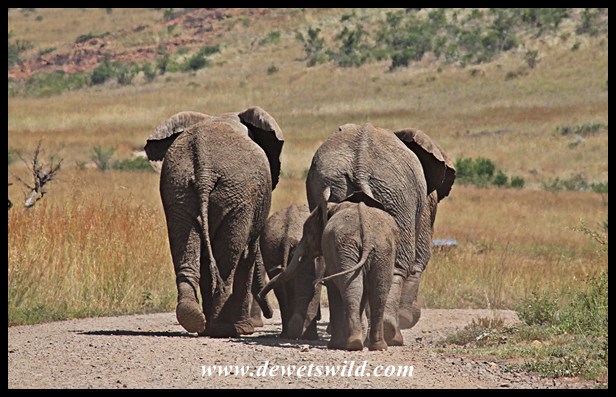
Heavyweights

Wide load ahead! African elephants laying claim to the road…

Weight(less)” is the theme for this week’s WordPress Photo Challenge.

Summer heat at Lower Sabie

We knew our December 2015 visit to the Kruger National Park was going to test our personal thresholds for high temperatures. It is general knowledge that South Africa’s Lowveld region has sweltering summers, confirmed by the weather forecasts in the week before our departure. On our early morning way, descending into the Lowveld along Schoemanskloof on the N4-highway, we were amazed at how quickly the outside temperature our car was registering was climbing upwards. By the time we arrived at Malelane Gate just after 08:00, we had reached 33°C, with the sun blazing down relentlessly. And yet, we couldn’t think of any place we’d rather be; we were back in South Africa’s flagship National Park, one of our favourite wild places, and we had ten days to explore the length and breadth of it to look forward to!

We were heading to Lower Sabie, and instead of following the tar roads via Skukuza we opted for the more direct route, along the gravel S25 and H5, from Malelane. Of course we had wonderful sightings along the way, most especially of some sleepy elephants! Early December is lambing season for the impalas, and each herd we passed had a few new members, all ears and long legs, to broaden our smiles.

By the time we checked in at Lower Sabie Rest Camp for our 3 night stay, the temperature had soared to a searing 43°C. Our cottage (unit 93), with a lovely view of the Sabie River in front of the camp and surrounded by huge, shady trees, provided welcome respite!

But of course no amount of heat was going to keep us indoors for long when there’s Big-5 country to explore outside! Our afternoon drive took in Gomondwane, Duke’s waterhole and a section of the Nhlowa-road to the south of Lower Sabie, after a quick visit to Sunset Dam just outside camp. Highlights of the drive included an unusually relaxed black rhinoceros, our best sighting ever of a side-striped jackal, and the cutest little warthog piglets you could imagine!

The itinerary planned for Sunday 13 December meant that we would be out of camp all day: a slow early morning drive (the camp gates open at 04:30 in high summer) to Skukuza along the Sabie River, visit with good friends at Skukuza over lunch, and then back to Lower Sabie via the Sand River, the Salitje road, Muntshe Mountain and Mlondozi Picnic Site. Covering that big an area is sure to deliver some unusual sightings; apart from a skittish leopard and all the more commonly seen game animals, we even found an African Rock Python along the way. Our final wildlife encounter of the day was with a pair of mating lions, within sight of Lower Sabie, resulting in sightings of all the Big-5 on a single day!

That wasn’t the end of the day however, as we were booked for a guided night drive after supper. Unfortunately strong winds sent the nocturnal animals into hiding, and the drive did not yield much more than a Verreaux’s Eagle Owl and enormous scorpion to get excited about.

We had one more day to explore the Lower Sabie area, and headed for Crocodile Bridge along the Nhlowa Road as soon as the camp’s gates opened. About halfway we met a large pack of hyenas at their den, and after spending some time with them our grumbling tummies told us that it was time to go enjoy our picnic breakfast at Croc Bridge. More great sightings on our way back to Lower Sabie along the Gomondwane Road, including a herd of elephants coming to drink from the Sabie River. We also noticed a male lion lying on the river bank and after slaking their thirst, the elephants started crossing the river. This was the lion’s cue to vacate his spot, and we were thrilled that he chose to head into the bush straight past our vehicle!

Lower Sabie is a wonderful place to while away the hot midday hours as there’s a constant stream of animals coming to drink from the river and birdlife abounds in the camp grounds!

There’s no better way to spend your last afternoon at Lower Sabie than slowly driving along the river, and spending some time at Sunset Dam. So that’s exactly what we did!

With that, our final night at Lower Sabie had arrived. Next morning we’d depart for Olifants Rest Camp, further north in the central regions of the Kruger National Park. We’ll share more about our time at Olifants next week, and will dedicate a special post in which we’ll tell you all about Lower Sabie and surrounds in an upcoming edition of de Wets Wild.

________________________

If you enjoy de Wets Wild as much as we enjoy sharing our love for South Africa’s wild places and their denizens with you, please vote for us in the 2015 South African Blog Awards.

We’ve entered the categories for “Best Travel Blog” and “Best Environmental Blog”, and you are allowed to vote for us in both. Clicking on the badge below will bring you to the voting site.

SA Blog Awards Badge

Thank you very much for your support!

Circle

The unusual posterior markings of the waterbuck is an ideal fit for this week’s WordPress Photo Challenge “Circle“!


—–

If you enjoy de Wets Wild as much as we enjoy sharing our love for South Africa’s wild places and their denizens with you, please vote for us in the 2015 South African Blog Awards.

We’ve entered the categories for “Best Travel Blog” and “Best Environmental Blog”, and you are allowed to vote for us in both. Clicking on the badge below will bring you to the voting site.

SA Blog Awards Badge

Thank you very much for your support!

Waterhole meeting

There is always something interesting to see along the Mphongolo River, north of Shingwedzi Rest Camp, and the final afternoon of our recent visit to the Kruger National Park delivered another memorable sighting in this area. At one of the few pools remaining in the rived bed, and with temperatures peaking at a sweltering 40°C, a large herd of elephants and an equally sized herd of buffaloes were converging, and jostling for position at the water and mud (with the elephants obviously winning the contest). Hiding in the middle of the pool was a single crocodile, probably hoping and praying that none of the behemoths notice it!

________________________

If you enjoy de Wets Wild as much as we enjoy sharing our love for South Africa’s wild places and their denizens with you, please vote for us in the 2015 South African Blog Awards.

We’ve entered the categories for “Best Travel Blog” and “Best Environmental Blog”, and you are allowed to vote for us in both. Clicking on the badge below will bring you to the voting site.

SA Blog Awards Badge

Thank you very much for your support!

Almost orphans

On the 15th of December, making our way to Olifants Rest Camp, in fact just about a kilometer before the camp’s gates, we came across two tiny warthog piglets, probably not any older than a day or two. They were frantically running around in the road, squeeling to high heaven, and approaching every passing vehicle seemingly hoping that it was their mother.

It seemed they were abandoned and they were clearly in distress.

However, after spending a few minutes at the scene we noticed their mother hiding in the thickets, grunting to her little ones but probably frightened of the vehicles gathered around her babies. We decided to leave then, hoping that as soon as there were no more cars around she’d come and collect the errant piglets and take them back to the safety of her burrow.

When we passed the scene again a little later, the warthog family was nowhere to be seen and we hoped that the story had a happy ending.

________________________

If you enjoy de Wets Wild as much as we enjoy sharing our love for South Africa’s wild places and their denizens with you, please vote for us in the 2015 South African Blog Awards.

We’ve entered the categories for “Best Travel Blog” and “Best Environmental Blog”, and you are allowed to vote for us in both. Clicking on the badge below will bring you to the voting site.

SA Blog Awards Badge

Thank you very much for your support!

Surprise osprey at Shingwedzi

We were most excited to find an osprey, a rather uncommon bird in South Africa, fishing at a pool in the Shingwedzi River, just a few kilometers north of Dipene along the S50-route, during our recent visit to the Kruger National Park.

Osprey

It was just one of almost 200 bird species we identified on the ten day trip, and we’ll be telling you all about our visit and sharing many of the special wildlife encounters we enjoyed in the days and weeks ahead here at de Wets Wild!

________________________

If you enjoy de Wets Wild as much as we enjoy sharing our love for South Africa’s wild places and their denizens with you, please vote for us in the 2015 South African Blog Awards.

We’ve entered the categories for “Best Travel Blog” and “Best Environmental Blog”, and you are allowed to vote for us in both. Clicking on the badge below will bring you to the voting site.

SA Blog Awards Badge

Thank you very much for your support!

Get lost!

Ever wondered what a lion’s face looks like when you disturb him and his lady love?

Like this!

Get out of my face

________________________

If you enjoy de Wets Wild as much as we enjoy sharing our love for South Africa’s wild places and their denizens with you, please vote for us in the 2015 South African Blog Awards.

We’ve entered the categories for “Best Travel Blog” and “Best Environmental Blog”, and you are allowed to vote for us in both. Clicking on the badge below will bring you to the voting site.

SA Blog Awards Badge

Thank you very much for your support!

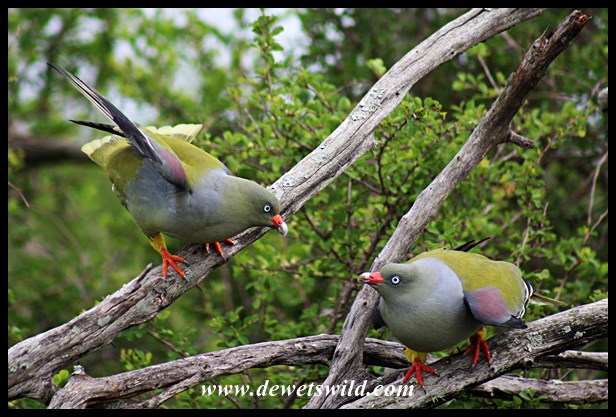
Pigeon quarrels

This morning we were entertained by the constant bickering between the members of a flock of beautiful African Green Pigeons.

Squabling