This evening we were welcomed back to Lower Sabie Rest Camp by a pair of mating lions!
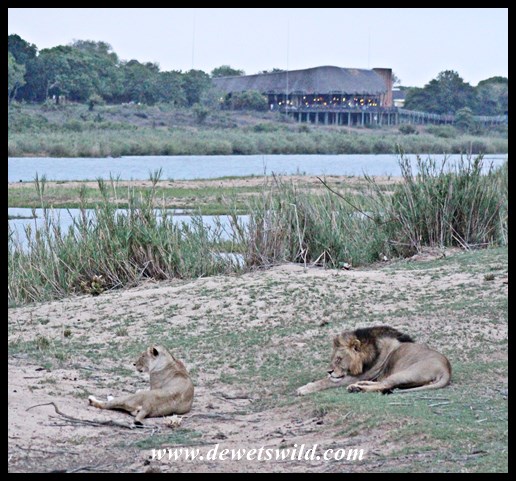
This evening we were welcomed back to Lower Sabie Rest Camp by a pair of mating lions!
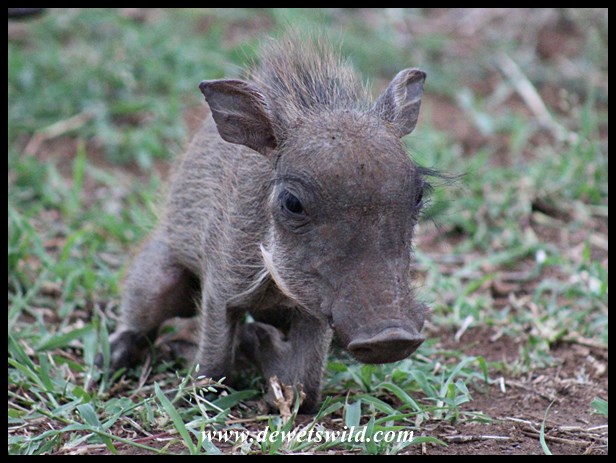
Day one of our annual December bush pilgrimage, this year to the Kruger National Park, and despite all the lions, jackals, elephants, rhinos, hippos, giraffes, buffaloes, zebras and antelope that crossed our paths today it was this tiny little warthog piglet and his siblings that were the real crowd pleasers!
———–
If you enjoy de Wets Wild as much as we enjoy sharing our love for South Africa’s wild places and their denizens with you, please vote for us in the 2015 South African Blog Awards.
We’ve entered the categories for “Best Travel Blog” and “Best Environmental Blog”, and you are allowed to vote for us in both. Clicking on the badge below will bring you to the voting site.

Thank you very much for your support!
An irritating fly homing in on its target; the eye of an impala ewe in the Kruger National Park.
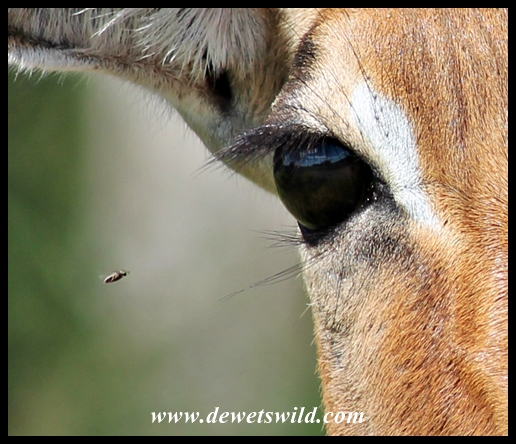
Impala being targeted by a biting fly
“Eye Spy” is the theme for this week’s WordPress Photo Challenge
________________________
If you enjoy de Wets Wild as much as we enjoy sharing our love for South Africa’s wild places and their denizens with you, please vote for us in the 2015 South African Blog Awards.
We’ve entered the categories for “Best Travel Blog” and “Best Environmental Blog”, and you are allowed to vote for us in both. Clicking on the badge below will bring you to the voting site.
Thank you very much for your support!
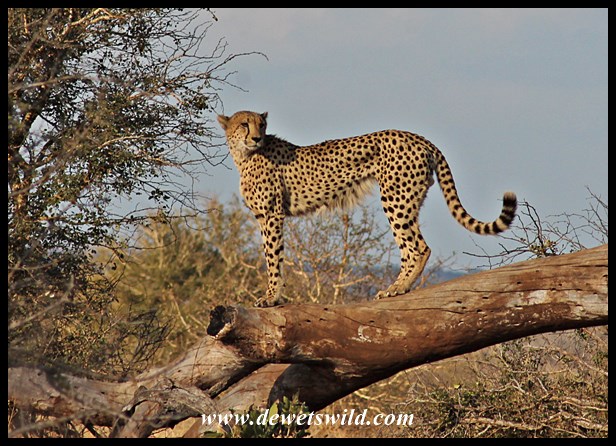

Few animals’ anatomy so clearly describes their way of life as that of a cheetah. With a small head, big chest, long legs, a supple back and a tail used as a rudder that enables it to change direction in a split second, the cheetah is absolutely built for incredible speed.


Cheetahs inhabit areas of open grasslands, bushveld and semi-deserts. Here they prey mostly on small and medium sized antelope, but also on rabbits, jackals and birds up to the size of kori bustards and ostriches. They are independent of water, but will drink when it is readily available.
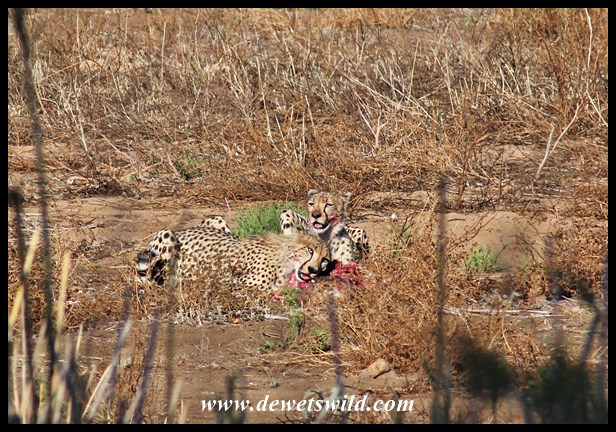
Cheetahs are diurnal cats, being most active in the early morning and late afternoon, resting up in shady vantage areas during the heat of the day. Both sexes mark and defend large territories, those of females usually being bigger in size than the males’. Females are solitary, except when accompanied by their cubs or a male suitor, while adult males often form coalitions of 2 or more that band together to defend a territory. While hunting and patrolling their territory, cheetahs will readily take to trees, termite mounds and small hills to scan their surroundings. Cheetahs are most famous for being the fastest mammals on the planet, capable of reaching speeds of 100km/h, which they can only maintain for a relatively short distance of 300 to 400m, in pursuit of prey. After such a chase, the cheetah normally takes a few minutes to catch its breath before feeding hastily, as other predators, even vultures and baboons, will rob them of their meal.


Cheetah females give birth to up to 6 cubs at a time. The cubs are hidden in long grass, thickets or rocky outcrops for the first month or two of their lives. They are weaned from as early as 3 months old and the female starts training them to hunt from about 4 months of age. The cubs become independent of their mother between 12 and 20 months after birth, at which time they are forced from her territory. The newly independent cubs roam widely and often have a difficult time of it, until they are successful in establishing a territory of their own. Lions, leopards and spotted hyenas are known to actively hunt and kill cheetahs, and they are susceptible to a variety of diseases. In some populations as few as 5% of cubs reach independence. In the wild, cheetahs live to between 10 and 16 years of age.

Orpen cheetah sighting
The King Cheetah is a beautiful and rare recessive genetic mutation of the cheetah in which the spots are fused into blotches and stripes. Seeing a King Cheetah in the wild occurs very rarely but there are a handful in captivity.


The 4th of December annually is commemorated as International Cheetah Day, to highlight the plight of these lithe big cats. The IUCN considers the cheetah vulnerable to extinction, with a total population of aproximately 7,500 which is believed to be decreasing further. They are threatened by habitat loss, the eradication of their prey base, conflict with livestock farmers and illegal hunting, and have seen tremendous declines in their distribution range. In South Africa wild cheetahs now probably number around 550 animals only, with a considerable percentage of this population persisting outside the big conservation areas in places where competition with larger predators are less of a threat. In our experience, the Hluhluwe-Imfolozi Park, Kruger National Park and Kgalagadi Transfrontier Park provides the best opportunities for encounters with wild cheetahs in South Africa.


The impala is a familiar sight in many of South Africa’s reserves and national parks, and often so numerous that most visitors do not give them more than a passing glance, which is a huge pity. They are medium sized antelope, standing around 90cm high at the shoulder and weighing between 40 and 80kg. The rams are bigger than the ewes and only they carry the beautifully shaped horns.
The Black-faced Impala, a seperate subspecies (A.m.petersi), occurs in Northern Namibia.


Impalas occur in fairly dense woodland and bushveld, especially where acacias and mopane trees are dominant, and reach their highest population densities in riverine vegetation. They are mixed feeders, including large amounts of grass and browse in their diet, with considerable variation in the plants they feed on during the different seasons. They prefer to drink daily and access to a reliable water source is an important habitat factor for impala – they’re seldom further than 2 or 3km from water.


Outside the mating season, impalas occur in large, mixed herds of up to 300 animals. In the mating season, adult rams (between 4 and 8 years old) establish territories in which they herd harem groups of about 20 ewes and lambs that they defend vigorously from the attentions of any other males. During this time, males that cannot successfully demarcate a territory or hold on to their harems will band together in bachelor groups.


Impalas are most active in the early morning and afternoons, and sometimes into the night. During the heat of the day they rest up in thickets or shade near water, at night they sleep in open areas. Impala herds do not have large home ranges and they often associate with other herbivores, most notably zebras, giraffes, kudus, blue wildebeest and monkeys and baboons. They’re extremely athletic, capable of speeds in excess of 60km/h and leaps 3m high and 12m far.


In South Africa, the impala mating season falls in autumn, with most of the lambs arriving en masse in early summer. Ewes give birth to single lambs in thickets or long grass, to rejoin the herd with their lamb after two days. Almost all the lambs in a herd are born within a few days of each other, ensuring that there are more lambs than predators can handle. In the herd, the lambs group together in nurseries watched over by one or two ewes.


Impalas are a staple of many of Africa’s large predators, especially cheetah, leopard, wild dog and crocodiles. Lambs are also taken by eagles, pythons, jackals and baboons. Owing to their dependence on drinking water and reluctance to move over longer distances, impala suffer greatly during prolonged droughts. They have a life expectancy of between 8 and 15 years in the wild.


In South Africa, the common impala’s natural distribution stretches across the Kwazulu-Natal, Mpumalanga, Limpopo and North West Provinces, and they are frequently encountered in the Hluhluwe-Imfolozi Park, uMkhuze Game Reserve, Ithala Game Reserve, Tembe Elephant Park, Kruger National Park, Mapungubwe, Marakele and Pilanesberg National Parks. The IUCN considers the common impala’s conservation status to be secure, with a stable population estimated at about 2 million, half of which occurs on private land, often outside their natural distribution range, being a popular game ranching animal.


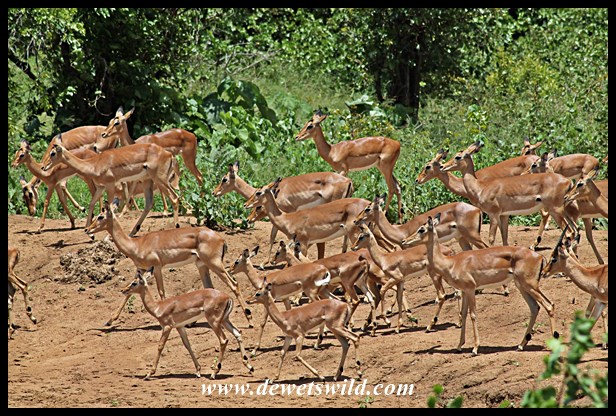
Uniquely coloured impalas appear from time to time in natural populations, and on game ranches these are often purposefully bred.


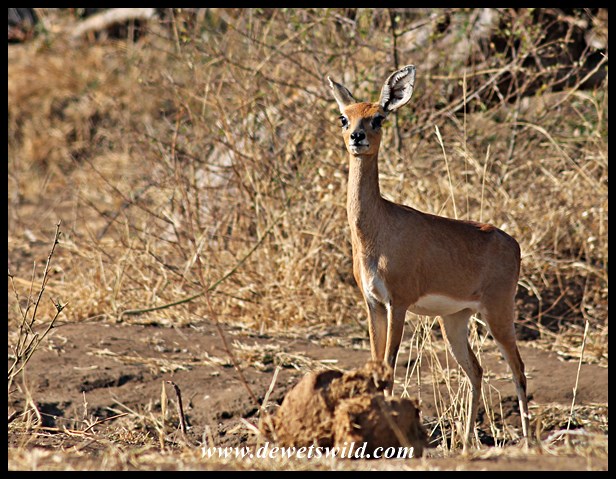
The little Steenbok is one of South Africa’s best known and most widely distributed small antelope. They weigh 11kg on average, and have a shoulder height of between 43 and 52cm. Only the males carry the straight little horns of between 9 and 19cm in length.


Steenbok have an extremely wide habitat tolerance, occurring from deserts to grasslands and bushveld and even in farmlands and on the edge of suburbia. They reach their highest population densities in open areas with short to medium length grass and only a scattering of trees and shrubs. They’re not dependent on water, but will drink when it is available. They feed on grass and leaves in about equal measures and will also ingest seeds, pods, fruit, roots and bulbs.


At high population densities individual steenbok of both sexes mark and defend small territories, while at lower densities pairs that share a common home range is more usual. Within their territories the Steenbok has preferred areas for feeding and resting. Steenbok are mostly diurnal animals, most active around dawn and dusk and resting up in deep shade during the heat of the day, though they do tend to be more nocturnal in their habits in areas where they are frequently disturbed. When threatened, Steenbok will prefer to try and hide, even in holes in the ground, and will wait until the last possible moment before jumping up and darting away at breakneck speed. Most interestingly, Steenbok defecate and urinate in scrapes they hoove in the ground and then cover again with soil, just like a cat.


Single lambs are born at any time of the year, though mostly in the rainy season, and are hidden in long grass, thickets or holes in the ground for the first few weeks of their life. Only about half of the lambs reach the weaning age of 3 months. They are fully grown by 14 months of age. All Africa’s larger predators, from the size of eagles, pythons and jackals to lions, prey on the Steenbok, and their natural life expectancy is only 6 to 10 years.


With an estimated population in excess of 600,000, and stable both inside and outside protected areas, the IUCN considers this common little antelope’s conservation status “least concern”. They can be found in all South Africa’s provinces, and are especially easy to observe in the Kruger National Park, Pilanesberg National Park, and Willem Pretorius Game Reserve.

Two plains zebra stallions battling it out in Ithala Game Reserve.


“Victory” is the theme for this week’s WordPress Photo Challenge
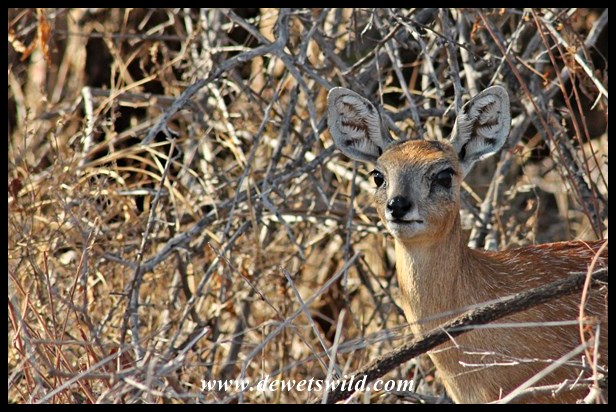


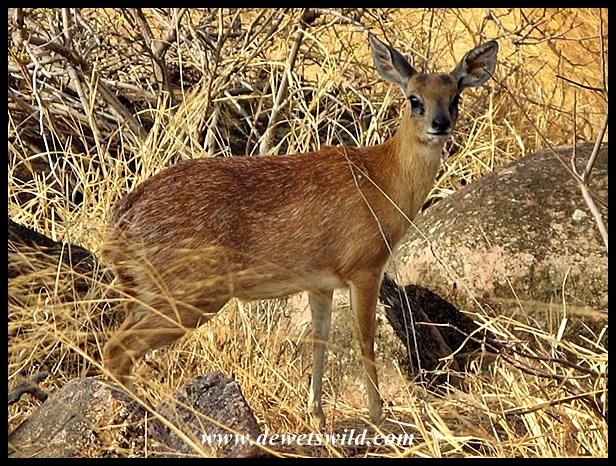
The little known Sharpe’s Grysbok is another of South Africa’s smaller antelope, at an average weight of 8kg and about 50cm high at the shoulder.
These grizzled antelope occur in riverine thickets and dense bushveld, often in association with rocky outcrops, and always near water. They require daily access to drinking water and are mixed feeders, browsing and grazing on leaves, young grass, shoots, roots, fruits, berries and seedpods.


Sharpe’s Grysbok are normally seen alone, occurring in pairs only when mating or when a ewe is accompanied by her latest lamb.They’re mostly nocturnal in their habits, hiding during the day in long grass, under shrubs, between rocks and even in holes dug by other animals, especially aardvarks. They have very small home ranges, and seldom flees far before hiding in a thicket. Rams mark their areas, which overlap with the ranges of up to 4 ewes, with glandular secretions and dungpiles. Lambs are born at any time of the year, and are hidden by the ewe for up to 3 months. Sharpe’s Grysbok are preyed upon by all Africa’s large predators, from jackals, pythons and eagles to lions, and have a short life expectancy of only 6 to 10 years in the wild.


The conservation status of Sharpe’s Grysbok is considered “least concern” by the IUCN, who describes it as being widespread and common with a generally stable population estimated at about 95,000, of which roughly a third occurs in formally protected areas. In South Africa, where they occur in the Limpopo and Mpumalanga Provinces, your best bet to find them are in the northern Kruger National Park, especially around Shingwedzi and Punda Maria camps.

Last week’s photo post “Treat“, featuring a family of hornbills raiding a picnic table, raised so much interest in the species that we decided to dedicate another special post to our country’s hornbills.
We’ve already introduced you to the biggest and most conspicuous of the family, the Southern Ground Hornbill (Bucorvus leadbeateri). These fascinating birds are an endangered species. Have a look at our special post about the Southern Ground Hornbill to learn more.
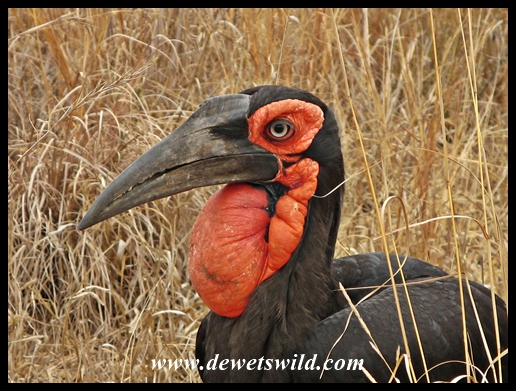
Southern Ground Hornbill
South Africa is also home to five other species of hornbills, all much smaller than the ground hornbill and all diurnal in their habits. They share a most intriguing method of nesting and raising their chicks. Just before laying, normally in the summer rainy season, the mostly monogamous pair selects a hole in a tree (rarely in cliffs) to serve as a nest, often using the same hole for this purpose year after year. Both sexes then proceed to seal the female inside the hole, plastering up the entrance with mud, food remains and droppings, leaving only a small slit through which the male can pass food to the female and chicks. While inside the hole, the female moults and regrows her tail and flight feathers. She lies a clutch of two to seven eggs and incubates them for between 24 and 30 days (varies between the species). When the chicks are around 40 to 50 days old, the female breaks out and then helps to reseal the hole. The chicks then stay inside and are fed by both parents for another two weeks or so before breaking out and taking their first flight. The chicks stay with their parents for around eight weeks after leaving the nest and are fully grown by one year of age.
Lophoceros nasutus
Length: 45 – 51cm
These hornbills can be found in acacia savannas (thornveld), mopaneveld, dry broadleaved woodlands and riverine woodlands, ranging from extreme northern Kwazulu-Natal through Mpumalanga, Limpopo, Gauteng and North West Province to the Northern Cape. They include a wide variety of food in their diet, taking insects, beetles, spiders, frogs, chameleons, small rodents, chicks and eggs and some fruits, searching for food mainly in the branches of trees.
Grey Hornbills normally move around in pairs or small flocks, but may gather in larger flocks of over 100 birds in the dry winter, when they become more nomadic.
The African Grey Hornbill has a wide distribution across Africa and its population appears to be stable, with the IUCN classifying their conservation status as “Least Concern”.


Lophoceros alboterminatus
Length: 50 – 54cm
The Crowned Hornbill is widespread in the Eastern Cape, Kwazulu-Natal and the lowveld of Mpumalanga and Limpopo Provinces, where it inhabits inland, coastal, mountain and riverine forests. They feed on insects, small rodents and reptiles, seeds and fruit and are mainly arboreal.
They can usually be found in pairs or in small flocks of up to seven birds.
Though the IUCN considers the Crowned Hornbill’s conservation status as “Least Concern”, it is thought that their numbers are dwindling due to loss of habitat.


Tockus erythrorhynchus rufirostris
Length: 40 – 47cm
Red-billed Hornbills occupy open bushveld, thornveld, mopaneveld, thickets along streambeds and semi-arid woodland, where they prefer to search for food on the ground in open, heavily grazed areas. They have a varied diet that includes dung beetle larvae which they find in the dung of elephants and other large mammals, other insects, scorpions, the eggs and chicks of small birds, small reptiles and seeds and berries.
They move around in groups of up to twelve birds and love taking dustbaths.


Tockus leucomelas
Males are generally larger than females, with a bigger beak. Length: 48 – 60cm, weight: 132 – 242g.
The Yellow-billed Hornbill is found in a wide range of habitats, from semi-arid savannas, dry broadleaved woodland and thornveld to riverine woodland, ranging from Kwazulu-Natal through Mpumalanga, Limpopo, Gauteng and North West Province to the arid Northern Cape. They have an omnivorous diet that includes insects, scorpions, snakes, rodents, eggs and chicks of small birds, berries, fruits, nuts and seeds. They feed mainly on the ground and will use its bill to turn over debris like small rocks and logs and dig in elephant dung in search of food.
Despite being widespread and common, the loss of suitable large nesting trees is causing their numbers to decline outside conservation areas. The IUCN considers the conservation status of the Yellow-billed Hornbill as “Least Concern”.


Bycanistes bucinator
Length: 58 – 65cm, Weight: 450g – 1kg
Trumpeter Hornbills inhabit evergreen lowland, coastal and riverine forests in the Eastern Cape, Kwazulu-Natal and the lowveld of Mpumalanga and Limpopo Provinces, and subsists on a diet of fruit, particularly from the sycomore fig (Ficus sycomorus) and bushwillows, and large insects.
These birds are normally seen in small groups of about five, sometimes aggregating in flocks of up to 50, some records even mentioning 200! Their call sounds very much like a baby’s crying.
Due to an apparently stable population, wide distribution and no substantial threats to their numbers, the IUCN classifies the Trumpeter Hornbill as “Least Concern”.


Last week, we were so excited to tell you about our time at Kruger National Park’s newest accommodation offering, the Pafuri Border Camp, that we skipped over the part of our visit leading up to our time in the extreme Far North of the Park.
We’ll take this opportunity to rectify that now.
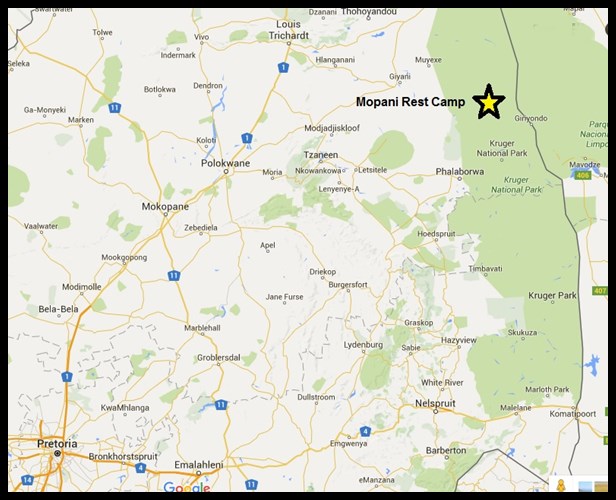
We arrived at Phalaborwa Gate on the Friday, early enough to allow a slow drive along the H14-road up to Mopani Rest Camp, where we were booked for a one-night stopover on the way to Pafuri Border Camp.


A quick afternoon sojourn past Mooiplaas, the Nshawu Vlei and Tinhongonyeni delivered no less than 6 tsessebe sightings, lots of energetic zebras, good numbers of other animals and birds, and a very dramatic storm brewing over the plains…


That evening we enjoyed a lovely meal at Mopani’s restaurant, the howling wind putting an end to any ideas we might have had of braaiing (the traditional South African barbeque) at our bungalow. Afterwards we searched for nocturnal animals among Mopani’s natural vegetation, and were not disappointed.


Leaving Mopani as soon as the gate opened Saturday morning, under heavy skies accompanied by a constant soft drizzle, we anticipated at least one good predator sighting. Sure enough, near Olifantsbadpan, we had a terrific encounter with two big female spotted hyenas and three of the cutest, most playful cubs you could imagine. Only afterwards did I realise that they were so close to our vehicle that I didn’t manage even one full body photo of them!


We expected to have good sightings of elephants around Shingwedzi, and our favourite rest camp delivered the goods just as we had hoped. It was still raining softly as we set of from Shingwedzi after breakfast, heading northward past Babalala Picnic Spot. The north of the Kruger Park is also well known for its exceptional birdlife and all these special sightings made the long road seem much shorter.


After a quick turn in Punda Maria for lunch, fuel and to stock up on some last minute goodies, we could tackle the last stretch of road to the magical paradise that is Pafuri.
 DeWetsWild