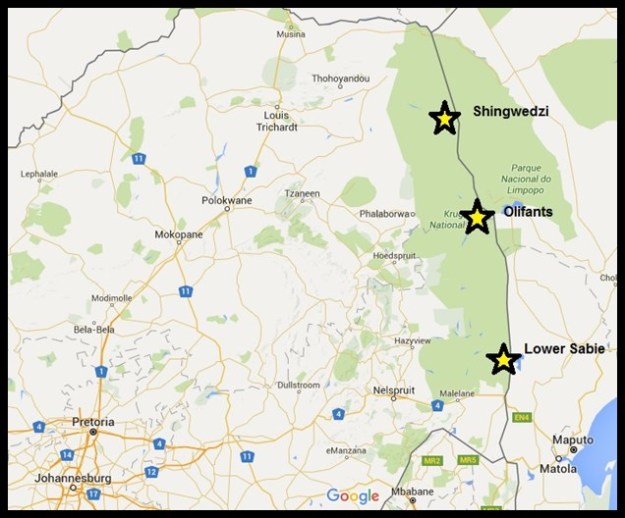
After three enjoyable nights in Olifants‘ spectacularly situated unit 14, we had only a third of our December holiday in the Kruger National Park left. Happily that didn’t depress our mood too much, as we would be spending the last three nights in our beloved Shingwedzi Rest Camp.
Soon after leaving Olifants, we came across a cantankerous hippo bull blocking the road to the north. While waiting for him to get out of the way, in his own time of course, a rustle in the dry mopane leaves beside the roads alerted us to a hyena that was also waiting for the traffic to clear…

The hippo, the hyena and the waiting tourists

The hippo, the hyena and the waiting tourists

The hippo, the hyena and the waiting tourists

The hippo, the hyena and the waiting tourists
Our plan was to stop at Mopani for brunch, so we only had a quick cup of coffee and a rusk or two at Letaba, no snakes in sight this time! On the way we couldn’t resist making a quick detour to marvelous Mooiplaas waterhole, as there is always something interesting to see there, and were handsomely rewarded with a couple of tsessebe sightings as well as a blue wildebeest that was having far too much fun rolling around in elephant dung to be considered sane…

Woodland Kingfisher in Letaba

African Fish Eagle on the Letaba River

Kudu bull

Tsessebe in mopane vegetation in Northern Kruger National Park

Plains zebra foal

Perhaps dung doesn’t stick to a rolling wildebeest…

Perhaps dung doesn’t stick to a rolling wildebeest…

Perhaps dung doesn’t stick to a rolling wildebeest…

Perhaps dung doesn’t stick to a rolling wildebeest…

Tsessebes at Mooiplaas
Mopani was a delight of feathered friends, with there even being a pair of African Paradise Flycatchers nesting in a tree right between the shop and the Tindlovu restaurant (which serves delicious mince-meat jaffles by the way!)

Marabou Storks

African Paradise Flycatcher (male)

White-crested Helmetshrike
The final stretch to Shingwedzi delivered special sightings of yet more mating lions, unfortunately spoiled by an idiot who got out of his car to try and get a better photo, as well as a beautiful old tusker.

More mating lions

The female glancing back after the male was startled by a dumb human getting out of his vehicle

Big old tusker
Whenever we stay at Shingwedzi, there’s only one road we take for our first afternoon drive – a slow drive along the S50 gravel road that follows the river, offering ample opportunity to appreciate the diverse and abundant wildlife that congregate on the river bank. That’s exactly where we pointed the Jazz’s nose after checking into our cottage, number 29, donated by the Wildlife Society in the 1950’s.

Shingwedzi Cottage 29, December 2015

Young waterbuck

Woodland Kingfisher

Grey-headed Kingfisher

Playful hippos

Bushbuck ewe

Western Osprey

Buffalo drinking from a pool in the Shingwedzi
Around Shingwedzi the best viewing is usually along the watercourses, which is why we decided on the S56-route along the Mphongolo River for our first morning drive from Shingwedzi.

Lion at the Sirheni turnoff

Big Buffalo Bull

Protective elephant herd

And off they go!
That afternoon, Red Rocks and Tshange viewpoints to the southwest of camp beckoned.

Lone elephant drinking from a pool at Red Rocks

Tiny elephant calf

Warthog family enjoying the mud

Lazy giraffe

The view from Tshange

Waterbuck

Sharpe’s Grysbok

This little elephant was probably less than a day old and very unsteady on his feet

Slightly older calf

Buffalo and oxpecker in discussion
One last guided nightdrive in search of nocturnal wildlife delivered much better sightings than the windy nightdrive we undertook from Lower Sabie a few days earlier.

Roosting marabou

Large-spotted Genet

African Scops Owl
By the time the sun rose over the horizon on our last full day in the Park, we were already travelling along the S50-route enjoying the Shingwedzi River’s abundant wildlife and awesome scenery before returning to camp and a late breakfast.

Sunrise over the Shingwedzi River

Buffalo bull

Another Grey-headed Kingfisher

Waterbuck youngster

Alert nyala ewe
Shingwedzi was nice and quiet in the early morning, as most guests were still out on the road searching for game, giving us an excellent opportunity to amble through the camp.

Broad-billed Roller

Yellow-billed Hornbill

Rock monitor
With such a wide variety of bird and animal life around Shingwedzi it was a rather difficult decision which area we’d drive to on our final afternoon. In the end we opted for the Mphongolo Loop (S56) again, and what a great choice that was! We’ve already shown you pictures of the waterhole meeting between large herds of elephants and buffaloes we witnessed that day. Dodging a couple more elephant and buffalo herds along the way, navigating through several herds of antelope and scanning the landscape for new species of birds to add to our ticklist, we were thrilled that our afternoon was concluded with a leopard lying in wait at a small waterhole.

Another beautiful tusker

Nyala lamb

African Openbills

Saddle-billed Stork

Waterhole meeting

Leopard lying in wait at a waterhole

Male Double-banded Sandgrouse
And so, our time at Kruger National Park has come to an end, for this visit at least as, of course, the next trip has already been booked. All that remained was to drive down to Phalaborwa Gate, from where Pretoria lay a hot six-hour drive away.

Elephant enjoying a mud bath

Buffalo catching a smell on the breeze

Those trunks are so dexterous!

Female Mocking Cliff Chat








 DeWetsWild