Tag Archives: Lower Sabie Rest Camp

A final round-up of our January ’24 visit to the Kruger National Park

Over the past couple of weeks we’ve been showing you some of what we experienced during a holiday visit to the Kruger National Park in early January. There was the excitement of a wild dog hunt, endearing hyena pups, smiles thanks to dung beetles and baboons, the royal presence of lions and leopards and even a concert by the Skukuza frog choir. The Kruger National Park is an amazing place, and well deserving of its position among the great wild places on the planet. We just cannot stay away.

The Kruger National Park is one of South Africa’s premiere bird-watching destinations, and even more so in summer when the park’s prolific birdlife is boosted by summer migrants from as far away as Eurasia. This gallery is but a tiny morsel of the amazing diversity of birds we encountered while exploring the southern reaches of the Park in January.

The Kruger National Park is even better known for its astounding variety of mammals, which at almost 150 recorded species is among the highest of any conservation areas on the planet! The animals are so used to the gawking people driving around them all day that it makes for wonderful photographic opportunities.

Far less glamorous – some may even call them creepy-crawlies! – but equally as important in the natural cycles that drums the beat in the Kruger National Park is the extraordinary variety of insects, fish, amphibians and reptiles that you may encounter if you keep your eyes peeled.

We’d love for you to join DeWetsWild on a guided tour of the Kruger National Park or to help you arrange a self-guided visit. Don’t hesitate to reach out!

Our 2023 in pictures

Join us for a look back at the wonderfully wild South African destinations we visited during 2023. May 2024 be a blessed year for you and your family, memorable for all the best reasons.

Leopards, leopards and more leopards!

Of all the “Big 5” animals none are as difficult to find as the Leopard. Seeing one is usually the highlight of a visit to a nature reserve in South Africa. Having six sightings of these beautiful cats – of which four were on one day! – will mean our latest visit to the Kruger National Park will not soon be forgotten!

Our first sighting, near Lower Sabie late afternoon just minutes before the gates closed, was not very awe-inspiring, even by Leopard standards. Being as lazy as only cats can be this individual did not even deign to show us its face.

Lazy Leopard near Lower Sabie

Early one morning while travelling along the S56 Mphongolo Loop north of Shingwedzi we came across a pair of Leopards in a tall tree – a smaller individual very high up in the tree and visually afraid of the bigger one below guarding the remains of a kill. Visitors who were on the scene before us later shared how the male stole the female’s kill and chased her to the top of the tree where he was too heavy to get to her.

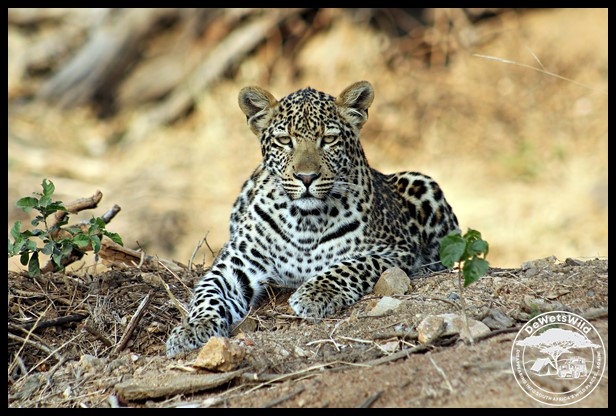
After spending quite some time at the Leopards in the tree we decided to move on to breakfast at Babalala Picnic Spot when, only 4km further along the same road, we found a young and curiously calm Leopard next to the road at the turnoff to Sirheni Bushveld Camp. She posed beautifully for all the photographers in the car, not fazed in the least by our proximity! Having been treated with such grace by the young princess we slowly backed away from her so that she could repose in tranquility.

Mere minutes later, still sauntering along the S56 towards Babalala, we found our third Leopard encounter for the morning where it was using a small outcrop of rocks as a vantage point and being particularly interested in a huge kudu bull lying nearby. The kudu soon saw the Leopard and did not even think the cat enough of a threat to stand up. Knowing it was outgunned, the Leopard gave the kudu a wide berth and disappeared into the dense shrubbery next to the Shisha stream.

That same afternoon, still extremely excited about our morning, which by then also included sightings of other charismatic or rare species of wildlife including lions, roan antelope, tsessebes, buffaloes and elephants we found our fourth Leopard sighting of the day along the S50 Kanniedood Road southeast of Shingwedzi. The apparently heavily pregnant female was in a hunting mood and stalking a mixed herd of impala, kudu and waterbuck mingling on the bank of the river. She was soon discovered however and slinked back across the road and out of sight.

Our final Leopard sighting of the trip (and I am sure we missed more than we saw thanks to their exceptional camouflage!) was before sunrise as we left Shingwedzi for a morning drive. This was a shy individual, trying to hide behind a palm frond for a minute or two and then deciding to retreat into the riverine vegetation lining the Shingwedzi.

I made a little compilation video of some of the Leopard encounters I told you about.


Join us on a night drive at Lower Sabie

During the hours of darkness visitors to the Kruger National Park are not permitted to drive themselves around the reserve, both for their own safety and that of the Park’s wildlife. Nighttime in wild Africa is a fascinating time, however, with nocturnal creatures roaming the dark, and for this reason the Park offers visitors night drives of two to three hours in duration and under the guidance of skilled guides, with spotlights being used to seek out animals and birds that might otherwise be hard to see during daylight. We undertook one such excursion from Lower Sabie Rest Camp during our visit to the Kruger Park last week.

With Joubert and his friend Erlo manning the cameras I could take a few video snippets of our drive. Hop on and come along!

Remember that DeWetsWild can also assist you with bookings for guided activities, like night drives, in the Kruger National Park when you make use of our reservation services for your holiday accommodation.

Kruger Holiday 2023: 26 June / Day 2

Day two of our winter holiday in the Kruger National Park, and today we explored the area between Pretoriuskop and Lower Sabie where we will be spending the night.

On our way to the wilderness – day 3

Just before sunrise on the 17th of August – Joubert’s final day as an eleven-year old – we headed out of Skukuza towards Pretoriuskop, driving along the Napi Road and intent on visiting every one of the waterholes along the way.

Just past Transport Dam we have the first big-ticket highlight of our morning: a cheetah on the hunt! Unfortunately the cheetah caught its steenbok prey at an awkward angle behind our vehicle and immediately carried it into the long grass away from the road, so these are basically the only photos we have of a most thrilling sighting!

Just a few kilometers past the scene of the cheetah kill we encountered a pack of very excited spotted hyenas in and next to the road. It appeared that an interloper was coming a bit too close to their den, causing quite a stir among the resident cubs.

At Shitlhave Dam this grey old Buffalo bull posed for some pictures.

While it was quiet along the Voortrekker Road towards Afsaal, with the day heating up nicely it was easy to decide where to head next: all along the Biyamiti River in the general direction of Crocodile Bridge and Lower Sabie. As expected, lots of animals and birds where congregating along the dwindling stream of water to quench their thirst.

Nearing Lower Sabie we felt compelled to cross the causeway over the Sabie River, and then back again (as most everyone visiting this part of the Park is wont to do) before heading into camp.

The last stretch of our route today again followed the course of the Sabie River back to Skukuza, through a part of the Kruger National Park famous for its teaming wildlife.

And so the sun set on another extremely rewarding day in the Kruger National Park. The next day would be Joubert’s twelve birthday – more on that in the next installment!

Not for sensitive viewers: a vicious Baboon assault

It was the afternoon of the 16th of August 2021 and Joubert and I were parked on the shores of Sunset Dam, just outside Lower Sabie in the Kruger National Park, enjoying the serene scenes playing out all around us as a myriad of birds and animals, including a troop of Chacma Baboons, mingled at the water’s edge.

Baboons peacefully foraging on the shore of Sunset Dam

Suddenly there was a frightful commotion as the baboons started screaming in alarm. Almost immediately we noticed a young baboon, shrieking to high heaven, being chased by two slightly older “teenage” baboons. This in itself was not abnormal, as there is often disagreements in a baboon troop, and peace usually returns quickly after the necessary discipline has been dispatched. The young baboon rushed into the muddy water at the dam’s edge, eliciting even more worried squeals from its mother as Sunset Dam is home to some monster crocodiles.

However, as soon as one of the “teenage” baboons got hold of the youngster, it was clear that this attack was much more sinister. We have no idea about their motive, but judging by the viciousness of their bites to the skull, neck and throat and the very rough way they tried to pull the younger baboon apart limb from limb, there was no doubting that the two teenagers were intent on killing their unfortunate target. At one stage early into the encounter an adult, perhaps the mother of the younger one, tried to intervene but this proved only a temporary reprieve – instead of running away the badly injured youngster tried to hide in the mud again where he was soon cornered once more.

By now the attack had gone on for about four minutes. Probably as was to be expected, the fracas attracted the attentions of a large crocodile that was hitherto lying dead still on the bank. With the tables likely to be turned on them within a second, the attacking baboons let go of their quarry and ran for safety.

The youngster that was so viciously mauled also scampered away, heading over the road towards the Sabie River, and out of our sight. His attackers apparently also lost track of him, as they searched every bush in the general vicinity looking for the young baboon without success.

One of the murderous baboon “teenagers” passing by us as he looks for their victim. (photo by Joubert)

Whether the little one could’ve survived its injuries we’ll never know, nor whether the murderers managed to track him down and finish the job… This definitely was one of the most harrowing experiences we’ve ever had in the bush.


Fish Eagle caught in the act

The call of the African Fish Eagle is so evocative of Africa’s wild places, and seeing one is always a special treat, high on the wish-list of many safari-goers. Especially when you get the chance to see it in action; gracefully descending with claws outstretched to snatch a fish from just below the water’s surface and then majestically soaring away with its prize grasped in its talons. The stuff nature documentaries are made of.

During our mid-August trip to the Kruger National Park, Joubert and I were lucky to see a Fish Eagle catch a sharp-tooth catfish from the waters of the Sabie River just downstream from Lower Sabie Rest Camp. While this particular individual won’t score a perfect ten for the execution – that splash-down would have had the Olympic audience snickering, and thank goodness for that sandbank! – it nevertheless was an amazing sighting. Most of these photographs were taken by Joubert.

On our way to the wilderness – day 2

Joubert and I were the first people out the gate at Skukuza on our first morning in the Kruger National Park when we visited last week. In the week before our arrival other visitors were bragging on the Park’s social media pages with their sightings of a big herd of sable antelope north of Lower Sabie, and as these rare and beautiful antelope are a favourite of ours, our route for the morning took us along the Sabie River and then in the general direction of the Mlondozi Picnic Spot. Along the way we had the joyful encounter with the young elephant knight we showed you two days ago.

By the time we reached Mlondozi, we hadn’t yet found the sables we came looking for. We were planning on having brunch at the picnic spot, but it was packed with other visitors and not a single table was available. We spent a few minutes enjoying the view, getting pictures of the birds and animals, and waiting for a table to clear, but eventually decided to rather move along.

We decided to use the extra time we had available due to the postponed lunch to do another circuit around Muntshe Mountain, and how wonderfully that turned out! We found the sables, and had probably the best sighting of these magnificent antelope I had in 30+ years! More about that soon, I promise.

Extremely satisfied with our morning, we headed for Lower Sabie where, just before the camp, we had a quick sighting of a leopard and enjoyed the abundant life that always congregate at the causeway over the Sabie River.

In contrast to Mlondozi, the picnic site at Lower Sabie was deserted, and Joubert and I could lunch in peace surrounded only by birds and butterflies.

By the time we finished lunch it was still too early to head back to Skukuza, so we drove south in the direction of Crocodile Bridge for a few kilometers along the main road, returning along the gravel Mativuhlungu Loop to Lower Sabie. Stopping at the causeway over the river again we were rewarded with a clear, though distant, view of an African Fish Eagle swooping down to snatch a catfish from the water. We’ll share that full sequence of pictures with you another day this coming week.

Just outside Lower Sabie, on the way to Skukuza, Sunset Dam is always a great place to stop and sit for a while, just soaking in the sights and sounds of the bush. On this occasion however the usual serenity of the place was shattered when a pair of teenage male baboons savagely attacked a much younger baboon at the water’s edge, seemingly intent on killing it. Baboons are always fascinating to watch, but I definitely have never experienced such a disturbing glimpse into their behaviour before. We’ll share some pictures from this harrowing sighting this coming Saturday, but please be warned!

It’s just a 45km drive, but with so much to see along the way it still took us 3 hours to get back to Skukuza and we made it back into camp with just a minute or two to spare before the gates closed. Our last sighting of the day was a pack of African Wild Dogs guarding the scraps of their kill against a bunch of vultures – what more could we ask for after such a wonderful day!?

Before ending off, I have to show you these photographs of a family of white rhinoceros we came across on day 2 of our trip to the wilderness. I won’t disclose when and where we saw them though so as not to tip off any poachers.


Crocodile Bridge was calling

The September school holidays presented the perfect opportunity to visit the Kruger National Park again, this time basing ourselves with family and friends in the south-eastern corner of the Park at Crocodile Bridge Rest Camp.
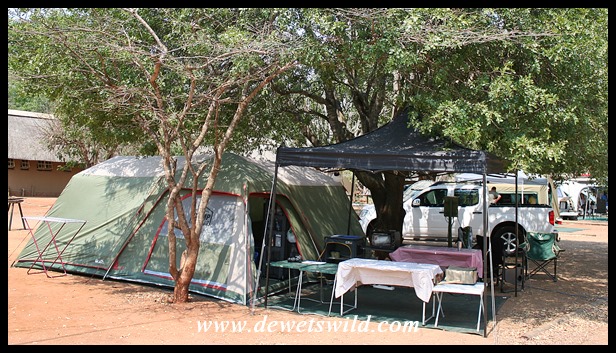
Camping at Crocodile Bridge, Kruger National Park, September 2019

Crocodile Bridge is located in one of the Kruger’s most game-rich areas, and even inside the camp there’s an abundance of wildlife that I found quite distracting from camping chores… From blossoms to butterflies and birds, bats to bushbuck, all placed themselves in the cross hairs of our camera lenses, and when we were quite certain we got enough shots of them we could peer just over the fence (or through it, in Joubert’s case) towards the Crocodile River flowing in front of the camp for even more subjects.

Despite being right at the southern border of the Kruger Park, Crocodile Bridge offers a multitude of drives to choose from when heading into the Park. Heading in a northerly direction towards Lower Sabie is a selection of different routes making for comfortable excursions and providing great sightings along the way. Whether you choose the main H4-2 road or one of the gravel S28, S130 or S82 routes, you are bound to arrive at Lower Sabie excited with what you’ve seen. You can then return to Crocodile Bridge along an entirely different option, getting a glimpse at different habitats and having all new wildlife encounters to boast about too!

Whether you stop in Lower Sabie for a simple body break, an ice cream from the shop or a meal at the Mugg & Bean restaurant overlooking the river, don’t miss the chance to stretch your legs with a walk on the lawns along the river in front of the bungalows. From the deep shade of enormous trees you can gaze over the river, perhaps being lucky like we were to see a pair of lions hunting right there, and revel in the songs of a multitude of birds flitting about the branches above you.

Quite literally a stone’s throw north of Lower Sabie is the Sunset Dam, one of two wonderful wildlife magnets no visitor to this part of the Kruger Park should miss out on. There’s a constant stream of wildlife coming and going at Sunset Dam at anytime of day, and the resident crocodiles and hippos (including these boisterous buddies) are easily among the most habituated of their kind anywhere in Africa, making for excellent photographic opportunities.

Just on the other side of Lower Sabie, the causeway over the Sabie River is another highlight. Here too there’s always crocodiles (like this one having fun in a cascade), hippos, terrapins and all manner of wading birds in attendance, often accompanied by elephants, buffaloes, antelope, baboon and giraffe, while the elevated vantage point provided by the bridge offers excellent views into the clear water of the Sabie below.

Because there was so much to see around Crocodile Bridge and Lower Sabie, we didn’t really feel the need to venture farther, and only took two extended drives to other parts of the Park. One of those excursions was to Skukuza, roughly a four hour drive from Crocodile Bridge along the most direct route past Mpondo Dam. After spending the midday hours at Skukuza’s nursery and a delicious buffalo pie at the golf club, we headed back to Crocodile Bridge via Lower Sabie again.

We only wandered north of the Sabie River once, putting a full day aside to traverse the routes between Lower Sabie and Tshokwane Picnic Spot – where we had to contend with a dusty, blustery wind of note while trying our best to enjoy our picnic lunch! Our rewards for sticking to the planned route despite the deprivations of sand and dust on our ham-and-cheese sandwiches was the little leopard cub and flashy hornbill we showed you a few days ago, so you’ll hear no complaints from us!

Sad as it was to return to Pretoria at the end of a fantastic week, we could at least console ourselves with the knowledge that the December holidays aren’t that far way… Guess where we plan to be heading?