The Manyeleti Nature Reserve is renowned for its large prides of Lions and so we had high hopes for excellent sightings before we arrived. We didn’t have to wait long into our first afternoon drive from Ndzhaka Camp for our first encounter with the “Kings of Beasts” as we happened upon a large pride walking with determination through the veld while our guide tried to manoeuvre the vehicle into position for the best pictures.
Lioness in the Manyeleti Nature Reserve
Lion family in the Manyeleti Nature Reserve
A young male Lion in the Manyeleti Nature Reserve
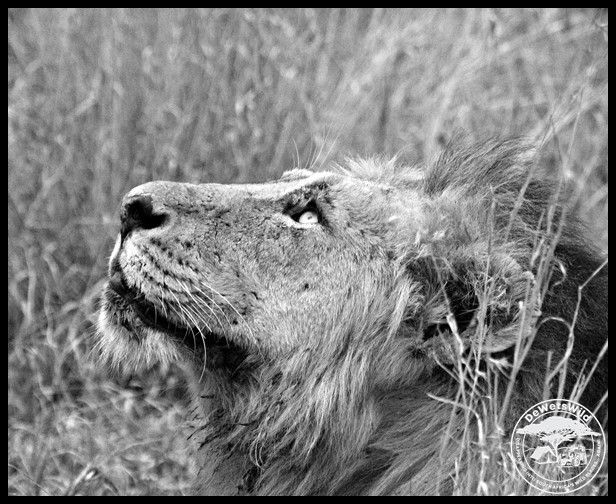
A big male Lion in the Manyeleti Nature Reserve
Young lion in Manyeleti Nature Reserve
Young lion in Manyeleti Nature Reserve
A big male Lion in the Manyeleti Nature Reserve
A big male Lion in the Manyeleti Nature Reserve
A big male Lion in the Manyeleti Nature Reserve
A young male Lion in the Manyeleti Nature Reserve
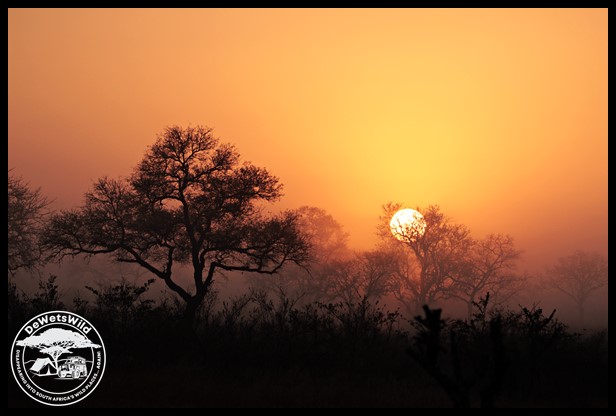
As we drove out of Buffelshoek Camp our last morning at Manyeleti Nature Reserve dawned like a painting with a glorious orange sun backlighting large trees eerily peering through the mist that settled on the plains overnight.
Sunrise over Manyeleti
Years of visiting our wild places has given me a sixth sense that told me we won’t be waiting long for another audience with Manyeleti’s monarchy that morning, but our first sighting as we drove from camp was of two spotted hyenas lying lazily on the two-spoor track, as if just waiting for us to arrive.
Lazy Spotted Hyenas on the two-spoor track
Lazy young Spotted Hyena
And then, there they were! Two enormous Lionesses with their stomachs distended from a large meal enjoyed overnight. Eventually they got up and started moving in the direction of the nearby waterhole. We followed along for a few hundred metres, until they probably felt they needed another break and picked a termite mound as an elevated bed. One of the Queens flopped onto her side almost immediately, but the other was very interested in something happening between us and the camp, still visible in the distance.
Two very full Lionesses in the Manyeleti Nature Reserve
Two very full Lionesses in the Manyeleti Nature Reserve
Two very full Lionesses in the Manyeleti Nature Reserve
Two very full Lionesses in the Manyeleti Nature Reserve
The Queen is not impressed! A Lioness in the Manyeleti Nature Reserve
Two lionesses on the move in the Manyeleti
Two lionesses on the move in the Manyeleti
Two lionesses on the move in the Manyeleti
Two lionesses on the move in the Manyeleti
Two lionesses settling on a termite mound in the Manyeleti
Being an extreme fan of African Elephants, when I made my first visit to Manyeleti Nature Reserve I was wondering how many elephants we would see there. Thankfully I can now confirm that the reserve has a thriving population of the pachyderms and they were very much in evidence as we went driving around the reserve.
This was the biggest herd we saw during our stay in the Manyeleti. In elephant society the breeding herds usually consists only of adults females and their offspring, with adult males only visiting the herd when there’s a cow in oestrus present.
Elephant family
Elephant calf
Elephant cow
Elephant cow
Elephant mother and calf
Elephant family crossing the road, with the matriarch taking a prominent protective roll
This young bull we found a bit later at a dam was definitely interested in some or other smell exuded by another elephant or elephants, using his trunk to test both the air and urine spots left on the ground.
Young Elephant bull testing for smells with his trunk
Young Elephant bull testing for smells with his trunk
Young Elephant bull testing for smells with his trunk
Young Elephant bull testing for smells with his trunk
One of our final sightings as we drove towards the gate on our way back home was of a small group of bachelor Elephant bulls hanging around at – and in – the large dam in the centre of the reserve.
Elephant bull at a large dam in Manyeleti
Elephant bull at a large dam in Manyeleti
Elephant bulls playing in a large dam in Manyeleti
Today is World Rhino Day. The ongoing war against rhino poaching still features in the headlines all over the world and unfortunately it is seldom good news. As the numbers continue to dwindle sightings of these enigmatic creatures in our wild places are getting ever more scarce. That’s probably the reason why this wonderful encounter we had with a White Rhino bull in the Manyeleti Nature Reserve when we visited earlier in September is so precious and memorable.
Colleague and friend Hannes and I might only have had two days in the Kruger National Park before we moved on to the Manyeleti Nature Reserve (of which I will start telling you in the next installment) recently, but we still had some terrific sightings around Mopani Rest Camp – even more than we could’ve expected, and we had some pretty high hopes!
The charm of the Kruger Park really lies in the amazing diversity of habitats, plants and wildlife that finds sanctuary there.
Hill covered by Bushveld Candelabra Euphorbias next to the Tsendze River
A closer look at the Bushveld Candelabra Euphorbias growing on a hill near Shipandani Hide
African Civet
Blue Wildebeest at Mooiplaas
Black-backed Jackal looking for a little shade at Tihongonyeni
Steenbok ram in close-up portrait
Black-backed Jackal and Blue Wildebeest at Mooiplaas
Plains Zebra
Giraffe
Waterbuck
Klipspringer
Sharpe Grysbok near Mopani
No matter the weather or the time of year, the Kruger National Park is always a slice of heaven for bird-watchers!
African Scops Owl
Chinspot Batis in Mopani
Chestnut-backed Sparrowlark
Wahlberg’s Eagle
Kittlitz’s Plover
Grey-backed Sparrowlark
African Hawk-Eagles
Cardinal Woodpecker
African Green Pigeon
Black-backed Puffback
Black-headed Oriole
Southern Ground Hornbill
Seeing a Ground Hornbill trying to snatch something from between some mopane branches was a very entertaining sighting!
Buffaloes roam the north of the Kruger National Park in enormous herds, but there are also many old bulls that have broken away from the breeding groups and can be quite disagreeable!
Buffalo Calf
Buffalo Bull
Buffalo Bull
Buffalo Cow
Buffalo Cow
You know that I can never get enough of Elephants, and in the north of the Kruger Park there’s ample opportunity to enjoy these magnificent creatures, so I still have a few more photo’s and a video to share!
Elephant feeding on mopane leaves near Tihongonyeni
The very noticeable “grass notch” shows that this elephant is left-handed!
These feet were made for walking
Elephant bulls walking away from Tihongonyeni Waterhole
Of course the large predators also get us very excited, even for people who visit the Park fairly regularly like we do. We’ll be remembering our two leopard sightings – one while we had just driven into the Park, and the other the following day – every time we pass those spots in future!
Leopard up a tree near Phalaborwa Gate
Leopard in a tree on the bank of the Tsendze River south of Mopani
September is generally regarded as the start of the spring season in South Africa, but with the rainy season still weeks away and temperatures starting to climb higher as the days grow longer, it is a very dry period of the year in most of the northern parts of the country. In our wild places, like the Kruger National Park, animals are seen congregating at or near the few remaining sources of water. The Mopani area of the Park is well served by several reliable waterholes and here visitors to the Park can expect interesting sightings of birds and animals taking turns at the water’s edge.
A Steenbok drinking from a puddle in the Ngobeni streambed
Elephants on the banks of the Letaba River
Mopani is situated on a hill overlooking the large Pioneer Dam, making this the most prominent of the area’s water sources. Visitors can get close to the water along the trail through the camp or at the Pioneer Hide.
White-faced Whistling Ducks
Black-winged Stilts
Goliath Heron
African Jacana
Yellow-billed Stork
Black Crake
Lazy Hippos
Juvenile Black Crake
White-faced Whistling Ducks
Squacco Heron at Pioneer Dam
Wood Sandpiper
Big Nile Crocodiles makes Pioneer Dam a dangerous place
Immature African Fish Eagle
Marico Sunbird
Another large body of water in this section of the Kruger Park is Grootvlei Dam, more distantly located from Mopani along the S50 gravel road to Shingwedzi.
Elephant bull drinking from Grootvlei Dam
Plains zebras drinking from Grootvlei Dam
African Fish Eagle at Grootvlei Dam
Black-winged Stilt
Flock of Cut-throat Finches at Grootvlei Dam
Enormous Nile Crocodile at Grootvlei Dam
Grootvlei Dam harbours many Nile Crocodiles
Watch this short video of a big Elephant bull drinking from Grootvlei Dam on a hot September morning:
On the way to Grootvlei visitors can make a detour first to the Mooiplaas waterhole, where a drinking trough is fed by a windpump and reservoir, and then along the Nshawu Marsh where several springs provide water even in drought years. Both these places are also well frequented by large predators waiting for thirsty herbivores to ambush.
Elephants at Mooiplaas Waterhole
Elephant at Mooiplaas Waterhole
Elephant herd walking away from Mooiplaas Waterhole
A lion in the light of early morning, searching the Nshawu Marsh for easy pickings
Elephants, plains zebras and a giraffe around one of the springs in the Nshawu Marsh
Because Mooiplaas (meaning “pretty farm”) is so close to Mopani, we love whiling away the last few minutes before the gates close there, and that’s exactly what we did when this herd of Elephants were having their sundowners.
South Africa’s Kruger National Park is renowned for wonderful encounters with African Elephants, and our quick visit last week proved no exception. We were based in the Mopani region of the Park, where mopane shrubs and trees dominate the plains and elephants congregate in their numbers near permanent water sources, like the Tihongonyeni waterhole. It was on our way to Tihongonyeni late one morning that these two bulls decided to make use of a flimsy shadow cast over the road by a big tree to rest their tired legs. Every time we ventured closer to try and sneak past on the verge of the road, the bull nearer to us would give a warning step or two in our direction, trunk outstretched, and so I’d back up again. Eventually we waited half-an-hour before the two eventually allowed us, with a shake of the head and a toss of the trunk as if they’d grown tired of our meekness and just wanted to be rid of us, to pass them.
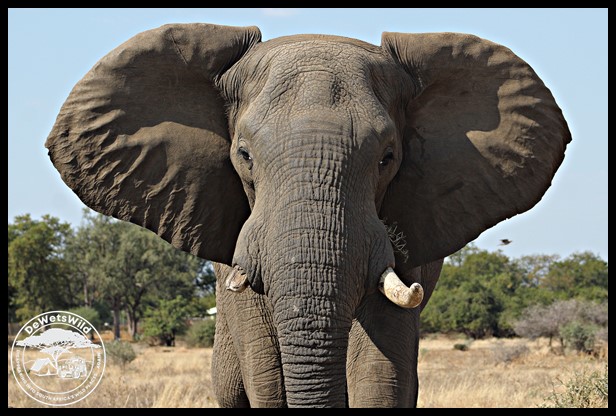
Impressive tusker near Tihongonyeni
African Elephant bull near Tihongonyeni waterhole in Kruger
African Elephant bulls near Tihongonyeni waterhole in Kruger
African Elephant bulls near Tihongonyeni waterhole in Kruger
Here’s a short video of an encounter we’ll remember fondly when passing that way again in future.
… as much as we do, then the Kruger National Park with its large population of African Elephants really is a must visit destination! This is just a few of the hundreds of elephant photos we took during our visit to the Park in June 2023, with a short video as bonus (and don’t miss the cute little baby trying to drink from the river alongside his mom around the middle of the video!).
Elephant family
Elephant family
Elephant cow in profile
Elephant bulls gathering at a self-dug waterhole in the dry Timbavati River
Elephant hogging Malopenyana Waterhole for himself (photo by Joubert)
Big old Elephant bull
Elephant family (photo by Joubert)
Smiling baby elephant (photo by Joubert)
Bull elephant in a hurry
Elephants (and a buffalo to the side) making their way to the waterhole at Babalala
Elephant warning (photo by Joubert)
Elephant Cow and baby
The Elephant’s Tail
Elephant youngster (photo by Joubert)
Elephants drinking from the Pioneer Dam at Mopani Rest Camp
A huge bull Elephant on his way to the Mooiplaas Waterhole
African Buffaloes are social animals that may congregate in herds many hundreds strong. Several such exceptionally large herds roam the Kruger National Park and we were fortunate to encounter some of them during our visit in June ’23. We also came across many lone bulls with their very intimidating attitudes – usually older ones that have been evicted from the breeding herds.
Big Buffalo Bull
Buffalo herd in the Nwaswitsontso River
Two young Buffalo bulls currying favour with a very commanding mature bull
Buffalo bull (photo by Joubert)
Buffalo cow
Buffalo cow with stunted horns accompanied by a bull (photo by Joubert)
Buffaloes (photo by Joubert)
Young but very imposing Buffalo bull
They might be at the water, but they’re not Water Buffalo – these are African, or Cape, Buffaloes
Old loner
Lopsided Buffalo cow
Death stare from a buffalo bull (photo by Joubert)
Buffalo Bull
Buffalo portrait
Buffalo close-up
This short video will give you a sense of the immenseness of these special buffalo herds:
Buffalo lend themselves beautifully to monochrome photography, and the slow passing of the huge herds gave us ample opportunity to play around with our cameras.
Of all the “Big 5” animals none are as difficult to find as the Leopard. Seeing one is usually the highlight of a visit to a nature reserve in South Africa. Having six sightings of these beautiful cats – of which four were on one day! – will mean our latest visit to the Kruger National Park will not soon be forgotten!
Our first sighting, near Lower Sabie late afternoon just minutes before the gates closed, was not very awe-inspiring, even by Leopard standards. Being as lazy as only cats can be this individual did not even deign to show us its face.
Lazy Leopard near Lower Sabie
Early one morning while travelling along the S56 Mphongolo Loop north of Shingwedzi we came across a pair of Leopards in a tall tree – a smaller individual very high up in the tree and visually afraid of the bigger one below guarding the remains of a kill. Visitors who were on the scene before us later shared how the male stole the female’s kill and chased her to the top of the tree where he was too heavy to get to her.
Lofty Leopard (Photo by Joubert)
The male at the lowest fork of the tree, with the kill well hidden (photo by Joubert)
The arrow indicates how high the female climbed into the tree to escape the male. By the way, parking into the veld and hanging out of your vehicle like the visitors in the Land Cruiser is not only bad etiquette but also dangerous.
After spending quite some time at the Leopards in the tree we decided to move on to breakfast at Babalala Picnic Spot when, only 4km further along the same road, we found a young and curiously calm Leopard next to the road at the turnoff to Sirheni Bushveld Camp. She posed beautifully for all the photographers in the car, not fazed in the least by our proximity! Having been treated with such grace by the young princess we slowly backed away from her so that she could repose in tranquility.
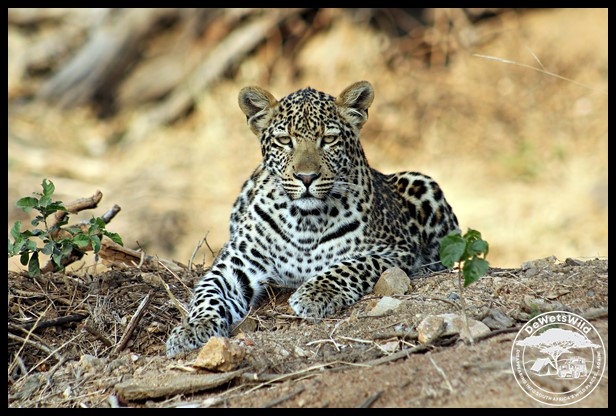
Young Leopard at the Sirheni turnoff (photo by Joubert)
Young Leopard at the Sirheni turnoff(Photo by Joubert)
Young Leopard at the Sirheni turnoff (photo by Joubert)
Young Leopard at the Sirheni turnoff
Young Leopard at the Sirheni turnoff (photo by Erlo van Aswegen)
Young Leopard at the Sirheni turnoff (photo by Joubert)
Mere minutes later, still sauntering along the S56 towards Babalala, we found our third Leopard encounter for the morning where it was using a small outcrop of rocks as a vantage point and being particularly interested in a huge kudu bull lying nearby. The kudu soon saw the Leopard and did not even think the cat enough of a threat to stand up. Knowing it was outgunned, the Leopard gave the kudu a wide berth and disappeared into the dense shrubbery next to the Shisha stream.
Leopard looking out for prey from a rocky outcrop (Photo by Joubert)
Leopard looking out for prey from a rocky outcrop
Leopard descending from the rocks to try its luck with a kudu bull
Stealthily moving closer (photo by Erlo van Aswegen)
Keeping cover (photo by Joubert)
Leopard posing beautifully (photo by Joubert)
That same afternoon, still extremely excited about our morning, which by then also included sightings of other charismatic or rare species of wildlife including lions, roan antelope, tsessebes, buffaloes and elephants we found our fourth Leopard sighting of the day along the S50 Kanniedood Road southeast of Shingwedzi. The apparently heavily pregnant female was in a hunting mood and stalking a mixed herd of impala, kudu and waterbuck mingling on the bank of the river. She was soon discovered however and slinked back across the road and out of sight.
Leopard along the Shingwedzi River (Photo by Joubert)
Leopard walking over the S50 to stalk a mixed herd of antelope (photo by Joubert)
Leopard walking over the S50 to stalk a mixed herd of antelope (photo by Joubert)
Leopard slinking away after being discovered by her prey
Leopard rushing away after being discovered by her prey (photo by Joubert)
Our final Leopard sighting of the trip (and I am sure we missed more than we saw thanks to their exceptional camouflage!) was before sunrise as we left Shingwedzi for a morning drive. This was a shy individual, trying to hide behind a palm frond for a minute or two and then deciding to retreat into the riverine vegetation lining the Shingwedzi.
Shy Leopard in the early morning (photo by Joubert)
Shy Leopard in the early morning (photo by Joubert)
I made a little compilation video of some of the Leopard encounters I told you about.
During the hours of darkness visitors to the Kruger National Park are not permitted to drive themselves around the reserve, both for their own safety and that of the Park’s wildlife. Nighttime in wild Africa is a fascinating time, however, with nocturnal creatures roaming the dark, and for this reason the Park offers visitors night drives of two to three hours in duration and under the guidance of skilled guides, with spotlights being used to seek out animals and birds that might otherwise be hard to see during daylight. We undertook one such excursion from Lower Sabie Rest Camp during our visit to the Kruger Park last week.
Hippopotamus (photo by Joubert)
Spotted Hyena (photo by Joubert)
Spotted Hyena (photo by Joubert)
Elephant (photo by Erlo van Aswegen)
Lion (photo by Joubert)
Lion (photo by Erlo van Aswegen)
With Joubert and his friend Erlo manning the cameras I could take a few video snippets of our drive. Hop on and come along!
Remember that DeWetsWild can also assist you with bookings for guided activities, like night drives, in the Kruger National Park when you make use of our reservation services for your holiday accommodation.









 DeWetsWild