Tag Archives: nature

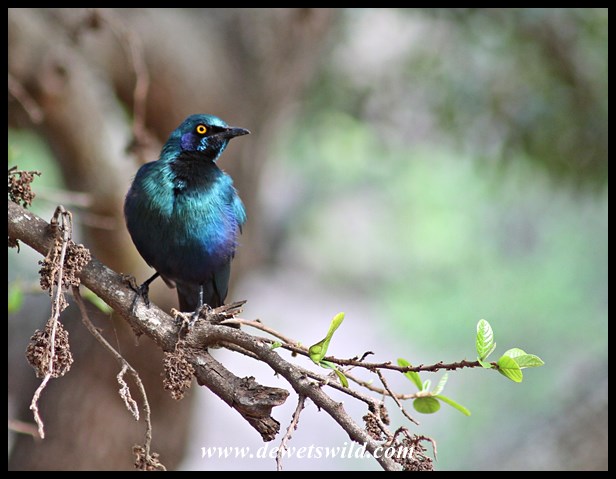
Glossy starling in Lower Sabie

A quick sojourn to Skukuza

Roughly two weeks ago I was invited to Skukuza Rest Camp, in the Kruger National Park, and of course this was the perfect opportunity to mix business and pleasure again. Unfortunately Marilize and Joubert couldn’t join me on this trip, but instead I enjoyed the company of a colleague as passionate about the Park as I am.

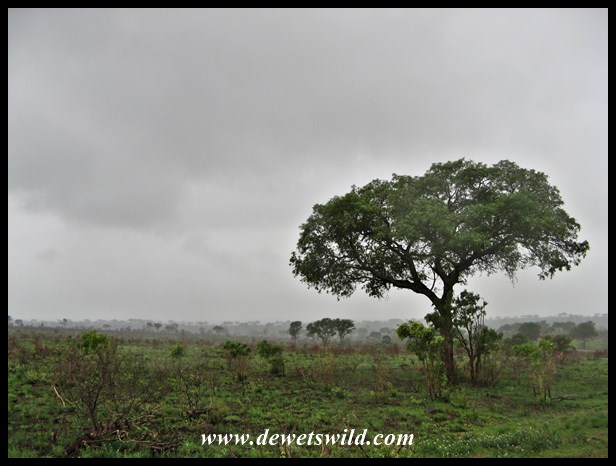
We drove to Kruger on the Sunday afternoon and could enjoy the scenery and wildlife along the way from Phabeni Gate to Skukuza. It had been raining all day, and some more in the weeks prior to our arrival, and fresh, green growth was sprouting all over.
KrugerNP_Nov14 (1)

Despite heavily overcast skies, Monday afforded us more opportunity to experience the Park, before and after our important meeting of course. The rains heralded the start of the impala lambing season, and many other kinds of animals were getting into the birthing action too.

And then Tuesday dawned, with bright and sunny skies, but for us it was time to head back to Pretoria, via Lower Sabie and exiting the Park at Crocodile Bridge.

Nothing like an unexpected bush visit to rejuvenate mind and body! This last gallery sums it up so well for me; even such a short visit to the Kruger Park can deliver unexpected and very memorable sightings. While doing our walkabout at Lower Sabie Rest Camp, I came across this tree agama being irritated by a large ant…


—————————————————–

Please vote for de Wets Wild in the 2014 SA Blog Awards

If you enjoy de Wets Wild as much as we enjoy sharing our love for South Africa’s wild places with you, please vote for us in the 2014 SA Blog Awards by clicking on this badge. We’ve entered both the Travel and Environment categories, and you may vote for us in both.

Thank you for your support!

SA Blog Awards Badge

Converge

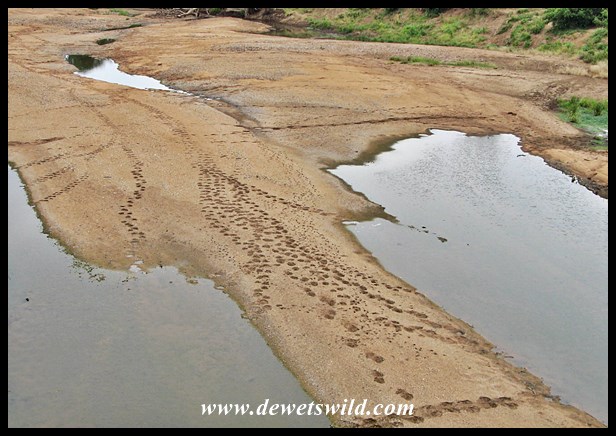
Tracks in the sand bear witness that these pools in the Shingwedzi River are a magnet for animals in the northern Kruger National Park

Converge

Converge” is the theme for this week’s WordPress Photo Challenge

—————————————————–

Please vote for de Wets Wild in the 2014 SA Blog Awards

If you enjoy de Wets Wild as much as we enjoy sharing our love for South Africa’s wild places with you, please vote for us in the 2014 SA Blog Awards by clicking on this badge. We’ve entered both the Travel and Environment categories, and you may vote for us in both.

Thank you for your support!
SA Blog Awards Badge

Spring in Kruger: September 2014

Well, according to the calendar it should have been spring. But judging by the temperatures we experienced, it seemed the Lowveld had skipped that season all together. It was only late September, but daytime temperatures rose to the upper thirties. The land was parched and animals were congregating in numbers at the last remaining water sources. It made for thrilling game viewing and just reminded us again that every season holds its own special appeal in the Kruger National Park.

Over the last couple of weeks, we already shared with you some of our most memorable sightings of the trip. Finding five cheetahs moving along the Shingwedzi River was exciting in the extreme, we were enthralled watching the interactions of different species of game at marvelous Mooiplaas waterhole, we laughed for joy at the playful antics of baby baboons, our encounters with the elephants of northern Kruger kept us on our toes and we empathised with thirsty, tired buffaloes along the Mphongolo. Time to wrap up now, and what better way than with a gallery of images taken during our four night stay – one night in the Shipandani Hide (near Mopani), and three nights at special Shingwedzi Rest Camp.

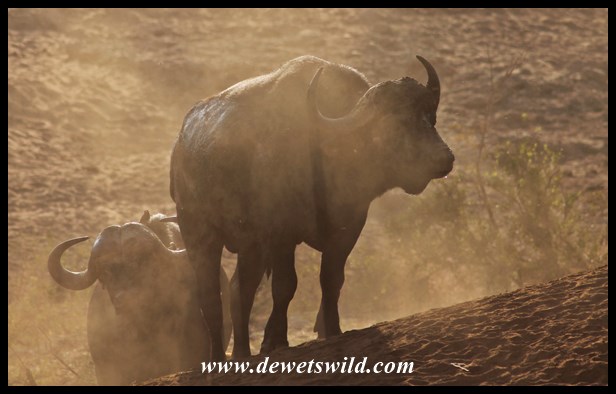
Buffaloes of the Mphongolo

It was hot. It was dry. It was dusty. The bellowing and snorting of buffalo filled our ears, their smell hanging thick in the air. The ground around our position was already littered with the trampled dung and tracks of hundreds of the animals. And still more of them kept coming, making their tiresome way in single file up the steep bank of the Mphongolo, then standing at the top catching their breath before rushing after the rest of the massive herd disappearing into the mopane. The last thing a tired buffalo needs at the end of a long, hot Lowveld day is to be caught alone when darkness falls…

During our September 2014 visit to the Kruger National Park, we encountered several exceptionally large buffalo herds around Mopani and Shingwedzi Rest Camps. This sighting however was the most memorable and we’ll undoubtedly think back to it every time we pass the location in future. The dry winter season had seen to it that the Mphongolo River was reduced to little more than a few stagnant pools surrounded by deep, soft, dusty sand. These pools sustain an incredibly diverse array of birds and game through the dry winter, making the 30km-long S56 Mphongolo River Loop, which follows the river course and offers dozens of good vantage points over the river, one of the best drives in the Shingwedzi area.


Dodging elephants in Northern Kruger

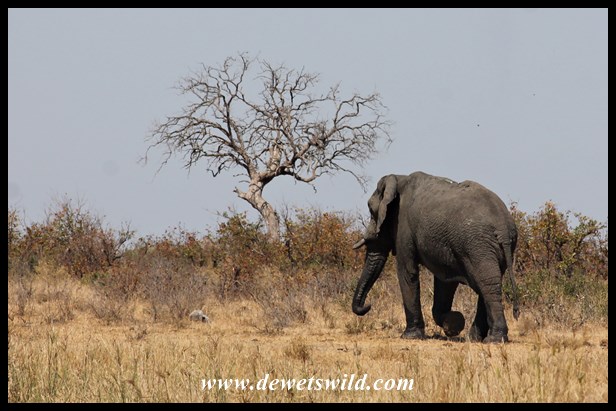
The north of the Kruger National Park is elephant country. When visiting the area, as we did at the end of September (again 😉 ), the problem is not so much finding elephants as it is staying safely out of their way while enjoying the sighting!

Take this bull as an example. When we arrived at the scene, he was standing out in the open in the middle of the road, but immediately then walked, in reverse, to behind this big tree, from where he kept watching us from either side. Having seen this behaviour before, we knew that he was planning an ambush and was just waiting for us to get closer so that he could have some fun with us. We thought better of the challenge and turned back…

Travelling along the rivers in the heat of the day, we came across breeding herds and solitary bulls making their way to the water for a drink and a swim, and resting in the cool shade of the riparian trees.

Kruger is famous for its big tuskers, and we were fortunate again to encounter about half-a-dozen bulls carrying above average ivory. We always cherish sightings of bulls this size as they’re living proof of the successes of those working very hard, day in and day out, to preserve and protect our natural heritage. The Park has a dedicated researcher monitoring these enigmatic animals, to whom you can submit photos and the location of any sightings.


If you love elephants as much as we do, then head for the north of the Kruger National Park. You are sure to have some special encounters, and if you treat them with respect, heed their body language and don’t invade their space, you’ll be perfectly safe.

Shingwedzi jungle-gym

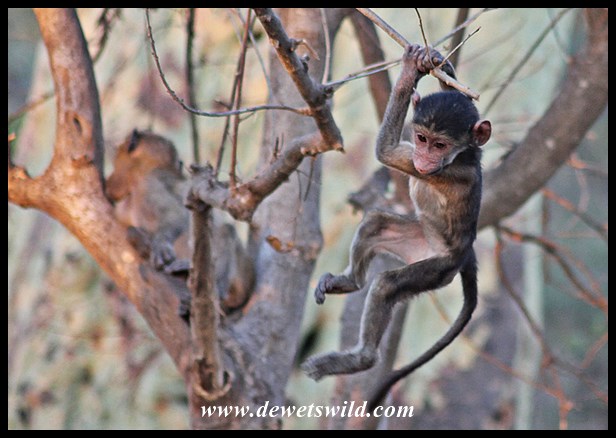
Boisterous Baby Baboons

Driving around the Kruger National Park, especially along one of the major rivercourses, you’re bound to come across a troop or two of baboons. Watching their behaviour and especially their human-like interactions is extremely entertaining.

We encountered this little group one afternoon along the Shingwedzi River, during our September 2014 visit. While the big male watched, sometimes with what seemed like considerable concern for their well-being, the energetic little ones were clambering into a small tree and jumping down again, over and over again, their happiness clearly written all over their faces…


Elephant mayhem at Mooiplaas

Marvelous Mooiplaas

There’s several waterholes in the Kruger National Park that have delivered us consistently good wildlife sightings over the years. One such drinking place is Mooiplaas, an artificial waterhole supplied by a borehole and windpump, adjacent to a natural wetland, about 5km to the south of Mopani Rest Camp. Directly translated from Afrikaans, Mooiplaas means “pretty farm”. The waterhole undeniably lives up to its name both in scenery and for the constant stream of birds and animals moving from the surrounding mopane vegetation to slake their thirst.

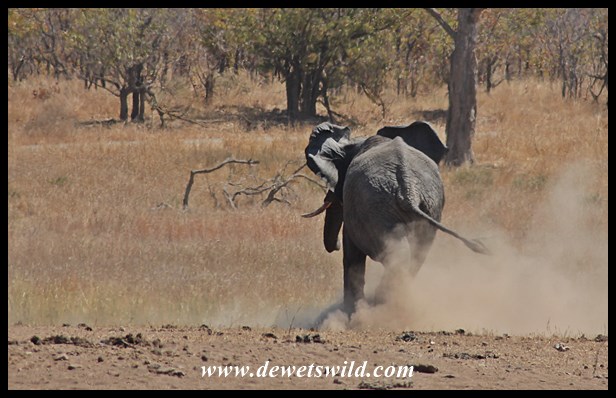
We visited Mooiplaas again on Heritage Day (24th September) while on our most recent visit to the Park. We arrived in the heat of the day, and found the place brimming with animals. Elephants, tsessebe, zebras, wildebeest, ostriches and a lone kori bustard were milling around, and from their behaviour we deduced that there must be predators around. Sure enough, in a clump of mopane shrubs, we saw two lions hiding from the heat; the female just out in the open enough to get photographic proof. It was obvious that these lions were not interested in hunting, and the animals could safely venture to the water for the moment. A young elephant bull caused a bit of an uproar among the plains game when he caught the lion’s smell on the wind, and started running around wildly, kicking up dust as he went.

After checking in for our night at Shipandani Hide, we decided to stop by Mooiplaas again in the late afternoon, and found that the lions had still not moved from their shady hideout. A group of elephant bulls were drinking from the reservoir, and a variety of birds were searching for food in the dust, but there was no sign of the large herds of zebra and antelope that frequented the area earlier in the day. Perhaps they understood that the lions would not be resting for much longer…

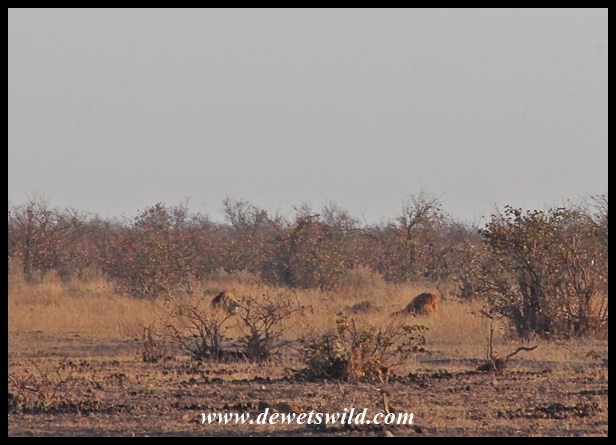
Throughout the night in the hide we could hear the lions roaring towards Mooiplaas, and of course that’s where we headed as soon as the gates opened. If the lions had made a kill during the night, the carcass wasn’t anywhere we could see it, and we had to be content with a far-off sighting of two large males lying in the grass some distance from the otherwise deserted waterhole.

Mooiplaas_25Sep2014

All too soon we had to leave, as we were heading for Shingwedzi and still had to return the keys for the hide to the reception at Mopani. Leaving Mooiplaas behind, we knew there would be more wildlife spectacles unfolding there that day. And we knew we’d return to Mooiplaas again as soon as we have the chance…


Signs

Finding and interpreting the signs of the wild can be just as fascinating and rewarding as watching the actual wildlife that were responsible for it!

Signs” is the theme for this week’s WordPress Photo Challenge