Tag Archives: nature

Blacksmith Lapwing

Vanellus armatus

Blacksmith Lapwings inhabit grasslands (dry or wet), mud flats or agricultural fields, golf courses and sports fields, almost always within a kilometre or two from a reliable water source, and feed on insects, worms and aquatic invertebrates. They are usually seen alone or in pairs, though they do at times congregate in flocks that number a hundred or more in response to a locally abundant food supply, especially outside the breeding season. Blacksmith Lapwings get their name from their call, which sounds almost like a blacksmith’s hammer hitting an anvil, and weigh around 160g with a wingspan just short of 80cm.

While they may breed throughout the year, nesting in this species reaches a peak at the end of the dry season in South Africa. Pairs nest well away from others of their kind and are highly territorial during the breeding season. The nest is a shallow scrape out in the open on the bare ground or among short grass, and near water, lined with vegetation, stones or mud. Both parents incubate the clutch of 1-4 eggs for around 4 weeks. Breeding birds will aggressively defend their eggs and chicks against anyone or anything that venture too close. The hatchlings fledge at about 40 days old, and then become independent about a month later.

The Blacksmith Lapwing has an increasing population distributed over much of Africa south of the equator and is considered of least concern by the IUCN. It can be found almost anywhere in South Africa.

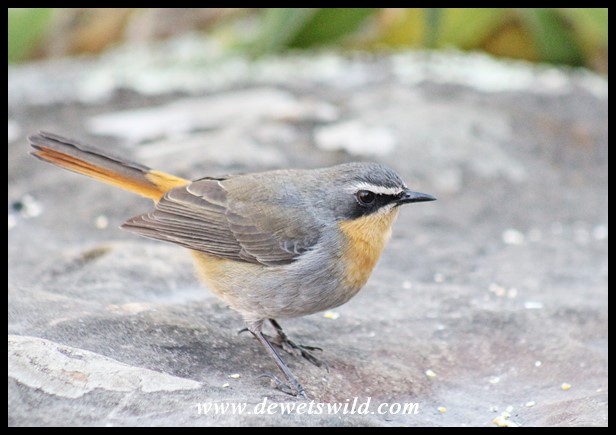
Cape Robin-Chat

Cossypha caffra

Most South Africans would be very familiar with the confiding little (28g) Cape Robin-chat – it was after all voted South Africa’s favourite bird!

Cape Robin-chats have adapted very well to human habitation, being extremely common in suburbs and around farmsteads. They occupy a wide range of natural habitats; from arid Karoo thicket vegetation along water courses to the edges of forests and suitably dense montane vegetation, from whence some birds move to lower altitudes during harsh winters. Cape Robin-chats search for food on the ground, amongst dense vegetation or out in the open, feeding on invertebrates, tiny frogs and reptiles, fruits and seeds. They are very fond of their daily splash bath, and are excellent at mimicking the songs of dozens of other birdspecies. They are usually seen singly or in pairs.

Pairs are monogamous and most hold their territories for years on end. The cup-shaped nest is usually built low in a dense bush. Breeding reaches a peak in spring. Clutches contain 2 or 3 eggs and are incubated by the female for between 14 and 19 days. Both parents feed the chicks until they fledge at about two weeks old and then for another few weeks more. The maximum recorded life span of a Cape Robin-chat is over 17 years!

The Cape Robin-Chat is a common resident in every South African province, though they are very patchily distributed north of our borders into East Africa, and with an apparently large and stable population is considered of least concern by the IUCN.

Photo Safari through Hluhluwe-Imfolozi Park (Part 3)

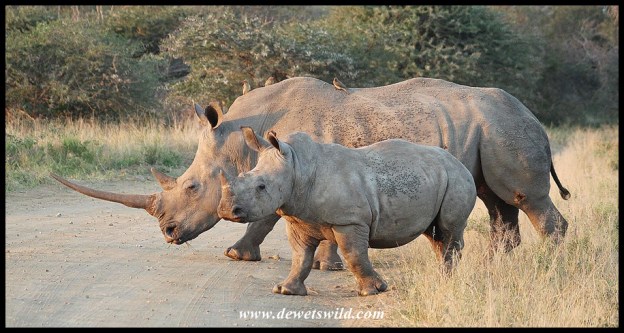
Hluhluwe-Imfolozi Park is famous as the place where the White Rhinoceros was saved from extinction in the middle of the previous century. These animals, and their more cantankerous cousins the Black Rhinoceros, still occur in healthy populations at Hluhluwe-Imfolozi, but how sad that they again face a terrible onslaught from greedy humans for their horns, even here in their ancestral home.

The Park is also home to the other members of the “Big 5“, although the leopards didn’t show themselves to us during this visit. We had several sightings of different lion prides lazing on sandbanks in the Black Umfolozi River, and we encountered elephants and buffaloes throughout the reserve on a daily basis. Spotted Hyenas were a regular sight around Mpila, and we were thrilled by an encounter with a small pack of African Wild Dogs hunting impalas near Bhekapanzi Pan. That same morning we also had a fleeting sighting of a cheetah on Sontuli Loop. Furthermore, baboons, vervet and samango monkeys, duikerbushbuck, nyala, kudu, waterbuck, wildebeesthippo, zebra, giraffe and warthog all put in appearances as we explored Hluhluwe-Imfolozi this winter.

As we wrap up this report from our winter holidays in the bush, we really hoped you enjoyed travelling through Hluhluwe-Imfolozi Park with us, and perhaps feel inspired to visit for yourself!

Being one of our favourite destinations, we’ve featured Hluhluwe-Imfolozi Park many times on our blog – have a look through all our posts about this special wilderness if you’d like to learn more about it.

Photo Safari through Hluhluwe-Imfolozi Park (Part 2)

The Hluhluwe-Imfolozi Park supports over 400 species of birds, many of which have become exceedingly rare, even threatened, outside formal conservation areas like this.

Bird-watching along the reserve’s road network is very rewarding, and there’s always something of interest at the three hides located at waterholes around the Park, or at the picnic sites set in beautiful locations along the Hluhluwe and Black Umfolozi Rivers. It is in the camps however, among the accommodation units, that the birds are most accustomed to a human presence and easiest to photograph as they go about their feathery business.

Enjoy this gallery showing some of the 73 species of bird we managed to identify during our recent winter visit to Hluhluwe-Imfolozi Park.


Being one of our favourite destinations, we’ve featured Hluhluwe-Imfolozi Park many times on our blog – have a look through all our posts about this special wilderness if you’d like to learn more about it.

Photo Safari through Hluhluwe-Imfolozi Park (Part 1)

Moving along to the latter half of our winter holidays in the bush brings us to another of Africa’s oldest conservation areas (and another of our favourite wild places) – the Hluhluwe-Imfolozi Park.

This conservation area covers an enormous 960km² of beautifully unspoilt wilderness, and incorporates the Hluhluwe and Umfolozi Game Reserves that were officially proclaimed in 1895.

We spent four nights in the Park – 3 in cottage #17 at wonderfully wild Mpila and the last in chalet #42 at the Park’s flagship tourist facility; Hilltop.

Of course no visit to a Game Reserve would be complete without plentiful encounters with wild creatures, so let’s get started with a few small critters we came across (more to follow in the next two days).

Being one of our favourite destinations, we’ve featured Hluhluwe-Imfolozi Park many times on our blog – have a look through all our posts about this special wilderness if you’d like to learn more about it.

iSimangaliso’s Eastern Shores – A Photographic Journey (Part 4)

Time to wrap up the photographic trip report of our recent visit to the Eastern Shores of Lakes St. Lucia, with a gallery of some of the larger animals we encountered on land and sea in the place of miracles and wonders – the iSimangaliso Wetland Park.

Follow the links for more of our posts about St. Lucia town, Cape Vidal and Mission Rocks.


iSimangaliso’s Eastern Shores – A Photographic Journey (Part 3)

On the Eastern Shores of Lake St. Lucia, the amazing diversity of life forms comes in all sizes. The star of this collection of photos showcasing some of the smaller creatures that crossed our path on our recent visit must be the tiny frog that somehow got into my mug while we were enjoying coffee and rusks one morning at Mziki viewpoint near Mission Rocks. Exactly when it got into my coffee is unclear – I had put my mug down a few times to take pictures – and I have no idea how much of my coffee I had shared with the little guy. Joubert only noticed it sitting in the cup when I took my last swig as we started packing up to leave. Lucky for it, I drink a lot of milk in my coffee so it wouldn’t have been scalded.

Follow the links for more of our posts about St. Lucia town, Cape Vidal and Mission Rocks.

iSimangaliso’s Eastern Shores – A Photographic Journey (Part 2)

The iSimangaliso Wetland Park is a bird-watcher’s paradise – 526 bird species have been recorded within its borders!

During the few days we recently spent on the Eastern Shores of Lake St. Lucia, we managed to tick 109 kinds of birds, and had we been better at identifying the “Little Brown Jobs” our list would undoubtedly have been quite a bit longer still.

This incredible diversity is surely due to the Park’s rich variety of habitats, and our “success” in connecting with so many kinds of birds can only be ascribed to the terrific collection of roads, hides, picnic sites and other localities so easily accessible to visitors.

We hope you enjoy this sample of iSimangaliso’s birdlife!

Follow the links for more of our posts about St. Lucia town, Cape Vidal and Mission Rocks.

iSimangaliso’s Eastern Shores – A Photographic Journey (Part 1)

We’re fresh back from a terrific holiday in two very special wild places in northern Kwazulu-Natal. Our first destination was the iSimangaliso Wetland Park, and specifically the Eastern Shores of Lake St. Lucia, where we spent one night at Manzini Chalets in the holiday town of St. Lucia, and four nights in a log cabin at Cape Vidal.

I can’t think of a better way to start off the report back on our trip than with a few landscape photos that illustrates why iSimangaliso is a land of “miracles and wonders”, and one of our favourite destinations!

Follow the links for more of our posts about St. Lucia town, Cape Vidal and Mission Rocks.

Back from the Bush

We’ve just arrived back home after a wonderful ten days in the bush, visiting the iSimangaliso Wetland Park and Hluhluwe-Imfolozi Park in South Africa’s Kwazulu-Natal Province.

While we get busy responding to the comments you left on the scheduled posts that published in our absence, here’s a small gallery of what you can expect when we report back on our trip in the coming days…