
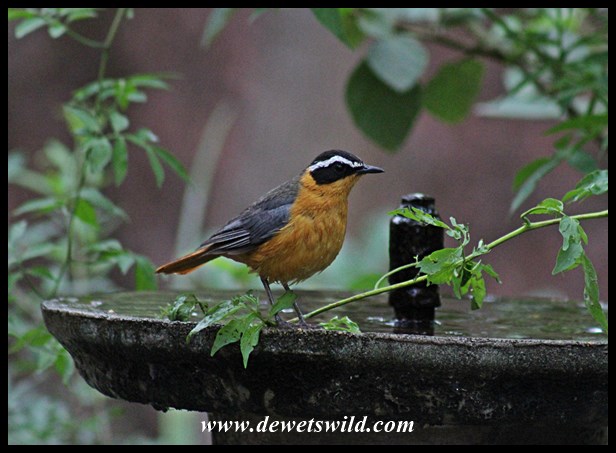
Cossypha heuglini
The White-browed Robin-Chat, also known as Heuglin’s Robin, is confined to the more tropical parts of our country, ranging from the Limpopo Valley through the Lowveld and along the Escarpment to northern Kwazulu-Natal, indicating its preference for dense, moist habitats like riverine forests and evergreen thickets. They feed mainly on insects and other invertebrates. Their cheerful song is one of the first heard in the mornings in areas where they occur.
White-browed Scrub Robins are monogamous, and pairs breed during spring and summer. They build their nests of twigs, dead leaves and other plant material in secluded spots such a hollows in tree trunks, a fork in a densely leafed shrub, or under exposed roots. The female takes responsibility for incubating the clutch of 2 or3 eggs, which hatch less than 3 weeks after being laid. Both parents feed the chicks after hatching. They leave the nest within 3 weeks of hatching and become fully independent at about two months old.
Beyond South Africa’s borders the White-browed Robin-Chat occurs widely in central, eastern and southern Africa, and is considered to be of least concern by the IUCN.


So pretty! I did t realize there were different types of Robins.
Thanks for reminding me of these lovely robins. Thanks also to the link to the recording of their song.
A beauty!
What a gorgeous bird!
It is a joy to see these photographs.