On the 15th of February 1912 the Mkuzi Game Reserve was proclaimed in the north of the Natal Province. At that stage the reserve covered 251km², with its northern and eastern border being the river of the same name. In the west the reserve straddles the Lebombo Mountain and in the south it reached to the Umsunduzi River and Nsumo Pan. Before its proclamation the area was popular among hunters, especially in winter when the dangers of malaria and tsetse flies were diminished, and as a result several animal species, including white rhino, buffalo and eland, were wiped from the area. With a large and impoverished human population living around it, after the reserve was established it faced, and still does, a never ending war with both commercial and subsistence poaching.
In the early years there was lots of hostility to the reserve’s existence, with neighbouring farmers seeing it as a breeding ground for the cattle disease nagana (of which the tsetse fly is a vector from game, which is immune against it). As a result, the reserve was deproclaimed in 1939 and control of the land transferred to the government veterinary department. Subsequently more than 38,000 wild animals were killed, with only black rhinos spared, after which an extensive aerial spraying campaign with poisonous insecticides followed. The war to control the tsetse fly was won at great financial and environmental cost. The reserve was re-proclaimed, under the auspices of the Natal Parks Board (now Ezemvelo KZN Wildlife), in 1954.
Shortly after, the reserve faced a new existential threat when the Mkuze River and the pans it feeds at Nhlonhlela and Nsumo dried up due to dams and extraction for irrigation upstream. With no surface water available for the animals the reserve staff had to sink deep boreholes in the bed of the river to pump water to two waterholes deeper in the reserve to prevent animals moving out. One of these waterholes, Kumasinga, is still a major attraction for both game and human visitors.

Entrance to the walkway at the parking area for Kumasinga Hide

Looking out from Kumasinga Hide

uMkhuze’s Kumasinga Hide

Nyala bull

uMkhuze 20122014

Impala ewe

Warthog family

New to the waterhole

Zebra reflections

Zebr and wildebeest sharing the waterhole

I took this photo of the outside of the hide a bit later in the day
In 1972 the Nxwala State Lands, on Mkuzi’s then south-eastern boundary, was incorporated into the reserve, increasing its size by a further 58km². The reserve boundary was later moved further south to beyond the Umsunduzi River to bring it to its current size. Today the reserve covers 400km² and uses the more correct traditional spelling of uMkhuze for its name. It forms an integral part of the iSimangaliso Wetland Park. Have a read here for more about the history of the iSimangaliso Wetland Park.
uMkhuze is rich in scenery and biodiversity. Records indicate that the reserve is home to more than 700 indigenous plant species, 90 mammal species, 450 bird species, 64 kinds of reptile (perhaps as many as 85), 43 kinds of frogs and 32 fish species. The extensive Nsumo Pan, its shores lined by magnificent fever trees, is a watery haven for a myriad water-dependent birds and a magnet for other kinds of wildlife. Majestic riverine forest trees like the sycomore fig trace the course of the Mkuze River. Sand forest is a unique and endangered plant community in South Africa of which a tiny portion is protected in uMkhuze and the open plains of the reserve are covered by savannas and grasslands with a fascinating mix of plant species. Above this all tower the 600m high peaks of the Lebombos.

Nsumo Pan

Nsumo Pan

Nsumo magic

Nsumo Pan

Nsumo Pan

Rainbow over Nsumo Pan

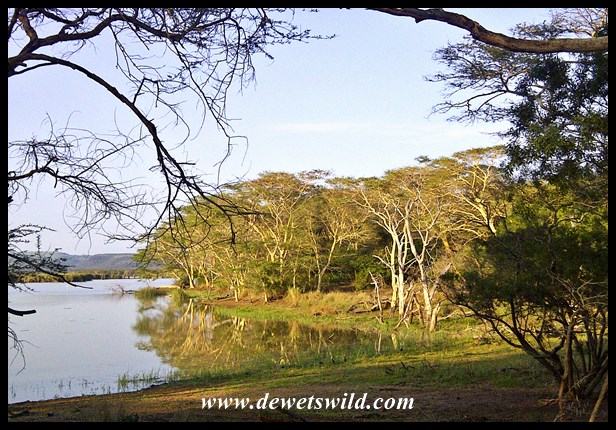
There’s beautiful specimens of the fever tree at uMkhuze

There’s beautiful specimens of the fever tree at uMkhuze

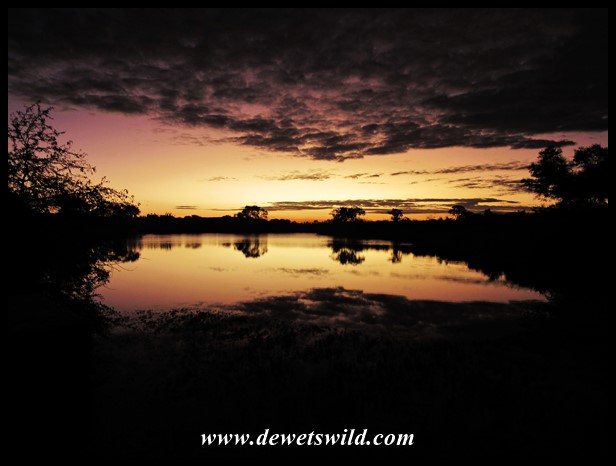
uMkhuze sunset

uMkhuze scenery, the Lebombo range in the background

uMkhuze scenery

Fever trees in Umkhuze Game Reserve

Fever trees

Fever trees

uMkhuze sunset at the lookout tower

uMkhuze scenery

uMkhuze scenery

Looking up into the branches of a massive fever tree

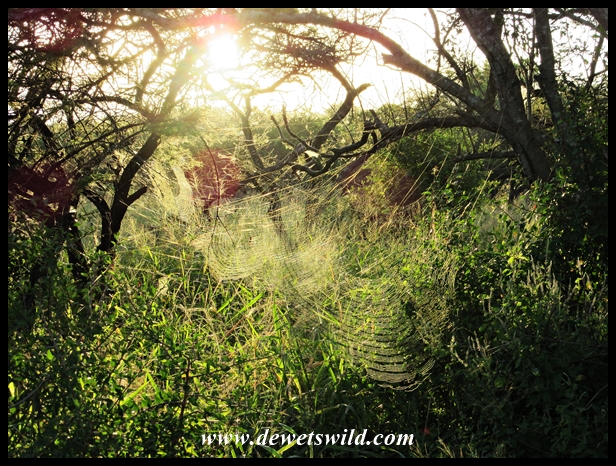
Golden Orb-web Spider webs in the golden light of early morning

Giant Carrion Flower (Stapelia gigantea)

uMKhuze landscape, with giraffes
Elephants were reintroduced to the uMkhuze Game Reserve in 1994, and today number more than a hundred animals. They are however not seen very often.

Matriarch of the uMkhuze Game Reserve elephant herd (photo by Joubert)

Younger members of the uMkhuze Game Reserve herd with their leader

Elephant Bull accompanying the herd

Playful Elephant youngster (photo by Joubert)
While the founding population of uMkhuze’s white rhinos were translocated from Hluhluwe-Imfolozi Park in the 1960’s, the black rhinos have occurred here throug the ages. What a pity that these enigmatic creatures are now again threatened by poaching

White rhinoceros

White rhinoceros

Don’t mess with a black rhino

White rhinoceros cow and rather large calf

Black Rhinos

White Rhinos
In August 2005, buffalo was reintroduced to Umkhuze Game Reserve (from Marakele National Park). Although numbering several hundred, they’re still not often seen and tend to remain in the wilderness areas far from human eyes.

Buffalo bull near Ophansi Gate

uMkhuze’s buffaloes are not frequently seen
After an absence of 44 years, lions were reintroduced to the uMkhuze Game Reserve in December 2013.
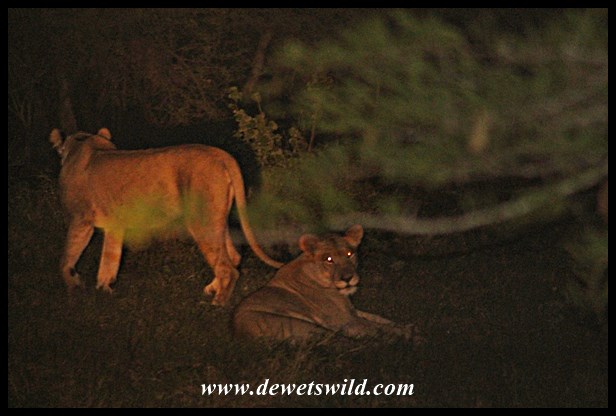
Lions at uMkhuze (18 December 2014)
uMkhuze is home to leopards, cheetahs and wild dogs, but we haven’t seen them yet. We did however have a few encounters with uMkhuze’s spotted hyenas over the years though.

Spotted hyena

Spotted hyena

Spot the spotted hyena!
uMkhuze harbours around 300 of the rare suni antelope which finds refuge in the sand forest.

A pair of suni in the sand forest

Suni

Suni
uMkhuze is well know for its sizable population of the beautiful nyala.

Nyala bull

Nyala

Nyala lamb

Nyala bull horning the mud

Nyala bull

Big Nyala bull
Other herbivores that occur in uMkhuze are hippo, giraffe, plains zebra, warthog, bushpig, kudu, blue wildebeest, bushbuck, impala, steenbok, common and red duiker, baboon, vervet monkey, thick-tailed bushbaby and scrub hare.

Plains zebras

Grey duiker

Radio-controlled warthogs

There seemed to be impala lambs around every corner at uMkhuze

Thick-tailed Bushbabies visited our tent at uMkhuze every night

Blue wildebeest

Giraffe

Giraffe

Impala herd

Vervet Monkeys admiring their reflections

Young Kudu bull

Common Duiker

Kudu cow

Hippos at rest in Nsumo Pan

Playful baboons at Kumasinga

Scrub Hare

Steenbok
uMkhuze is considered one of the top bird-watching destinations in South Africa

Broad-billed rollers

European Honey Buzzard

Cattle egret

Woolly-necked Stork Buffet at uMkhuze

European Roller

Crested Guineafowl

Crested Francolin

Trumpeter Hornbill

Spur-winged Goose (male)

Lappet-faced Vulture

White-faced Whistling Duck at Kumasinga, uMkhuze

Tawny Eagle

Southern Yellow-billed Hornbill

Bearded Scrub-Robin

Chinspot Batis (male)

Jameson’s Firefinch

Blue Waxbill

Pied Wagtail

African Jacana

Yellow-throated Longclaw

White-crested Helmetshrike

Golden-breasted Bunting

Crested Guineafowl

Black Flycatcher

African Darter

Purple-crested Turaco

Rudd’s Apalis

White-browed Scrub Robin

Pink-throated Twinspot

European Nightjar

Grey Waxbill

Sombre Greenbul

Common Waxbill

African Hoopoe

Burchell’s Coucal

African Harrier-Hawk

Yellow-fronted Canary

Chinspot Batis

Emerald-spotted Wood Dove

Red-backed Shrike

European Nightjar

Pink-backed Pelican in flight
Cold-blooded creatures abound in uMhuze too, and visitors can expect to see anything from fish to nile crocodiles while exploring the reserve.

Red Toad at home outside our cottage

Common Tropical House Gecko outside the bathroom window

Juvenile African (Edible) (Lesser) Bullfrog

Striped Skink enjoying a grasshopper meal

Tortoises have right of way on uMkhuze’s roads – this is a Natal Hinged Tortoise

Tortoise have right of way on uMkhuze’s roads

Serrated Terrapins soaking up the sun at Nsumo Pan

Flap-necked Chameleon (photo by Joubert)

Eastern Natal Green Snake at Kumasinga Hide, 21 March 2022

Leopard Tortoise

Tree Agama female

Water Monitor

Crocodile lurking in the water

Redbreast Tilapia in Nsumo Pan
In 1958 Mkuzi Game Reserve opened to the public, when three rustic huts were erected for use by overnight visitors. The reserve’s Mantuma Rest Camp today provides a variety of comfortable accommodation options in huts, chalets, safari tents and cottages with a swimming pool available to accommodated guests. Unleaded petrol and diesel is available and the reception office doubles as a small shop selling mainly snacks and fizzy drinks. The Rhino Din-o is a small cafeteria in Mantuma that sells light meals and offers excellent value for money. There is also a well-shaded picnic site for day visitors in the grounds of the reception office. Guided night drives and guided walks through the Fig Tree Forest departs from the main camp. The exclusive Nhlonhlela Bush Lodge, overlooking the pan with the same name and able to accommodate 8 guests, is located a few kilometers away from Mantuma, while the rustic Umkhumbe Camp in the far south of the reserve also accommodates groups of up to 8 guests. There is a spacious camping ground at eMshopi at the western entrance to the reserve. All these overnight facilities are booked through Ezemvelo KZN Wildlife. Malaria is still endemic in the area and precautions are strongly advised.

Mantuma, uMkhuze, December 2014

Mantuma Tent #22, uMkhuze Game Reserve, iSimangaliso Wetland Park, March 2017

Chalet 12 in Mantuma Camp, uMkhuze Game Reserve, Isimangaliso Wetland Park, March 2022

Chalet in Mantuma

Swimming Pool at Mantuma

Emshopi Campsite
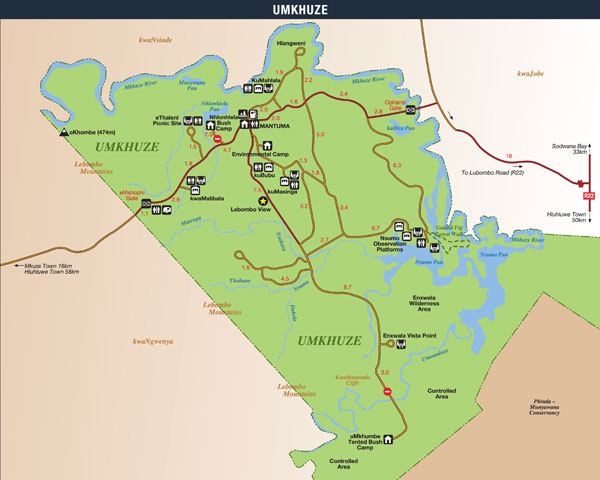
There are two access gates into the uMkhuze Game Reserve. In the west, 15km from Mkuze town, lies eMshopi Gate. In the east, providing easy access from Sodwana and the R22 road, is the newer Ophansi Gate which opened in 2006. Visitors have access to a road network spanning 100km within the reserve for game viewing, much of it tarred. There is a beautiful picnic site with braai facilities on the shores of Nsumo Pan. Photographic hides at kuMalibala, kuMasinga and kuMahlahla as well as two on Nsumo Pan are well maintained and very popular. The Lebombo Lookout Tower, just a few kilometers south of the main camp, is another spot not to be missed.

One of the bird-viewing hides at Nsumo

One of the bird-viewing hides at Nsumo

Nsumo picnic site

Nsumo Picnic Site

Fever trees

Nsumo picnic site

Lebombo Lookout Tower

Atop the observation tower

uMkhuze sunset at the lookout tower

Driving through the riverine forest at Ophansi Gate

eMshopi Gate

Historic first gate to Mkuzi
















 DeWetsWild