Category Archives: Memorable sightings

Subantarctic Fur Seal at Cape Vidal

Arctocephalus tropicalis

The Subantarctic Fur Seal is a sea living mammal that usually occurs in the chilly waters of the southern Atlantic, Indian and Pacific Oceans. Finding one on the much more tropical beach at Cape Vidal in the iSimangaliso Wetland Park on South Africa’s north-eastern coast, thousands of kilometers from where it belongs, was therefore a very unexpected surprise! Why and how exactly some seals roam so widely outside their usual range still is not really understood, but vagrants of this species has been recorded in South Africa before and even as far north as the Tanzanian coast. When we first noticed this individual it was lying far up the beach, trying its best to stay out of a strong wind, but I later noticed it enjoying the swell at the incoming tide. While to my opinion our visitor looked in good, energetic health I did alert the Park authorities as soon as I had connectivity again just in case they wanted to have a look themselves, as these long distance swimmers are often very tired and underfed by the time they reach our shore and are then looked after at a specialised rehabilitation centre until they can be shipped back to their natural homes.

Subantarctic Fur Seals live and breed around and on tiny islands just north of the Antarctic Polar Front at roughly 60°S latitude, including the South African territory of the Prince Edward islands. Fully grown males, at 1.8m long and 160kg in weight, is much larger than the females, which weigh only about 50kg. They feed mainly on fish and squid. Pups are born in the southern summer (most of them in December). It is estimated that they can live to 25 years of age in the wild.

With a population estimated at around 200,000 adults and considered to be stable, the IUCN lists the Subantarctic Fur Seal as being of least concern. This is a wonderful improvement as they were extensively hunted for their pelts in the 1800’s.


Buff-spotted Flufftail

Sarothrura elegans

A very secretive and rarely seen bird, the Buff-spotted Flufftail inhabits forests and other densely vegetated patches in areas of fairly high rainfall. These days they’re found in well planted gardens within their range with increasing frequency. It is mainly insectivorous, searching for invertebrates in the leaf litter of its dense habitat. They appear to be active throughout the day and night.

Pairs of Buff-spotted Flufftails are monogamous and territorial during the breeding season, which spans the months of spring to autumn. Using a wide range of plant material the female takes about 3 days to construct a well hidden dome-shaped nest with a side entrance underneath densely growing plants. Both partners take it in turns to incubate the clutch of 3-5 eggs over a two week period. The chicks leave the nest when they’re only a day or two old, accompanying their parents on foraging excursions. They grow quickly and can fly by the time they’re about 3 weeks old. At this point their parents will kick the chicks out of their territory and start breeding again – the pair may raise up to 4 broods in a season! Fully grown Buff-spotted Flufftails are about 15cm long and weigh around 50g.

In South Africa, the Buff-spotted Flufftail has a patchy and limited distribution, stretching from the Western and Eastern Cape through most of Kwazulu-Natal on to the escarpment in Mpumalanga and Limpopo. Beyond our borders they’re found over much of west, central and eastern Africa. The IUCN considers this species to be of least concern.

Limpopo Ramble 2022: Eastern Rock Sengi

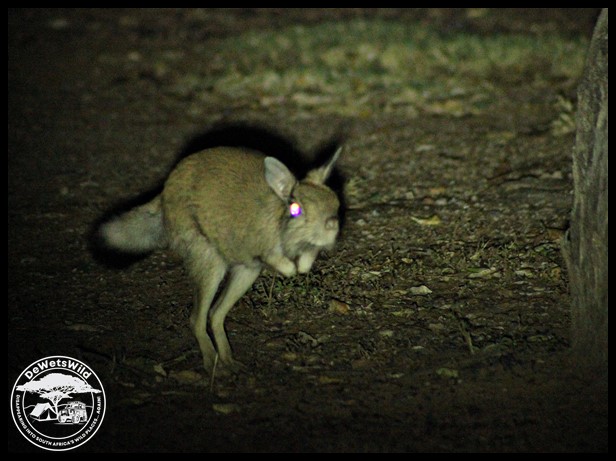
During our recent visit to Marakele National Park, while enjoying the magnificent view from the Lenong Viewpoint, we spied a little Eastern Rock Sengi basking in the early morning sun – a habit they are particularly fond of – behind a fence surrounding one of the communication towers also built atop the mountain. While the fence is a rather irritating obtrusion in these photo’s of ours, it is probably because of it that the Sengi felt comfortable enough to be out and about, safe in the knowledge that neither us humans nor any other predator could reach it!

Elephantulus myurus

The Sengis, or Elephant Shrews, (order Macroscelidea) are a family of 20 small, insectivorous mammal species occurring only in Africa. While they’re superficially very shrew-like they are in fact not related to shrews at all (and they are in fact more closely related to elephants, even if their “trunks” aren’t nearly as long and prehensile), which is why the scientific community is trying to move away from the old moniker in favour of Sengi, a name based in indigenous African languages.

The Eastern Rock Elephant Shrew, or Sengi then, occurs widely in South Africa’s northern and eastern provinces and throughout Zimbabwe, extending into portions of Lesotho, Eswatini, Botswana and Mozambique south of the Zambezi. The IUCN considers it to be of least concern.

As suggested by its name, the Eastern Rock Sengi is always found in close association with rocky areas where they hide in cracks and tiny caves among the boulders. Here they subsist on a diet that consist of insects (mainly ants and termites) and other invertebrates, though they will also eat seeds. They are diurnal, very rarely venturing out in the dark. They are also very alert and nervous, usually dashing for cover at the slightest disturbance.

Eastern Rock Sengi’s are mainly solitary and seen in pairs only while they breed during spring and summer. Females usually give birth to twins after a two-month long gestation. The young are very well developed and can move around with their mother soon after birth. Fully grown, Eastern Rock Sengi’s measure about 26cm long (of which the tail is more than half) and weigh approximately 60g. They have a very short lifespan and may live to only around 18 months of age in the wild.

Limpopo Ramble 2022: Royal Welcome at Marakele

Scarcely half-an-hour after arriving at Marakele National Park on the 29th of June, while making our way between reception and our allocated tent at Tlopi Tented Camp, we were met by this beautiful male lion, out patrolling and marking his territory. It really is nice to have your arrival acknowledged by the local royalty, don’t you think?

Limpopo Ramble 2022: Taking our Elephant for a walk

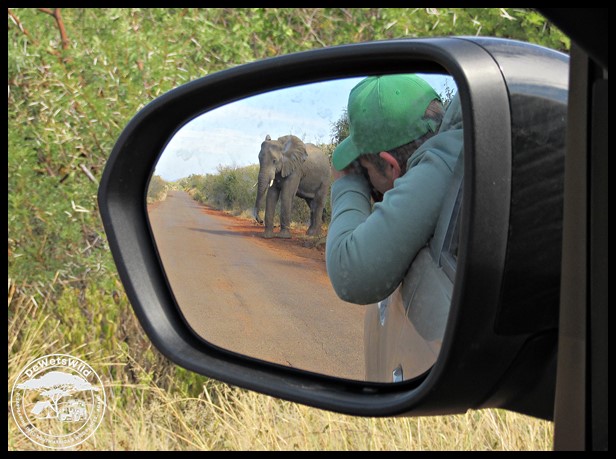
Late one evening as we were slowly heading back to Marakele National Park’s Tlopi Camp with a few minutes left before gate closing time, we found our way blocked by a big herd of elephants, and I parked our vehicle a good distance away so that we could enjoy the sighting. While the herd were peacefully going about their business up ahead, suddenly a young elephant cow came charging at full tilt out of the bush right next to us!

I immediately turned the car around and drove off. After a few hundred metres I slowed down so that we could resume our more leisurely game-viewing pace, only to have the raging cow appear in the rear-view mirror again. This being repeated several times, it was startling to realise that she would not relent and in the end she chased us for over a kilometre – with Joubert snapping away these photographs – before she turned around.

Limpopo Ramble 2022: Tlopi Buffalo Pub

One afternoon during our recent visit to Marakele National Park, while relaxing on the deck of our safari tent and enjoying the serenity of Tlopi Camp, this sizable herd of buffaloes visited their local waterhole for a drink. Joubert is responsible for all these pictures.

Limpopo Ramble 2022: Verreaux’s Eagle Nest in Mapungubwe

On a sheer rock face in the Mapungubwe National Park, we found a pair of Verreaux’s Eagles attending to their chick at their nest. So large was the nest that we seldom got even a glimpse of the fluffy white chick, but it was wonderful nevertheless to see the majestic adults coming and going.

Limpopo Ramble 2022: Mapungubwe’s Treetop Walk

One of the real treats of a visit to Mapungubwe National Park is the Treetop Walk through the riverine forest on the South African bank of the Limpopo River (Botswana is on the opposite side). Sadly the length of the elevated boardwalk was trimmed significantly by recent floods, but it still offers a wonderful glimpse into life in the tree canopy and an amazing opportunity to watch elephants from above if you are lucky to be on the treetop walk when a herd moves through on their way to the water.

Limpopo Ramble 2022: The Land of the Giants

In the Mapungubwe National Park, three aspects are truly iconic of this landscape: Elephants, baobabs, and rocky hills and cliffs. It’s as if the entire atmosphere of the Park hinges on these key natural attributes.

Mapungubwe, situated as it is at the place where the borders of South Africa, Botswana and Zimbabwe meet, has a high population of elephants and especially so when the dry season concentrate the behemoths along the banks of the Limpopo River. From families of cows and tiny calves to enormous bulls can all be expected along any of the roads traversing the Park, and sometimes waiting for these charismatic animals to clear the way can be a very entertaining delay. At other times, the dense mopane veld may lead to you inadvertently finding yourself in the personal space of one of the giants and they might react with more than a little agitation!

The Elephants even move through Mapungubwe’s unfenced main camp Leokwe, as we experienced one evening upon arriving at out cottage.

Baobabs are the undisputable rulers of Mapungubwe’s plant kingdom. With this part of the world now firmly in Winter’s grip, the trees are mostly leafless, lending more credence to the myth that the Creator tossed them to earth, planting them upside down. Elephants have a paticular liking for the pulpy wood of the baobab, and many of Mapungubwe’s trees show damage as a result, leading to the Park authorities protecting some prime specimens by using wire as wrapping around their trunks (those of the trees, not those of the elephants 😉 )

On the largest scale of all, it is the rocky, hilly landscapes that really forms the basis of Mapungubwe’s ancient atmosphere. The hills are composed mainly of dolerite – the remains of molten rock pushed up from deep inside the earth through sandstone that has long since weathered away to leave only the harder volcanic geology visible.

Limpopo Ramble 2022: Hungry Honeymooners

During our recent visit to Mapungubwe National Park we left the environs of Leokwe Camp early one morning to go and explore the western reaches of the Park around the Maloutswa Pan, near the Limpopo Forest Tented Camp and Mazhou Camping Site. We were already close to our destination when we came across a mating pair of lions enjoying the early morning sun.

Mating pair of Lions

The female especially was interested in (we thought) a herd of impala grazing nearby, and got up to sneak out of view followed by the male. Anticipating an impending attack on the impalas, we positioned our vehicle for a clear view of the antelope grazing entirely unaware of the danger lurking nearby.

What we didn’t see, but the lions did, was a family of warthogs. When next we saw the lions they were chasing the warthogs at speed across the road!

Unfortunately, or fortunately depending on which team you support!, the warthogs were too quick for the lions, and the honeymoon pair had to continue searching for their next breakfast opportunity.