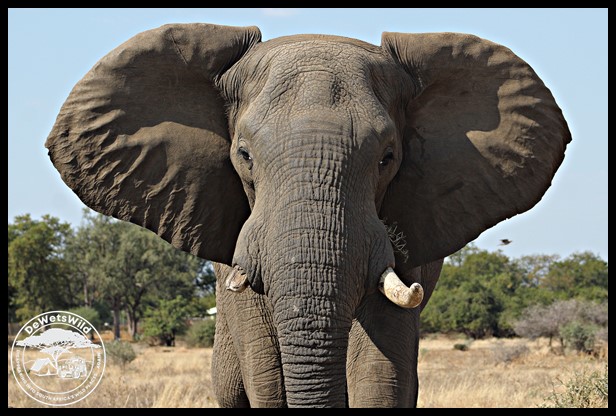
… as much as we do, then the Kruger National Park with its large population of African Elephants really is a must visit destination! This is just a few of the hundreds of elephant photos we took during our visit to the Park in June 2023, with a short video as bonus (and don’t miss the cute little baby trying to drink from the river alongside his mom around the middle of the video!).
Elephant family
Elephant family
Elephant cow in profile
Elephant bulls gathering at a self-dug waterhole in the dry Timbavati River
Elephant hogging Malopenyana Waterhole for himself (photo by Joubert)
Big old Elephant bull
Elephant family (photo by Joubert)
Smiling baby elephant (photo by Joubert)
Bull elephant in a hurry
Elephants (and a buffalo to the side) making their way to the waterhole at Babalala
Elephant warning (photo by Joubert)
Elephant Cow and baby
The Elephant’s Tail
Elephant youngster (photo by Joubert)
Elephants drinking from the Pioneer Dam at Mopani Rest Camp
A huge bull Elephant on his way to the Mooiplaas Waterhole
African Buffaloes are social animals that may congregate in herds many hundreds strong. Several such exceptionally large herds roam the Kruger National Park and we were fortunate to encounter some of them during our visit in June ’23. We also came across many lone bulls with their very intimidating attitudes – usually older ones that have been evicted from the breeding herds.
Big Buffalo Bull
Buffalo herd in the Nwaswitsontso River
Two young Buffalo bulls currying favour with a very commanding mature bull
Buffalo bull (photo by Joubert)
Buffalo cow
Buffalo cow with stunted horns accompanied by a bull (photo by Joubert)
Buffaloes (photo by Joubert)
Young but very imposing Buffalo bull
They might be at the water, but they’re not Water Buffalo – these are African, or Cape, Buffaloes
Old loner
Lopsided Buffalo cow
Death stare from a buffalo bull (photo by Joubert)
Buffalo Bull
Buffalo portrait
Buffalo close-up
This short video will give you a sense of the immenseness of these special buffalo herds:
Buffalo lend themselves beautifully to monochrome photography, and the slow passing of the huge herds gave us ample opportunity to play around with our cameras.
Of all the “Big 5” animals none are as difficult to find as the Leopard. Seeing one is usually the highlight of a visit to a nature reserve in South Africa. Having six sightings of these beautiful cats – of which four were on one day! – will mean our latest visit to the Kruger National Park will not soon be forgotten!
Our first sighting, near Lower Sabie late afternoon just minutes before the gates closed, was not very awe-inspiring, even by Leopard standards. Being as lazy as only cats can be this individual did not even deign to show us its face.
Lazy Leopard near Lower Sabie
Early one morning while travelling along the S56 Mphongolo Loop north of Shingwedzi we came across a pair of Leopards in a tall tree – a smaller individual very high up in the tree and visually afraid of the bigger one below guarding the remains of a kill. Visitors who were on the scene before us later shared how the male stole the female’s kill and chased her to the top of the tree where he was too heavy to get to her.
Lofty Leopard (Photo by Joubert)
The male at the lowest fork of the tree, with the kill well hidden (photo by Joubert)
The arrow indicates how high the female climbed into the tree to escape the male. By the way, parking into the veld and hanging out of your vehicle like the visitors in the Land Cruiser is not only bad etiquette but also dangerous.
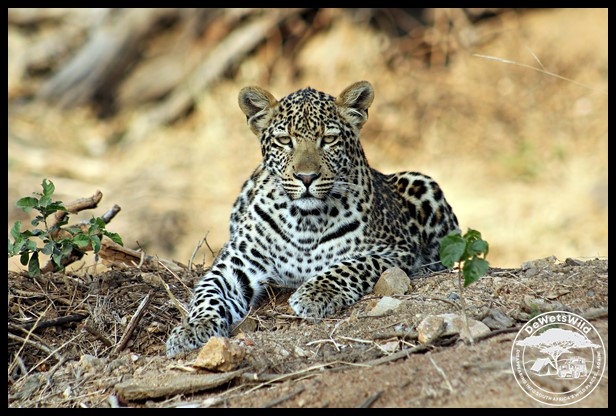
After spending quite some time at the Leopards in the tree we decided to move on to breakfast at Babalala Picnic Spot when, only 4km further along the same road, we found a young and curiously calm Leopard next to the road at the turnoff to Sirheni Bushveld Camp. She posed beautifully for all the photographers in the car, not fazed in the least by our proximity! Having been treated with such grace by the young princess we slowly backed away from her so that she could repose in tranquility.
Young Leopard at the Sirheni turnoff (photo by Joubert)
Young Leopard at the Sirheni turnoff(Photo by Joubert)
Young Leopard at the Sirheni turnoff (photo by Joubert)
Young Leopard at the Sirheni turnoff
Young Leopard at the Sirheni turnoff (photo by Erlo van Aswegen)
Young Leopard at the Sirheni turnoff (photo by Joubert)
Mere minutes later, still sauntering along the S56 towards Babalala, we found our third Leopard encounter for the morning where it was using a small outcrop of rocks as a vantage point and being particularly interested in a huge kudu bull lying nearby. The kudu soon saw the Leopard and did not even think the cat enough of a threat to stand up. Knowing it was outgunned, the Leopard gave the kudu a wide berth and disappeared into the dense shrubbery next to the Shisha stream.
Leopard looking out for prey from a rocky outcrop (Photo by Joubert)
Leopard looking out for prey from a rocky outcrop
Leopard descending from the rocks to try its luck with a kudu bull
Stealthily moving closer (photo by Erlo van Aswegen)
Keeping cover (photo by Joubert)
Leopard posing beautifully (photo by Joubert)
That same afternoon, still extremely excited about our morning, which by then also included sightings of other charismatic or rare species of wildlife including lions, roan antelope, tsessebes, buffaloes and elephants we found our fourth Leopard sighting of the day along the S50 Kanniedood Road southeast of Shingwedzi. The apparently heavily pregnant female was in a hunting mood and stalking a mixed herd of impala, kudu and waterbuck mingling on the bank of the river. She was soon discovered however and slinked back across the road and out of sight.
Leopard along the Shingwedzi River (Photo by Joubert)
Leopard walking over the S50 to stalk a mixed herd of antelope (photo by Joubert)
Leopard walking over the S50 to stalk a mixed herd of antelope (photo by Joubert)
Leopard slinking away after being discovered by her prey
Leopard rushing away after being discovered by her prey (photo by Joubert)
Our final Leopard sighting of the trip (and I am sure we missed more than we saw thanks to their exceptional camouflage!) was before sunrise as we left Shingwedzi for a morning drive. This was a shy individual, trying to hide behind a palm frond for a minute or two and then deciding to retreat into the riverine vegetation lining the Shingwedzi.
Shy Leopard in the early morning (photo by Joubert)
Shy Leopard in the early morning (photo by Joubert)
I made a little compilation video of some of the Leopard encounters I told you about.
Yesterday I lamented the fact that we’d be leaving the Kruger National Park today and heading back home to Pretoria. Well, as is often the case, the Kruger still had one present in store for us before we left. This morning, just a kilometer from Shingwedzi Rest Camp, that gift took the form of a buffalo carcass, two bloody lionesses and the smallest pair of lion cubs we’ve seen in a long time!
Lioness feeding on the buffalo carcass
Second lioness walking along the road, having fetched her cubs to join the feast (phot by Joubert)
Cutest, tiniest cubs (phot by Joubert)
Second lioness walking along the road, having fetched her cubs to join the feast (phot by Joubert)
Second lioness walking along the road, having fetched her cubs to join the feast (phot by Joubert)
Cutest, tiniest cubs (phot by Joubert)
The cubs playing on the sandy riverbed
The cubs playing on the sandy riverbed
The two lionesses reuniting
The cubs joining their mom and aunt
The cubs joining their mom and aunt
The first female, very bloodied, walks away for a drink of water
Here’s a little video compilation of the cubs as they walked along the road with their mother:
We had a feast of leopards around Shingwedzi today – no less than 4 separate encounters with these spotted beauties! These photos by Joubert are just a little teaser; we will share more when we get back home.
Lofty Leopard (Photo by Joubert)
Young Leopard at the Sirheni turnoff(Photo by Joubert)
Leopard looking out for prey from a rocky outcrop (Photo by Joubert)
Leopard along the Shingwedzi River (Photo by Joubert)
I know of no place better than Bontle Camp in the Marakele National Park to more reliably see our very own African kangaroos, or Springhares to give them their proper English name even though they’re not hares either!
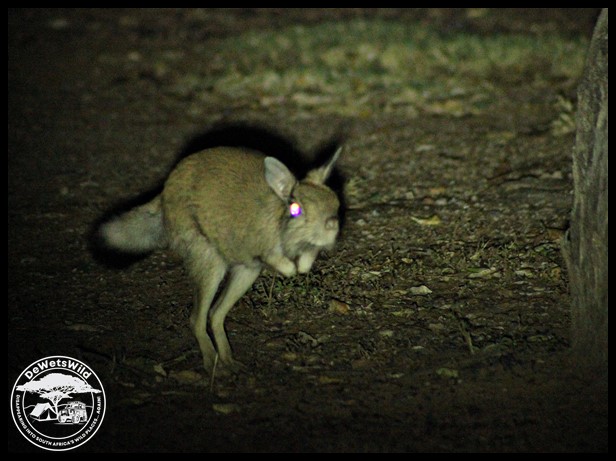
Springhare jumping aroun in Bontle Camp after dark
Springhare jumping aroun in Bontle Camp after dark
Springhare jumping aroun in Bontle Camp after dark
Springhare jumping aroun in Bontle Camp after dark
Pedetes capensis
The Springhare is a large rodent, measuring up to 90cm in length and weighing between 2.5 and 3.5kg. Their mode of propulsion is unique among mammals in sub-Saharan Africa, jumping kangaroo-like as they move around and covering up to 2m in a single bound.
They inhabit areas with compact, but not hard, soil – usually sandy or sedimentary – in which they very prodigiously tunnel their own burrows of up to 140m in extent. Each individual Springhare lives in its own burrow system, except for females who’d share it with their latest baby, and these have several entrances, side tunnels and escape holes. They’ll often block the tunnel entrance behind them once they’ve entered it. These tunnels are important refuges for many other kinds of animals that shelter in holes in the ground. While several Springhares may have tunnels in near proximity to one another they’re not social animals.
Female Springhares give birth to a single young (very seldomly twins) at any time of year after a 3 month gestation period. The baby stays in the mother’s tunnels until it is weaned at about 2 months of age. Females may have between 2 and 4 young every year. They only live to about 6 years old in the wild.
Springhares are a favourite prey of almost every predator on the continent, humans included. They are active at night and do not emerge from their burrows until total darkness falls well after sunset. They forage near their burrows to enable a quick escape, and feed mainly on grass (roots, stems and blades), bulbs and herbs. Springhares are often considered a pest in farmlands where they can do considerable damage to crops.











 DeWetsWild