Tag Archives: wildlife

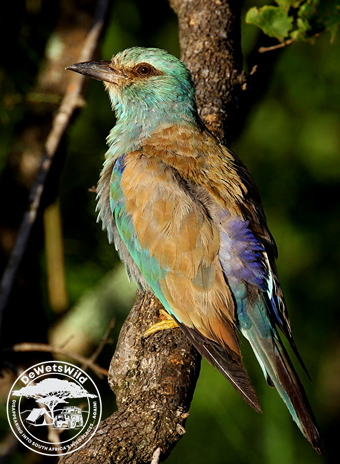
European Roller

Coracias garrulus

The European Roller is a summer visitor to much of South Africa as well as most of the rest of sub-Saharan Africa, migrating to this part of the world from Europe, the Middle East, Asia and North Africa. They arrive here from October and depart again from March. Although they migrate in large flocks numbering into the hundreds, European Rollers are usually seen singly or in loose aggregations during our austral summer, inhabiting grasslands, savannas and open woodlands and to an increasing extent coastal heathland in the extreme south. They feed mainly on invertebrates and small vertebrates like chicks, lizards and frogs.

European Rollers breed in the mid-summer in their northern hemisphere abodes, using holes in trees or cliffs as nests in which clutches of 1-7 eggs are incubated by the female for just short of 3 weeks. The chicks start flying when they’re about a month old and remain dependent on their parents for at least another month more. Adults measure around 30cm in length and weigh approximately 120g.

European populations of this Roller has undergone considerable declines in recent years, due to hunting, poisoning and a loss of breeding habitat, though the IUCN still considers it to be of least concern.

African Mourning Dove

Streptopelia decipiens

African Mourning Doves inhabit tall riverine woodlands, feeding predominantly on grasses, seeds and small fruits, and occasionally termites, found by foraging on the ground. They are quite large doves, adults weighing around 160g and measuring about 30cm in length. This dove is usually seen singly or in monogamous pairs, only rarely congregating in larger groups, but often associates with other kinds of doves. They appear to breed throughout the year, using flimsy stick platform-nests built in trees. Typically, clutches contain 2 eggs.

The African Mourning Dove has a limited distribution in South Africa, occurring only in the Limpopo Valley and Lowveld, where the Kruger National Park‘s Letaba, Satara and Shingwedzi Camps are excellent locations to go looking for them, and enjoying their characteristic voices. They’re distributed more widely, if patchily, north of our borders, occurring through east Africa and the Sahel. The IUCN considers the African Mourning Dove to be of least concern.

Boys Weekend in the Pilanesberg

Early on this past Saturday morning Joubert and I headed for the Pilanesberg National Park’s Kwa Maritane Gate. Our plan was to spend all of Saturday, most of Sunday morning and the night between in one of South Africa’s most easily accessible wildlife destinations, enjoying a bit of father-son company and shared hobbies in the beautiful surroundings far from the city’s distractions. When the Gate opened at 05:30 we set off, enjoying some thrilling encounters with the Park’s wildlife right from the start.

While we were enjoying the Pilanesberg’s sights and sounds from the coolness of the photographic hide at Makorwane Dam, Joubert suggested that we head for Bakgatla Resort to go setup camp before the day got any hotter.

With our tent pitched and our camping chairs unpacked, we could enjoy our lunch, a few glasses of cold drink and an ice-cream treat surrounded by a selection of Bakgatla’s permanent residents of the feathered variety.

The first stop on our afternoon drive was Rathlogo Hide, just a few kilometers from Bakgatla.

At Tilodi Dam we laughed at the antics of a male African Black Duck that was most impressed with himself for having chased off a White-faced Whistling Duck from “his” shoreline.

There was much more wildlife to be seen as we traveled through the southeastern portions of the Park.

At Lengau Dam a group of baboon youngsters were having great fun roughhousing in a dead tree and occasionally dropping into the water below – no doubt enjoying great relief from the oppressive heat but I was surprised that they weren’t more afraid of the crocodiles!

With the sun setting it was time to head towards Bakgatla.

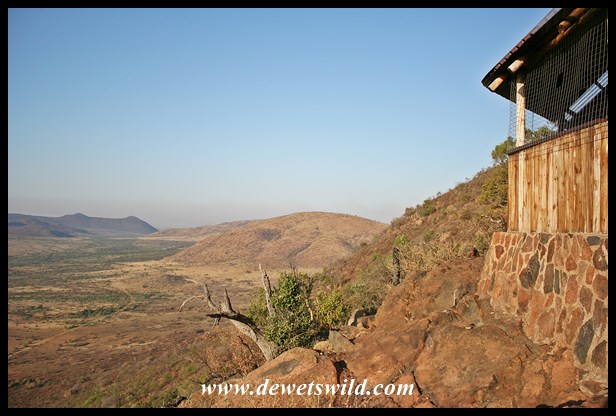
On Sunday morning we packed up our camp and headed for the Lenong Viewpoint to enjoy our morning tea and rusks from a beautiful vantage point high on top of one of Pilanesberg’s mountains. The rest of the morning we spent visiting more of our favourite spots in the Park, until the day started getting really hot again. We enjoyed a quick lunch at Fish Eagle Picnic Spot and then headed for Kwa Maritane Gate and home…

Pilanesberg National Park is an easy 160km drive from our home in Pretoria.

A thousand posts on de Wets Wild!

Today we celebrate a major milestone for us here at de Wets Wild – our 1,000th post!

A huge word of thanks must go to our all our friends and followers for their support and encouragement over the course of the past 6 years! Thank you for sharing our love and passion for South Africa’s wild places and the creatures that find a home there with us – we hope you’ll continue to do so for many years to come!

Seems fitting now to have a look at some of the most popular posts and other highlights we enjoyed on this journey. (Clicking on the links provided should open the posts in a new window without closing this post).

Perhaps unsurprisingly, our “About” page (home page) is by far the most visited.

But how and why the post about South African Hornbills come in second place, I have no explanation!? That they’re fascinating birds we won’t argue about.

South Africa’s vultures are getting some well-deserved attention as well.

Another post about a bird that got a lot of attention is that about the black heron and its fascinating hunting technique.
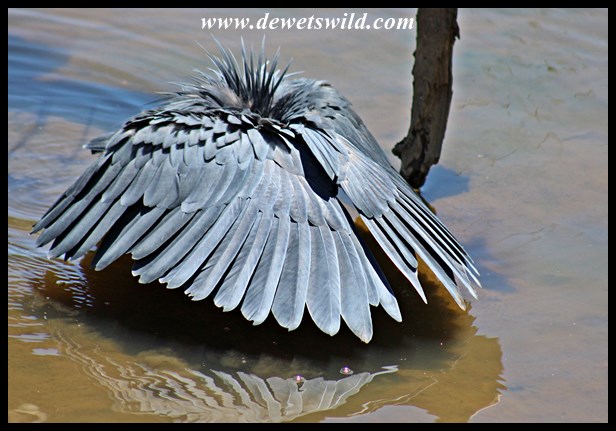
Black Heron “canopy feeding”

Early into our blogging “career” we took part in a few photo challenges – the image we posted of dew droplets caught in a spider’s web was the best received of those.

The post we did on the Kruger National Park’s Selati Line, with thanks to my sister for the use of her photos, has been a perennial favourite.
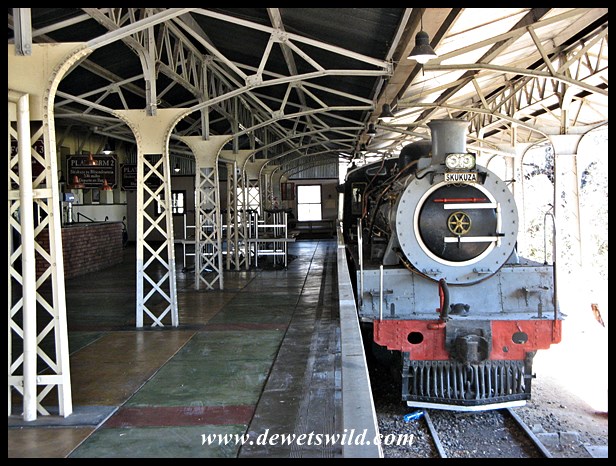
Steam engine at Skukuza "station"

Steam engine at Skukuza “station”

The features we did on Pafuri Border Camp (in Kruger) and Nyathi Rest Camp (in Addo) when they opened are still very popular – people are obviously very eager to explore new destinations and we’re glad that de Wets Wild could help so many of them plan their visits!

But it is not only the new destinations that people are interested in, as the posts about familiar favourites like Skukuza in the Kruger Park, Loskop Dam and Golden Gate Highlands National Park prove.

Plains Zebras seem to be the most popular mammal featured here at de Wets Wild, as a few posts about these beautiful animals feature at the top of the charts!

But the world’s cutest bouncing baby rhino will not be outdone!
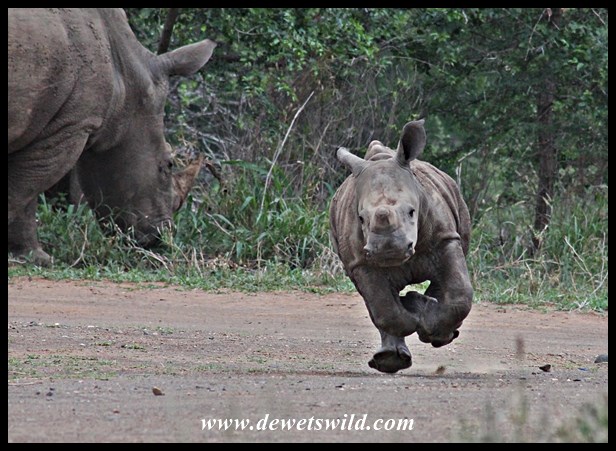
You’ll never catch me!

Of course we cannot talk about highlights and forget how your support helped us feature in the honours at the SA Blog Awards – from finishing as runners up in both the Best Travel Blog and Best Environmental Blog Categories in 2014, 2015 and 2016 to finally winning in both in 2017!



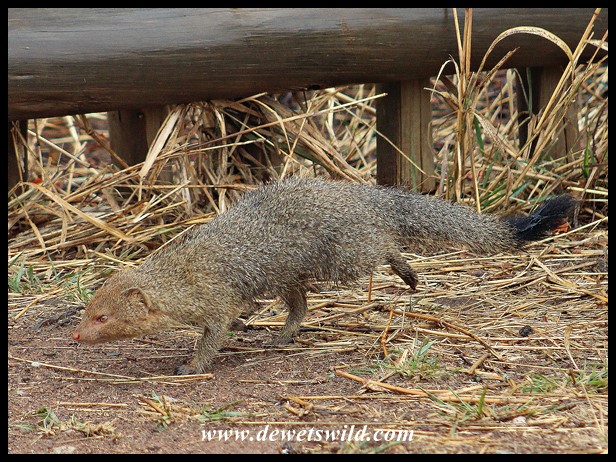
Slender Mongoose

Herpestes sanguineus

Despite its relative small size – adults weigh around 500g and grow to about 60cm in length – the Slender Mongoose is a very active diurnal carnivore, capable of overpowering prey up to the size of guineafowl and domestic chickens, but usually preying on invertebrates, eggs, reptiles (including snakes), rodents, frogs and small birds and at times a small quantity of fruits and berries as well.

Slender Mongooses are not particular about their habitat and will inhabit any area where there is sufficient cover. They mostly hunt on the ground, but are quite capable climbers, and at night hide in burrows, thickets, hollow tree trunks and similar shelters. They are solitary animals and likely any groups encountered will be consisting of a female with her latest litter of 1 or 2 (seldomly up to 4) cubs. Like most other mongooses they are very susceptible to rabies. Their life expectancy in the wild is approximately eight years.

The IUCN lists the Slender Mongoose as Least Concern. It is distributed over a wide area of sub-Saharan Africa, being absent only from the driest deserts and most densely forested areas. In South Africa they are found in all provinces except the Western and Eastern Cape, where the closely related Cape Grey Mongoose fills the same general ecological niche.

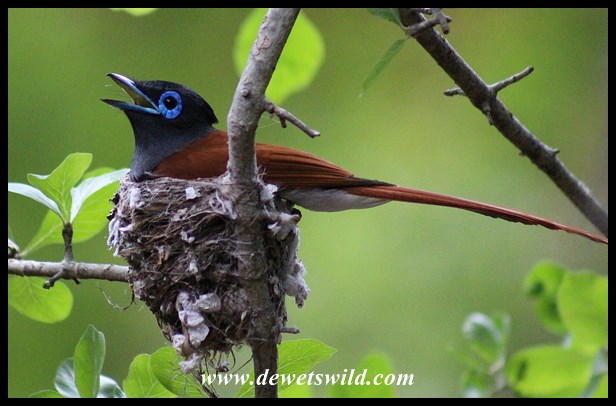
African Paradise Flycatcher

Terpsiphone viridis

Certainly one of our prettiest small birds, the shy African Paradise Flycatcher is distributed widely over sub-Saharan Africa where they inhabit a variety of woodland habitats and well-planted gardens and parks in city suburbs, being particularly common in evergreen forests and denser woodland types such as is found along rivers and large streams. They feed mainly on tiny flying insects, or invertebrates (including spiders) gleaned from leaves and twigs, and occasionally berries.

Without their streaming tail feathers, adult males of this species measure around 17cm in length – double that if you include the tail – and weigh about 14g.

Pairs of the African Paradise Flycatchers are monogamous and they may even mate for life. They breed in summer, with both sexes working on the construction of the tiny cup-shaped nests using spider web and a variety of other fine natural materials. Clutches of 2 or 3 eggs are incubated by both parents and hatch after just two weeks. The chicks leave the nest at about two weeks of age, and the parents care for the newly fledged chicks for another week or so after that.

In South Africa, Paradise Flycatchers can be found in all our provinces with the exception of the arid Northern Cape. Here they exhibit distinct seasonal movements, trekking to the lower lying coastal areas and lowveld during the harsh winter on the higher lying areas. The IUCN considers the African Paradise Flycatcher to be of least concern.

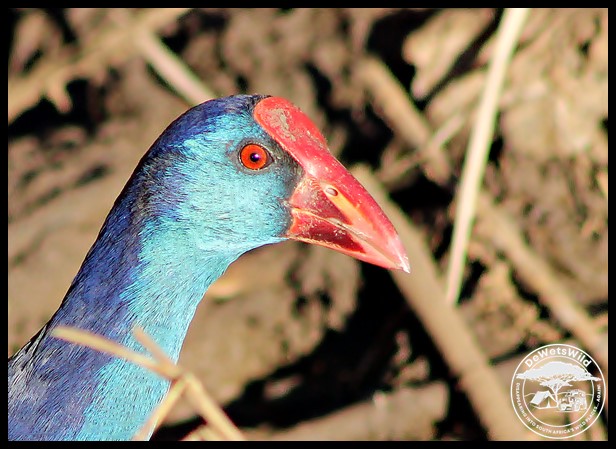
African Swamphen

Porphyrio madagascariensis

The African Swamphen is a shy, skulking inhabitant of dense reedbeds along slow flowing rivers, marshes, swamps and temporary wetlands where they feed mainly on aquatic plants, insects and other invertebrates, fish, frogs and eggs. They are usually seen singly but may be encountered in small family groups from time to time. African Swamphens breed at any time of year, though there is a distinct peak in the summer months. Their nests are large and built of and among reeds. Clutches contain between 2 and 5 eggs, are incubated by both parents and hatch after about 3 weeks. Both parents care for the chicks, which fledge at about two months old.

Adults are around 42cm long, weigh approximately 600g and are by far the biggest members of the rail family occurring in South Africa.

In South Africa, the African Swamphen, or Purple Gallinule as it was previously known, is distributed very patchily on the highveld and along the eastern and southern coastlines. Some authorities consider the African Swamphen to be a subspecies of the Purple Swamphen (P. porphyriowhich has a wide distribution over Africa, Europe, Asia and Australia), and is listed as being of least concern by the IUCN.

Southern Foam Nest Frog

Chiromantis xerampelina

Foam Nest Frogs are excellently adapted to an arboreal lifestyle, living near seasonal and permanent water in the savanna biome and often seen inside houses and other buildings in these parts. At 9cm in length, adult females are slightly larger than males.

During spring and summer Foam Nest Frogs congregate around pools of standing water to mate. The female secretes a fluid from her oviducts and then, using their hind legs in a process that may take several hours, she and the attending males churn it into a thick white foam ball that attaches to a branch or other structure hanging over the water and in which up to 1,200 eggs, fertilised by several of the present males, are then laid. At times the mating frogs congregate in large groups creating enormous, collaborative foam nests. Inside the foam balls, now with a hardened outer edge and looking very meringue-like, the eggs and newly hatched tadpoles are kept moist and safe from smaller predators. When they are a few days old the tadpoles drop from the foam ball into the water to find food and complete their metamorphosis.

In South Africa, Foam Nest Frogs are commonly encountered in the north of Kwazulu-Natal, the lowveld of Mpumalanga and widely through the bushveld regions of Limpopo. They are also distributed widely over much of the rest of southern, central and eastern Africa. The IUCN considers it to be of least concern.

White-necked Raven

Corvus albicollis

Powerfully built with a most intimidating beak and boasting a wingspan of over 80cm and weighing around 800g, the White-necked Raven is the largest member of the crow family occurring in South Africa. They are true omnivores, feeding on carrion, small vertebrates, insects, eggs, fruits and grains, and they will also scavenge human waste (although they’re not as frequently associated with human habitations as others of the family). It has also been observed that they’ll pick up tortoises and drop them from a great height, usually on rocks, to break the shells.

White-necked Ravens are usually encountered in territorial pairs or small family groups, but at times congregate in groups that may number over a hundred at a good food source, especially outside of the breeding season. Their preferred habitat is open hilly and mountainous areas where they nest on cliffs during the spring and early summer. Their large stick nests, lined with fur, wool and grass, are often utilised by other birds once the ravens have deserted it after their own chicks fledged. Clutches contain 2-5 eggs and are incubated by both parents.

White-necked Ravens occur patchily from Uganda and Kenya southwards to South Africa, where they can be found in all our provinces with the exception of Gauteng and the North West. While noting that some populations are declining due to unspecified reasons (though I suspect poisoning is probably a major factor) the IUCN lists the White-necked Raven as being of least concern.

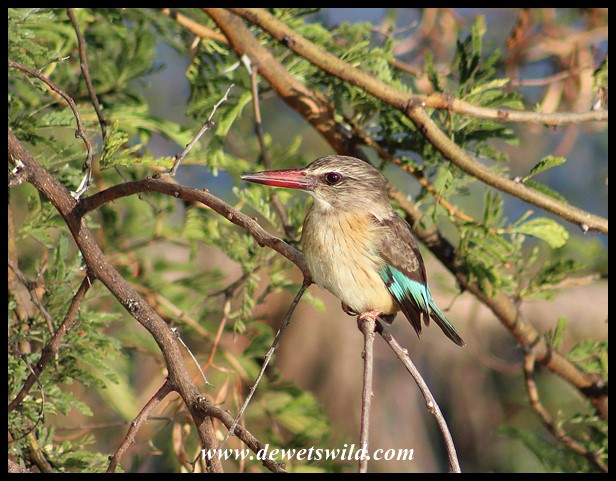
Brown-hooded Kingfisher

Halcyon albiventris

Despite what their name suggests, the Brown-hooded Kingfisher does not feed predominantly on fish – their diet consists mainly of invertebrates, small birds and reptiles caught on dry land and only occasionally includes small fish, crabs and tadpoles. It is a bird of savannas,  woodlands, riverine thickets and forest edges and does not need to live near water. They’re becoming ever more frequently encountered in suburban parks and gardens.

Brown-hooded Kingfishers are usually seen singly or in pairs (that often stay in the same area for many consecutive years) or in family groups following the end of the spring-summer breeding season. Their nests are burrows (up to a meter deep) excavated by both parents in river banks or other earthen walls, and in which the female incubates clutches of 2-5 eggs for around 2 weeks. Fully grown they measure around 23cm in length and weigh about 60g.

The Brown-hooded Kingfisher lives in Africa south of the equator, and mainly in the eastern half from Kenya southwards to South Africa (all provinces, though very patchily in the arid central and western provinces and mainly in association with introduced vegetation around human settlements in those parts). Thanks to a large and stable population the IUCN considers the species to be of least concern.