With it being a short school holiday we had the opportunity to visit the privately owned Rhino & Lion Nature Reserve for a day this past week.
The reserve was established in 1990 and is located in the Cradle of Humankind World Heritage Site northwest of Johannesburg in the Gauteng Province of South Africa. It covers approximately 1,600 hectares of undulating terrain at the transition between the open grasslands of the Highveld and the savannas of the Bushveld.

Hilltop scenery in the Rhino & Lion Nature Reserve

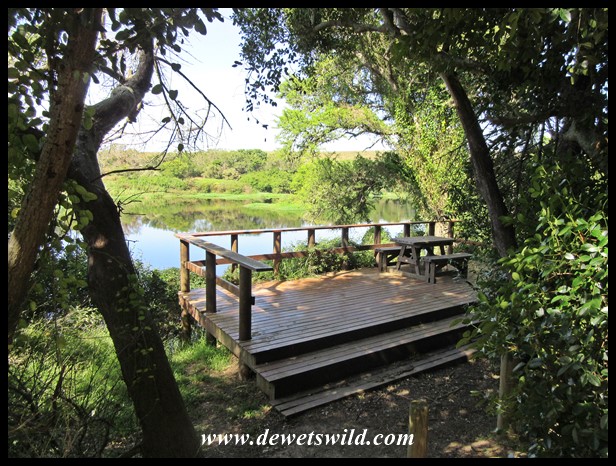
A dam at the Rhino & Lion Nature Reserve

An exotic Jacaranda tree in full bloom stands out like a sore thumb among the natural vegetation of the Rhino & Lion Nature Reserve
Going by the name, clearly pride of place at the reserve goes to two species. The first is the white rhinoceros, which are heavily guarded on the reserve to keep them safe from poachers – in fact, several of the reserve’s rhinos arrived here as orphans after their mothers were poached. Furthermore the horns of the rhinos at the Rhino & Lion Nature Reserve has been infused with a toxin that makes it unfit for human consumption to further deter the unscrupulous syndicates supplying the traditional medicine markets in Asia.

White Rhinos at Rhino & Lion Nature Reserve

White Rhino at Rhino & Lion Nature Reserve

White Rhino at Rhino & Lion Nature Reserve
In a corner of the reserve are four large camps through which visitors are allowed to drive to view two prides of lion, African wild dogs and cheetahs in natural surroundings. Whenever we consider visiting a destination where large predators are kept in camps and enclosures we are always very careful that it is not in any way linked to the absolutely abhorrent canned hunting fraternity, cub petting or the lion-bone trade. The owners and management of the Rhino & Lion Nature Reserve have publicly undertaken that the animals on the reserve will not be subjected to such inhumane practices.
The first and most expansive of the predator camps at the reserve is allocated to the tawny lions. We arrived there just minutes before feeding time, and found the lions up and very active indeed!

Young lioness at the Rhino & Lion Nature Reserve

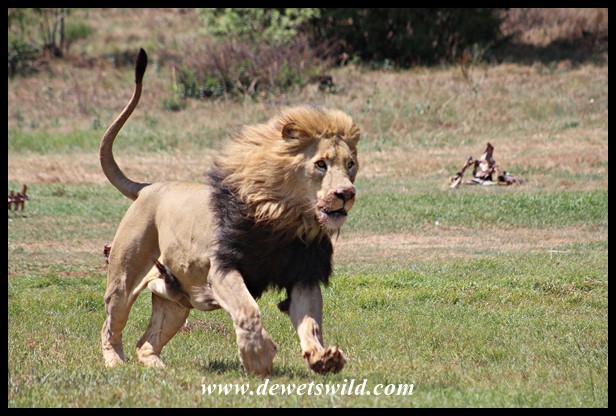
Big male lion at the Rhino & Lion Nature Reserve

Big male lion at the Rhino & Lion Nature Reserve

Feeding time at the Rhino & Lion Nature Reserve

Feeding time at the Rhino & Lion Nature Reserve

Energetic female lions at the Rhino & Lion Nature Reserve

Feeding time at the Rhino & Lion Nature Reserve

Feeding time at the Rhino & Lion Nature Reserve(photo by Joubert)

Feeding time at the Rhino & Lion Nature Reserve

Feeding time at the Rhino & Lion Nature Reserve

Feeding time at the Rhino & Lion Nature Reserve
The next camp visitors enter houses a sizable pack of the highly social African Wild Dog, also known as Painted Wolves for their beautifully blotched coats.

African Wild Dogs at the Rhino & Lion Nature Reserve

African Wild Dogs at the Rhino & Lion Nature Reserve

African Wild Dogs at the Rhino & Lion Nature Reserve

African Wild Dogs at the Rhino & Lion Nature Reserve
A pride of White Lions is to be seen in the third predator camp (regular readers of our blog will remember how excited we were to have seen one of only three known wild white lions back in January during a visit to the Kruger National Park).

White Lions at the Rhino & Lion Nature Reserve

White Lion at the Rhino & Lion Nature Reserve

White Lion at the Rhino & Lion Nature Reserv
In the fourth camp visitors can try and spot cheetahs, though these lanky cats use their camouflage to great effect and finding them may be neigh impossible if they don’t want to be spotted!

Cheetah at the Rhino & Lion Nature Reserve

Cheetah at the Rhino & Lion Nature Reserve

Cheetahs at the Rhino & Lion Nature Reserve

Cheetah at the Rhino & Lion Nature Reserve
Another positive feature of the reserve is the vulture restaurant – a feeding station where carcasses are regularly laid out for the endangered birds. Throughout our day on the reserve we had regular sightings of the impressive but endangered Cape Vultures overhead, and many other kinds of birds were also in evidence.

Soaring Cape Vulture

Cattle Egret

Egyptian Geese on the wing

Common Moorhen (immature)

Pied Crow (hoping for road kill?)

African Sacred Ibis

White-browed Sparrow Weaver
Other kinds of mammals, aside from the rhinos and large predators, thrive on the reserve and roam freely over most of it. We were especially impressed by the large herd of eland and beautiful sable antelope, and we also saw black-backed jackal, black and blue wildebeest, blesbok, buffalo, gemsbok, grey duiker, impala, roan antelope, springbok, warthog, waterbuck and yellow mongoose.

Black-backed Jackal

Black Wildebeest

Blesbok

Blue Wildebeest

African buffalo

Eland calves

Eland herd

Eland calves

Eland bull

Eland bull

Gemsbok

Gemsbok

Grey Duiker

Impala ram

Roan Antelope

Sable Antelope bull

Sable Antelope bull

Sable Antelope bull

Sable Antelope cow

Springbok

Warthog boar

Warthog sow

Waterbuck calf

Waterbuck bull

Yellow Mongoose
Special mention needs to be made of the reserve’s population of Hartmann’s Mountain Zebra. Being not at all indigenous to this part of the country visitors are provided an opportunity to see the least well-known of the three kinds of zebra found in South Africa.

Hartmann’s Mountain Zebra (photo by Joubert)

Hartmann’s Mountain Zebra

Hartmann’s Mountain Zebra foal

Hartmann’s Mountain Zebra

Hartmann’s Mountain Zebra

Hartmann’s Mountain Zebra

Hartmann’s Mountain Zebra

Hartmann’s Mountain Zebra
The main visitor centre of the reserve offers an extensive picnic site and playground, restaurant, swimming pool and the wildlife centre – a collection of endangered and mostly non-indigenous reptiles, birds and mammals, obviously well taken care of and displayed in well maintained terrariums and enclosures, among which visitors are allowed to stroll at their leisure.

Picnic Site at the Visitor Centre

Clouded Leopard at the Wildlife Centre

Nile Crocodile at the Wildlife Centre

Black Jaguar at the Wildlife Centre

Reptile exhibits at the Wildlife Centre

Suni breeding pair at the Wildlife Centre at the Rhino & Lion Nature Reserve

Fulvous Whistling Duck

Mallard drake
Visitors can overnight on the reserve in chalets and log cabins, the latter overlooking a portion of the lion camp. Given the rather small size of the reserve the road network, all dirt, is not very extensive but the majority of roads can at least be fairly easily traversed in standard passenger vehicles while there’s also additional routes available to 4×4’s. Unfortunately the Wonder Cave which as adjacent to the reserve was closed at the time of our visit.

The log cabins overlook the lion camp at the Rhino & Lion Nature Reserve

The chalets at the Rhino & Lion Nature Reserve
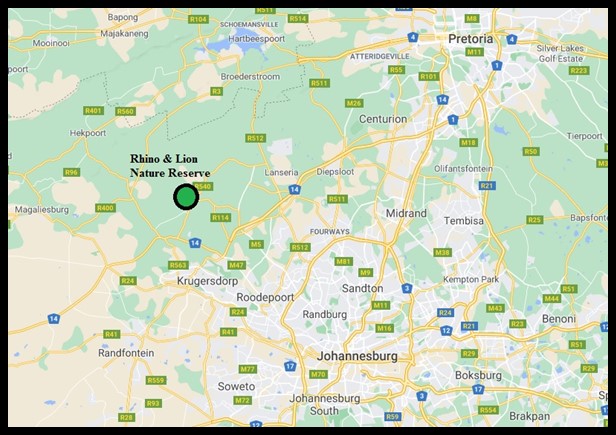
Location of the Rhino & Lion Nature Reserve (Google Maps)
-25.971587
27.791940








 DeWetsWild