Tag Archives: Satara Rest Camp

Family Breakfast

We encountered this ravenous family sitting down for a buffalo breakfast at Ximangwaneni Dam near Satara this morning!

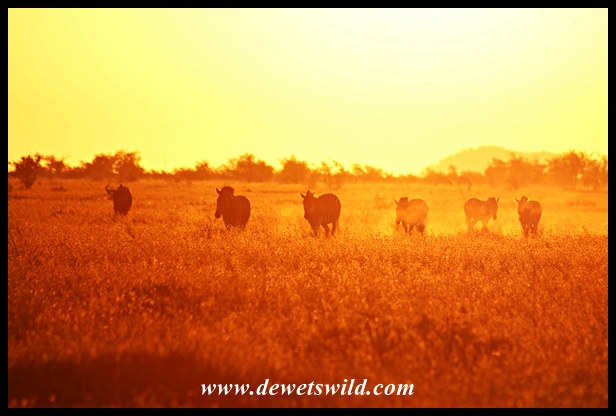
The magic of a Kruger sunset

Seems it’s not only humans that appreciate the beauty of a Kruger sunset!

27-June-2016

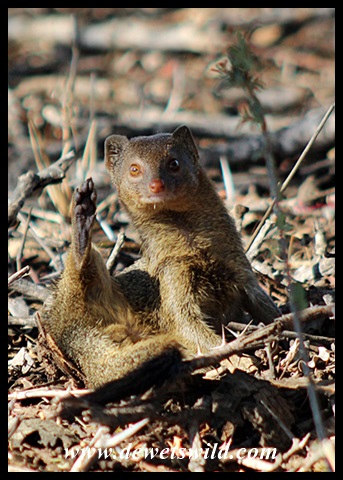
“High Five” the mongoose!

Saying “Hi” the mongoose way?

26-June-2016

Slender Mongoose seen near Satara today.

Hi from Kruger!

It’s the first day of the winter school holidays, and we find ourselves in the Kruger National Park again. Seems this lazy lion was as happy to see us back here as we were to see him!

25-June-2016

We’ll be spending the next few days at Satara, before moving on to Mopani, and hopefully we’ll have good enough signal to send a daily postcard from the bush.

Our 2014 in pictures

Looking back at the fantastic places we stayed at while exploring South Africa’s wild places in 2014…

Satara Rest Camp, Kruger National Park

Satara is unique among the Kruger National Park‘s camps. It is not situated on a serene river bank or atop a hill commanding views over the wilderness. Instead, it is located seemingly in the middle of a vast plain of flat grasslands and thornveld as far as the eye can see, inhabited by thousands of grazing animals and of course the predators that follow them. And that’s exactly the reason for Satara’s popularity; it probably has the highest density of large African predators in the entire Kruger.

Satara is a misspelling of the Hindi word “satrah”, meaning seventeen, and so named by a land surveyor and his Indian assistant measuring up this piece of the lowveld for farmland in the late 1800’s. Colonel James Stevenson-Hamilton appointed Tim Healy as the first ranger to the post at Satara in 1910, and he was followed by ranger W. Lloyd, who met an untimely death due to pneumonia and was buried by his wife and a servant in a coffin made from ceiling planks, just outside the present perimeter of the camp. By 1929, 3 years after the Kruger National Park was proclaimed, the first twelve huts at Satara were made available to overnight visitors, and by 1974, with the threat of malaria and soggy roads in the rainy season adequately under control, visitors could enjoy Satara all year round (instead of just during winter).

Today, Satara is the second biggest, and by far one of the most popular, rest camp in the Kruger National Park, offering a variety of accommodation and camping options to overnight guests, serviced by a restaurant, shop and filling station. Satara has a large amphitheatre where wildlife filmshows are presented in the evenings, and in the projector room is an interesting display about the camp and the Park’s wildlife. The camp also has a large swimming pool and play area for those hot summer days, and guests can join a variety of guided activities like walks and drives. Inside the camp a rich variety of smaller animals and birds are quite at home; Satara’s famous for its owls, badgers and wild cats.

Mention Satara, and anyone who has ever been there will likely immediately think about the S100; a gravel road leading to Nwanetsi Picnic Spot and the most popular drive in the Satara area. The S90, S100, S41 and H6 roads explore the game-rich area to the east of Satara and seldom disappoints. Nwanetsi has a cliff-top viewpoint overlooking a peaceful stretch of water, while the Sweni Hide nearby is probably the better option for serious photographers.

The most direct access to Satara is through Orpen Gate, about 50km to the west along the tarred H7-route. This road offers excellent opportunities for seeing the “Big 5“, especially near Nsemani Dam, or along the short detour to Girivana waterhole. In fact, we often end our time at Satara by spending our final afternoon at Girivana, enjoying the procession of animals and birds coming to slake their thirst in the golden light of the setting sun.

Two long but very rewarding gravel roads turn of the H7 about 20km from Satara: Turn north and you’ll be following the S39-road to the popular Timbavati picnic spot and Ratelpan Hide (and onwards to the Olifants River if you wish), or turn south and follow the S36-road towards the rustic, and much quieter, Muzandzeni and Nhlanguleni picnic spots. Over the years, we’ve had excellent sightings on both roads though the road towards Timbavati probably offers slightly more frequent encounters with Kruger’s big game. Along both routes there’s also turnoffs that will get you back to Satara quicker, if you find yourself pressed for time, and that also provide good game viewing opportunities.

The H1-3 road south to Tshokwane Picnic Spot, and the H1-4 northwards to the Olifants River, both passes several waterholes and often offers wonderful sightings of the big cats, especially in the early morning. It’s also worthwile taking a longer detour to the Lindanda Memorial, at the site where ranger Harry Wolhuter had his epic battle with a lion.

Satara’s an excellent choice for those hoping to see Africa’s big predators in abundance, but it has so much more to offer and enjoy. Spend a couple of hours at Girivana, soaking in the peace and quiet of a golden African sunset, and you’re sure to agree.


Winter in Kruger, Satara August 2014

After spending 5 wonderful nights in Skukuza, Marilize unfortunately had to get back to Pretoria. Joubert and I safely delivered her back to the big city and, after we had a couple of hours of rest, it was time to head back to the Kruger again, this time accompanied by my younger brother Niel. Our destination: Satara Rest Camp, in the central plains of the Park.

There’s a reason Satara’s such a popular destination in the Kruger National Park, and we experienced it again during our August visit to the area. It’s the cats!

We made our way to Satara after entering at Malelane Gate, stopping at Skukuza and Tshokwane en-route. Though we enjoyed sightings of a myriad of animals and birds, not to mention the gorgeous natural scenery, the mating pair of lions we found at Olifantsdrinkgat, the lion pride with their giraffe kill just north of Tshokwane, and the young giraffe with a curious black blotch on its neck, were highlights of the drive northwards.

After pitching our tent and setting up camp next to the fence, there could only be one route to take in the afternoon, and Satara’s famous S100 did not disappoint. Apart from abundant plains game like zebra, waterbuck and giraffe, we found a big herd of buffalo. To end the day on the perfect note, in the fading light of dusk, we had a far-off glimpse of a leopard being dive-bombed by a pair of martial eagles. The light and distance was against us taking good enough photographs, but the memory will remain for a long time and the sighting meant that we had seen every member of the “Big-5” on our first day at Satara. That night, we enjoyed a simple dinner while a hungry hyena lay mere meters away from us on the other side of the fence, hoping that we’d toss it a few scraps. We firmly believe that you should not feed wild animals, and so the hyena had to lope away disappointed when we turned in for the night.

Our route for the 10th of August took us along the S100 to Nwanedzi Picnic Spot and the Sweni Hide, then along the Trichardt Road and past the spot where ranger Wolhuter had his infamous encounter with a hungry lion to Tshokwane, on to Nhlangulene and Muzandzeni Picnic Spots on the S36, and then back to Satara with a quick detour to Girivana waterhole. As we left camp in the morning, Niel joked that he would do nothing but search every tree that day to spot a leopard. By 14:45 that afternoon, his wish was granted. Another “Big-5” day completed, “our” hyena brought a friend to supper, but again had to get up from the table with an empty tummy.


Monday dawned over the Kruger and we headed for the Timbavati Picnic Spot and Ratelpan Hide. We’ve heard and seen reports of a white vervet monkey frequenting the area and were holding thumbs that we’d be able to get a glimpse of it too. You’d understand then that we were overjoyed when Joubert saw the white monkey strolling casually down the middle of the road towards us!

Back in Satara during the heat of the day, we walked around taking photographs of the camp and its birdlife. We’ll save those for a dedicated post on Satara that we’re planning to publish in the next few weeks.

Beautiful impala lily flowers

Beautiful impala lily flowers

In the afternoon, we headed for the open plains to the east of Satara, opting to drive the S100 back to camp in the last light of the day. Our cheetah sighting on this drive will remain a lasting memory.

Come the 12th of August and it was time to pack up our campsite and head back home. We decided to leave the Park through Phalaborwa Gate, roughly 120km to the northwest of Satara, so that we could stretch our legs at Joubert’s favourite place to visit in the entire Kruger Park, Letaba’s Elephant Hall.

Of course, after a wonderful visit like this there was no way we could have had our fill of our beloved Kruger National Park, and so within a day of getting back to Pretoria we had to feed our addiction by making another reservation. We’ll be heading for the Shipandani Overnight Hide near Mopani, and heavenly Shingwedzi, later this month 😉 .


Just another day in the Kruger…

… as if there’s such a thing!

While touring the Lowveld in February, we concluded our trip with a stay at Swadini in the Blyde River Canyon Nature Reserve – more on the time we spent there in an upcoming edition of de Wets Wild. Having first explored the Pafuri area in the far north of the Kruger National Park and then spending time at Letaba in the Park’s central region, we wanted to make one more day visit to the Park, and Swadini being only 70km from the Orpen Gate made that an easy undertaking.

Our route took us from Orpen Gate down to Muzandzeni Picnic Site for breakfast, past Nhlanguleni Picnic Site to Tshokwane Picnic Site where we had lunch, and back to Orpen via Satara Rest Camp. Despite it being an overcast day with regular downpours, we still managed great sightings, as evidenced by this little gallery of images we took on the day (you can click on any of the pictures for a better view).

Our 2013 in pictures

As the year is rushing to its end, we’re looking back at all the wonderful places we stayed at in South Africa’s wild places during 2013:

Olifants Wilderness Trail, June 2013

Through our eyes

A small group of people are inspecting a dung-covered thorn-bush out in the African wilderness, the sun having just peeked over the eastern horizon, listening enchanted to their guide explaining the scene: “Long ago, the hippo lived on land with the elephant, the rhino and the buffalo. But Hippo complained bitterly to the Creator that his skin was far too sensitive for the African sun and pleaded to be allowed to live in the water. Crocodile wasn’t at all pleased with this arrangement though, fearing that the bulky hippo would eat all the fish in the river. Hippo then promised to spread his dung with his tail so that Crocodile could check that there was no fish bones in it. But the crocodile was still not convinced, as he’d have to go onto dry land to check Hippo’s dung, so Hippo put Crocodile’s mind at ease by saying that the rangers would check the dung on his behalf. And this is what we’re doing now, just checking that Hippo is keeping to his agreement with Crocodile”

My brother Niel and I arrived early morning on Saturday 15th of June for our annual brothers-trip to the Kruger National Park. We’d slowly make our way up to Satara Rest Camp that day, before joining the Olifants Wilderness Trail on Sunday afternoon at Letaba Rest Camp. Lots of time for relaxed game-viewing and photography along the way, and Kruger delivered the goods as always.

At 15:00 our Trail Guides Aaron and Louis meet up with Niel and I and the six other participants with whom we’ll be sharing our much-anticipated wilderness experience for the next three nights. It’s a two-and-a-half hour drive to the base camp, with frequent stops to appreciate the scenery and rich bird and animal life for which the Kruger Park is so renowned, and by the time we arrive darkness had already engulfed the small rustic camp.

The unspoiled African wilderness quickly makes friends of strangers, and there’s nothing to help the process along like a camp fire – or bush TV as Louis describes it because it’s so hypnotic. In the light of the dancing flames and with the grunting of hippos in the background, Aaron explains our schedule for the next three days and goes through some basic safety pointers for walking among dangerous wild animals. There’d be two days of walking, each starting with an early wake-up, coffee and rusks before dawn. At first light we’d drive a short distance into the wilderness before setting off on foot, spending four to five hours in the veld and enjoying a light picnic breakfast at a scenic spot, before returning to base for lunch and some quiet relaxation. The afternoon walks would be at a slower pace, taking in the setting sun from a beautiful vantage point, where after we’d return to camp for dinner before relaxing around the camp fire again. We’re also introduced to Shadrack, the shy camp caretaker and the cook responsible for the hearty traditional South African meals we’d enjoy for the next couple of days.

When walking in the bush, the focus shifts from the big hairy scary creatures to the smaller features that would normally go unnoticed while driving through the Park, although there’s always a good chance of encountering big game along the way. Easy to understand therefore why your heart would start racing when a scrub hare unexpectedly jumps up next to your feet while walking through the tall “adrenalin grass” next to the Hlahleni stream!

The Olifants Wilderness Trail has been running since 1979, and the little base camp is as rustic today as it was then. Four A-frame huts, each with two beds, provide accommodation to the trailists, who enjoy their meals and each other’s company at the communal boma and fireplace which has a commanding view over the Olifants River and the Lebombo Mountains. At the back of the camp are the pole-enclosed toilets and hot-water showers. There’s no electricity (or cellphone reception) at the camp, so in the evenings and early mornings paraffin lamps add to the camp’s peaceful atmosphere. This is wilderness at its uncluttered best, and a rich variety of birds and animals visit the camp and surrounds throughout the day.

Sitting atop a large boulder next to a deep river pool, watching the sun set over the Olifants while hippos are snorting and splashing just metres away, was the absolute highlight of our Olifants Wilderness Trail experience; an abiding memory that will remain with us forever.

All too soon the time came to return to civilisation. The mood on the vehicle was a lot more sombre on the way back to Letaba, and it was with heavy hearts that we said goodbye to Aaron, Louis and our fellow trailists.

Kudu calf

Kudu calf

Bateleur

Bateleur

Giraffe bull

Giraffe bull

For Niel and I it was time to head back to the city, but Kruger had one more surprise in store for us on the way to Phalaborwa Gate. Masthulele, currently the biggest of Kruger’s Tuskers, accompanied by two younger bulls, was enjoying a drink from a pool in one of the dry river courses. How nice it was to bump into this familiar old friend!

Masthulele

Masthulele

Crocodile at Sable Dam

Crocodile at Sable Dam