Tag Archives: picnic spots

Breathing in our Natural Heritage at Marakele

In South Africa, we celebrate the 24th of September as “Heritage Day”, and of course to us de Wets our country’s natural heritage is our biggest pride. What better way then to spend the Heritage Day long weekend than at a place as beautiful as Marakele National Park, accompanied by a group of wonderful friends?

Marakele’s varied landscapes makes for such a diverse experience – from the top of the Waterberg massif to the plains of Kwaggasvlakte below. A few fires passed through the area some days before our visit (a quite natural occurrence in African savannas, to which animal and plant life alike are perfectly adapted) and as soon as the first rains of spring fall Marakele should be transformed into a green paradise again.

There’s no doubt in our mind that Marakele’s populations of the popular “Big Five” animals must be growing at a good rate. We’ve never seen so many elephants on any of our previous visits to this Park, and this latest visit also delivered us our first encounters with both Marakele’s buffaloes and lions. It is now only the Park’s leopards that still elude us.

By now our regular readers will know that we love walking around after dark looking for nocturnal creatures, and in this respect the Thutong Environmental Education Centre where we stayed delivered a range of arachnid species!

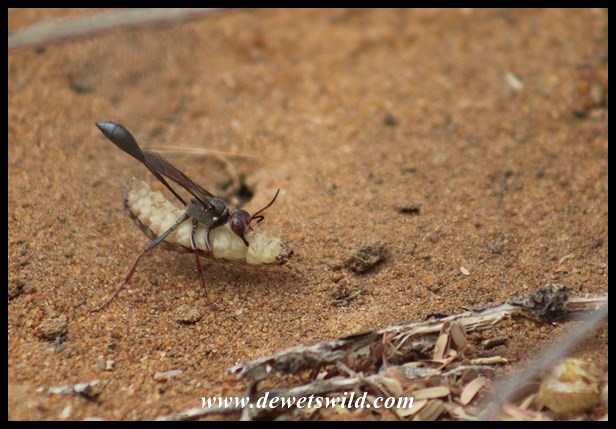
We’ve already shared with you a series of photos of a wasp dragging a paralysed caterpillar to a nesting tunnel for its young to feed on – have a look here for the complete set.

Wasp and prey

Marakele means “a place of sanctuary”, and it is as true for human visitors as it is for the immense collection of wildlife that calls this gem of a place home!

A big group of people needs a big place to stay. Marakele’s Thutong Environmental Education Centre is a dormitory-style facility built purposely to accommodate visiting school groups, however it is available for private groups when not being used by school children. Provided is six double rooms with en-suite bathrooms for the teachers, with a maximum of 128 children that can be accommodated in 16 seperate rooms with 8 bunk beds in each. Thutong also has a decently equipped kitchen to cook for that many mouths, and a large hall and fireplace. It is securely fenced – the necessity for which we clearly understood when we found lion tracks right outside the gate one morning!

Want to learn more about Marakele National Park? Why not scroll through all our posts about this special place, here.

Back from Marakele

If you thought we were a little quiet the last few days, you’d be right. We spent the Heritage Day long weekend enjoying our natural heritage and the company of good friends at Marakele National Park. Here’s just a little sample of some of what we experienced, with a promise of more to come later in the week.

Nylsvley Nature Reserve

Almost 180 years ago, the Voortrekkers on their Great Trek northwards (away from the British colony in the Cape), reached what they thought was the source of the River Nile in what is today South Africa’s Limpopo Province. Of course they were still thousands of miles away from the real Nile, but the name stuck.

Our Nyl River is a minor tributary of the Limpopo, but forms one of South Africa’s largest and most pristine wetland areas – an area 70km long and 7km wide at its widest point. In years of exceptional rainfall (normally about once in ten years) the total inundated area covers as much as 160km². In 1974 the provincial government established the Nylsvley Nature Reserve (39km² in size) to protect a portion of this delicate ecosystem, which was recognised as a wetland of international importance under the Ramsar convention in 1998.

Joubert and I decided to pay the reserve a quick one night visit this past weekend.

Nylsvley’s motto reads “Nylsvley is for the birds” and considering that this relatively small reserve has an impressive list of over 380 recorded bird species, it is certainly most fitting. Nylsvley is an important breeding habitat for over 100 kinds of waterbirds (more than any other wetland in the country), many of which is considered rare or range restricted in South Africa. While the rainy season hasn’t yet started and most summer migrants are yet to arrive, we still managed to identify 79 species of birds in the little over 24 hours we spent at Nylsvley. We’d dearly want to return in late summer, once the wetland has been flooded, in anticipation of the spectacle of a reported 80,000 waterbirds congregating at Nylsvley.

And while pride of place at Nylsvley really does go to the birdlife, the reserve is also home to thousands of invertebrate species (including 55 kinds of dragonflies and 194 kinds of butterflies), 13 kinds of fish, 23 kinds of amphibians, 58 reptile species (including many venomous snakes, so wear sensible shoes when hiking!) and 77 species of mammals (among which sizable populations of rare roan antelope and tsessebe). Vegetation comprises broad-leaved woodlands, thornveld, grassland and of course the floodplains, and over 600 species of plant have been recorded in the reserve.

Nylsvley Nature Reserve falls under the jurisdiction of the Limpopo Department of Economic Development, Environment and Tourism, with the NGO Friends of Nylsvley playing an active role in the protection of the reserve and extended floodplain. Visitors to the reserve can overnight in the rustic camping area (6 shady sites), a dormitory with space for 36 people, or in one of the 5 chalets (4×2 bed, 1×6 bed). Other facilities in the reserve include a picnic area for day visitors, a restaurant, three bird-viewing hides, a limited road network (which can be carefully negotiated in a sedan), and an extensive network of hiking trails. The services of expert guides can be arranged through the reserve’s reception office. Most other services and shops are available in the nearby towns of Modimolle (formerly Nylstroom) and Mookgopong (Naboomspruit).

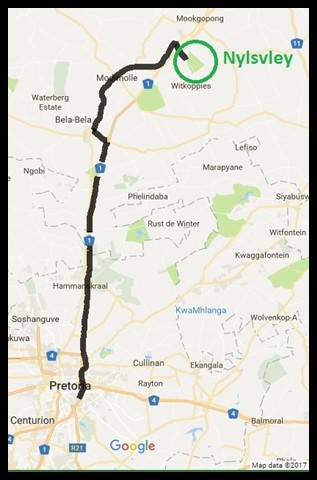
Nylsvley is an easy 170km away from us in Pretoria, along the N1 and R101 highways to the north.

Pretoria to Nylsvley along the N1 and R101

Father & Son Time at Nylsvley

This past weekend Joubert and I took a short camping breakaway to a new destination for us; the Nylsvley Nature Reserve in Limpopo Province.

Father and son time at Nylsvley

Of course we’ll tell you more about our trip, and the reserve, in an upcoming edition of de Wets Wild!

The night before we ventured into the Wilderness…

Earlier this month I was joined by my mother, sister and brother in the Kruger National Park, chiefly to participate in the Napi Wilderness Trail, one of several guided multi-day walking trails available in the Park.

However, with the trail only starting on Sunday afternoon, we weren’t going to let the weekend go to waste and got underway from Gauteng to Kruger in the wee hours of Saturday morning. Arriving at Kruger’s Malelane Gate around 07:30 allowed us time to enjoy a quick picnic breakfast and coffee before following a meandering route along the quieter gravel roads as we made our slow way to Lower Sabie, making frequent stops to appreciate the wildlife and scenery for which the Kruger Park is world renowned.

Our accommodation for the night was a basic but comfortable 4-bed hut located close to a communal kitchen and bathroom at Lower Sabie‘s eastern fenceline. These huts are surrounded by enormous trees and indigenous shrubbery frequented by a myriad of birds and small reptiles that are quite used to having humans poking lenses in their faces…

Our game drive for the afternoon took us first to Sunset Dam just outside the camp’s gates, then a quick detour across the causeway over the Sabie River, and then along the S28, S137 and H4-2 roads to the south of Lower Sabie, returning to camp just before the gates closed.

Walking around camp in the dark after dinner, looking for nocturnal wildlife with a flashlight, is a firmly entrenched tradition for the de Wets. Both inside and outside Lower Sabie, there’s always plenty to see, and we’re almost unwilling to go to bed for fear of missing out on something interesting!

Being one of the first vehicles to leave Lower Sabie when the gates opened at 06:00 on Sunday morning, we opted to take the main road to Skukuza before this hugely popular route gets too busy with traffic. A quick detour along the short Nwatimhiri causeway-loop rewarded us handsomly with a sighting of three young lions trying to hide, with limited success, in the thick riverine vegetation. Along the way we also popped into Nkuhlu Picnic Spot, Skukuza’s airport, the Skukuza Golf Club and Lake Panic birdhide, before heading for historic Pretoriuskop, all the time enjoying some more of the Kruger Park’s sights, sounds and smells.

After arriving at Pretoriuskop there’s more than enough time to pop into reception to complete all the necessary formalities for the Napi Trail and then take a gentle stroll through the camp appreciating the astounding variety of birdlife that occurs there.

Right on time (at 15:00) we were met at the designated spot by our two guides and group of four fellow trailists for the main event; the Napi Wilderness Trail (more about that wonderful experience in our next post, so stay tuned!).


Photo Safari through Hluhluwe-Imfolozi Park (Part 1)

Moving along to the latter half of our winter holidays in the bush brings us to another of Africa’s oldest conservation areas (and another of our favourite wild places) – the Hluhluwe-Imfolozi Park.

This conservation area covers an enormous 960km² of beautifully unspoilt wilderness, and incorporates the Hluhluwe and Umfolozi Game Reserves that were officially proclaimed in 1895.

We spent four nights in the Park – 3 in cottage #17 at wonderfully wild Mpila and the last in chalet #42 at the Park’s flagship tourist facility; Hilltop.

Of course no visit to a Game Reserve would be complete without plentiful encounters with wild creatures, so let’s get started with a few small critters we came across (more to follow in the next two days).

Being one of our favourite destinations, we’ve featured Hluhluwe-Imfolozi Park many times on our blog – have a look through all our posts about this special wilderness if you’d like to learn more about it.

iSimangaliso’s Eastern Shores – A Photographic Journey (Part 4)

Time to wrap up the photographic trip report of our recent visit to the Eastern Shores of Lakes St. Lucia, with a gallery of some of the larger animals we encountered on land and sea in the place of miracles and wonders – the iSimangaliso Wetland Park.

Follow the links for more of our posts about St. Lucia town, Cape Vidal and Mission Rocks.


iSimangaliso’s Eastern Shores – A Photographic Journey (Part 3)

On the Eastern Shores of Lake St. Lucia, the amazing diversity of life forms comes in all sizes. The star of this collection of photos showcasing some of the smaller creatures that crossed our path on our recent visit must be the tiny frog that somehow got into my mug while we were enjoying coffee and rusks one morning at Mziki viewpoint near Mission Rocks. Exactly when it got into my coffee is unclear – I had put my mug down a few times to take pictures – and I have no idea how much of my coffee I had shared with the little guy. Joubert only noticed it sitting in the cup when I took my last swig as we started packing up to leave. Lucky for it, I drink a lot of milk in my coffee so it wouldn’t have been scalded.

Follow the links for more of our posts about St. Lucia town, Cape Vidal and Mission Rocks.

iSimangaliso’s Eastern Shores – A Photographic Journey (Part 2)

The iSimangaliso Wetland Park is a bird-watcher’s paradise – 526 bird species have been recorded within its borders!

During the few days we recently spent on the Eastern Shores of Lake St. Lucia, we managed to tick 109 kinds of birds, and had we been better at identifying the “Little Brown Jobs” our list would undoubtedly have been quite a bit longer still.

This incredible diversity is surely due to the Park’s rich variety of habitats, and our “success” in connecting with so many kinds of birds can only be ascribed to the terrific collection of roads, hides, picnic sites and other localities so easily accessible to visitors.

We hope you enjoy this sample of iSimangaliso’s birdlife!

Follow the links for more of our posts about St. Lucia town, Cape Vidal and Mission Rocks.

iSimangaliso’s Eastern Shores – A Photographic Journey (Part 1)

We’re fresh back from a terrific holiday in two very special wild places in northern Kwazulu-Natal. Our first destination was the iSimangaliso Wetland Park, and specifically the Eastern Shores of Lake St. Lucia, where we spent one night at Manzini Chalets in the holiday town of St. Lucia, and four nights in a log cabin at Cape Vidal.

I can’t think of a better way to start off the report back on our trip than with a few landscape photos that illustrates why iSimangaliso is a land of “miracles and wonders”, and one of our favourite destinations!

Follow the links for more of our posts about St. Lucia town, Cape Vidal and Mission Rocks.