Tag Archives: nature

A new treasure unveiled in Kruger; the Pafuri Border Camp

An omnipresent sense of history permeates the grounds and buildings of Pafuri Border Camp, with the call of a wild frontier on your doorstep clarion clear and impossible to refuse.

Here at Pafuri in the Far North of the Kruger National Park, Harold and Tiny Mockford built their lives, raised a family, grew old. From 1938 to 1985, Mockford was the recruiting agent and administrative officer at the labour recruitment station established at Pafuri by the Witwatersrand Native Labour Association (WNLA, colloquially simply “Wenela”, later TEBA – The Employment Bureau of Africa) to provide migrant workers for the mushrooming gold mines at Johannesburg.

Comprising the beautifully restored and period-furnished residences inhabited by the Mockfords and other WNLA / TEBA staff, the Pafuri Border Camp will offer overnight accommodation in three very spacious self-catering units: the one-bedroom (4-sleeper) Mockford Cottage, the three-bedroom (6-sleeper) Doctor’s House, and the four-bedroom (8-sleeper) Mockford House. Relaxing on the wide verandas that wrap around the houses, enclosed by mosquito gauze just as they were when their original inhabitants lived there, it is hard not to imagine what daily life entailed for those who lived and worked here all those years ago. The camp’s deep swimming pool will be a delight on hot summer days, as it was no doubt for the family Mockford. A small room next to the tiny reception office will be dedicated as a museum in which Pafuri’s fascinating history can be regaled. More “modern” amenities, such as a fuel station, shop and restaurant, is available at Punda Maria Rest Camp, approximately 65km to the South-West.

One of the biggest highlights of the new Pafuri Border Camp is its proximity to Crooks Corner, the Luvuvhu River and Pafuri Picnic Site. Being first to arrive at the river viewpoints in the morning and the last to have to leave those serenely beautiful scenes in the evening is a privilege not to be underestimated. Crooks Corner, so named because the borders of South Africa, Zimbabwe (then Southern Rhodesia) and Mozambique (then Portuguese East Africa) meet here and allowed scoundrels of all description to escape the long arm of the law, has a very special allure in the golden light of sunrise and dusk. Spending time along the Luvuvhu as the riverine forest slowly awakes in the morning delivers a serenity to the human spirit that must be experienced to be truly appreciated.

You can bet that the birdwatching fraternity will be ecstatic at the news of Pafuri Border Camp’s opening. Pafuri is South Africa’s bird-watching mecca; the diversity of its feathered inhabitants simply astounding.

Mammalian wildlife abounds in the Luvuvhu’s riverine bush, with nyala, impala, warthog, baboon and vervet monkey occurring in exceptional numbers. Several other species, including elephant, buffalo, hippo, waterbuck, kudu, blue wildebeest, zebra, and seldomly-seen predators, add to the show. An astonishing number of Nile crocodiles, some in excess of 5 meters in length and probably weighing more than a ton, rule the murky waters of the Luvuvhu.

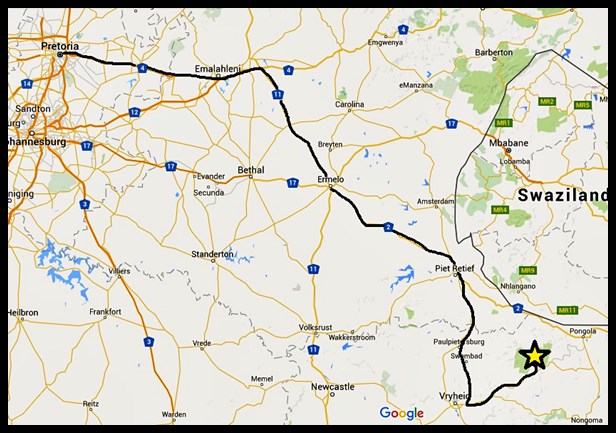
Come 1 November 2015, this new destination, hard not to describe in superlatives and quite literally a stone’s throw away from the border post into Mozambique, will open to its first official guests. We recently had the immense pleasure and privilege to spend two nights at Pafuri Border Camp while the finishing touches were being made to the accommodation. It is sure to prove very popular with nature lovers and history buffs from all over the world. Bookings for Pafuri Border Camp is through South African National Parks. Via the N1 highway and Kruger’s most northern entrance, Pafuri Gate, the camp is located approximately 620km from Pretoria.

(Google maps)

(Google maps)

Marievale’s for the birds (and birdwatchers)!

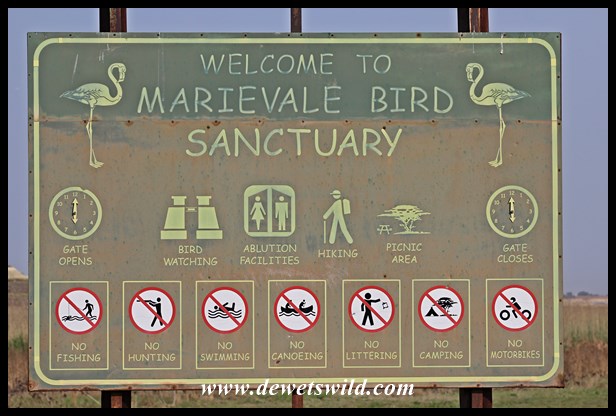
This past Sunday, my brother introduced Joubert and me to the Marievale Bird Sanctuary, a popular destination for birdwatchers and photographers in Gauteng’s Far East Rand.

Marievale 11Oct2015 (16)

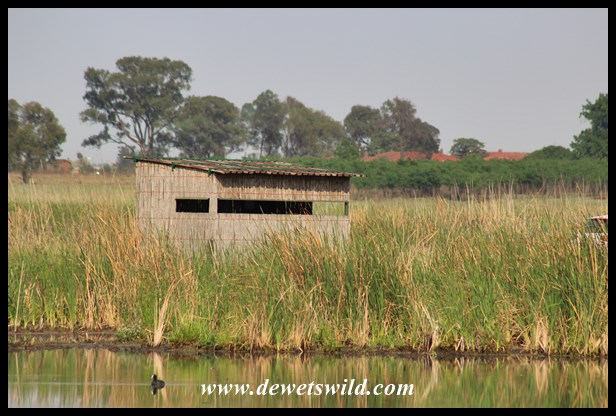
Marievale protects 1012 hectares of the much larger Blesbokspruit RAMSAR wetland, surrounded by mine dumps and other development. Facilities include two 4-bed chalets overlooking the wetland for overnight visitors, a conference centre, picnic sites, walking trails and several photographic hides. The roads in the reserve are rough gravel, for the most part easily traversed in a normal sedan.

Marievale 11Oct2015 (13)

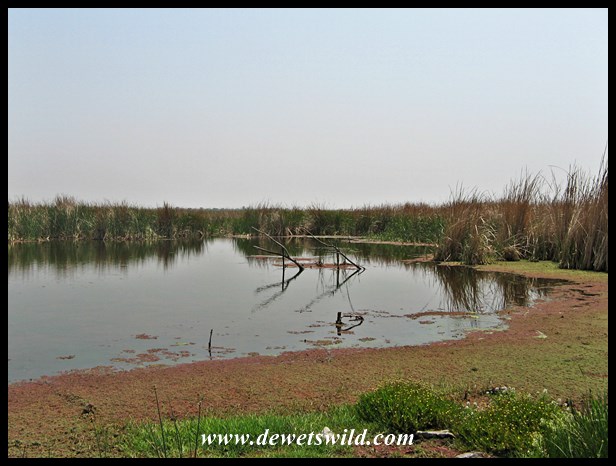
The reserve’s vegetation comprises extensive stands of reedbeds (about 70% of its surface area) and flooded grasslands, interspersed with areas of open water and, during drier periods, mud flats frequented by impressive concentrations of wading birds. The area can hardly be described as pristine however, as the wetland itself owes its existence to the altered flow of the river caused by mining, railways and roadworks, inundating what would otherwise have been grasslands. Pollution from the mines and industries surrounding it, and upstream, is now threatening Marievale’s man-made wetlands.

Marievale 11Oct2015 (35)

Nevertheless, the list of bird species recorded at Marievale has around 280 entries; during the extremely enjoyable six hours we spent in the reserve on Sunday we managed to tick 70 of those. Many of the birds are quite accustomed to the steady flow of human visitors and offer excellent photographic opportunities from the hides or while walking and driving around.

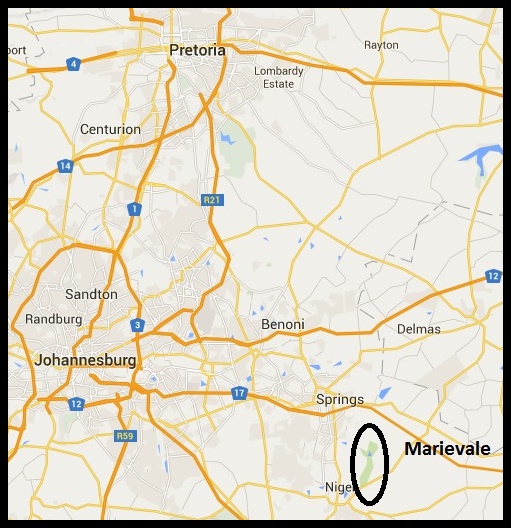
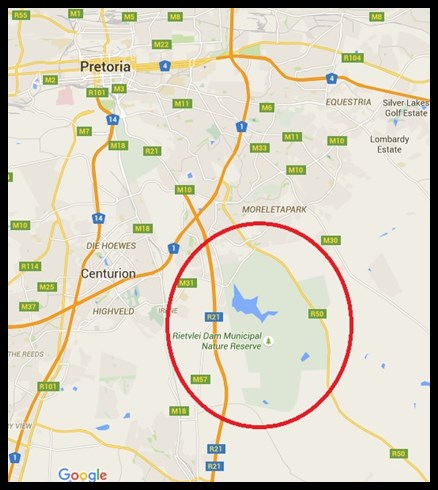
Marievale Bird Sanctuary is controlled by the Gauteng Province’s Department of Agriculture and Rural Development and is easily accessed from the R42 to Delmas, just 4km outside the town of Nigel (map drawn with Google Maps).

Marievale location


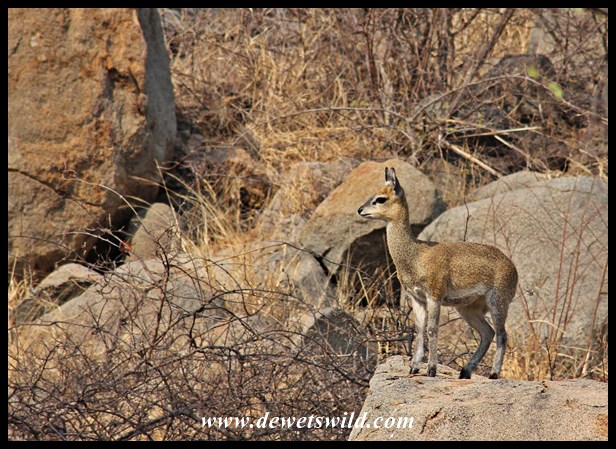
Klipspringer

Oreotragus oreotragus

The Klipspringer is another of South Africa’s smaller, and cuter, antelope, between 49 and 65cm high at the shoulder and weighing between 9 and 19kg. Adult ewes are slightly heavier than the horn-carrying rams.

Uniquely among antelope, the Klipspringer walks on the tips of its hooves, allowing it to balance like a ballerina on exceptionally small areas. This is a handy adaptation to the rugged and rocky mountains, hills and outcrops they inhabit. Their very apt Afrikaans name literally means “Rockjumper”. More than 90% of their diet consists of browse; leaves, twigs, flowers, fruit and seeds, preferring young growth. They are independent of drinking water.

Klipspringer pairs mark and defend small territories, in which they stay together for long periods, often for life. Small groups normally comprise the territorial pair accompanied by one or more of their lambs. Klipspringers are well camouflaged, and usually only observed when they stand sentinel on a conspicuous vantage point. They move around their rocky abodes with amazing agility, and are most active in the early mornings and late afternoons. Single lambs are born at any time of the year and have a life expectancy of between 7 and 15 years.

The IUCN considers the Klipspringer’s conservation status as “least concern”, with a stable population of at least 42,000 on the African continent. Good places to search for Klipspringer in South Africa is the Karoo, Kruger, Mapungubwe, Marakele and Pilanesberg National Parks. Some authorities believe that three different species of Klipspringer occur in South Africa; the Angolan or Tyler’s Klipspringer (O. tyleri) in the extreme north-west corner of the Northern Cape Province, the Cape Klipspringer (O. oreotragus) in the south-west of the country and the Transvaal Klipspringer (O. transvaalensis) in the north-east, though these may well only be different subspecies based on slight variances in colouration, horn length and body size.


Happy Place

A selection of photos from Shingwedzi Rest Camp, in the Kruger National Park. As near as you can get to heaven on earth.

Happy Place” is the theme for this week’s WordPress Photo Challenge

The joys of spring at Ithala

We’ve been singing Ithala Game Reserve‘s praises on this blog for a long time and our recent Heritage Day long weekend visit to this South African treasure further cemented our belief that Ithala is one of our country’s prime conservation areas.

Colourful spring flower displays were in evidence all over the reserve, despite not receiving much rainfall yet. With over 900 plant species at Ithala, including some extreme rarities like the pepper-bark tree and Lebombo cycad, Ithala is a botanist’s delight. Unfortunately we don’t know the names of most, but that doesn’t mean we didn’t enjoy the show just the same!

The giraffe is Ithala’s emblem, and we were lucky to enjoy several encounters with these curious animals.

Most large game species were eradicated from the area before the reserve was proclaimed in 1972, and Ithala therefore had to be restocked. Today it is home to all the species that occurred here historically, with the exception of lion, and all-in-all provides sanctuary to 83 mammal species.

Ithala’s a bird-watcher’s paradise, with a list of 318 species recorded in the reserve. While we didn’t tick quite that many species during our visit – most of the summer migrants have not yet arrived – we were very thrilled with our close-up sighting of a pair of blue cranes shortly after arriving. Being South Africa’s national bird, it seemed a particularly special treat for Heritage Day!

Ithala’s not only about the big and obvious birds and animals, and closer inspection will reveal a multitude of insects, arachnids, amphibians and reptiles. We even encountered three of the reserve’s 41 snake species while walking around Ntshondwe Camp; they pose no danger as long as you don’t threaten them and true to form all three moved away very quickly and quietly.

Talking about Ntshondwe, we just have to mention again how beautifully the accommodation units are placed into the natural vegetation, offering privacy and a really intimate nature experience.

INtshondwe Unit 15, Ithala Game Reserve, September 2015

Ntshondwe Unit 15, Ithala Game Reserve, September 2015

Its faunal and floral diversity aside, Ithala is richly blessed with amazingly diverse scenery. The reserve extends over 30,000 hectares, its area ranging in altitude between the 1,450m peak of Ngotshe Mountain to 400m above sea level along the Pongola River. The reserve’s vegetation ranges from grasslands to woodlands to dense riverine forest.

We’re already making plans for our next visit to Ithala in early 2016, and you can probably see why!

Ithala Game Reserve is managed by Ezemvelo KZN Wildlife, and lies a 500km drive to the South-East of Pretoria.

Pretoria to Ithala (drawn with Google Maps)

Pretoria to Ithala
(drawn with Google Maps)


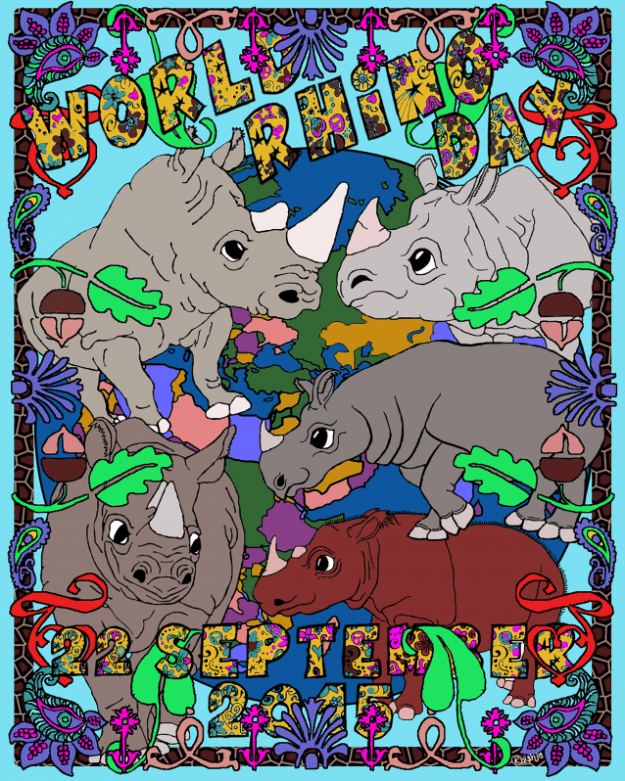
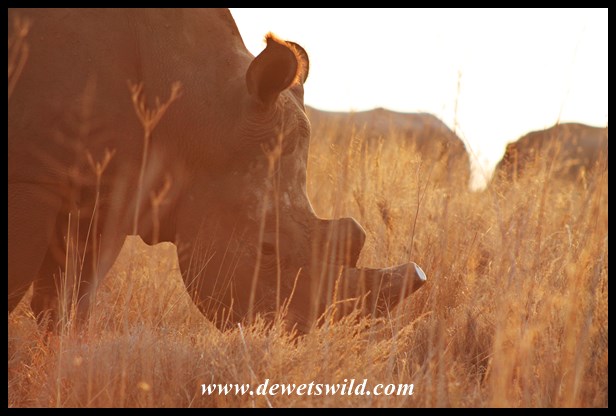
World Rhino Day 2015

How long do we have left to appreciate our rhinos in their natural environment?

Will Joubert be able to take his children to a South African game reserve and show them what a real, live rhino looks like?

Would the citizens of the countries driving the slaughter of our rhinos to satisfy their fallacious beliefs even care about what they stole from Africa’s children?

World Rhino Day is upon us again, and as every year before for almost the last decade the future for these spectacular creatures seem even more bleak.

Figures published by South Africa’s Department of Environmental Affairs at the end of August 2015 indicated a minimum of 749 rhinos lost to poaching in South Africa for the year to date, 544 of which in the flagship Kruger National Park. A recent poaching incident in Hluhluwe-Imfolozi Park pushed the total lost in Kwazulu-Natal Province this year to 75. This follows on the loss of a staggering 3,900+ rhinos in this country alone to the end of 2014, since the poaching scourge started escalating in 2007 .

Still, there are many individuals and organisations investing enormous effort and resources into ensuring these charismatic animals are protected for future generations, and they deserve our respect and support. According to DEA at the time of their release, 138 poachers have been arrested in the Kruger Park this year, many of them heavily armed and only apprehended after exchanging fire with rangers and military personnel. The costly process of translocating rhinos out of high-danger zones to areas where they are thought to be more secure, is continuing. South African National Parks invested large sums donated by the Howard G Buffet Foundation, Peace Parks Foundation, and private donors into the purchasing of helicoptersall-terrain vehicles and other equipment to ensure that the Kruger Park’s rangers have the resources they need to face this onslaught on the wildlife in a Park bigger than many sovereign countries. Involving the communities living around reserves where rhino occur is pivotal to success, exemplified by SANParks’ liaison with Christian churches and iSimangaliso Wetland Park and their partners’ “Rhino Walk” taking place between 7 September and 2 October, during which they’ll visit 75 schools with thousands of learners. Fighting rhino poaching requires a multi-faceted approach, which is why iSimangaliso have also recently de-horned the entire rhino population on the Western Shores of Lake Saint Lucia, and publicised this widely.

Had it not been for these, and many more, dedicated people, and their tireless efforts, the situation undoubtedly would have been far worse still.

The war has not yet been lost.

WRD2015PosterLoRes-638x798

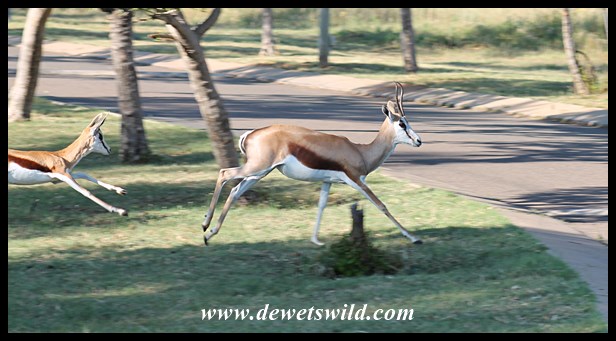
Springbok

Antidorcas marsupialis

The Springbok is the only gazelle occurring in South Africa. They are medium-sized antelope, with a shoulder height of 70 – 85cm and a weight of 26 – 50kg, rams being more strongly built with thicker, longer horns than the ewes.

The Springbok prefers open country, occurring from deserts and semi-deserts to dry shrubby plains and grasslands. They are mixed feeders, including a wide variety of grass and browse in their diet. They will drink regularly if surface water is available, but can live for indefinite periods without drinking.

Springbok are herding animals, sometimes congregating in their thousands. In the 1800’s, explorers and settlers recorded springbok treks numbering millions of animals, often taking days to pass through a particular area. Most groups however are much smaller, consisting of about 30 individuals. During the rutting season, adult rams establish small territories in the best grazing areas to which the breeding herds are most attracted. They are most active during early morning and late afternoon, resting during the heat of the day, often out in the open.

The Springbok is well known for their agility and stiff-legged jumping displays, known as “pronking”. They can jump as high as 3.5m, and can reach speeds in excess of 80km/h. It is thought that their “pronking” is an energy-efficient way of displaying to predators that it would not be worth their effort to attempt chasing the springbok. Despite being so fleet of foot, springbok, especially solitary rams, are a staple in the diet of cheetahs and other large predators, and lambs are easy prey for anything the size of an eagle, jackal or one of the small cat species and upwards. Their life expectancy in the wild is estimated at only 10 to 12 years.

Single lambs are born at anytime of the year, though most births coincide with the rainy season. The lambs remain hidden for the first couple of days of their lives, before joining their maternal herds and associating with other lambs in “nurseries” in the herd. Lambs start grazing by two weeks of age and by a month old they can run as fast as the adults. Lambs are weaned by 4 months of age and ewes can start reproducing at 6 months old. In years of good rainfall, adult ewes can lamb every 8 to 14 months. This exceptional fecundity ensures that springbok numbers can rebound quickly when better times return after droughts or disease epidemics.

The Springbok is one of the most common and widespread antelope in South Africa. Their numbers were severely depleted by hunting in the 1800’s and the migrations of herds, millions strong, must have been a sight to behold. They have however been widely reintroduced to their former range, being popular game farm animals, and have also been introduced to areas which they didn’t naturally occupy. Today, the IUCN considers the springbok’s future to be secure, and estimates the population in South Africa at a minimum of 1,25-million animals, with a similar number occurring in Namibia, Botswana and Angola.

The Springbok is South Africa’s national animal, and mascot of the country’s national rugby team (participating in the Rugby World Cup that starts today).

Springbok (16)

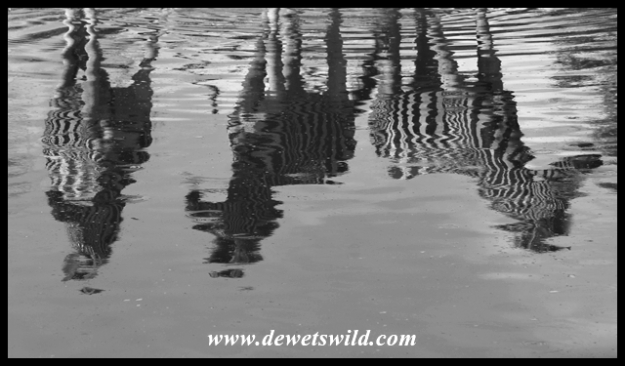
Monochromatic

Zebras reflecting in the water of the Kumasinga Pan, on a hot December day at uMkhuze Game Reserve.

Monochromatic


Monochromatic” is the theme for this week’s WordPress Photo Challenge.

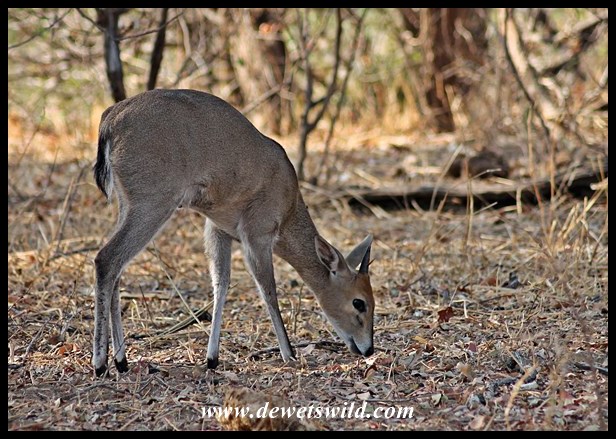
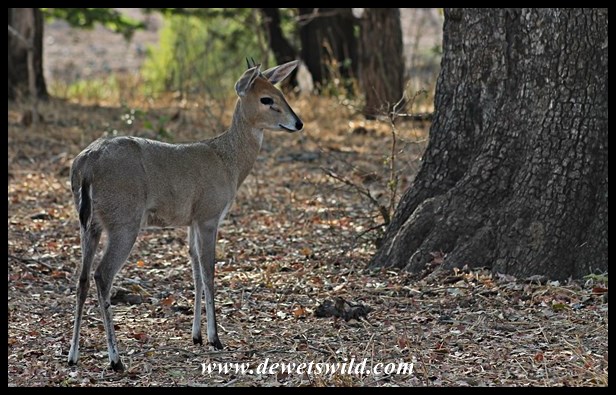
Common Duiker

Sylvicapra grimmia

The Common, or Grey, Duiker is the largest and most widespread of the three duiker species occurring in South Africa. These small antelope stand between 45cm and 70cm high at the shoulder, and only the rams carry short horns, though on average the ewes, at between 16 and 25kg in weight, are about 2kg heavier.

Common duikers occur in all of South Africa’s natural habitats, and can even hold their own in intensively farmed area, and in and near towns and city suburbs. They are independent of water, and drink seldomly even where surface water is readily available. These duikers are mixed feeders, subsisting on leaves predominantly but also taking grass, bark, seeds, fruits, flowers, twigs, pods, fungus, roots and tubers. Unusually for antelope, they have been seen eating insects, small vertebrates like chicks and geckos, and carrion.

Grey duikers are mostly solitary, occurring in pairs when mating or when a ewe is accompanied by her lamb. Both sexes are territorial and mark their areas with dung-middens and secretions from facial scent glands, ram’s territories usually being larger and overlapping those of one or more ewes. These antelope are mostly nocturnal, active from dusk to dawn and sometimes all day under overcast conditions. By day, they seek cover in long grass or dense thickets. When threatened, they will first attempt to hide before fleeing with sidestepping moves along well defined pathways – thus giving rise to their name (“duiker” being Afrikaans for “diver”).

Single lambs, weighing less than 2kg, are born at any time of year (mostly in the rainy season) after a gestation of 190 days. Newborn lambs are hidden in dense vegetation. All Africa’s larger predators, from lions to owls, eagles and even baboons, will prey on common duikers, explaining why their life expectancy in the wild is only 8 to 12 years. Shine, a well-known and much loved resident at Kruger National Park’s Shimuwini Bushveld Camp lived to the ripe old age of 22 before falling prey to a leopard.

The common duiker is one of Africa’s most numerous antelope, and it is estimated that as many as 10-million occur across the continent. Some populations however are under considerable pressure from subsistence and commercial hunting. They are regularly seen in most of South Africa’s wild places and are a frequent nighttime sighting along country roads.

Grey Duiker (12)


South African Vultures

“Probably there is no other bird whose appearance on the wing and on the ground offers more vivid contrast. Sailing majestically far up in the blue, without perceptible movement of its great pinions, it seems to cleave the air free of all conscious effort, and conveys to the earth dweller far below, the ideal of poetic motion. When seen on mother earth, it is hard to realise that this ungainly, clumsily hopping, and repellent-looking bird is the same that so delighted our senses when on the wing, nor is the picture in any sense restored as, distributed at its feast, it flaps heavily away to some adjacent tree.” – James Stevenson-Hamilton, Wildlife in South Africa, 1947.

If ever there’s a bird suffering from bad press, it must be the vulture. Their unflattering appearance perfectly suits their vital ecological function. If they look like undertakers, it is because they are: clearing away the dead and the rotting, minimising disease and recycling nutrients through the system. Vultures spend most of their time gliding effortlessly on the thermals, using their incredible eyesight to find carrion on the ground far below, each species supremely adapted to consuming particular portions of the carcass.

Nine species of vulture has been recorded in South Africa.

Hooded Vulture (Necrosyrtes monachus)

With a weight of around 2kg and wingspan of 1.6m, the Hooded Vulture is one of the smaller vulture species occurring in South Africa. They prefer savannah and woodland, and often scavenge around refuse dumps and abattoirs. Their thin bills allow Hooded Vultures access to scraps of meat other vultures can’t reach. Locally, these birds breed in the dry season raising a single chick in a treetop nest after an incubation period of around 50 days. Chicks fledge between 80 and 130 days after hatching and are then cared for by their parents for another 3-4 months.

Hooded vultures are quite common in Africa north of our borders, but in South Africa they are rare and occur only in the Lowveld of Mpumalanga and Limpopo Provinces, where they can be seen in the Kruger National Park. Despite estimating their African population at just below 200,000, the IUCN classifies them as endangered due to a declining population.

EDIT: In 2017 the IUCN reclassified the Hooded Vulture as “Critically Endangered” due to a rapid decline in their population.

White-headed Vulture (Trigonoceps occipitalis)

White-headed Vultures are medium-sized vultures, with a wingspan of up to 2.3m and up to 4.7kg in weight. They occur in savannah and dry woodlands, and nest and roost on treetops, especially baobabs. Pairs are thought to probably be territorial, incubating a single egg and raising the chick during the dry season, when carcasses are more abundant.

White-headed vulture populations are declining across their range and they are largely restricted to conservation areas. With a total population of between 10,000 and 20,000, the IUCN considers them vulnerable. In South Africa they occur in Kwazulu-Natal, Mpumalanga, Limpopo and the Northern Cape – we’ve encountered them at Hluhluwe-Imfolozi Park and the Kruger National Park before.

EDIT: In 2017 the IUCN reclassified the White-headed Vulture to “Critically Endangered.

White-backed Vulture (Gyps africanus)

White-backed vultures are closely related to the Cape Vulture, but much smaller, with a wingspan of 2.2m and a weight of between 4 and 7kg. They feed predominantly on carrion, preferring the softer pieces of the carcass. White-backed Vultures breed in small colonies, making their nests in the tops of trees, where they raise a single chick. They range widely, covering enormous areas daily in their search for food. White-backed vultures can congregate in huge numbers at large carcasses and waterholes.

The White-backed vulture is the most numerous vulture in South Africa’s savannah areas, occurring in the provinces of Kwazulu-Natal, Mpumalanga, Limpopo, North-West, the western Free State and the Northern Cape. Their population has however decreased drastically, prompting the IUCN to classify them as endangered with a total estimated population of 270,000 of which 40,000 occur in Southern Africa. Hluhluwe-Imfolozi Park, uMkhuze Game Reserve, Kruger National Park and Ithala Game Reserve are good places to search for White-backed Vultures.

EDIT: In 2017 the IUCN reclassified the White-backed Vulture to “Critically Endangered.

Bearded Vulture (Gypaetus barbatus)

The Bearded Vulture, or Lammergeier, is a specialised vulture occurring in high mountains (normally above 2000m) and feeding especially on marrow and bone fragments rather than meat. They carry large bones to a considerable height before dropping them on rocks below so that it splinters into pieces it can swallow and exposes the marrow inside. It also employs this practice when preying on tortoises! These vultures have also been observed hunting prey of considerable size by forcing them off cliffs. Pairs forage over enormous areas, covering hundreds of kilometres on the wing in a single day. These vultures breed in large nests built on inaccessible cliffs and raise 1 or 2 chicks; eggs hatch within 60 days of laying and the chicks fledge 100-130 days later. Young remain dependant on their parents for up to two years. Adults’ wingspan stretches to 2.8m and African specimens average 5.7kg in weight.

In South Africa, the Lammergeier is threatened with extinction and occurs only in the Drakensberg Range and surrounds, where the population is estimated at about 100 breeding pairs. We’ve been fortunate to encounter them at Golden Gate Highlands National Park and in the uKhahlamba Drakensberg Park, especially at Giant’s Castle Game Reserve. They also have a localised distribution across the highlands of East Africa and a wide distribution in Europe and Asia, although they can’t be considered numerous anywhere.

The IUCN considers the Bearded Vulture as being “Near Threatened” on a global scale.

Lappet-faced Vulture (Torgos tracheliotos)

The Lappet-faced Vulture is the most powerful of the African vultures and dominates all other species at a carcass. It has a wing-span of up to 2.9m, weighs up to 9.4kg and has one of the largest and most powerful beaks of any bird of prey, useful to break through the tough skins of large mammal carcasses. Carrion is their main food source, preferring the skin, tendons and ligaments that other vultures can’t cope with, but they are known to hunt small prey up to the size of flamingoes. These vultures inhabit dry savannah and deserts and are less social than many other species – any congregations are likely to be at or near a large carcass or waterhole. Their enormous nests are placed in the forks of large trees, and here both parents incubate (mostly) a single egg for about 55 days.

The IUCN considers them vulnerable, with a total population of about 8,000 remaining in Africa. In South Africa they are seldom found outside of the big game reserves in Kwazulu-Natal (Hluhluwe-Imfolozi Park), Mpumalanga and Limpopo (Kruger National Park) and the Northern Cape.

EDIT: In 2017 the IUCN reclassified the Lappet-faced Vulture to “Endangered.

Cape Vulture (Gyps coprotheres)

Endemic to Southern Africa, the Cape Vulture, or Cape Griffon, inhabits mountains, grasslands, savannah and semi-desert, nesting in colonies on high cliffs and rocky ledges. At 11kg in weight with a wingspan of 2.6m they are the biggest vulture in Africa, much bigger than the closely related White-backed Vulture, yet are dominated by the Lappet-faced Vulture at carcasses. They cover immense distances in search of large mammal carcasses, the staple of its diet being the softer tissues like meat and organs.

In 2006 the IUCN estimated their population at between 8,000 and 10,000 birds and classifies them as vulnerable. They occur in all South Africa’s provinces and we’ve seen them at Golden Gate Highlands National Park, Hluhluwe-Imfolozi Park, Kruger National Park, Marakele National Park (one of the country’s biggest breeding colonies), Oribi Gorge Nature Reserve and the reserves comprising the uKhahlamba Drakensberg Park, where they are the most numerous kind of vulture.

EDIT: In 2017 the IUCN reclassified the Cape Vulture to “Endangered.

Three other vulture species have been recorded in South Africa. A small population of Palm-nut Vulture (Gypohierax angolensis) occurs patchily along the north coast of Kwazulu Natal Province and can be seen at Umlalazi Nature Reserve, where we hope to visit in 2016. The Egyptian Vulture (Neophron percnopterus) appears to have become extinct as a resident species in South Africa and is now only seen very rarely, probably as a vagrant from elsewhere on the continent. There has similarly been only a handful of South African observations of Ruppell’s Vulture (Gyps ruepelli), a species common further north in Africa.

The first Saturday of September is recognised annually as International Vulture Awareness Day; a day to highlight the plight of these enigmatic birds that perform such an important ecological function and yet face so many threats to their continued existence. South Africa’s vulture populations are declining due to poisoning (accidental and deliberate), habitat loss, diminished food availability, electrocution by powerlines, drowning in small reservoirs and poaching for use in traditional medicine and other cultural practices. Several vulture restaurants operate throughout the country, where carcasses are made available to vultures to supplement their diets, especially when raising chicks, and reduce the risk of poisoning and poaching.
IVAD logo 2014