Category Archives: South African Wildlife

The inhabitants of South Africa’s wild places

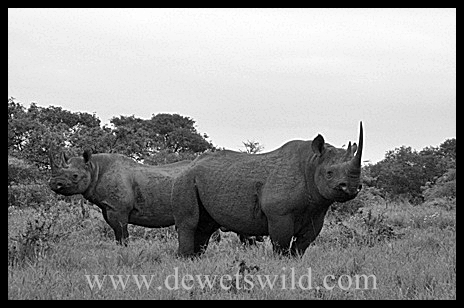
Black Rhinoceros

Diceros bicornis

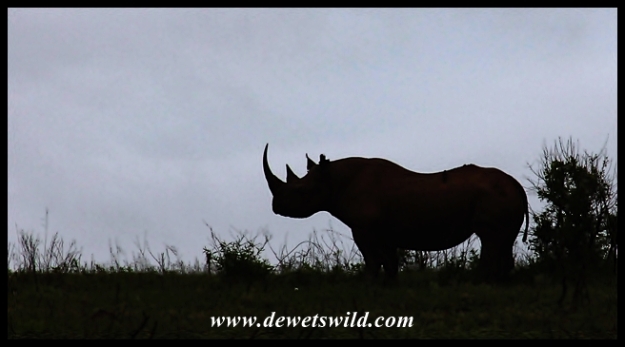
Black Rhino (8)

One of the rarest and most rewarding sightings you can hope to have in a South African game reserve or national park, is of the black rhinoceros. Even the most fleeting glimpse of this worthy member of the charismatic “Big 5” is sure to excite any wildlife lover!

The black rhinoceros is not named for the colour of its hide, which can in fact be vary varied depending on the shade of mud the animal has been rolling in. Instead, it is named in contrast to the other African rhino species, the white rhinoceros. Many people will however testify that the black rhinoceros may well be named for its volatile and extremely aggressive temperament, and having lived through more than one determined black rhino charge, we certainly agree! Just yesterday (30/01/2014) another game ranger was seriously injured in a black rhino attack in South Africa.

Black rhinos are much smaller than the white rhino, and further differs in having a pointed upper lip instead of the wide flat mouth of their “white” cousins, which explains their alternative (and scientifically more correct) name of hook-lipped rhinoceros. These plucky animals weigh up to 1,200kg and stand up to 1.65m high at the shoulder.

Being almost exclusively browsers, black rhinos use their pointed upper lips with great dexterity when feeding on the leaves, shoots, twigs, thorns and flowers of a huge variety of trees, shrubs, herbs and succulents (some of which would be deadly poisonous to other animals).

As long as there’s sufficient food, water and shade available, black rhinos inhabit a wide range of habitats, ranging from the dry riverbeds of the Namib desert to the edges of forests. They tend to be solitary except when mating or when cows are accompanied by their calves, only very occasionally getting together in bigger temporary groupings around waterholes.

Females give birth to single calves, that weigh around 40kg, at intervals of between 3 and 5 years, after a gestation period of 450 days. Black rhinos have a life expectancy of 30 to 40 years in the wild and while adults seldom fall prey to predators, the calves are at risk of attack by lions and spotted hyenas.

Today, the black rhinoceros is considered to be critically endangered. Relentless poaching saw their population dwindle from an estimated 100,000 animals in 1960 to an all time low of 2,410 in 1995. Dedicated conservation efforts resulted in the total population increasing to 4,880 by 2010, of which 1,915 (or 40% of the total) found sanctuary in South Africa’s wild places. However, the explosion in illicit hunting to feed a seemingly insatiable demand in the Far East (where rhino horn is considered to be both medicinal and a status symbol) is threatening once again to bring this majestic animal to the brink of extinction. It is against this backdrop that the recent auction of a black rhino hunting permit by the Dallas Safari Club for US$ 350,000 caused major international controversy.

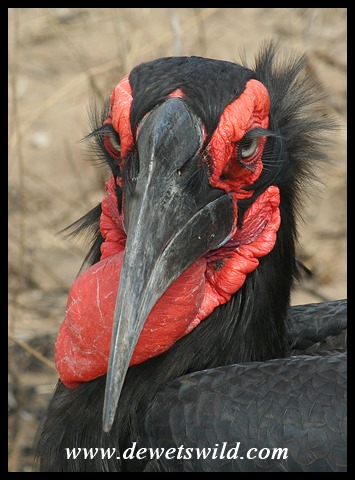
Southern Ground Hornbill

Bucorvus leadbeateri

The Southern Ground Hornbill is an easily recognisable bird that occurs in the northern and eastern parts of South Africa. Turkey-sized, weighing up to 6 kilograms, very confident, and with the longest eyelashes imaginable, they make great photographic subjects.

Ground hornbills are mostly found in woodland or savanna with large trees used for roosting, and nesting in deep holes in often dead trees.

In the early morning, their booming, lion-like, calls can be heard up to 3 kilometres away. Groups of between 2 and 11 individuals occupy home ranges of about 100 square kilometres. These groups consist of a dominant alpha pair, the only ones in the group that breed, and their “helpers” of various ages. Though they lay clutches of two or three eggs between September and December and incubate the eggs for 45 days, only one hatchling is raised to fledging, the others either dying of neglect or being killed by their older sibling. The chick leaves its tree-hole nest at three months of age and is then cared for by its parents and their helpers for up to two years. This means that a pair of ground hornbills produce a maximum of one offspring only once in three years which is an exceptionally low rate of reproduction for a bird – some studies have found that only one chick every nine years reaches adulthood! Ground hornbills can live for up to 30 years in the wild.

Though they are quite capable flyers, you’ll mostly see them striding across the savanna – they can walk distances up to 11 km a day – searching for food. Ground hornbills are predators and their diet ranges from small fry like insects, snails, lizards and frogs to large snakes and mammals up to the size of hares! They’re often encountered near veldfires and on burned areas, searching for exposed prey fleeing the flames or scorched morsels ready for the picking. They’ve also learnt that visitors to game reserves often offer handouts of food from inside motor vehicles, a practice that should not be encouraged as it is detrimental to their health and negatively affects their natural behaviour.

Unfortunately, the Southern Ground Hornbill is an endangered species in South Africa. Having lost much of its habitat to farming practices and tree harvesting, they’re also targeted by poachers supplying the traditional medicine (or muthi) trade, in which their ground up bones are regarded as “protection” against lightning strikes. This, coupled with their slow reproductive rate, has pushed them to the brink of being wiped out. Today, the only place in the country where they can be found reliably is in the Kruger National Park, where the population stands at about 700 individuals. In an effort to boost their numbers, conservators often remove the second-laid egg from nests for hand-rearing and then later release the juvenile bird back into the wild, and in this way founder populations have been re-established at a handful of reserves from which they’ve disappeared.


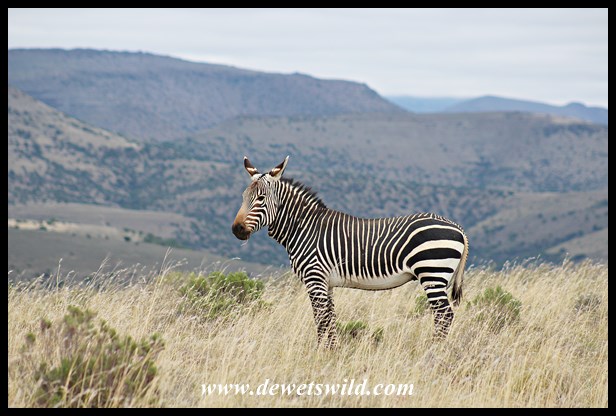
Cape Mountain Zebra

Equus zebra zebra

The Cape Mountain Zebra is a smaller, and much rarer, cousin of the better known plains zebra. It occurs naturally only in the southern provinces of South Africa and is considered vulnerable, though the population is increasing in size thanks to dedicated conservation work at especially the Mountain Zebra and Karoo National Parks, both of which offers an excellent chance of seeing these beautiful animals in their natural habitat.

Mountain Zebras occur in small family groups of up to 15 animals, led by a dominant stallion, while young stallions roam around in bachelor groups after being ejected from the groups they were born in. Adults of both sexes are extremely protective of their young.

Mountain Zebras inhabit, as their name suggests, dry, rocky, mountainous areas and the surrounding plains and valleys (the latter being important as hiding places against cold weather). They are almost exclusively grazing animals and can stay without water for up to three days, though they prefer to drink daily if surface water is available.

Mares give birth to a single foal at any time of the year. With an adult weight of around 250kg and shoulder height of 1.25m, the Cape Mountain Zebra is slightly smaller than the plains zebra.

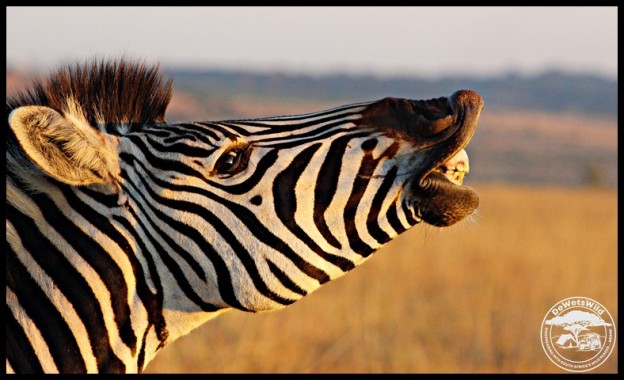
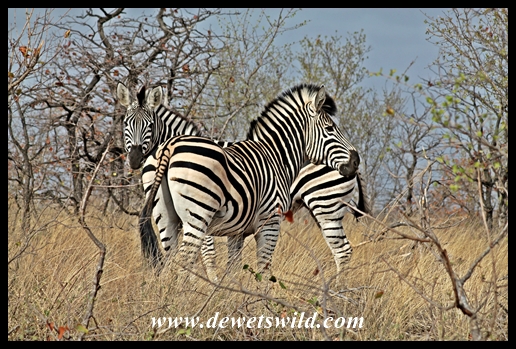
Plains Zebra

Equus quagga

Plains zebra_Kruger_9

The photogenic plains zebra is one of Africa’s most familiar and popular large game animals and they occur in good numbers in protected areas almost all over South Africa.

They occur in small and relatively stable family groups of up to 30 animals, consisting of a dominant stallion, up to nine mares and their foals of various ages. Young stallions are kicked out of their maternal groups at about the age of three years, and then band together in bachelor groups. Larger groups, that sometimes number into the thousands, are aggregations of these family and bachelor groups. Adults are normally very protective of the foals, though stallions will often kill foals when they take over a family group from another stallion.

Plains zebra inhabits open grasslands and bushveld and avoid densely vegetated areas. They are extremely dependant on water and need to drink daily, and subsists almost exclusively on a diet of grass.

Foals are born at any time of the year, though births peak around the start of the rainy season. The foals can stand and walk within twenty minutes of birth and are suckled until about 13 months of age. Adults weigh between 220 and 340kg (stallions being only slightly heavier than adult mares) and stand up to 1.4m high at the shoulder.

Zebras are a favourite prey of lions and spotted hyenas, and foals also often fall prey to leopards, cheetahs and wild dogs. As a result, their life expectancy in the wild is usually below 20 years.

One of the most inspiring conservation projects in South Africa is the breeding of zebras that resemble the extinct quagga (Equus quagga quagga), the southernmost subspecies of the plains zebra that was hunted to extinction in the late 1870’s, with the last specimen of this uniquely South African species of horse, a mare, dying in distant Amsterdam Zoo in 1883. Over a century later however it was realised, through DNA analysis, that the quagga was a localised race of the still extant plains zebra, and the Quagga Project came into being to try and bring them back through selective breeding. With each subsequent generation showing more and more quagga-like characteristics, one day we may again see true-to-form quaggas roaming their native country in vast numbers.

World Rhino Day 2013

There are people who look at this face and notice only the horns. They believe, despite ample evidence to the contrary, that it can cure a host of ailments and they are willing to pay huge sums of money to get it. Even more ridiculously the ability to acquire these horns is in itself being seen as a symbol of wealth and status, something to aspire to. They don’t care that this animal will be savagely killed and disfigured so that they can consume a product that has no more curative powers than their own hair and fingernails, and then even boast about it!

World Rhino Day 2013

World Rhino Day 2013

There are people who look at this face and notice the eyes. The eyes of an animal that has been on this planet much longer than we have.  We count ourselves among these people. We believe that this animal has just as much of a right to live on this planet as humans do. We believe the world will be an emptier, less beautiful place if this animal is no longer around. We want this animal to share this planet with many more generations of humans to come. Some of us even put their own lives on the line on a daily basis to achieve this goal.

This year alone, South Africa has already lost more than 635 rhinos to poaching (2013/09/13 Department of Environmental Affairs). Last year, a total of 668 fell to the poachers’ bullets in this country alone. There are many people and organisations working tirelessly to prevent poaching and to educate people around the world, often at great cost and risk to themselves, and if it weren’t for their efforts we have no doubt that the situation would have been much more dire still.

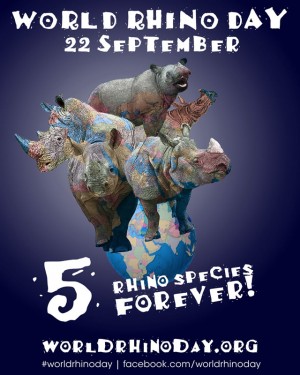
Click on the World Rhino Day poster below if you’d like to learn more about what people and organisations around the world are doing to secure the future of the five species of rhinoceros we share this planet with.

WRD2013640px-300x375

World Elephant Day 2013

World Elephant Day 2013 logo

Today, elephants in Africa and Asia are faced with the threats of escalating poaching, habitat loss and various other conflicts with humans. World Elephant Day was launched on August 12th, 2012, to bring attention to the plight of these iconic animals and will be observed for the second time this year.

World Elephant Day 2013

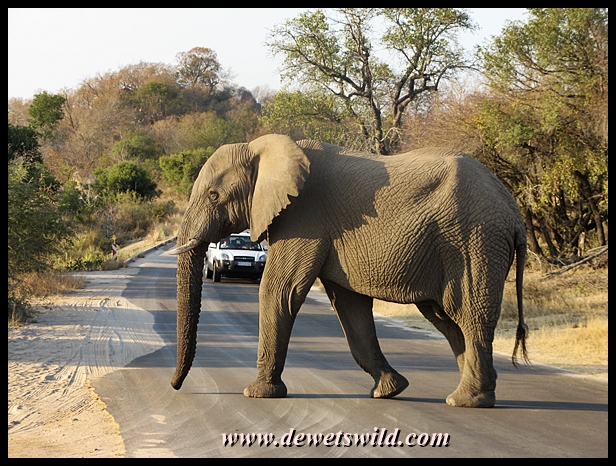
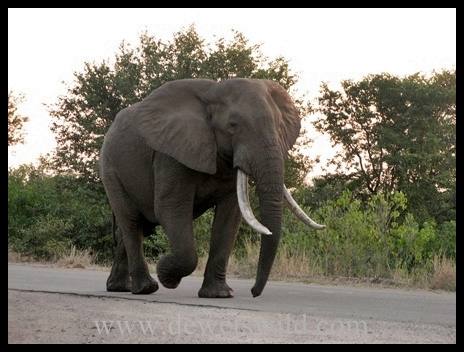
The African Elephant is one of our favourite species and every encounter with them is a moment to treasure. Shown here is a young bull crossing a road in the Kruger National Park, just south of Skukuza Rest Camp.

If you’d like to see some more of very special South African elephants, have a look here:

Isilo of Tembe

Kruger’s Big Tuskers

Masbambela

Bowling for Buzzards!

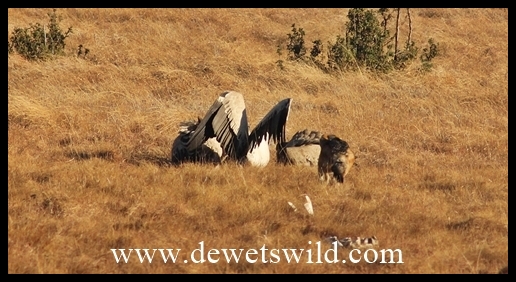
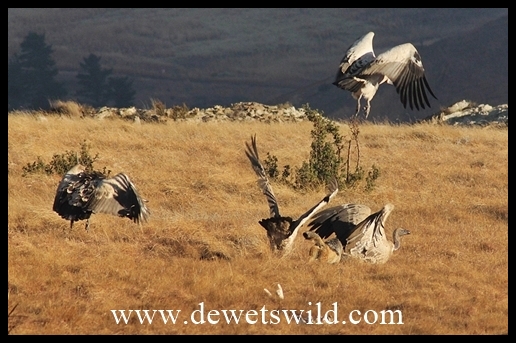
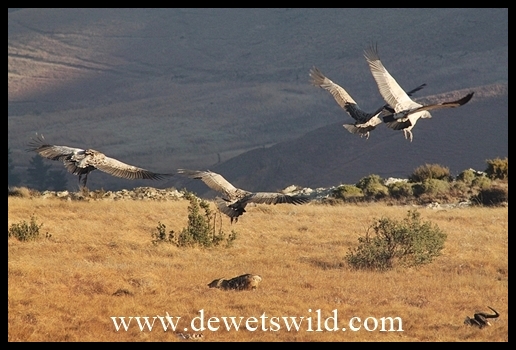
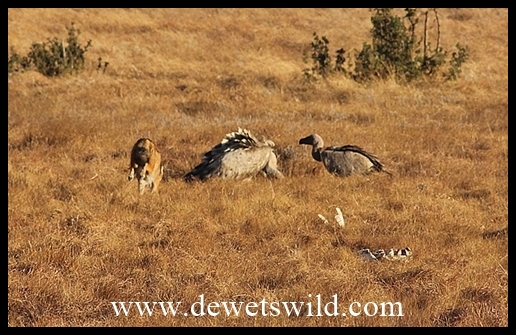
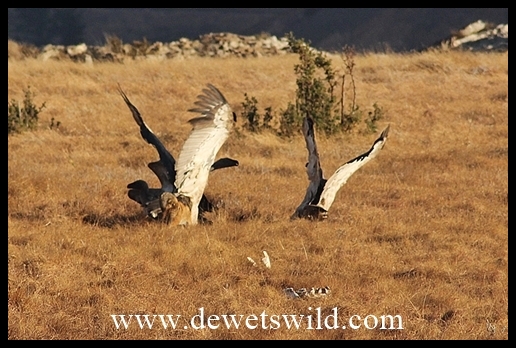
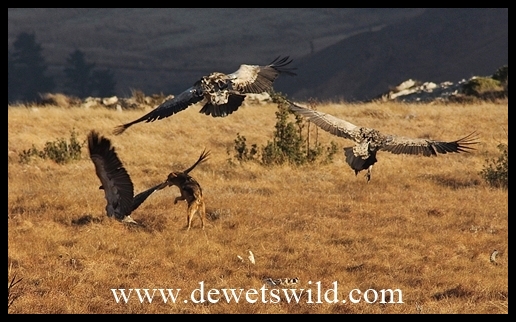
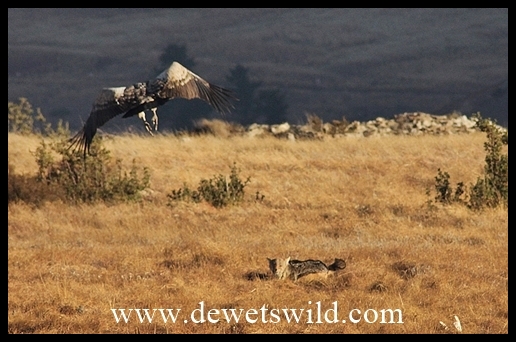
This afternoon, watching from the hide at the Golden Gate vulture restaurant*, I was treated to one of the most entertaining sequences of animal interaction I have ever experienced!

A pair of black-backed jackals were protecting the last scraps of a carcass with everything they had against a group of Cape griffons.

Bowling for Buzzards_3192

Bowling for Buzzards_3193

Bowling for Buzzards_3195

Bowling for Buzzards_3196

I couldn’t help but think of the “bowling for buzzards” scene in the animated Disney movie “The Lion King” where meerkat Timon and warthog Pumbaa save little Simba by rushing into the huddle of vultures surrounding the lion cub!

Bowling for Buzzards_3218

Bowling for Buzzards_3219

Bowling for Buzzards_3220

Bowling for Buzzards_3221

A “Vulture Restaurant” is a feeding station where carcasses are made available for vultures in safe places to mitigate the risk of them feeding on poisoned carcasses elsewhere.

Isilo of Tembe

In the presence of majesty

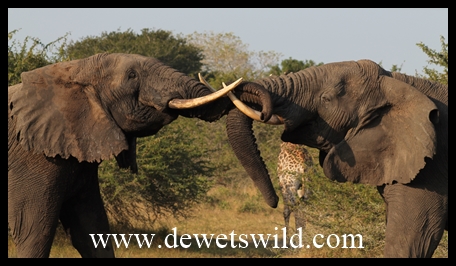
It’s mid-afternoon at Tembe Elephant Park, and we’re watching a number of elephant bulls milling around Mahlasela Pan. Occasionally the peaceful scene is disturbed by two or more of the younger bulls mock-fighting and testing one another’s strength with heads held high and tusks and trunks interlocked, sending nervous nyalas and impalas running for cover…

Isilo_1657

Slowly, royally, a magnificent tusker moves out from behind a clump of bushes to drink from the pan. The day before, when our guide Patrick asked us what we’d most like to see at Tembe I was very quick in replying “Isilo please!”. And now, perched in the game-viewing vehicle, we’re speechlessly admiring South Africa’s biggest living tusker – a wish granted, a prayer answered. We’re looking upon one of the most awesome animals in all creation and nothing could wipe the smile from our faces.

Isilo_1645

Isilo. “The King”. What an apt name.

Isilo_1650

We watch enthralled as Isilo moves around the pan, stopping often to quench what must be a massive thirst. The old gentleman is looking frail; at an estimated sixty years of age, he’d be having trouble eating the woody vegetation that has sustained him all his life. His tusks must weigh about 60 kilograms each, and in excess of 2.5 meters in length – what a strain it must be on the neck to keep those massive ivory pillars from scraping on the ground as he moves. Yet there’s no feeling of pity. This is the King!

Isilo_1693

Isilo_1702

Isilo_1737

Isilo_1801

Taking his leave now of the pan and the younger company around it, Isilo ambles westwards into the woodland. We follow alongside, hoping to spend as much time in his audience as he will allow. Occasionally he stops to enjoy a tender creeper or succulent young shoot.

Isilo_1815

Isilo_1824

Isilo_1830

My heart skips a beat as Isilo turns towards us, moving ever closer, gently and peacefully passing within touching distance of the admiring humans in the game-viewing vehicle. No one says a word. There’s no need to; the expressions on our faces tell the full story.

Isilo_1840

As we follow a while, Isilo slowly walking along the sandy track into the sunset, there’s no denying that we’ve spent a tiny fraction of our lives in the presence of majesty. Sala kahle Isilo. Stay well.

Isilo_1858

We went to Tembe Elephant Park in search of Isilo, and it was every bit the exhilarating experience we had hoped it would be. But Tembe turned out to be so much more: have a read here for more of our impressions of this South African treasure.

If you’re interested in South Africa’s big tuskers, you can see more pictures of these magnificent animals, from the Kruger National Park this time, here and here.

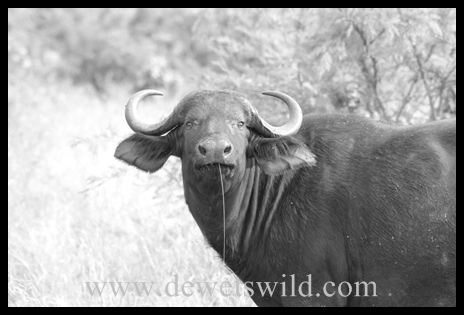
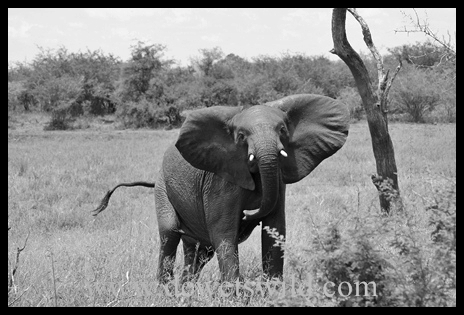
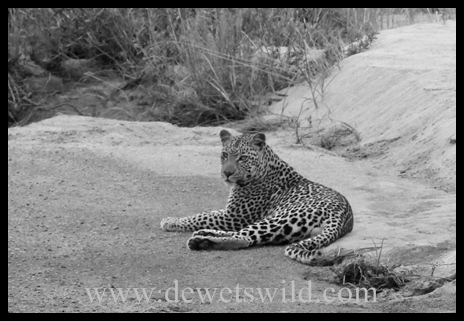
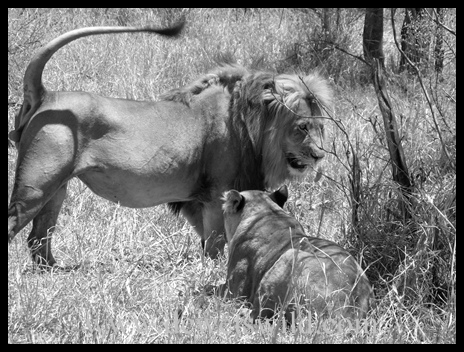
The Big-5 in Black-and-White

The “Big Five” is probably Africa’s most sought-after animals – the term was coined by colonial-era trophy hunters to describe the group of animals considered the most dangerous to hunt: Black Rhino, Buffalo, Elephant, Leopard and Lion. Today, these animals are a major reason for the popularity of South Africa’s wildlife reserves among locals and tourists from all over the world.

1B&W_BlackRhino

B&W_Buffalo

B&W_Elephant

B&W_Leopard

B&W_Lion

We’re participating in the online adventure travel and photography magazine LetsBeWild.com‘s Wild Weekly Photo Challenge for bloggers. This week’s challenge is “Black-and-White

Kruger’s Big Tuskers

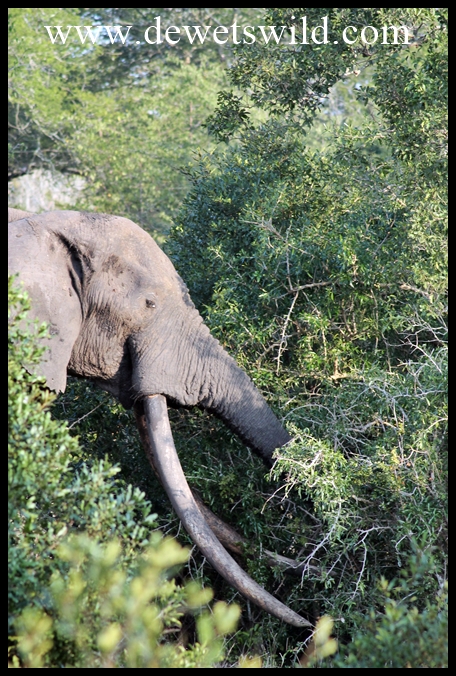
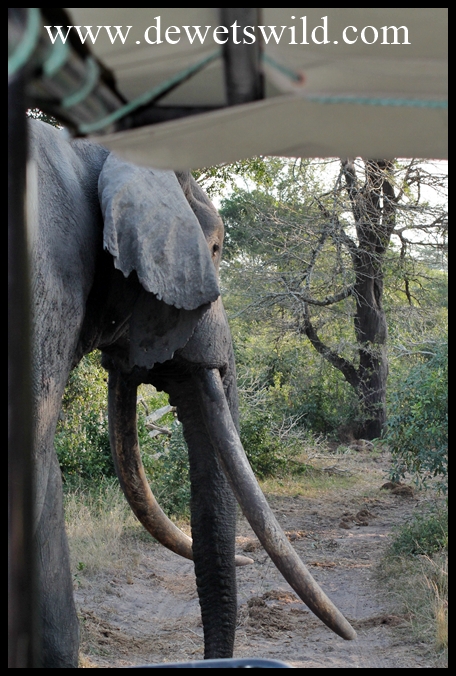
There’s more than 14,000 elephants in the Kruger National Park, and of course they are a big drawcard for visitors to this game reserve, being charismatic animals and members of the famed “Big 5”.

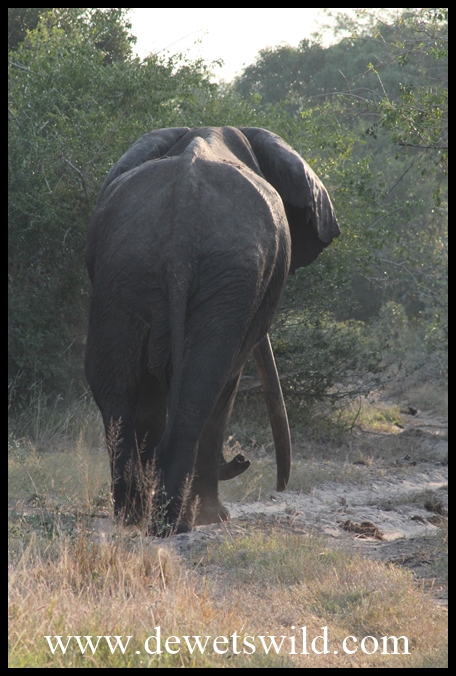
For us too, encountering elephants is always a special treat: witnessing the interactions between different herd members or the playful antics of the calves, and there’s few things in nature as beautiful as the gait of a confident elephant bull, his massive head swaying from side to side,  intent on ensuring anything and everything in his way clears out before he gets there.

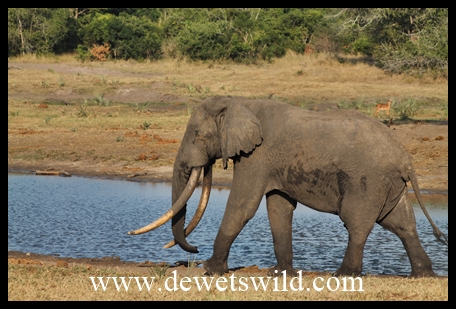
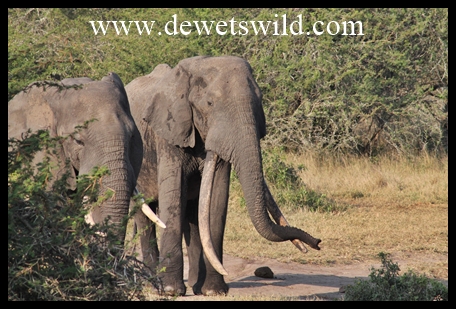
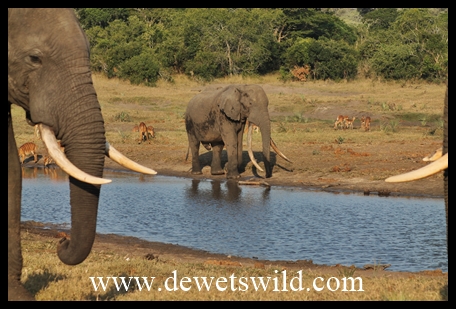
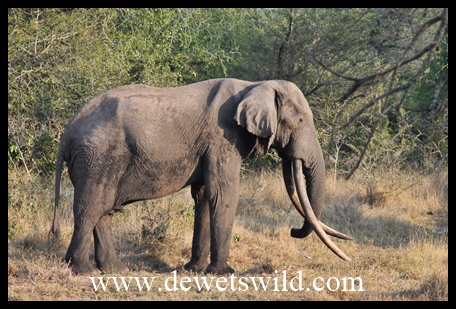
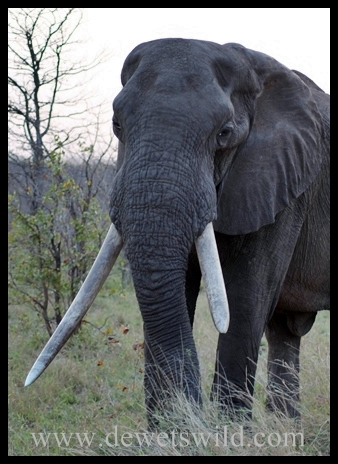
The Kruger Park is known as one of the few remaining places on the African continent where you still have the chance to see elephants carrying impressive tusks, sometimes in excess of 2 or even 3 metres in length and weighing anything between 40 and 70kg. In the Letaba Rest Camp there’s a fascinating  museum dedicated to the elephant, where visitors can also marvel at the tusks of some of Kruger’s most famous tuskers.

Over the years, we’ve been extremely fortunate to have encountered a handful of these living monuments while exploring the Kruger National Park, especially in the northern regions of the park in the vicinity of Shingwedzi, Letaba and Mopani Rest Camps. Traditionally, these remarkable giants are given distinctive names, either for the area they roam or in honour of Kruger staff members who have dedicated their lives to the protection of this special place.

Eventhough I was then only a child travelling to the Kruger Park with my parents, long before the advent of cheap (digital) photographic equipment, encounters with the magnificent Mandleve and Mabarule will live in my memory forever.

The photographs we’re sharing here are more recent. In January 2006, Marilize and I became two of the very small number of people to have had the honour of seeing Masbambela -we’ve already posted some pictures of him in a previous post (here)

MASBAMBELA_JAN06

Masbambela

Our sighting of Ngunyupezi in April 2007, when the whole de Wet clan went camping at Shingwedzi, was just as special – it was only the second officially recorded sighting of this enigmatic bull, whose left tusk characteristically grows almost straight down. At one point he charged at us, head held high and that straight tusk leading the way like the lance of a medieval knight! Ngunyupezi is still seen in the Shingwedzi area from time to time.

Ngunyupezi_APR07

Ngunyupezi

Hlanganini was a well-known tusker, regularly seen around Letaba Rest Camp. This is also where we met him, in September 2007. Hlanganini died a couple of years ago, following a fight with another bull.

HLANGANINI_SEP07

Hlanganini

During a visit in June 2011, my brother Niel and I came accross two of the new generation of Kruger  Tuskers: Machachule, right at Shingwedzi’s back gate, and Masanana, near Letaba.

Machachule_Jun11

Machachule

Masasana_Jun11

Masasana

We’ve already had five encounters with Masthulele, believed to be Kruger biggest tusker at the moment, over the years. This sighting was in April 2012 near Letaba, while visiting the Park with our friends the du Plessis’.

Edit: SANParks announced in September 2017 that Masthulele had died during 2016.

Masthulele_Apr12

Masthulele

During our visit in September of 2012 we were lucky to see two more tuskers: Mandzemba welcomed us back to our beloved Shingwedzi, while Ngodzi bade us farewell us we departed from Mopani. These two tuskers haven’t been named “officially” by Kruger’s management (yet) and their names are, for now, derived from waterholes found in their home ranges.

Mandzemba_Sep12

Mandzemba

Ngodzi_Sep12

Ngodzi

Everytime we visit the Kruger Park, we hope for another special appearance by one of these majestic animals. It may be years before we are fortunate to have our path cross one of theirs again, but when it happens it will surely be another thrilling experience!