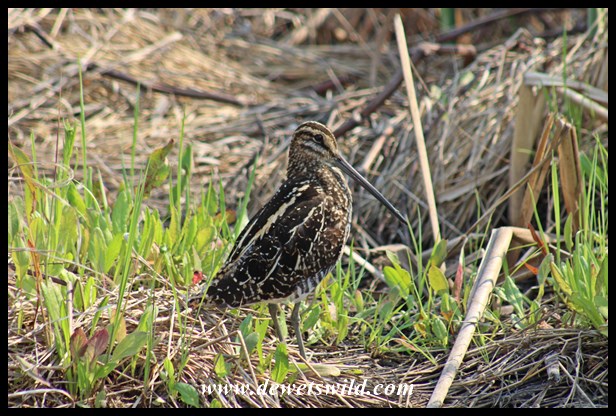
The African Snipe is a wading bird closely associated with wetland habitats (seasonal or permanent) with a muddy substrate and flooded vegetation, where they feed on aquatic invertebrates ranging from worms to crabs. Adults grow to about 28cm in length and average 113g in weight.
African Snipes build their grass-platform nests in dense vegetation surrounded by water or wet ground. Pairs are monogamous and build their nests well away from others of their kind, and at any time of year though there appears to be a breeding peak in winter. Clutches of 1-3 eggs are incubated solely by the female but both parents take care of the chicks, which leave the nest when they’re about 3 weeks old. When not breeding they may occur in flocks of around 20 or so.
In South Africa we have two species of Epauletted Fruit Bat, often occurring together in mixed colonies and indistinguishable from each other in the field. These are Peters’s (E. crypturus) and Wahlberg’s (E. wahlbergi) Epauletted Fruit Bats. They’re distributed in the moist eastern parts of our country, with Wahlberg’s occurring from the Garden Route through to the Lowveld while Peters’s occurs as far south as the Eastern Cape coast. Both species are also found further north into central and east Africa and are considered to be of least concern by the IUCN.
Epauletted Fruit Bats are large bats, weighing around 100g with wingspans of about 50cm. They inhabit forests, riverine woodland and dense savannas in which there’s a preponderance of fruiting trees. Unfortunately their fondness for soft fruit make them a nuisance in orchards.
Epauletted Fruit Bats are mainly nocturnal though they may be seen about on heavily overcast days. They utter a frog-like pinging call, a familiar night sound in many of the wild places we visit and a personal favourite. By day they hang in deep shade in trees or under thatched roofs, often in noisy colonies numbering from a few individuals into the hundreds. They normally search for food singly, although large groups may congregate at fruiting trees. Most babies are born in early summer, with the single baby clinging to its mother’s nipples as she flies around in search of food.
Epauletted Fruit Bat at Skukuza Airport
Epauletted Fruit Bat under the thatch of Skukuza’s shop
Epauletted Fruit Bats roosting in a palm near our accommodation at Shingwedzi
Epauletted Fruit Bats
Epauletted Fruit Bats in Crocodile Bridge Rest Camp
Tawny-flanked Prinias are small birds, weighing less than 10g but (thanks to their long tails) attaining a length of around 13cm. They are usually seen in pairs or small family groups, and inhabit dense grass and shrubbery, often along water courses and in gardens. They feed almost entirely on insects and other invertebrates.
Excluding the harshest parts of winter, Tawny-flanked Prinias breed almost throughout the year. Pairs are monogamous and weave a pear-shaped nest low in a shrub, often over water. The clutch of 2-5 eggs are incubated over a period of 2 weeks by both parents, and the hatchlings leave the nest by the time they’re 2 to 3 weeks old.
African Pied Wagtails are always found near bodies of water, both natural and man-made and both flowing and stagnant, but with a particular fondness for wide rivers with sandy banks and boulders in and around the water. Here they feed mainly on invertebrates ranging from worms to crabs, but will also consume tadpoles, small fish and seeds. Adults weigh around 27g and grow to about 20cm in length.
Pied Wagtails are usually seen in monogamous pairs, or small family groups during the breeding season. Both parents work to build the cup-shape nest, often over or otherwise near water, using grass, leaves, hair and feathers. Their breeding season stretches from late winter to early autumn. The clutch of 2-5 eggs are incubated by both parents for around 2 weeks, with the chicks becoming independent at around 6 weeks of age.
The African Dusky Flycatcher inhabits forests (mainly edges and clearings), riverine woodland and densely planted parks and gardens, and is easily overlooked. They feed mainly on flying insects but do include a little fruit in their diet on occasion. They are small birds, weighing about 11g as adults and measuring around 13cm in length.
Pairs of the African Dusky Flycatcher are monogamous and build their cup-shaped nests in holes in trees or crevices in rocks using fine plant material, feathers and spider webs. Their breeding season spans spring and summer, and only the female incubates the clutch of 2 or 3 eggs over a 2-week period while the male brings food to her at the nest. The chicks become independent within 3 weeks of hatching, often allowing the parents to raise another brood in the same season.
As their name suggests, the Cape Rock-Thrush occurs only in rocky habitats, especially steep hills and mountain sides and deep valleys in grasslands and heathland with a sparse covering of trees, and it sometimes ventures into villages and reserve rest camps in such areas. They follow a diverse, omnivorous diet including insects and other invertebrates, small vertebrates like lizards and geckos, fruits, seeds and aloe-nectar. At a weight of around 60g and a length of about 21cm, the Cape Rock-Thrush is the biggest member of the family occuring in South Africa.
Cape Rock Thrushes are usually encountered singly or in pairs. Their breeding season spans spring and summer and their nests are untidy, shallow platforms built in crevices or on ledges which may be used for several consecutive breeding seasons. The male is very protective of the pair’s territory, while the female takes most of the responsibility for incubating the clutch of 2-4 eggs over a 2-week period. Both parents take care of the chicks, which become independent before they’re a month old.
Infamous for its tenacity and downright cantankerous disposition, the Honey Badger may only stand 30cm high at the shoulder with a weight up to 16kg (males are much bigger than females), but that doesn’t deter them from tangling with buffaloes, elephants and lions (or anything else for that matter) daft enough to cross swords with them.
Honey Badgers inhabit a wide range of habitats, from deserts to mountains to forests, though they prefer more open habitats. They even occur in some of our cities and towns. They are equally catholic about their diet, feeding mostly on insects, eggs and rodents as well as fruits, berries, bulbs and carrion, but also including anything else they can overpower – snakes, young crocodiles, fish, amphibians, birds and mammals up to the size of small antelope have all been recorded. Although it isn’t a major part of their diet, their penchant for honey and the lengths they will go to in order to gorge themselves on it has earned them their English common name.
These tough creatures are usually seen alone or in pairs, and may be active by day or night. They are excellent climbers and rest up in crevices or holes in the ground (dug by themselves or taken over from other animals). This is also where the females give birth to litters of 1-4 pups (usually 2) at any time of year. The female raises the pups alone, moving them to a new den every few days until they can start moving around with her at around 3 months old. The pups are fully grown by the time they’re 8 months old but may remain with their mom until they’re as old as 18 months.
One of our most cosmopolitan and abundant bird species, the Fork-tailed Drongo inhabits a wide range of habitats ranging from grasslands with a sprinkling of trees to forest edges, favoring open woodlands and savannas. It has also adapted very well to exotic plantations, suburban parks and gardens. They feed mainly on insects and other invertebrates, but have also been noted feeding on small lizards, fish, eggs and birds. Adults measure ± 25cm long and weigh around 44g.
Fork-tailed Drongos are feisty birds, often mobbing large raptors and mammalian predators much bigger than themselves. They’re often seen at veld fires catching insects trying to escape the flames, or following large mammals around to catch the insects disturbed into flight while the big herbivores are moving around – even using the backs of these animals as perches from which to launch an attack. Fork-tailed Drongos are excellent mimics – they will even imitate the alarm calls of other birds or small carnivores, like meerkats, to startle them into dropping whatever food they might have found in order to steal it.
Fork-tailed Drongos form monogamous pairs. The breeding season in this species spans spring and summer. Their nests are small cups built of fine plant material and spiderweb, usually suspended like a hammock between two twigs in a tree or shrub. Clutches of 2-5 eggs are incubated by both parents for between 2 and 3 weeks, with the chicks leaving the nest around 3 weeks after hatching.
Verreaux’s Eagle-Owl, or the Giant Eagle-Owl, is the biggest owl occurring in Africa and one of the biggest on the planet. Females are considerably larger than males, and tip the scales at up to 3kg, with a wingspan of over 1.5m. It inhabits dry savanna, woodlands and riverine forests, even penetrating deserts along drainage lines where large trees grow (such as in the Kalahari). As can be expected from such a large bird of prey their menu includes mostly small to medium vertebrates (up to the size of hares, springhares, piglets, monkeys, herons, flamingoes and even other large owls!)
Pairs of Verreaux’s Eagle-Owl are monogamous and defend fairly large territories. Here they roost and nest in large trees, taking over the large stick nests of other big birds of prey or utilising the tops of the nests of the hamerkop or sociable weavers. They breed through winter and spring, when the female incubates a clutch of (usually) 2 eggs for over 5 weeks, while the male feeds her at night. Usually the second chick to hatch dies of starvation within 2 weeks, as the first-hatched hogs most of the food brought back by the parents. The surviving chick stays in the nest for around 2 months, but will remain dependent on its parents for up to a year and some may even stay with their parents to help raise the next chick. Though they are mainly nocturnal, Verreaux’s Eagle-Owls are regularly encountered on the hunt around dawn and dusk
The Groundscraper Thrush is a species of open savannas and woodlands, but have also adapted to plantations, orchards, suburbia and sports fields where they easily become quite tame and bold around humans. They feed mainly on insects, worms and other invertebrates, found by scraping away leaf litter or scratching in the grass (hence its English common name). Adults weigh around 76g and grow to a length of about 21cm.
Groundscraper Thrushes are usually encountered in monogamous pairs. They build their bowl-shaped nests in the forks of trees, using a wide variety of plant parts and other soft materials. They breed in spring and summer, with most nesting activity noticed from September to November. Both parents incubate the clutch of 2-4 eggs for around 2 weeks, with the hatchlings leaving the nest about the same length of time after hatching but remaining with their parents for up to 6 weeks more. Parents are extremely protective of their nest and young and will even attack humans venturing too close.