Category Archives: South African Wildlife

The inhabitants of South Africa’s wild places

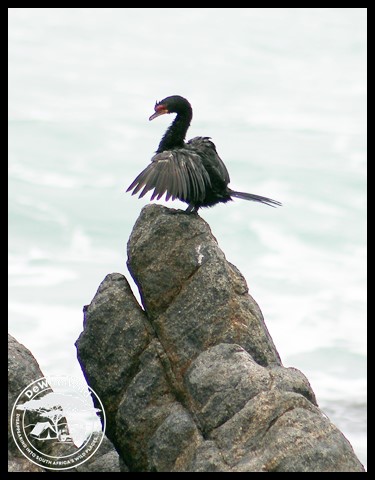
Bank Cormorant

Phalacrocorax neglectus

The Bank Cormorant is an endangered species restricted to the Atlantic coastlines of Namibia and South Africa’s Northern and Western Cape Provinces, where an abundance of kelp (sea bamboo) occurs. It has a population estimated at only 2,500 breeding pairs (7,500 individuals), declining from an estimated 9,000 breeding pairs in the 1980’s due to human and seal disturbance at breeding sites and a reduced food supply. Away from the breeding colonies (where they often occur alongside other kinds of cormorant) they’re usually only seen alone or in small groups.

While the Bank Cormorant is strictly a marine species it seldom ventures further from the coastline than 10km seawards, where it catches fish, octopus, lobster, shrimp and other invertebrates by diving up to 30m deep and staying submerged for up to 80 seconds.

Bank Cormorants form monogamous pairs, breeding in small colonies of 20-100 pairs at any time of year. The pair works together to construct the large platform nest of seaweed, sticks and feathers glued together by guano on inaccessible rocks on the shore or on islands. The parents take turns to incubate the clutch of 1-3 eggs over a month-long period. The chicks take flight for the first time when they’re 8-10 weeks old but remain dependent on their parents until they’re about 6 months old. Fully grown they weigh about 2kg, measuring around 76cm in length.

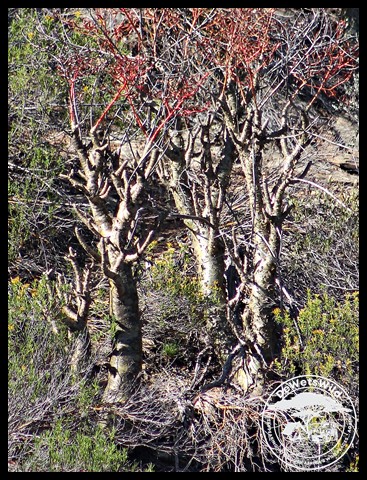
Botterboom

Tylecodon paniculatus

The Botterboom (“Butter Tree”) is a xerophytic plant native to the Succulent Karoo, occurring from the Eastern Cape to central Namibia. It is the largest species of its genus, growing up to 3m tall, and usually grows on rocky slopes. Botterbome make wonderful feature plants in a water-wise indigenous garden, but as it is poisonous will cause paralysis and even death in livestock that feeds on it.

The Botterboom flowers from November, seeding in autumn in time for the sparse winter rainfall season in its native range. It is pollinated by nectar-feeding birds. The plants drops its leaves at the onset of the flowering season, photosynthesizing through its fat, yellow-green stem during the very hot and dry Succulent Karoo summer and carrying leaves only from autumn to spring.


Small Striped Swordtail Butterfly

Graphium policenes

Despite a wingspan of up to 7cm, the Small Striped Swordtail is one of the smaller butterflies in the family. In South Africa it is found in coastal bush and forests in Kwazulu-Natal and the extreme north-east of the Eastern Cape. They usually fly high and very fast, but do congregate at mud puddles from time to time. Adults are on the wing through the warmer months from September to April.

Pincushion

Genus Leucospermum

The Pincushions are a key component of South Africa’s Cape Floristic Region, an area of incredible floral diversity and endemism known as fynbos, the smallest of the world’s six floral kingdoms and a recognised World Heritage Site. Among the 48 currently recognised species in the genus are species that grow prostrate along the ground while others grow as large shrubs up to 5m tall. Most of these species have a limited distribution and 40 of them are threatened to some degree or another by inappropriate land use, incorrect fire management and invading alien plants and ants. Only 5 species occur outside the Cape Floristic Region.

Pincushions are evergreen and grow in relative depleted soil. The flowers are pollinated by nectar-feeding birds and rodents, and once the seeds have been formed these are carried underground by native pugnacious ants (genus Anoplolepis). The seeds remain dormant underground until a fire sweeps through the fynbos above, at which point the seeds germinate and establish a new generation of Pincushion plants.

Pincushions are popular in gardens and in the cut flower trade.

Namaqua Sandgrouse

Pterocles namaqua

The Namaqua Sandgrouse is a bird of dry habitats (less than 300mm of annual rainfall), ranging from sandy savannas and shrubland to gravel deserts. It is a seed-eater and highly nomadic. When not breeding they move around in flocks, often congregating in their hundreds if not thousands at waterholes in the early morning.

Namaqua Sandgrouse may breed at anytime of year, though nesting peaks at the end of the rainy season when grasses go to seed. Pairs are monogamous and their nest is little more than a scrape in the ground next to a small shrub or clump of grass. Clutches of 2-3 eggs are incubated by both parents for a 3 week period, the female sitting on the eggs by day while the male takes the night shift. The chicks can walk and start foraging soon after hatching. For the first 2 months of their lives their father makes daily trips to a waterhole up to 60km away to carry water back to his chicks in his belly feathers. The chicks can start flying short stints when they’re about a month old, but remain dependent on their parents till the age of about 3 months. Fully grown they measure about 26cm in length and weigh around 180g.

The Namaqua Sandgrouse occurs from south-western Angola, through Namibia, Botswana and marginally Zimbabwe to South Africa, where it is found in the more arid western half of our country in the provinces of North West, Free State, Northern Cape, Western Cape and Eastern Cape. The IUCN considers it to be of least concern, the sinking of artificial waterholes in farm lands proving beneficial to this species.

Ruddy Turnstone

Arenaria interpres

The Ruddy Turnstone is a migrant wading bird visiting South Africa during our summer months, arriving from their breeding grounds in the Northern Hemisphere (“our” birds mostly originate from central Siberia) about September and staying until April. Some birds, usually young ones, remain behind during our winter. While they prefer to forage along rocky or kelp-covered shores or beds of eelgrass growing on sandy or muddy flats exposed at low tide, they’re also occasionally recorded at inland freshwater bodies, especially while migrating. They feed on invertebrates uncovered by turning over rocks and debris washed out of the ocean, hence the name. Several birds may work together to shift heavier objects, such as dead fish. The Ruddy Turnstone is a gregarious bird, usually encountered in small flocks and often associating with other species of wading birds. Adults measure about 23cm in length and weigh around 100g.

With the exception of Antarctica the Ruddy Turnstone is found seasonally along parts of the coastline of every continent, and it is listed as being of least concern with an estimated mature population of up to 500,000 birds. In the austral summer they’re found along the entire South African coastline, being especially numerous at Langebaan Lagoon in the West Coast National Park.

Bontle’s Springhares

I know of no place better than Bontle Camp in the Marakele National Park to more reliably see our very own African kangaroos, or Springhares to give them their proper English name even though they’re not hares either!

Pedetes capensis

The Springhare is a large rodent, measuring up to 90cm in length and weighing between 2.5 and 3.5kg. Their mode of propulsion is unique among mammals in sub-Saharan Africa, jumping kangaroo-like as they move around and covering up to 2m in a single bound.

They inhabit areas with compact, but not hard, soil – usually sandy or sedimentary – in which they very prodigiously tunnel their own burrows of up to 140m in extent. Each individual Springhare lives in its own burrow system, except for females who’d share it with their latest baby, and these have several entrances, side tunnels and escape holes. They’ll often block the tunnel entrance behind them once they’ve entered it. These tunnels are important refuges for many other kinds of animals that shelter in holes in the ground. While several Springhares may have tunnels in near proximity to one another they’re not social animals.

Female Springhares give birth to a single young (very seldomly twins) at any time of year after a 3 month gestation period. The baby stays in the mother’s tunnels until it is weaned at about 2 months of age. Females may have between 2 and 4 young every year. They only live to about 6 years old in the wild.

Springhares are a favourite prey of almost every predator on the continent, humans included. They are active at night and do not emerge from their burrows until total darkness falls well after sunset. They forage near their burrows to enable a quick escape, and feed mainly on grass (roots, stems and blades), bulbs and herbs. Springhares are often considered a pest in farmlands where they can do considerable damage to crops.

The Southern African Springhare (P. capensis) is found in portions of all South Africa’s provinces with the exception of Kwazulu-Natal and the Western Cape. Beyond our borders their distribution extends northwards to the southern DRC. The East African Springhare (P. surdaster) from Kenya and Tanzania was recognized as a closely related but distinct species in the 1990’s. The IUCN considers both species of Springhare to be of least concern.

Greater Flamingo

Phoenicopterus roseus (ruber)

The Greater Flamingo is the largest species of flamingo, standing up to 1.8m tall with a weight up to 4.5kg (more usually 1.6m and 2.7kg, respectively). It is distributed from India and western Asia, into southern Europe and  through much of Africa and Madagascar, the widest occurrence of any kind of flamingo. The IUCN lists the Greater Flamingo as being of least concern. It is found at suitable habitat throughout South Africa but is classified as near-threatened locally due to pollution, water extraction and disturbance at breeding and feeding sites, fences spanning water bodies, and collisions with power lines.

Greater Flamingoes are social birds often forming enormous flocks, especially when breeding, and inhabit coastal mudflats, dams, sewage works, river mouths and even small temporary pans that form after rainfall, also occasionally feeding along sandy beaches. They may move over exceptional distances in response to rainfall, mostly migrating during the night at flying speeds of 50-60km/h. Greater Flamingoes feed on tiny aquatic invertebrates, like brine shrimp or fly larvae, that they filter from the water. South Africa doesn’t have any regularly used Greater Flamingo breeding sites – they breed exclusively at large, seasonally flooded and shallow salt pans like Etosha in Namibia and Makgadikgadi in Botswana.

The Greater Flamingo was long considered to be one species with the American Flamingo (P. ruber) but this view is no longer accepted in the scientific community.

Lesser Flamingo

Phoeniconaias (Phoenicopterus) minor

Most people are probably familiar with flamingoes, of which there are altogether six species on the planet. Two species occur in South Africa. In this edition of DeWetsWild we’ll showcase the Lesser Flamingo, and in the next installment we’ll cover the Greater Flamingo.

Lesser Flamingoes inhabit shallow, nutrient-rich, wetlands that may include salt pans, saline lakes, mudflats, tidal lagoons and even sewage treatment plants. They feed exclusively on cyanobacteria, better known as blue-green algae, syphoning it from the shallow water in typical flamingo fashion. They can cover enormous distances migrating mostly at night between suitable water bodies at an average speed of 60km/h. They’re regularly found in association with Greater Flamingoes at the same locations.

Lesser Flamingoes breed exclusively on salt pans and saline lakes, forming breeding colonies of several thousand monogamous pairs, each of which builds a mound of mud up to 40cm high and surrounded by water (as protection against land-based predators) to use as a nest, usually coinciding with the rainy season. The parents take it in turns to incubate the single egg (rarely two) for a month, with the chick leaving the nest and joining a creche within 6 days of hatching. Though the chicks can fly by the time they’re 3 months old the parents continue to feed the chick on a secretion from their gastrointestinal tract for several months. Fully grown they stand almost a meter tall, with a similar wingspan, and weigh approximately 2kg.

The IUCN classifies the Lesser Flamingo as being near threatened, siting a declining population and threats to important breeding sites. At the latest estimates their population stood at between 2.2 and 3.4-million distributed from the Indian Subcontinent, through the south of the Arabian Peninsula, to East Africa and on to southern Africa, with smaller populations around Lake Chad and in West Africa. There is evidence of considerable movement between populations, even over thousands of kilometres. In South Africa there’s concentrations of this species in the Western Cape, on the Highveld, and at Lake St. Lucia, though their only regularly used breeding colony in our country is at Kamfers Dam outside Kimberley and susceptible to pollution and human encroachment.

Gaboon Adder

Bitis gabonica

The Gaboon Adder must surely rate as one of the best camouflaged, if not one of the most beautiful, snakes in South Africa. These large vipers may grow to 2m in length (usually up to 1.3m in our part of the world) and weigh up to 8kg. It boasts the longest fangs of any venomous snake, up to 5cm long, and its venom is produced in large quantities – less than a quarter of a dose is sufficient to kill an adult human. The venom is cytotoxic and rapidly cause swelling, intense pain and shock and may lead to tissue death and amputation, difficulty breathing and heart failure if treatment with anti-venom is not quickly commenced. Thankfully they’re surprisingly placid and bites to humans are very rare.

Gaboon Adders inhabit forests and other similarly moist and densely vegetated habitats, where they feed on a wide range of vertebrate prey up to the size of rabbits. They are mainly nocturnal hunters, but like to bask in the sun on the edge of clearings in the forest during the day. Females are gravid for up to a year after mating, producing up to 40 live young, usually in the summer months.

In South Africa the Gaboon Adder is restricted to a small coastal strip stretching from St. Lucia Estuary to the Mozambique border – almost all of its natural range in this country is therefore included in the iSimangaliso Wetland Park. They have also been introduced to the Umlalazi Nature Reserve to the south. Outside of South Africa, Gaboon Adders are found along the forested mountain border of Zimbabwe and Mozambique, coastal Tanzania, and widely through Africa’s equatorial reaches from Zambia in the south to Nigeria in the west and to Uganda and South Sudan in the east. The IUCN lists it as vulnerable with a declining population over most of its range. and though the local population is estimated to be stable at between 2,000 and 3,500 in the wild it is still considered to be “near threatened”.