Category Archives: Memorable sightings

Buffaloes of the Mphongolo

It was hot. It was dry. It was dusty. The bellowing and snorting of buffalo filled our ears, their smell hanging thick in the air. The ground around our position was already littered with the trampled dung and tracks of hundreds of the animals. And still more of them kept coming, making their tiresome way in single file up the steep bank of the Mphongolo, then standing at the top catching their breath before rushing after the rest of the massive herd disappearing into the mopane. The last thing a tired buffalo needs at the end of a long, hot Lowveld day is to be caught alone when darkness falls…

During our September 2014 visit to the Kruger National Park, we encountered several exceptionally large buffalo herds around Mopani and Shingwedzi Rest Camps. This sighting however was the most memorable and we’ll undoubtedly think back to it every time we pass the location in future. The dry winter season had seen to it that the Mphongolo River was reduced to little more than a few stagnant pools surrounded by deep, soft, dusty sand. These pools sustain an incredibly diverse array of birds and game through the dry winter, making the 30km-long S56 Mphongolo River Loop, which follows the river course and offers dozens of good vantage points over the river, one of the best drives in the Shingwedzi area.


Dodging elephants in Northern Kruger

The north of the Kruger National Park is elephant country. When visiting the area, as we did at the end of September (again 😉 ), the problem is not so much finding elephants as it is staying safely out of their way while enjoying the sighting!

Take this bull as an example. When we arrived at the scene, he was standing out in the open in the middle of the road, but immediately then walked, in reverse, to behind this big tree, from where he kept watching us from either side. Having seen this behaviour before, we knew that he was planning an ambush and was just waiting for us to get closer so that he could have some fun with us. We thought better of the challenge and turned back…

Travelling along the rivers in the heat of the day, we came across breeding herds and solitary bulls making their way to the water for a drink and a swim, and resting in the cool shade of the riparian trees.

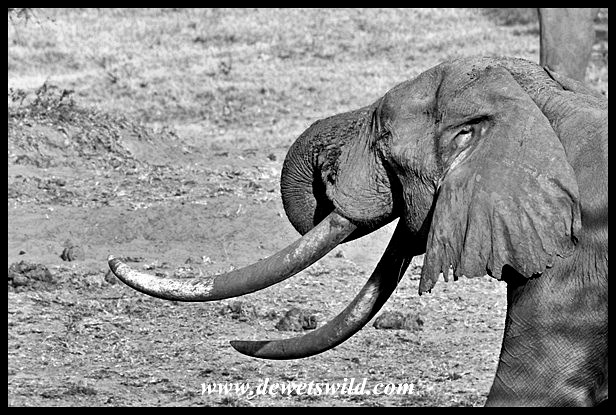
Kruger is famous for its big tuskers, and we were fortunate again to encounter about half-a-dozen bulls carrying above average ivory. We always cherish sightings of bulls this size as they’re living proof of the successes of those working very hard, day in and day out, to preserve and protect our natural heritage. The Park has a dedicated researcher monitoring these enigmatic animals, to whom you can submit photos and the location of any sightings.


If you love elephants as much as we do, then head for the north of the Kruger National Park. You are sure to have some special encounters, and if you treat them with respect, heed their body language and don’t invade their space, you’ll be perfectly safe.

Shingwedzi jungle-gym

Boisterous Baby Baboons

Driving around the Kruger National Park, especially along one of the major rivercourses, you’re bound to come across a troop or two of baboons. Watching their behaviour and especially their human-like interactions is extremely entertaining.

We encountered this little group one afternoon along the Shingwedzi River, during our September 2014 visit. While the big male watched, sometimes with what seemed like considerable concern for their well-being, the energetic little ones were clambering into a small tree and jumping down again, over and over again, their happiness clearly written all over their faces…


Elephant mayhem at Mooiplaas

Marvelous Mooiplaas

There’s several waterholes in the Kruger National Park that have delivered us consistently good wildlife sightings over the years. One such drinking place is Mooiplaas, an artificial waterhole supplied by a borehole and windpump, adjacent to a natural wetland, about 5km to the south of Mopani Rest Camp. Directly translated from Afrikaans, Mooiplaas means “pretty farm”. The waterhole undeniably lives up to its name both in scenery and for the constant stream of birds and animals moving from the surrounding mopane vegetation to slake their thirst.

We visited Mooiplaas again on Heritage Day (24th September) while on our most recent visit to the Park. We arrived in the heat of the day, and found the place brimming with animals. Elephants, tsessebe, zebras, wildebeest, ostriches and a lone kori bustard were milling around, and from their behaviour we deduced that there must be predators around. Sure enough, in a clump of mopane shrubs, we saw two lions hiding from the heat; the female just out in the open enough to get photographic proof. It was obvious that these lions were not interested in hunting, and the animals could safely venture to the water for the moment. A young elephant bull caused a bit of an uproar among the plains game when he caught the lion’s smell on the wind, and started running around wildly, kicking up dust as he went.

After checking in for our night at Shipandani Hide, we decided to stop by Mooiplaas again in the late afternoon, and found that the lions had still not moved from their shady hideout. A group of elephant bulls were drinking from the reservoir, and a variety of birds were searching for food in the dust, but there was no sign of the large herds of zebra and antelope that frequented the area earlier in the day. Perhaps they understood that the lions would not be resting for much longer…

Throughout the night in the hide we could hear the lions roaring towards Mooiplaas, and of course that’s where we headed as soon as the gates opened. If the lions had made a kill during the night, the carcass wasn’t anywhere we could see it, and we had to be content with a far-off sighting of two large males lying in the grass some distance from the otherwise deserted waterhole.

Mooiplaas_25Sep2014

All too soon we had to leave, as we were heading for Shingwedzi and still had to return the keys for the hide to the reception at Mopani. Leaving Mooiplaas behind, we knew there would be more wildlife spectacles unfolding there that day. And we knew we’d return to Mooiplaas again as soon as we have the chance…


Memorable sighting: Cheetahs near Shingwedzi, 27 September 2014

Memorable sighting: Cheetahs near Shingwedzi, 27 September 2014

At the end of a hot Lowveld afternoon, we’re enjoying a slow drive along the Shingwedzi River, as has become our habit every time our visits to Shingwedzi Rest Camp come to an end. This route, the gravel S50, is our absolute favourite road in the Kruger National Park and we’re taking in as much of the magical wilderness atmosphere as we can. After enjoying snacks and a cold drink in deep, cool, shade next to the Tshilonde waterhole, it’s time to head back towards camp.

Only minutes later, turning a corner near the Ntsumaneni Spruit crossing, we spy a feline shape next to the road… We’re thrilled to find two cheetahs waiting by the roadside, and our excitement grows tenfold as a third, fourth and then fifth make their way out of the mopane bushes towards us. With no other cars around, we find ourselves in the company of what we assume is a female with her four almost fully-grown cubs, a rare sighting indeed. The cheetahs seem nervous, constantly staring back towards the vegetation they emerged from, and do not hang around very long before crossing the road and heading into the bush again, disappearing from sight. We may have spent only a few minutes with these lithe cats, but it is another Kruger memory we’ll cherish for as long as we live.
(You may click on any of the images to view them in bigger resolution)

The Endangered Wildlife Trust in conjunction with the SANParks Honorary Rangers, is conducting a census of Kruger Park’s cheetahs and wild dogs, and inviting visitors to contribute to the project by submitting photos of these species they encounter between September 2014 and June 2015. Of course, we’ve already sent in our submission!

The second male to appear was a beautiful specimen
Memorable lion sighting near Skukuza, 3 August 2014

It was late afternoon on the 3rd of August, and the sun was slowly setting on our first day back in the Kruger National Park. We were enjoying a leisurely drive along the Sabie River, taking in the deep calming atmosphere that comes with sunset in a magnificent natural setting like this, about 5km from Skukuza Rest Camp.

Unexpectedly, a young elephant ran across the road towards the river, trumpeting loudly and shaking his ears and trunk around, clearly extremely agitated. From a short side loop, we watched as he flushed a pride of lions from the reeds, quite some distance from the road.

The young elephant that started the show

The young elephant that started the show

Noticing that the lions will now be making their way towards the road, we anticipate where they’ll be moving out of the river bed and position our vehicle in that spot. We have to wait only a minute or two before noticing the first feline shapes appearing among the riverine vegetation, much closer to the road already. The lions are coming, and they are heading straight for us!

One by one, the entire pride of about fifteen animals, including three magnificent males, pass right beside us, crosses the road and moves into the bush on the opposite side. We watch enthralled from inside our vehicle as the big cats move by close enough to stroke (though of course, that would be very foolish to even attempt!).

(You can click on the photos to view them in a gallery, for a bigger view – we’re sure you won’t be sorry that you did 😉 )

Kruger welcomed us back in the most emphatic way imaginable. What else did it have in store for us in the nine days ahead? We hope you’ll join us again to find out!


Bowling for Buzzards!

This afternoon, watching from the hide at the Golden Gate vulture restaurant*, I was treated to one of the most entertaining sequences of animal interaction I have ever experienced!

A pair of black-backed jackals were protecting the last scraps of a carcass with everything they had against a group of Cape griffons.

Bowling for Buzzards_3192

Bowling for Buzzards_3193

Bowling for Buzzards_3195

Bowling for Buzzards_3196

I couldn’t help but think of the “bowling for buzzards” scene in the animated Disney movie “The Lion King” where meerkat Timon and warthog Pumbaa save little Simba by rushing into the huddle of vultures surrounding the lion cub!

Bowling for Buzzards_3218

Bowling for Buzzards_3219

Bowling for Buzzards_3220

Bowling for Buzzards_3221

A “Vulture Restaurant” is a feeding station where carcasses are made available for vultures in safe places to mitigate the risk of them feeding on poisoned carcasses elsewhere.

Isilo of Tembe

In the presence of majesty

It’s mid-afternoon at Tembe Elephant Park, and we’re watching a number of elephant bulls milling around Mahlasela Pan. Occasionally the peaceful scene is disturbed by two or more of the younger bulls mock-fighting and testing one another’s strength with heads held high and tusks and trunks interlocked, sending nervous nyalas and impalas running for cover…

Isilo_1657

Slowly, royally, a magnificent tusker moves out from behind a clump of bushes to drink from the pan. The day before, when our guide Patrick asked us what we’d most like to see at Tembe I was very quick in replying “Isilo please!”. And now, perched in the game-viewing vehicle, we’re speechlessly admiring South Africa’s biggest living tusker – a wish granted, a prayer answered. We’re looking upon one of the most awesome animals in all creation and nothing could wipe the smile from our faces.

Isilo_1645

Isilo. “The King”. What an apt name.

Isilo_1650

We watch enthralled as Isilo moves around the pan, stopping often to quench what must be a massive thirst. The old gentleman is looking frail; at an estimated sixty years of age, he’d be having trouble eating the woody vegetation that has sustained him all his life. His tusks must weigh about 60 kilograms each, and in excess of 2.5 meters in length – what a strain it must be on the neck to keep those massive ivory pillars from scraping on the ground as he moves. Yet there’s no feeling of pity. This is the King!

Isilo_1693

Isilo_1702

Isilo_1737

Isilo_1801

Taking his leave now of the pan and the younger company around it, Isilo ambles westwards into the woodland. We follow alongside, hoping to spend as much time in his audience as he will allow. Occasionally he stops to enjoy a tender creeper or succulent young shoot.

Isilo_1815

Isilo_1824

Isilo_1830

My heart skips a beat as Isilo turns towards us, moving ever closer, gently and peacefully passing within touching distance of the admiring humans in the game-viewing vehicle. No one says a word. There’s no need to; the expressions on our faces tell the full story.

Isilo_1840

As we follow a while, Isilo slowly walking along the sandy track into the sunset, there’s no denying that we’ve spent a tiny fraction of our lives in the presence of majesty. Sala kahle Isilo. Stay well.

Isilo_1858

We went to Tembe Elephant Park in search of Isilo, and it was every bit the exhilarating experience we had hoped it would be. But Tembe turned out to be so much more: have a read here for more of our impressions of this South African treasure.

If you’re interested in South Africa’s big tuskers, you can see more pictures of these magnificent animals, from the Kruger National Park this time, here and here.

Kruger’s Big Tuskers

There’s more than 14,000 elephants in the Kruger National Park, and of course they are a big drawcard for visitors to this game reserve, being charismatic animals and members of the famed “Big 5”.

For us too, encountering elephants is always a special treat: witnessing the interactions between different herd members or the playful antics of the calves, and there’s few things in nature as beautiful as the gait of a confident elephant bull, his massive head swaying from side to side,  intent on ensuring anything and everything in his way clears out before he gets there.

The Kruger Park is known as one of the few remaining places on the African continent where you still have the chance to see elephants carrying impressive tusks, sometimes in excess of 2 or even 3 metres in length and weighing anything between 40 and 70kg. In the Letaba Rest Camp there’s a fascinating  museum dedicated to the elephant, where visitors can also marvel at the tusks of some of Kruger’s most famous tuskers.

Over the years, we’ve been extremely fortunate to have encountered a handful of these living monuments while exploring the Kruger National Park, especially in the northern regions of the park in the vicinity of Shingwedzi, Letaba and Mopani Rest Camps. Traditionally, these remarkable giants are given distinctive names, either for the area they roam or in honour of Kruger staff members who have dedicated their lives to the protection of this special place.

Eventhough I was then only a child travelling to the Kruger Park with my parents, long before the advent of cheap (digital) photographic equipment, encounters with the magnificent Mandleve and Mabarule will live in my memory forever.

The photographs we’re sharing here are more recent. In January 2006, Marilize and I became two of the very small number of people to have had the honour of seeing Masbambela -we’ve already posted some pictures of him in a previous post (here)

MASBAMBELA_JAN06

Masbambela

Our sighting of Ngunyupezi in April 2007, when the whole de Wet clan went camping at Shingwedzi, was just as special – it was only the second officially recorded sighting of this enigmatic bull, whose left tusk characteristically grows almost straight down. At one point he charged at us, head held high and that straight tusk leading the way like the lance of a medieval knight! Ngunyupezi is still seen in the Shingwedzi area from time to time.

Ngunyupezi_APR07

Ngunyupezi

Hlanganini was a well-known tusker, regularly seen around Letaba Rest Camp. This is also where we met him, in September 2007. Hlanganini died a couple of years ago, following a fight with another bull.

HLANGANINI_SEP07

Hlanganini

During a visit in June 2011, my brother Niel and I came accross two of the new generation of Kruger  Tuskers: Machachule, right at Shingwedzi’s back gate, and Masanana, near Letaba.

Machachule_Jun11

Machachule

Masasana_Jun11

Masasana

We’ve already had five encounters with Masthulele, believed to be Kruger biggest tusker at the moment, over the years. This sighting was in April 2012 near Letaba, while visiting the Park with our friends the du Plessis’.

Edit: SANParks announced in September 2017 that Masthulele had died during 2016.

Masthulele_Apr12

Masthulele

During our visit in September of 2012 we were lucky to see two more tuskers: Mandzemba welcomed us back to our beloved Shingwedzi, while Ngodzi bade us farewell us we departed from Mopani. These two tuskers haven’t been named “officially” by Kruger’s management (yet) and their names are, for now, derived from waterholes found in their home ranges.

Mandzemba_Sep12

Mandzemba

Ngodzi_Sep12

Ngodzi

Everytime we visit the Kruger Park, we hope for another special appearance by one of these majestic animals. It may be years before we are fortunate to have our path cross one of theirs again, but when it happens it will surely be another thrilling experience!