Category Archives: Memorable sightings

Limpopo Ramble 2022: Pel’s Fishing Owl

Now, searching for the Pel’s Fishing Owl can make you feel like Indiana Jones searching for some long lost artefact only to be thwarted at every turn. We have spent many, many hours over the years slowly driving through prime habitat in search of this elusive bird and have always come off second best.

Upon arrival at Mapungubwe National Park on the 25th of June, and while completing the usual formalities at the entrance gate, I enquired about whether there had been any recent sightings of Fishing Owls in the Park and whether we might book a special guided drive to search for them in case there was. Without hesitation the kind receptionist picked up the phone, and minutes later we were being escorted down to the banks of the Limpopo River by Leonard Luula, one of the excellent guides at Mapungubwe.

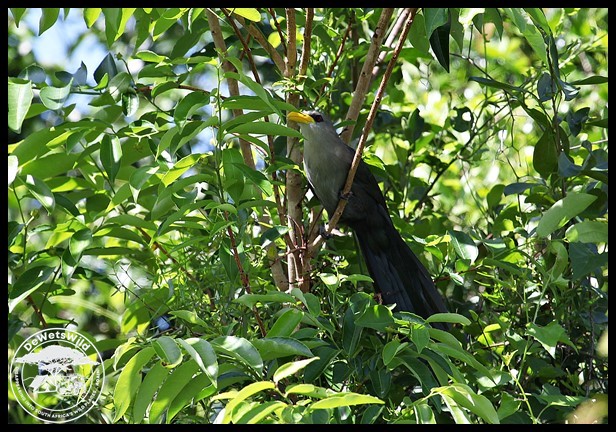
Leonard’s expert eye quickly picked out the bird that has eluded us for so long sitting in a tall riparian tree. We were ecstatic.

We went back to the same area early the following day and were very grateful to see the owl once again before it shuffled out of view along its perch to behind the screen of leaves.

Scotopelia peli

As its name suggests, the Pel’s Fishing Owl subsists on a diet of fish (and the occasional frog, crab and even baby crocodile!) which it catches at night by swooping down over the water to snatch its prey from it. They live in riverine forests on the banks of large rivers and swamps.

Pel’s Fishing Owl usually nests in deep cavities or old hamerkop nests in tall trees near the water’s edge, mainly during the months of summer and autumn. The female incubates the clutch of two eggs for around 5 weeks while being provided food by the male. Both eggs usually hatch, but only one chick survives to fledging as the parents feed mainly the stronger chick and neglect the weaker, which dies of starvation within a few days of hatching. The chick remains in the nest for almost 10 weeks and is dependent on its parents for up to 9 months months after fledging. Due to it taking so long to raise a chick, pairs generally breed only every second year.

Pel’s Fishing Owl is the second largest owl on the African continent (after Verreaux’s Eagle-Owl). Adults have a wingspan of around 1.5m, sit about 60cm tall, and weigh approximately 2kg. Their call can be heard up to 3km away.

While overall Pel’s Fishing Owl is considered to be of least concern, it is listed as endangered in South Africa, with a population estimated at only between 70 and 100 mature individuals. Here, these enigmatic birds are found in the north of Kwazulu-Natal, along large Lowveld rivers – notably the Olifants and Luvuvhu – and along the course of the Limpopo on the border with Zimbabwe and Botswana. Thankfully, most of this restricted range is covered by formal protected areas, such as the iSimangaliso Wetland Park, Kruger National Park and of course Mapungubwe National Park. They are very sensitive to human disturbance and threatened by habitat loss. Beyond our borders, Pel’s Fishing Owls are found widely, if somewhat patchily, over much of sub-Saharan Africa.

Autumn Adventure – Boys will be boys, even if they’re lions

Early into the third morning of our latest visit to the Hluhluwe-Imfolozi Park, we happened upon a pride of lions on the bank of the Hluhluwe River at a spot called Sitezi. Most members of the pride quickly walked past, but at the rear of the family were three teenage males with boundless energy! They had great fun, and so were we watching them with cameras clicking away.

Autumn Adventure – Bouncy Baboons

On our way to the Memorial Gate on the 2nd of April, as we were heading home from a wonderful week in Hluhluwe-Imfolozi Park, we got distracted by these rambunctious Baboons! I think they must’ve watched a rugby game at some point…

With one exception, these are all Joubert’s photographs.

Autumn Adventure – Warthog Mud Spa

There must have been a special on offer on mud spa treatments at the uBhejane Hide while we were visiting the Hluhluwe-Imfolozi Park in March this year, and the Warthogs were queuing for their turn!

Autumn Adventure – Eastern Natal Green Snake at Kumasinga Hide

While we were spending a full day at Kumasinga Hide in uMkhuze Game Reserve on the 21st of March, this lovely Eastern Natal Green Snake caused quite a stir among the human visitors to the hide. I should add that the fear was entirely needless, as this species is absolutely harmless to humans, although it will bite in self-defense if you try to pick it up. It was clear that this snake was very used to having people around his home as it wasn’t nearly as frazzled as the humans were…

Later in the day the snake returned to make another appearance. Owing to its relaxed disposition it was easy for us to get another few photographs before it moved off.

Autumn Adventure – A day at Kumasinga

The first place we went to after arriving at the uMkhuze Game Reserve on the 19th of March (well, after we checked into our chalet in Mantuma Camp) was the Kumasinga Hide; in our opinion one of the best photographic hides available in any of South Africa’s public reserves. Before our trip we had planned to spend a day in the hide if conditions seemed right, so when Joubert got these photographs of European Bee-eaters splashing in the waterhole our minds were made up.

On the 21st of March, a public holiday in South Africa, we set out from Mantuma Camp at 5am when the gates opened and headed straight for Kumasinga Hide, only about 4km out of camp. We arrived in the pitch dark and settled in for the day ahead. Not long after, Marilize made sure we each had a bowl of porridge and a hot cup of coffee to set the day off to a great start.

Slowly the sunrise started to light the scene in front of us while birdsong started to fill the air.

With it still quiet at the waterhole but with a beautiful glow to the morning I used the opportunity to take a few pictures of the hide.

Shortly after I took my seat again, the birds started arriving for their morning drink.
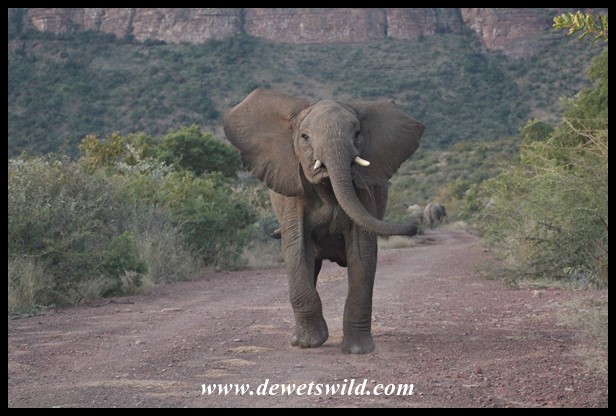
Just before 8am the first mammals (apart from us) arrived on the scene, but didn’t venture down for a drink.

For more than the next hour-and-a-half it was mostly birds providing the entertainment, with the star of the show undoubtedly being a glamorous Purple-crested Turaco.

By now it was 09:30 and the day started to heat up. Two Nyala bulls put in an appearance at opposite sides of the waterhole, making it difficult for Joubert and me, and a few other photographers who were in the hide at the time, to decide where to focus.

A lone Blue Wildebeest bull arrived as well, but didn’t stay long.

A troop of Vervet Monkeys entered the stage from the left and passed all along the edge of the waterhole to the other side.

One of the Nyala bulls had a special act in store for us. He proceeded to a particular spot on the edge of the waterhole and thoroughly covered his horns with mud. Perhaps the show was more for the benefit of other nyalas than for us.

His performance completed, the Nyala vacated the stage for the herd of Impalas that had finally mustered the courage for a drink of water.

The next actor on the Kumasinga platform really got the attention of every person in attendance with his surprise appearance. We’re going to keep a few photos of this very confiding Eastern Natal Green Snake on the backburner until the next post on de Wets Wild.

An animal that usually sticks around only for a second or two before slipping away, especially when they see a camera it seems, is the Slender Mongoose. What a wonderful opportunity to see this one so calmly going about its business all around the waterhole.

Despite the clouds building up the mid-day heat was oppressive and a seemingly constant stream of Nyalas and Impalas were now making their way to the water.

Another magnificent Nyala bull strode confidently down to the water and, after quenching his thirst, went to the same spot the other bull did earlier and proceeded to attack the mud in the same fashion.

This younger bull tried to imitate the master’s strange behaviour on a different patch of land.

Several birds also came down to the water for a drink in the heat of the day, and Joubert got some excellent practice taking photographs of birds in flight thanks to a pair of Fork-tailed Drongos regularly splashing into the waterhole to cool off.

Next, a family of Warthogs arrived noisily and, after drinking, also cooled down in the waterhole as if they didn’t have a care in the world.

Around 1pm another big Nyala bull, strutting his stuff for all his rivals, had his drink and then proceeded to, as the others before him, cover his horns with mud at the designated spot.

Shortly after the flock of European Bee-eaters came around the waterhole again, allowing Joubert another chance to get shots of them as they cooled down in the dark water.

Traffic at the waterhole gradually decreased as the afternoon wore on…

but our slithery friend paid us another visit!

By dusk only the Marsh Terrapins were still around to keep us company.

And by the time darkness fell, and a leopard started rasping behind us (in the same general direction as the car!) it was time for us to head back to camp.


Autumn Adventure: Butterflies in abundance

Whenever we get a chance to explore South Africa’s wild places I am amazed at the variety and number of butterflies that are on show. This certainly was the case again when we visited the iSimangaliso Wetland Park and Hluhluwe-Imfolozi Park in March this year.

Autumn Adventure: Something Fishy

You can’t really say that you’ve been to Cape Vidal in the iSimangaliso Wetland Park if you haven’t spent at least a little time exploring the rock pools there and at Mission Rocks at low tide.

Seeing freshwater fish without casting a line is a little more tricky than peering into a rock pool, but the viewing platforms next to uMkhuze Game Reserve’s Nsumo Pan – and the pan’s clear water – makes it possible to see fish like these Red-breast Tilapia easily from above.

Autumn Adventure: Flirtatious Lion

I can’t be sure of course, but I think this young lion we saw in March while visiting the Hluhluwe-Imfolozi Park was only this charming because he wanted us to hang around for breakfast…

Autumn Adventure – Elephants: Cape Vidal’s Highway Patrol

Over the years we’ve visited Cape Vidal, in the iSimangaliso Wetland Park, many times – our most recent visit was the twelfth time I had been there – but up until this latest visit we’ve only had one fleeting sighting of an Elephant there before. Seeing them so frequently this time around was therefore a real treat! It must be noted that the elephants roaming the shores of Lake St. Lucia have a reputation for cantankerous temperaments; this year January a family were lucky to escape without serious injury when a bull flipped their car on the main road leading to Cape Vidal, and so it goes without saying that we treat them with the utmost respect.

Soon after arriving through the Bhangazi Gate on the 23rd of March we took a detour along the Vlei Loop, where we had our first encounter with a herd of elephants emerging from a dense thicket into the road. Aside from one youngster who wanted to show off his menacing moves, this encounter went off calmly and without incident.

Where the Vlei Loop rejoins the main road we found a lone bull on his way to the iZindondwe Pan, and we couldn’t believe our luck!

After the bull walked off from his drink we got underway ourselves again, only to find the herd of elephants now also at the junction with the Vlei Loop. They were still very calm, though the older cows were keeping a vigilant eye on us, and we could watch them at leisure from our Duster. We especially enjoyed a youngster having a good scratch on a road marker! Eventually the matriarch gave the signal and the entire herd set off in the direction of Mission Rocks.

Well, we thought that it was the entire herd, but as we started rolling this frantic youngster came charging from the thick bush along the road. These “teenage” elephants can be real pranksters so there’s no telling whether he “ambushed” us or were really feeling lost having fallen behind the rest of his herd.

The next morning we were heading to St. Lucia town to stock up on groceries, and just after our picnic breakfast at Mission Rocks we found the herd blocking our way yet again. This time they were solidly laying claim to the road and we were not going to argue their right of way. Besides, elephants walking towards you always make better pictures than elephants walking away!

Eventually the herd reversed us back all the way to the Mission Rocks turnoff, and we thought that was a splendid spot to get out of their way and watch the parade pass in front of us.

What we didn’t know was that a portion of the herd decided to do some bundu-bashing and emerged from the forest immediately next to the spot we chose to watch their family members walk along the road. We very quickly had to start the car and get out of their way, because now THEIR way was blocked by US and they were not happy!

Once the road was clear ahead of us we could return to the junction. Looking right we could see the herd moving along in the direction of Cape Vidal, but as we turned left in the direction of Bhangazi Gate and St. Lucia town, we were stopped in our tracks again by two young stragglers chasing each other around.

Altogether we saw elephants 6 times during our 3 days on the eastern shores of Lake St. Lucia. We felt really lucky, and know that next time we visit we’re going to recall all these encounters every time we pass the same spots.

Elephant herd blocking the road…again!