Category Archives: Limpopo Province

Our experiences in the reserves of Limpopo, South Africa

Limpopo Ramble 2022: The Kingdom of Mapungubwe

Mapungubwe Hill and the valleys around it, today part of the Mapungubwe National Park and World Heritage Site, was the seat of a powerful African Kingdom that ruled between 1,100 and 700 years ago. Mapungubwe Hill is by far South Africa’s most important iron age archeological site and can be visited on guided tours.

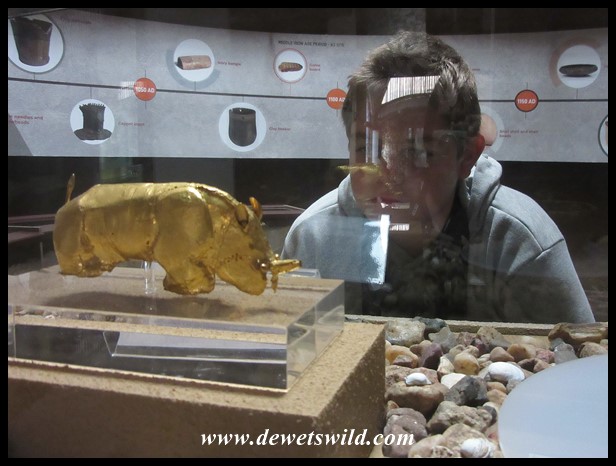
The Interpretive Centre at Mapungubwe, itself an award-winning architectural marvel, provides a fascinating glimpse into the daily lives of the people who lived in the Kingdom of Mapungubwe. Royalty ruled from atop the hill, with their subjects living below. The Kingdom’s riches were based on gold and ivory, traded with cultures from as far afield as Persia and China through a trade route leading through the east coast of Africa. Mapungubwe means  “Place where rock turns into liquid” in reference to the smelting of gold practiced by the country’s citizens.

The rich archeological treasures of Mapungubwe were re-discovered in 1933. Having been recognised formally as a National Monument in 1984, the Mapungubwe Cultural Landscape was inscribed as a Unesco World Heritage Site in 2003.

Limpopo Ramble 2022: The Land of the Giants

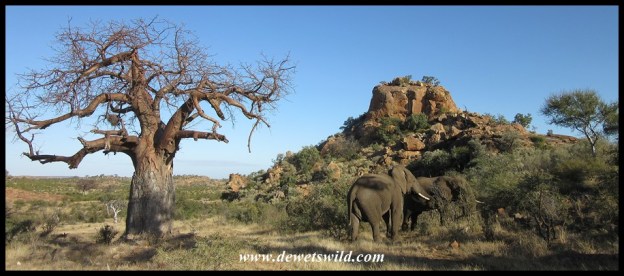
In the Mapungubwe National Park, three aspects are truly iconic of this landscape: Elephants, baobabs, and rocky hills and cliffs. It’s as if the entire atmosphere of the Park hinges on these key natural attributes.

Mapungubwe, situated as it is at the place where the borders of South Africa, Botswana and Zimbabwe meet, has a high population of elephants and especially so when the dry season concentrate the behemoths along the banks of the Limpopo River. From families of cows and tiny calves to enormous bulls can all be expected along any of the roads traversing the Park, and sometimes waiting for these charismatic animals to clear the way can be a very entertaining delay. At other times, the dense mopane veld may lead to you inadvertently finding yourself in the personal space of one of the giants and they might react with more than a little agitation!

The Elephants even move through Mapungubwe’s unfenced main camp Leokwe, as we experienced one evening upon arriving at out cottage.

Baobabs are the undisputable rulers of Mapungubwe’s plant kingdom. With this part of the world now firmly in Winter’s grip, the trees are mostly leafless, lending more credence to the myth that the Creator tossed them to earth, planting them upside down. Elephants have a paticular liking for the pulpy wood of the baobab, and many of Mapungubwe’s trees show damage as a result, leading to the Park authorities protecting some prime specimens by using wire as wrapping around their trunks (those of the trees, not those of the elephants 😉 )

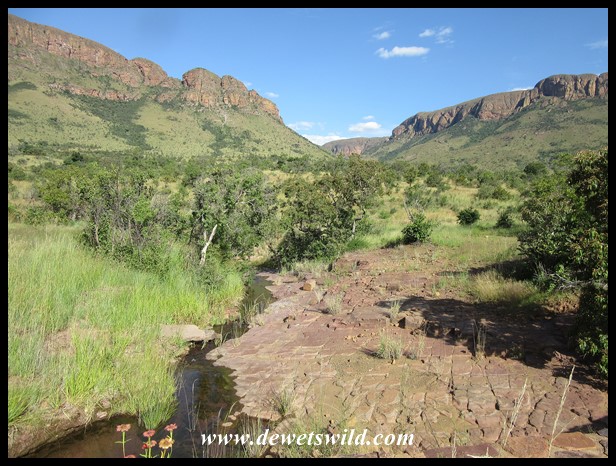
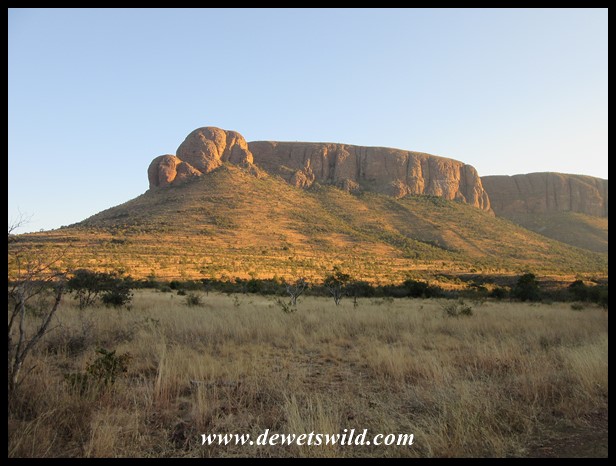
On the largest scale of all, it is the rocky, hilly landscapes that really forms the basis of Mapungubwe’s ancient atmosphere. The hills are composed mainly of dolerite – the remains of molten rock pushed up from deep inside the earth through sandstone that has long since weathered away to leave only the harder volcanic geology visible.

Limpopo Ramble 2022: Hungry Honeymooners

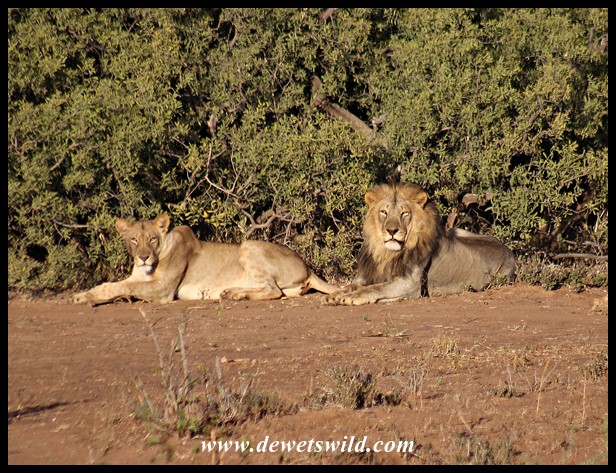
During our recent visit to Mapungubwe National Park we left the environs of Leokwe Camp early one morning to go and explore the western reaches of the Park around the Maloutswa Pan, near the Limpopo Forest Tented Camp and Mazhou Camping Site. We were already close to our destination when we came across a mating pair of lions enjoying the early morning sun.

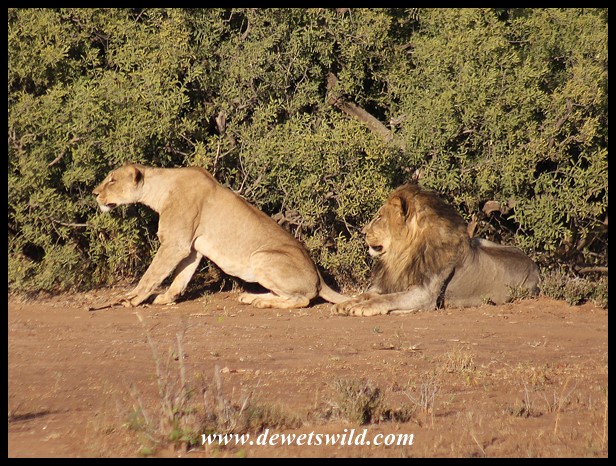
Mating pair of Lions

The female especially was interested in (we thought) a herd of impala grazing nearby, and got up to sneak out of view followed by the male. Anticipating an impending attack on the impalas, we positioned our vehicle for a clear view of the antelope grazing entirely unaware of the danger lurking nearby.

What we didn’t see, but the lions did, was a family of warthogs. When next we saw the lions they were chasing the warthogs at speed across the road!

Unfortunately, or fortunately depending on which team you support!, the warthogs were too quick for the lions, and the honeymoon pair had to continue searching for their next breakfast opportunity.


Limpopo Ramble 2022: Pel’s Fishing Owl

Now, searching for the Pel’s Fishing Owl can make you feel like Indiana Jones searching for some long lost artefact only to be thwarted at every turn. We have spent many, many hours over the years slowly driving through prime habitat in search of this elusive bird and have always come off second best.

Upon arrival at Mapungubwe National Park on the 25th of June, and while completing the usual formalities at the entrance gate, I enquired about whether there had been any recent sightings of Fishing Owls in the Park and whether we might book a special guided drive to search for them in case there was. Without hesitation the kind receptionist picked up the phone, and minutes later we were being escorted down to the banks of the Limpopo River by Leonard Luula, one of the excellent guides at Mapungubwe.

Leonard’s expert eye quickly picked out the bird that has eluded us for so long sitting in a tall riparian tree. We were ecstatic.

We went back to the same area early the following day and were very grateful to see the owl once again before it shuffled out of view along its perch to behind the screen of leaves.

Scotopelia peli

As its name suggests, the Pel’s Fishing Owl subsists on a diet of fish (and the occasional frog, crab and even baby crocodile!) which it catches at night by swooping down over the water to snatch its prey from it. They live in riverine forests on the banks of large rivers and swamps.

Pel’s Fishing Owl usually nests in deep cavities or old hamerkop nests in tall trees near the water’s edge, mainly during the months of summer and autumn. The female incubates the clutch of two eggs for around 5 weeks while being provided food by the male. Both eggs usually hatch, but only one chick survives to fledging as the parents feed mainly the stronger chick and neglect the weaker, which dies of starvation within a few days of hatching. The chick remains in the nest for almost 10 weeks and is dependent on its parents for up to 9 months months after fledging. Due to it taking so long to raise a chick, pairs generally breed only every second year.

Pel’s Fishing Owl is the second largest owl on the African continent (after Verreaux’s Eagle-Owl). Adults have a wingspan of around 1.5m, sit about 60cm tall, and weigh approximately 2kg. Their call can be heard up to 3km away.

While overall Pel’s Fishing Owl is considered to be of least concern, it is listed as endangered in South Africa, with a population estimated at only between 70 and 100 mature individuals. Here, these enigmatic birds are found in the north of Kwazulu-Natal, along large Lowveld rivers – notably the Olifants and Luvuvhu – and along the course of the Limpopo on the border with Zimbabwe and Botswana. Thankfully, most of this restricted range is covered by formal protected areas, such as the iSimangaliso Wetland Park, Kruger National Park and of course Mapungubwe National Park. They are very sensitive to human disturbance and threatened by habitat loss. Beyond our borders, Pel’s Fishing Owls are found widely, if somewhat patchily, over much of sub-Saharan Africa.

Limpopo Ramble 2022

We’re fresh back from our visits to two of the lesser known National Parks in South Africa’s Limpopo Province; Mapungubwe and Marakele. We had a wonderful time and have lots of stories and photos to share in the coming weeks. This is just a little teaser.

Mapungubwe National Park 25-29 June 2022

Marakele National Park 29 June to 3 July 2022

Marakele in February

In Middle February we had the opportunity of a quick weekend visit to the Marakele National Park in the Waterberg of Limpopo Province. With us still experiencing a good rainy season here in the north of the country, the Park’s scenery was lush and green and it was good to see the Waterberg (Water Mountain) living up to its name.

We were booked into Tlopi Tented Camp again, and with its wonderful view of the dam and mountains beyond and an abundance of animal life all around it was as near to heaven as can be imagined.

On Saturday afternoon we explored the plains and foothills of this section of the Park. Animals were to be seen in abundance, but the amazing scenery also kept clamouring for attention.

Some very interesting insects came to visit our fully-equipped safari tent after dark.

At dawn on Sunday morning there was just one place we wanted to go; up to the Lenong Viewpoint atop the Waterberg. The narrow, steep, winding road that takes you there, the immense vistas and the fresh air up there takes our breath away every time. 

Eventually we had to descend from the mountain, go back to Tlopi to pack our belongings, and head for home – at least we could console ourselves with a few hours drive through the Park to get to the gate and the outside world.

Our 2021 In Pictures

Take a look back with us at the wonderfully wild South African places we visited in 2021.


Springtime rejuvenation at Nylsvley

Monday the 1st of November was a declared public holiday in South Africa, to allow for the running of the municipal elections. Of course this little gift of a long weekend was too good to pass up, so the de Wets headed north into the Bushveld for a two night visit to the Nylsvley Nature Reserve – one of our country’s most highly-rated bird watching destinations.

True to its reputation, Nylsvley delivered abundantly on the bird front during our visit, despite the fact that many of the summer regulars haven’t arrived in South Africa yet and despite most of the wetlands being completely dry at the end of the dry season. We managed to tick 82 species of birds without trying very hard.

Besides the birds, another reason to visit Nylsvley is the sizable populations of three of South Africa’s rarer antelope species that are found here: Southern Reedbuck, Roan Antelope, and Tsessebe.

These antelope were just some of the 25 kinds of mammals we encountered during the 48 hours or so we spent at Nylsvley, ranging from bats, squirrels and mice to lofty giraffes.

We found a little waterhole that was well frequented by the reserve’s giraffes, and had great fun photographing the giants as they stooped to drink.

Even on a smaller scale, Nylsvley has so much to offer!

If you’d like to learn more about Nylsvley you are welcome to have a read through a previous post we did on the reserve following a visit in 2017.

Entrance Gate at Nylsvley Nature Reserve

And don’t worry – Marilize and I performed our civic duty by casting our votes as soon as we got back to Pretoria on Monday afternoon. 😉

Surprise Weekend at Marakele; Sunday 13 June 2021

It was the morning after Marilize’s milestone birthday, which unfortunately coincided with South Africa experiencing a “third wave” of Covid-19 infections precluding any big commemoration with the extended family and friends. It was up to me and Joubert to make the event memorable, so we surprised Marilize with a weekend breakaway to Marakele National Park.

Having spent all day Saturday at our comfortable safari tent overlooking the dam at Tlopi Tented Camp, we decided to prolong our departure back home to Pretoria on Sunday by exploring the roads leading through the Marakele National Park before checking out. There were lots of animals and birds to be seen, but it is Marakele’s awe-inspiring scenery that steals the show every time!

Check-out time at Tlopi Tented Camp is at 10:00 in the morning. While I was packing the Duster, Joubert was keeping an eye out for thieving monkeys and getting some final photographs of life in and around Tlopi.

It was time to head for the gate. Along the way we detoured to the Bolonoto Pan and the graves of the Coetzee family, but no matter how we tried we just couldn’t stretch our weekend any further. Around midday we handed back the key for Tlopi unit 10 to the friendly reception staff and said our goodbyes to Marakele National Park, till next time.

Surprise Weekend at Marakele; Baby Elephant Rescue!

We were still watching the herd of elephants calmly going about their business on the shores of the dam at Tlopi Tented Camp in Marakele National Park on Marilize’s birthday, when suddenly there was a tremendous uproar in the herd.

Cows were trumpeting in panic and rushing to a specific spot, while one particular youngster was screaming blue murder and running away from the same place as quickly as the grown-ups were approaching.

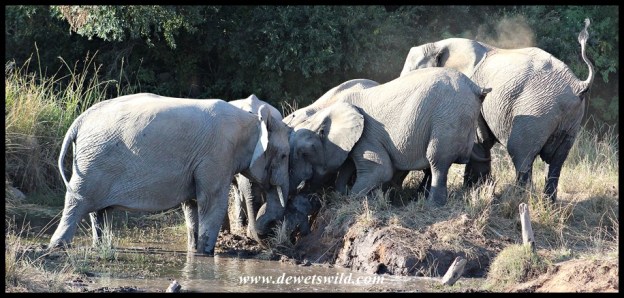
It quickly became apparent that a tiny baby had fallen down a small embankment and into the mud at the edge of the pool, struggling to get up. Within seconds the adult cows were lending either a helping foot or trunk and the baby was lifted to safety.

While we didn’t see how the baby ended up in the mud to begin with, from their reaction to the youngster that fled the scene earlier, and who was still screeching to high heaven but now circled back to the group of cows where they were soothing the upset baby, it was rather clear who the adult elephants thought carried the blame for the incident!