Almost 180 years ago, the Voortrekkers on their Great Trek northwards (away from the British colony in the Cape), reached what they thought was the source of the River Nile in what is today South Africa’s Limpopo Province. Of course they were still thousands of miles away from the real Nile, but the name stuck.
Our Nyl River is a minor tributary of the Limpopo, but forms one of South Africa’s largest and most pristine wetland areas – an area 70km long and 7km wide at its widest point. In years of exceptional rainfall (normally about once in ten years) the total inundated area covers as much as 160km². In 1974 the provincial government established the Nylsvley Nature Reserve (39km² in size) to protect a portion of this delicate ecosystem, which was recognised as a wetland of international importance under the Ramsar convention in 1998.

Nylsvley sunrise

Nylsvley sunrise
Joubert and I decided to pay the reserve a quick one night visit this past weekend.
Nylsvley’s motto reads “Nylsvley is for the birds” and considering that this relatively small reserve has an impressive list of over 380 recorded bird species, it is certainly most fitting. Nylsvley is an important breeding habitat for over 100 kinds of waterbirds (more than any other wetland in the country), many of which is considered rare or range restricted in South Africa. While the rainy season hasn’t yet started and most summer migrants are yet to arrive, we still managed to identify 79 species of birds in the little over 24 hours we spent at Nylsvley. We’d dearly want to return in late summer, once the wetland has been flooded, in anticipation of the spectacle of a reported 80,000 waterbirds congregating at Nylsvley.

Rufous-naped Lark

African Snipe

Amethyst Sunbird

Black-chested Snake Eagle

Black-collared Barbet

Cardinal Woodpecker

Coqui Francolin (female)

Coqui Francolin (male)

Crested Francolins

Fork-tailed Drongo

Glossy Ibises in flight over Vogelfontein

Golden-tailed Woodpecker

Grey Go-away Bird

Grey Heron

African Grey Hornbill

Blue-billed Teals

Lizard Buzzard

Marabous circling above Vogelfontein

Northern Black Korhaan

Orange-breasted Bushshrike and Chinspot Batis

Ostrich family

Secretary Bird

Southern Black Tit

Southern Boubou

Large congregation of Spur-winged Geese at Vogelfontein

Spur-winged Goose coming in to land

Swainson’s Spurfowl

Well camouflaged White-browed Scrub Robin

White-throated Swallow

Southern Yellow-billed Hornbill
And while pride of place at Nylsvley really does go to the birdlife, the reserve is also home to thousands of invertebrate species (including 55 kinds of dragonflies and 194 kinds of butterflies), 13 kinds of fish, 23 kinds of amphibians, 58 reptile species (including many venomous snakes, so wear sensible shoes when hiking!) and 77 species of mammals (among which sizable populations of rare roan antelope and tsessebe). Vegetation comprises broad-leaved woodlands, thornveld, grassland and of course the floodplains, and over 600 species of plant have been recorded in the reserve.

Blue wildebeest

Bushbuck

Tower of giraffes

Giraffe

Big herd of roan antelope on the floodplain at Vogelfonteinin Nylsvley Nature Reserve

Roan Antelope Bull

Scrub Hare

Steenbok ewe

Tsessebes

Warthog

Waterbuck bull
Nylsvley Nature Reserve falls under the jurisdiction of the Limpopo Department of Economic Development, Environment and Tourism, with the NGO Friends of Nylsvley playing an active role in the protection of the reserve and extended floodplain. Visitors to the reserve can overnight in the rustic camping area (6 shady sites), a dormitory with space for 36 people, or in one of the 5 chalets (4×2 bed, 1×6 bed). Other facilities in the reserve include a picnic area for day visitors, a restaurant, three bird-viewing hides, a limited road network (which can be carefully negotiated in a sedan), and an extensive network of hiking trails. The services of expert guides can be arranged through the reserve’s reception office. Most other services and shops are available in the nearby towns of Modimolle (formerly Nylstroom) and Mookgopong (Naboomspruit).

Entrance Gate at Nylsvley Nature Reserve

Nylsvley Campsite

Camping at Nylsvley Nature reserve, September 2017

What is camping without a fire?

Spoonbill Restaurant

The three “Duck Den” Chalets

The Cormorant “suite”

Heron House

Interesting directional post at the Jacana Hide

A litle pond is all that remains presently at Jacana Hide – hopefully the rains are not far off!

Crake Hide at the Vogelfontein floodplain

View over Vogelfontein wetland from Crake Hide
Nylsvley is an easy 170km away from us in Pretoria, along the N1 and R101 highways to the north.
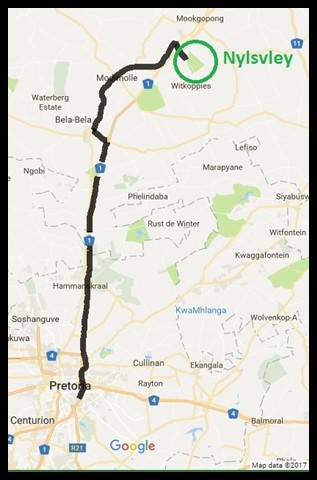
Pretoria to Nylsvley along the N1 and R101






 DeWetsWild