Author Archives: DeWetsWild

Unknown's avatar

About DeWetsWild

Nature and wildlife enthusiast and tour guide, based in Pretoria, South Africa.

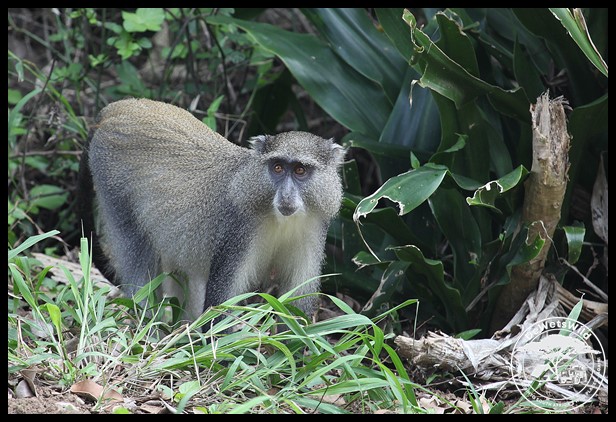
Samango Monkey

Cercopithecus mitis

The Samango Monkey is one of South Africa’s less well-known primates, being restricted to the densely vegetated habitats along the coast and adjacent hinterland of the Eastern Cape and Kwazulu-Natal and the escarpment forests of Mpumalanga and Limpopo provinces.

Samango Monkey (5)

Males are considerably stronger built than females, and weigh up to 11kg.

Samango Monkeys are to be found only in indigenous forests and on their edges, where they feed on fruits, flowers, leaves, seeds, insects, bark, eggs, nestlings and small mammals and reptiles. Troops number up to 70 individuals, though usually far fewer with 20 being the average, and are lead by between one and five adult males. They are strictly diurnal and much more arboreal than the vervet monkey, their better known and more widely distributed South African cousin. Single babies are born in the summer months. Forest predators, like leopards, crowned eagles and pythons, are their biggest natural enemies.

Known elsewhere in Africa as the Sykes’ or Blue Monkey, with several recognised subspecies, the race of Samango Monkey occurring in South Africa is considered “vulnerable” by the IUCN, as they occur mostly in small numbers in highly fragmented habitats, with little genetic exchange between subpopulations. We’ve encountered Samango Monkeys in the Hluhluwe-Imfolozi Park, Tembe Elephant Park and in the Oribi Gorge, but it is only at Cape Vidal in the iSimangaliso Wetland Park that you’d be virtually guaranteed to see this special species as they’ve become quite habituated to the human presence and boldly raid even the best protected picnic basket…

These are all camera trap photos of samango monkeys at Cape Vidal

Variegated Slug Eater

Duberria variegata

While visiting the iSimangaliso Wetland Park recently, we came across this tiny snake at  the Amazibu Hide between St. Lucia Town and Cape Vidal.

Variegated Slugeater (2) Variegated Slugeater (4)

Referring to our copy of the Field Guide to Snakes and Other Reptiles of Southern Africa (Bill Branch, Third Edition 1998), Marilize suspected it to be a Variegated or Spotted Slug Eater, an identification confirmed with the assistance of the helpful people at the SA Reptiles Forum.

These snakes are endemic to a very small piece of South Africa’s north-eastern and Mozambique’s southern coastline, occurring in dune forests and grasslands (habitat in abundance at iSimangaliso). It burrows in leaf litter and sandy substrates and, as its name suggests, feeds on slugs and snails. Females give birth to between 7 and 20 live young, about 10cm in length, in late summer, which would mean the 12cm-long specimen we encountered was still quite young (Adults grow to between 22cm and 34cm).

Just goes to show that no matter how much time you spend in natural environments, there’s always something new to discover and interesting to learn!


Seven colours make a rainbow

A beautiful double rainbow following on a magnificent thunderstorm at Glen Reenen, in the Golden Gate Highlands National Park.

ROYGBIV

ROY G. BIV” is the theme for this week’s WordPress Photo Challenge

Hungry Hungry Hippo!

Just when you thought it was safe to go back into the water…

Well, when it’s Lake Saint Lucia you’re talking about then it is never safe to go into the water, thanks to the hippos, crocodiles and sharks that populate this aquatic environment. Better to be safe ON the water then? Only if you don’t encounter this playful young hippo, seemingly intent on making a meal of the tourist launch!

Luckily for the tourists on the boat, mom intercedes and calls him to order, dispensing quick discipline hippo-style with a bite and a roll on top of the little delinquent.

This delightful scene played out while we were enjoying a guided launch-tour of Lake Saint Lucia aboard the Santa Lucia, during our recent visit to the iSimangaliso Wetland Park. We’ll share more photos and memories from the cruise in an upcoming edition of de Wets Wild.

At the end of a wonderful long weekend…

Our long weekend at the iSimangaliso Wetland Park has come to an end, but please “stay tuned” in the weeks to come as we’ll share some of our latest experiences from this spectacular world heritage site.

iSimangaliso Sunrise

No place like Cape Vidal…

Apart for Cape Vidal and the iSimangaliso Wetland Park, we can’t think of any other place in South Africa (or the world) where you can end a day of fun at the beach with a fantastic sighting of a leopard walking mere centimeters away from your car window. And that’s exactly how our day played out!

Grey-headed gull taking flight at Cape Vidal's beach

Grey-headed gull taking flight at Cape Vidal’s beach

Leopard sighting on the Grassland Loop - 15th June 2015

Leopard sighting on the Grassland Loop – 15th June 2015

St. Lucia flypast

Today we joined a tour of Lake Saint Lucia aboard the Santa Lucia cruiser, and this low level flypast by an African Fish Eagle was just one of the highlights!

St Lucia Flypast

Cape Vidal, 13 June 2015

We were the first car into the iSimangaliso Wetland Park through Bhangazi Gate this morning, before sunrise. And this leopard sighting was just one of the day’s highlights!

We’re spending three nights at picturesque Cape Vidal, and can’t wait to experience all that iSimangaliso has in stall for us tomorrow…

Cape Vidal Leopard 20150613

Time off

Time away from work and school.

Time to allow the warm glow of an African sunset to rejuvenate body and mind.

We’re spending a long weekend in the iSimangaliso Wetland Park!

Time off

Off-Season” is the theme for this week’s WordPress Photo Challenge

Waterbuck

Kobus ellipsiprymnus

The Waterbuck is the largest member of the family Reduncinae, which also includes the Southern Reedbuck, Mountain Reedbuck, Grey Rhebok and several other species occurring elsewhere in Africa.

The race occurring in South Africa, the Common Waterbuck (K.e.ellipsiprymnus) is characterised by a white circle around their tails, distinguishing them from the Defassa Waterbuck (K.e.defassa) which has a solid white patch on their posteriors. These shaggy antelope weigh up to 270kg and adult bulls are up to 1.7m high at the shoulder. The gracefully curved horns of the bulls can reach a meter in length.

As their name suggests, the waterbuck is seldom found far from a permanent water source, requiring to drink around 9 liters of water daily. Waterbuck inhabit open savannah, grasslands, floodplains, marshes and reedbeds, where they feed predominantly on long grass. They occur in mixed herds with up to sixty members, though normally much smaller. Most calves are born in the rainy season, and remain hidden for up to four weeks before joining their maternal herds. When pursued by predators, waterbuck will often take refuge in deep water, being good swimmers. They’re a favourite prey of lions, though calves fall victim to all of Africa’s large predators, and have a life expectancy up to 18 years.

The waterbuck is one of South Africa’s most common and well-known antelope, occurring naturally in most of the Northern and Eastern provinces and introduced widely outside its natural range on private land. The biggest population occurs in the Kruger National Park, with sizeable herds also at Ithala Game ReservePilanesberg National Park and the iSimangaliso Wetland Park, among the many private and public protected areas in which they can be found. It is also widespread in the rest of Africa, with the IUCN estimating a total population of around 200,000 for the continent.

Waterbuck (14)