
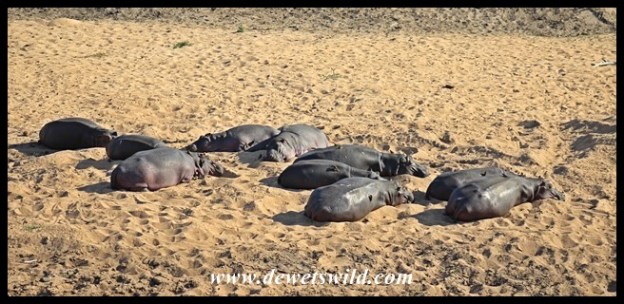
The Kruger National Park is experiencing one of the worst droughts in recorded history, and the Satara area of the Park seems to be the worst affected of all.
Of course, this has a tremendous impact on the water dependent hippopotamus. While there are still substantial pools of water remaining in man-made dams, stream and the large rivers, the lack of rain has meant that the available grazing around these water sources has been drastically denuded, causing the hippos to have to travel further and further to satisfy their considerable daily food requirement. For the first time I can remember, we encountered hippos spending the heat of the day out in the open veld, miles away from the nearest water.


On the second day of our winter 2016 visit, we noticed a hippo that had succumbed to the drought lying in a pool in the Nwanetsi River, just a few kilometers from Satara along the S100-road. Knowing that the carcass would soon start attracting predators intent on an easy meal, we decided to visit the sighting again that evening. Sure enough, we arrived to find a fairly large crocodile tearing at the bloating body. When the rest of the hippo pod occupying the pool started moving closer, we thought we were going to see them attack the crocodile to try and defend their fallen comrade. Bot nothing. They plodded past, barely giving the unfolding events a passing glance, almost as if resigned to the fact that they too will likely meet their end in this fashion, and leaving the crocodile to go about his gory business…


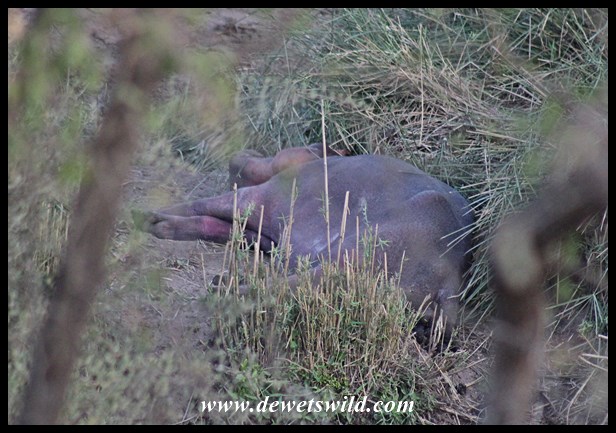
Harrowing as it was to witness, we had to remind ourselves that drought, and the deaths of the animals too old or weak to cope with the demands made by the difficult circumstances, is a part of the natural cycle in a wilderness like Kruger. We passed the same pool in the Nwanetsi again on our last afternoon at Satara, only to find that another emaciated member of this particular herd of hippos had lost the battle.
 DeWetsWild
Pingback: Hippopotamus | de Wets Wild
Pingback: Herbivore Haven | de Wets Wild
Weather patterns are so extreme everywhere – I wished we could have sent some of the massive amounts of rain we recently had in West Virginia (and which led to deadly flooding) in your direction.
It was amazing to see how close the live animals passed by the crocodile feeding on the carcass…
It was so surprising to see the normally very aggressive hippos react so passively, Annette.
maybe they are so hungry that they have to conserve calories and therefore limit any exertion?
Confronted with the scene it was very hard not to impart human emotions on what we were seeing…
Your posts on the impact of drought on the animals in the wild have been very sad, disturbing, but also educational. For those of us who are far removed from these wild areas, we would never know what is happening as climate changes wrecks havoc with animal habitats.
This is heart-breaking.
It really isn’t easy to look at the normally portly hippos when they are just skin-and-bones, and one has to wonder how much of the current drought conditions were brought on, or exacerbated, by human causes. We’re holding thumbs that the next rainy season will bring an end to the 3-year long drought, without going into the opposite extreme of flooding as it so often does!
Can you imagine how painfully starving they are to reach that point?!
I’m hoping for an end to the drought – very soon.
Oh man, this is sad. But understand what you are saying about the cycle of life. A friend of mine loves the Kruger Park, but says she just cannot go there until the rain has fallen. She says the starving animals is just too sad a picture.
During our visit it was only some of the hippos and buffaloes that we could see were taking strain, most of the other animals were actually coping quite well under the circumstances, it seemed.
Ag foeitog die arme ou seekoeie…
Die natuur kan so hard wees, ne Tannie Frannie?
So sad to see this, Dries. I hope that the summer brings much needed rain, but the animals have to survive the winter first. 😦
That’s so true Sylvia, and it is still a long stretch of probably three months at least before we’ll know if the rains are coming…
Fingers crossed.
‘n Vriendin was verlede week in die Wildtuin en sê dit is kurkdroog
Dis waarskynlik die ergste droogte wat nog in die Wildtuin opgeteken is, Tina. Gelukkig lyk die noordelike deel, die helfte noord van die Letaba rivier, baie beter as die omgewing rondom Satara.
Ons hou maar duime vas vir ‘n goeie en vroeë reënseisoen
Sad indeed. If droughts are increasing in frequency, duration and intensity it may be a result of ongoing climate change. Depending on your point of view, that could be called natural or not I suppose.
Very true Michael. It has been around a quarter of a century since we had a drought of this scale in Kruger, so I guess it was due…
Dis bitter hartseer,Dries,maar soos jy sê dis deel van die siklus.Daar was juis ‘n oorbevolking van seekoeie.Dit lyk nou of daar ‘n El Nina inkom,wat reën en vloede gaan bring.
Van een uiterste na die ander…
Die lewe gaan aan… ek hoop die reën kom vroeg hierie lente en die veld en diere het dit ‘n bietjie makleker die somer!
Die hele Suid-Afrika hou asem op dat die droogte gebreek word wanneer die lente kom – nie net in die Wildtuin nie, maar regoor die land.
Yes, it is part of a natural cycle, but what a dreadful, sad sight nevertheless. And here in the UK we have rain every few days, and heavy rain, not the usual light drizzle. How can anyone not believe that the climate has been affected, by whatever means.
That’s very interesting Candy – seems weather patterns are growing ever more extreme!
It seems so harsh, but that is how the natural world is I guess.
So very true, P J B.
don’t wake them 🙂
Yup, you want to let sleeping hippos lie!
That’s such a sad story. But as you say, it’s part of the natural cycle.
Thanks for weighing in, Penne.
Poor hippos. It’s hard to see them suffer and not be able to do anything to help.
At times it is really difficult to let nature take its course.
Oh, that’s so sad. I’m sorry. What will happen to them?
Unfortunately only the strongest and healthiest hippos that can cope best with the difficult circumstances will survive through this drought, Jane. Hopefully the drought will be broken with the start of the next rainy season in Spring, if the El Nino effect starts to weaken as predicted.
Thanks for the information, de Wets. California is in a bad drought season which was slightly relieved with the recent El Niño. Not as drastic as this, I’m sure.
Good or bad, it’s fascinating to think about the global impact of the El Nino weather pattern. Hopefully things will normalise all over the world once it dissipates.
True. I think we are unfortunately facing a “new normal”.
One where the parameters are constantly changing…
This is so very sad.
Terribly, Lois. We have to remind ourselves that it’s all part of the natural cycle.
Poor hippos. Sad.
Nature can be as cruel as it can be beautiful…