Tag Archives: wildlife

Sickle Bush

Dichrostachys cinerea

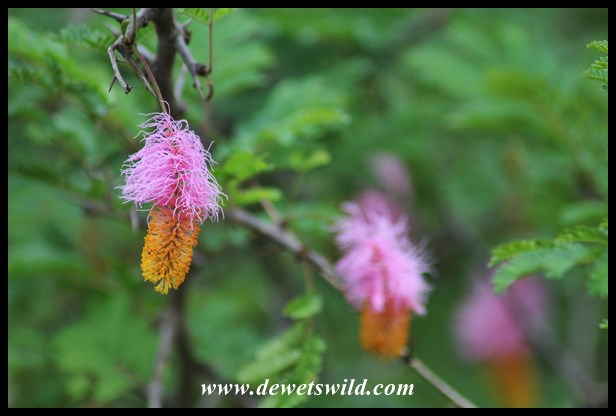
The Sickle Bush is a hardy, thorny shrub or small tree (maximum 7m high) occurring in the savanna habitats of South Africa’s Kwazulu-Natal, Mpumalanga, Limpopo, Gauteng and Northwest Provinces. In overgrazed areas the Sickle Bush quickly form dense thickets and as such can be problematic to farming communities, despite the leaves and pods being excellent fodder for game and small stock, and therefore regular clearing of such invasive thickets yield much sought-after firewood. It is considered to be of least concern by the IUCN. Apart from South Africa it occurs naturally over the rest of sub-Saharan Africa, the Middle East, the Indian subcontinent, South Asia and Australia, and has been introduced to the Caribbean and parts of North America.

The beautiful flowers are borne during summer, explaining where this plant gets its alternative local name of “Kalahari Christmas Tree” from. Apart from being used as fodder or firewood, or fashioned into small implements or fence posts, the roots, bark and leaves of the Sickle Bush is also used in traditional medicines. The species is also ideally suited to be made into attractive bonsai.

Sabota Lark

Calendulauda sabota

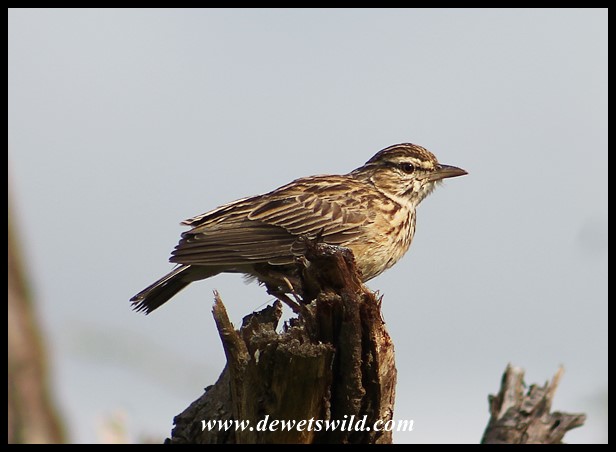
The Sabota Lark is a common inhabitant of dry, open grasslands, savannas and scrublands, one of our most numerous larks. They feed on seeds and insects, and is apparently not dependent on a regular water supply. They love calling from a high vantage point, such as a treetop or pole, and mimicking the songs of other birds. It occurs only in parts of South Africa, Swaziland, Namibia, Botswana, Zimbabwe, Mozambique and Angola. The IUCN lists it as being of Least Concern.

Normally seen singly, in monogamous pairs or small family groups, Sabota Larks breed during spring and summer. Their cup-shaped nests are usually built low to the ground, hidden amongs rocks or dense, thorny vegetation. Adult Sabota Larks weigh about 23g, attaining a total length of about 14cm.

Common Dwarf Gecko

Lygodactylus capensis

The Common Dwarf Gecko inhabits well-wooded savanna and thicket habitats, and have adapted very well to the urban environment in towns and cities throughout their South African distribution, which stretches from Kwazulu-Natal, through Mpumalanga, Limpopo, Gauteng and North West to the extreme north-eastern parts of the Northern Cape. Populations have also become established in towns and cities outside their natural distribution range. Outside our country they’re found throughout central Africa to Tanzania. They feed on ants and termites.

Cape Dwarf Geckos breed throughout the year, laying small eggs in pairs in cracks and under loose bark. Depending on the ambient temperature, the eggs may take between 2 and 5 months to hatch. Adults measure about 4cm in length, tail excluded.

Martial Eagle

Polemaetus bellicosus

The Martial Eagle, with a wingspan of up to 2.6m and weight of as much as 6kg, is Africa’s biggest eagle. Females are considerably larger than males. They occupy a wide range of flat and open habitats, ranging from semi-desert to woodland. Martial Eagles are big and powerful enough to subsist on a diet of large vertebrates up to the size of small antelopes and kori bustards, and have a special taste for nile and rock monitor lizards. Their exceptional eyesight allows them to detect prey from even 6km distant, and they often soar at great height.

Martial Eagles are usually seen singly or in pairs, adults forming monogamous, permanent pair-bonds and defending a sizable territory. They prefer to build their huge stick nests in tall trees but will also utilise man-made structures like utility pylons and windpumps for the purpose. The breeding season stretches from autumn to spring, with a single egg being laid. The female takes most of the responsibility for incubating the egg (which takes around 7 weeks) and brooding the chick, only starting to help the male hunt a fortnight or so after the chick has hatched. While the chick makes its first flight at an age of about 3 months it will remain with its parents until they start breeding again.

Martial Eagles occur throughout South Africa, but are most numerous inside our bigger conservation areas and uncommon outside these areas, and have for the most part been exterminated entirely from urbanized environs. It also occurs widely over sub-Saharan Africa, with the exception of the equatorial forests. It is listed as Vulnerable by the IUCN, with populations declining mainly as a result of being persecuted as stock killers and through loss of habitat and natural prey,

Large Spotted Genet

Genetta maculata

The Large Spotted Genet is a great example of dynamite in a small package. These lithe omnivores weigh only around 1 – 3kg, are around a meter long (including the tail) and stand just 15cm high at the shoulder, but they’re skilled predators of anything up to the size of hares, small crocodiles and guineafowl and include such varied fair as invertebrates, amphibians, reptiles, fish, crabs, rodents carrion and fruit in their diet. Large Spotted Genets inhabit mesic savannas, riverine woodlands and forests.

Large Spotted Genets are nocturnal and very rarely seen in the daylight, usually only becoming active well after nightfall. By day they hide in thickets, holes in trees, crevices among boulders, tunnels dug by other animals and even in the roofs of buildings. Though they are excellent climbers and can jump distances of up to 4m between trees, they do most of their hunting on the ground. They are mostly solitary, any groupings encountered being either a mating pair or mother with young.

Females give birth to between 1 and 5 pups in spring and summer after a two month gestation period. The young are weaned at 2 months after birth, but will remain with their mother until they are around 6 months old. They are fully grown by about 11 months and have a life expectancy of between 8 and 14 years in the wild. Large Spotted Genets fall prey to a wide range of predators, including large owls, pythons, leopards, caracal and jackals.

The IUCN lists the Large Spotted Genet as being of least concern. It occurs from Kwazulu-Natal, through Mpumalanga and the eastern half of the Limpopo Province, through much of our neighbouring states to the north and throughout central and eastern Africa as far as Burkina Faso in the west and Eritrea in the northeast.

The Cape Genet, or South African Large Spotted Genet (Genetta tigrina), which occurs from the Western Cape along the coast and adjacent interior as far north as Durban in Kwazulu-Natal, is difficult to distinguish from the Common Large Spotted Genet (G. maculata) and is considered the same species by some authorities.

 

Orange-breasted Bushshrike

Chlorophoneus sulfureopectus

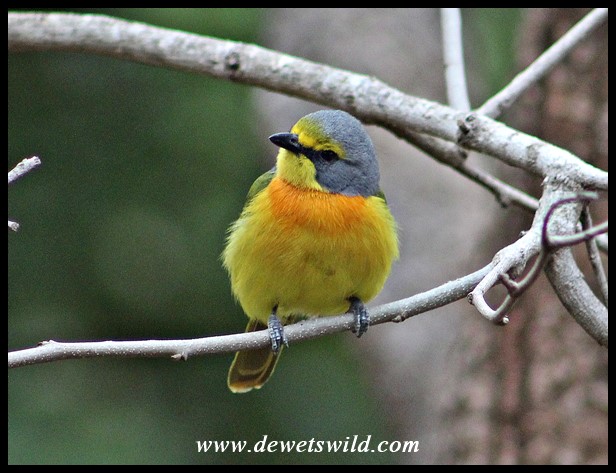
As they are shy and retiring birds, much more often heard than seen as they move around in the upper stories of tall trees looking for insect prey, any encounter with the Orange-breasted Bushshrike is a special treat. It is a bird of savanna and woodland thickets and forest margins, often near or along rivers and streams. It is one of the smaller members of the family, measuring only 19cm in length and weighing around 27g. These lovely birds usually move around in monogamous pairs. They build shallow cup-shaped stick nests in trees during the breeding season which stretches from spring to late summer.

The Orange-breasted Bushshrike is widely distributed across sub-Saharan Africa, from Senegal in West Africa to here in South Africa, where they are to be found from the Eastern Cape, through Kwazulu-Natal, to Mpumalanga, Limpopo and the North West Province. The IUCN considers this species to be of least concern.

Citrus Swallowtail

Papilio (Princeps) demodocus

The large Citrus Swallowtail butterfly (wingspan of 9 to 13cm) commonly occurs all over South Africa as well as the rest of the continent south of the Sahara, inhabiting a wide variety of habitats. They are strong fliers, often pausing on flowers and at mud puddles. Though they may be encountered throughout the year they are most frequently seen in the high summer, explaining why they’re also known as the “Christmas Butterfly”. Females lay eggs singly on the tops of leaves, the eggs hatching only a few days later. Their larvae can become pests in citrus orchards, Citrus-plants being just one of several related food plants utilised by this widely distributed species. Adults feed on nectar and rotting fruit.

Black-bellied Bustard

Lissotis melanogaster

The Black-bellied Bustard is an inhabitant of higher rainfall grassland, savanna and woodland habitats, usually with tall, dense grass cover in which it is fairly difficult to see and often near wetlands. Insects and other invertebrates make up the bulk of their diet, with a bit of berries, seeds and green leaves thrown in for variety. With a weight of up to 2.7kg the males are considerably bigger than the females, which averages around 1.4kg.

Black-bellied Bustards are usually seen singly or in temporary pairs, the latter mainly during the breeding season (which spans spring and summer) when males will attempt to mate with as many females as possible. Apart from an elaborate flying display the male also employs a most amusing two-step call with which it tries to impress the females, almost as if he has a burp stuck in his throat released with a load “pop”! The female lays a well camouflaged clutch of 1 or 2 eggs in a scrape on the bare ground, usually between tufts of grass, and is singly responsible for the incubation of the eggs and the care of the chicks.

The IUCN lists the Black-bellied Bustard as being of least concern, though it also notes that its populations are probably dropping due to habitat degradation. It is widely distributed in the savanna regions of sub-Saharan Africa, from Senegal to Ethiopia and southwards to South Africa, where it occurs in Kwazulu-Natal and the Escarpment and Lowveld of Mpumalanga and Limpopo.

The bloody fight that never was

At the end of our Satara Summer, on the way to the Kruger National Park’s Orpen Gate from where we were to head back home to Pretoria, we were lucky to see a lone Cheetah resting in the shade of a small thorn tree. Having stopped for a last photo or two, it was Marilize who noticed a Spotted Hyena heading straight towards the Cheetah. Knowing just how hateful the relationship between Africa’s large predators are, we were sure we were probably going to witness a tremendous fight when the two meat-eaters meet, especially when the Cheetah noticed the Hyena, snarled at it viciously, and got up to defend its turf. But turns out this Hyena was not a fighter; he walked straight past the Cheetah as if it wasn’t even there, and not paying the cheetah’s tantrum any attention whatsoever. It was rather amusing seeing the Cheetah standing by himself, looking decidedly confused, as the Hyena disappeared from view…

Waiting hours for a glimpse at a White Lion

White Lions are exceedingly rare and especially so in the wild. Several zoos, “safari parks” and circuses around the world house White Lions, but these are often horribly inbred. These lions are not albinos, instead being the result of a mating between two lions carrying a recessive gene for white (leucistic) fur instead of the usual tawny colouration. Naturally White Lions are only ever found, from time to time, in South Africa’s Lowveld, where the Kruger National Park and a few renowned private nature reserves are situated. As far as wild White Lions are concerned, at present, there are known to be two young white cubs in the same pride that roam around Orpen in western Kruger and the adjacent Timbavati reserve, and a single young male born to a pride near Satara and fairly wide-roaming since he and his brothers were ejected from their natal pride.

It is this latter individual that we came across on the 3rd of January 2020, the final full day of our Satara Summer. Having fairly often visited the Kruger National Park my entire life, it was always my, hitherto unfulfilled, wish to see a truly WILD White Lion, so you will appreciate just how excited we were at this opportunity! It was an exceedingly hot day, and on hot days lions are seldom very active. So we sat for hours in our vehicle in the blazing sun, waiting, hoping, that he might get up, and move around just a little, so that we can get more than just a glimpse. He obliged, for a minute or two only, to move from the large tree where he was lying with his three brothers to a smaller shrub a few meters away. That was it. He didn’t move again until we had to leave to get back to camp before the gates closed. But we were thrilled and grateful for the chance to see such an enigmatic animal.

While they can not be considered wild, there is a pride of White Lions on view at the Rhino & Lion Nature Reserve near Johannesburg.