We encountered this ravenous family sitting down for a buffalo breakfast at Ximangwaneni Dam near Satara this morning!

Lion pride with buffalo kill

Lion pride with buffalo kill

Lion pride with buffalo kill

We encountered this ravenous family sitting down for a buffalo breakfast at Ximangwaneni Dam near Satara this morning!
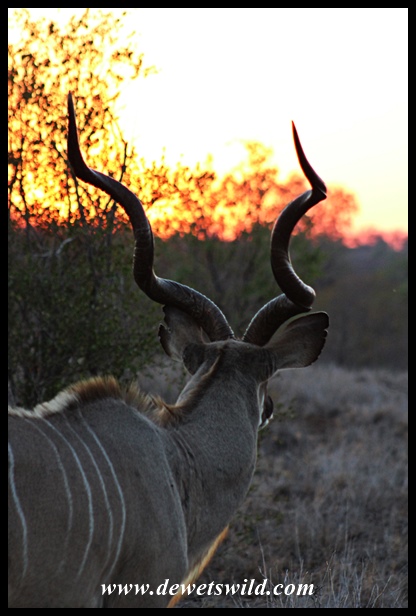
Seems it’s not only humans that appreciate the beauty of a Kruger sunset!
Saying “Hi” the mongoose way?
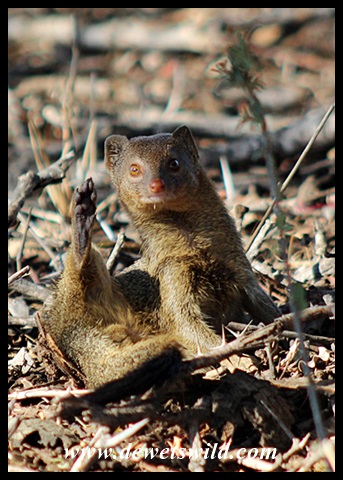
Slender Mongoose seen near Satara today.
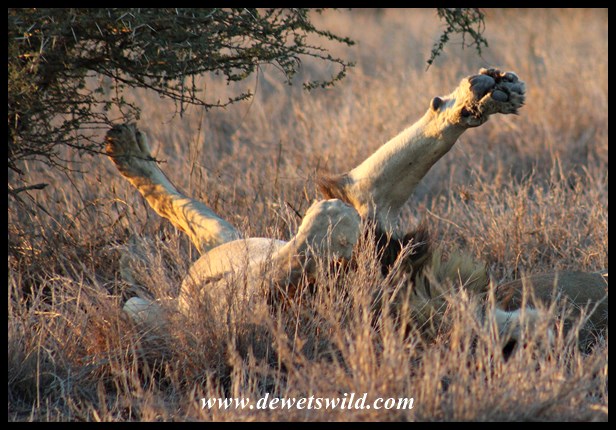
It’s the first day of the winter school holidays, and we find ourselves in the Kruger National Park again. Seems this lazy lion was as happy to see us back here as we were to see him!
We’ll be spending the next few days at Satara, before moving on to Mopani, and hopefully we’ll have good enough signal to send a daily postcard from the bush.
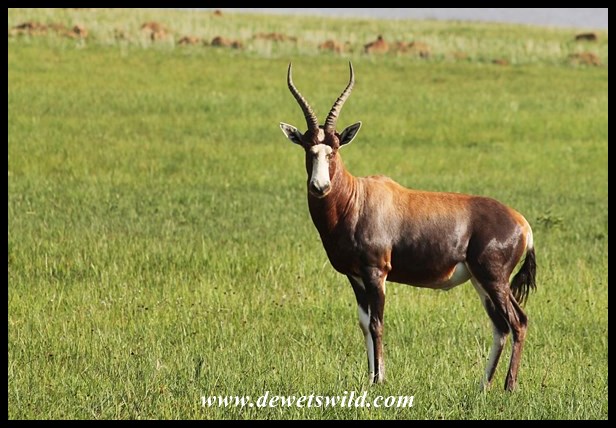
The Blesbok is a medium-sized antelope endemic to South Africa’s central plains. They have a shoulder height just short of 1m and weigh around 70kg. The “bles” in their name refers to the striking white blaze on their faces. White Blesbok have a leucistic coat and are mainly selectively bred on game ranches.


The Blesbok naturally occurs only on the open grasslands of South Africa’s Highveld, where they are well adapted to the cold winters, though they have been introduced to farmland in the more densely wooded Bushveld and drier Karoo regions as well with varying success. Their diet consists almost exclusively of short grasses and require daily access to a supply of fresh drinking water.


Blesbok form large mixed herds during winter, but at the onset of the summer the rams will start establishing small territories, demarcated with scent glands and dung heaps, advertised through ritualised displays and maintained through some serious fighting, in which they attempt to herd and keep groups of ewes with which to mate. Blesbok are diurnal animals, resting during the heat of the day by positioning themselves with lowered heads facing the sun. Blesbok are fast runners with great stamina. When moving, herd members follow each other in a straight line, even when fleeing from predators.


Ewes give birth to single lambs, usually in the summer months, and will nurse only their own lambs. Lambs are capable of running with the herd within 20 minutes of birth, and are preyed upon by jackals, caracals and feral dogs. Most of Africa’s large predators have been exterminated from the Blesbok’s range. They have a life expectancy of up to 17 years in the wild.


The Blesbok once occurred in enormous numbers on the Highveld of South Africa, but excessive hunting led to the population plummeting to a low of about 2,000 at the end of the 19th century. Their numbers have since been built back up, but not nearly to erstwhile levels, with the IUCN estimating a population of approximately 240,000, most of which occur on private land where they are a popular game ranching animal as they can be contained by standard stock fencing. Golden Gate Highlands National Park, Rietvlei Nature Reserve and Willem Pretorius Game Reserve are good places to go searching for Blesbok.


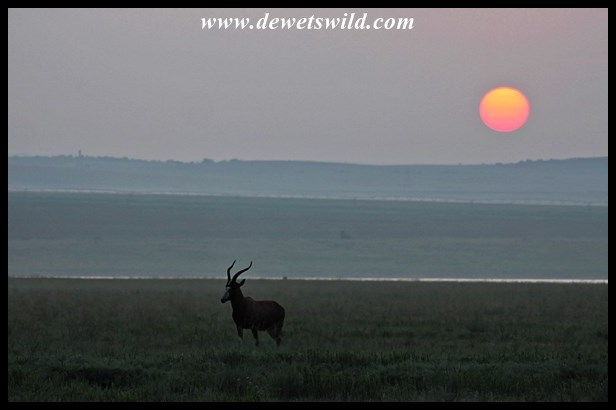

With their long white tails, stiff mane, whiskery muzzles, and curved, forward facing horns the Black Wildebeest looks quite menacing and is easily recognisable. Bulls have a shoulder height of only 1.2m and weigh in at around 160kg, considerably smaller than their closely related cousins, the Blue Wildebeest.
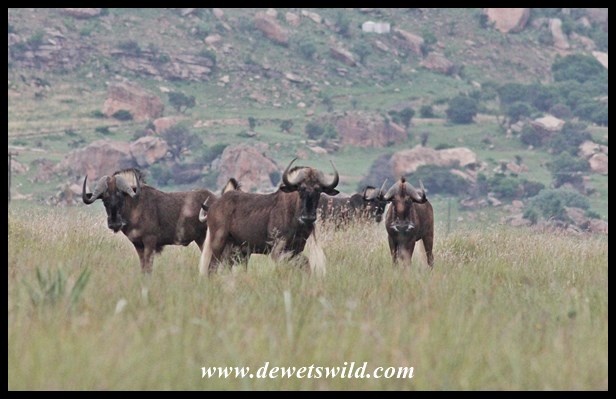
An inhabitant of open grasslands and semi-desert plains, Black Wildebeest subsists on a diet of grass, low shrubs and succulents, and need to drink daily. They have a preference for highlands and mountain plateaus, and are quite resistant to the extreme cold experienced in such habitats, especially during winter.


Black Wildebeest are gregarious animals, coming together in herds of 6 to 60 made up mostly of cows and calves traversing the territories of bulls in their prime. Bulls unable to hold territories of their own join together in bachelor groups. During the hot summer they are mostly active from early evening to early morning, while they are active for most of the daylight hours in winter. As their open habitat usually offers very little in the form of shade, they spend the hottest hours of the day standing still and facing away from the sun. Black Wildebeest are extremely nervous, taking flight at high speed at the scantest sign of danger, and can be aggressive and unpredictable, especially when cornered, which is why you’ll seldom see them in captivity – as recently as 2013 a farmer and his son were killed when the family was attacked by two black wildebeest.


Cows give birth in the herd to single calves between November and January. The calves can keep up with the herd within minutes of being born. Most of the larger predators have been wiped out in the black wildebeest’s range and as such black-backed jackals preying on calves were the biggest predatory threat to them, though recently lion and cheetah have been reintroduced to some reserves where they occur and should re-establish a natural predator-prey balance. Their natural life expectancy is about 16 years.


The Black Wildebeest occurs naturally only in South Africa, Lesotho and Swaziland. In times past the Black Wildebeest was a migrating species, moving seasonally between the moist highveld grasslands and dry Karoo in incredible numbers, but modern farming practices have made such large scale movements impossible and the species is now confined to fenced farms and reserves. Some of the best places to see them include Chelmsford Nature Reserve, Golden Gate Highlands National Park, Mountain Zebra National Park and Willem Pretorius Game Reserve. By the end of the 19th century indiscriminate hunting had almost driven the species to extinction, but since then concerted conservation efforts have ensured that numbers have been built up to an estimated 18,000 on private land and in state conservation areas, and the IUCN now considers their populations to be safe and increasing. That being said, hybridisation with the closely related Blue Wildebeest is an increasing threat to the genetic purity of the Black Wildebeest.


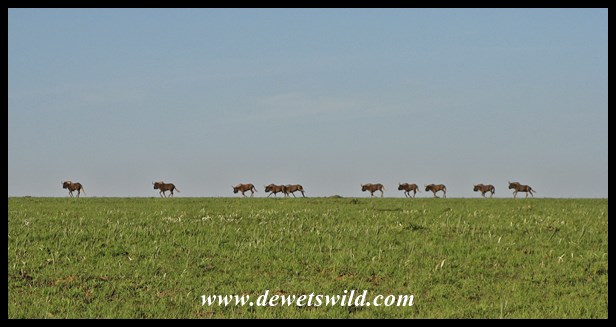
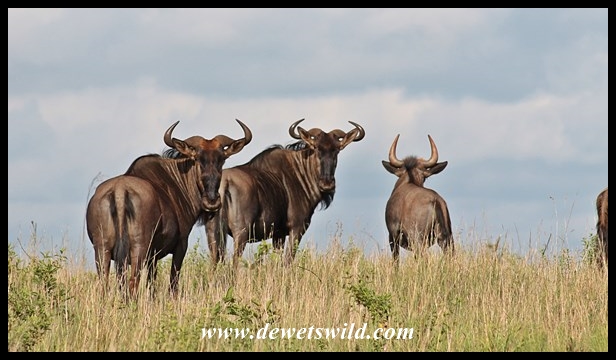
The Blue (or Common) Wildebeest must be one of Africa’s most familiar antelope, although it will probably never be included in a list of the continent’s most elegant creatures. Bulls stand around 1.5m high at the shoulder, and weigh about 240kg, while cows are more lightly built at around 180kg.


Blue wildebeest inhabit open grasslands, savannas and semi-deserts, where they subsists almost exclusively on short grasses and require a reliable supply of water, even in arid regions.


These diurnal herbivores congregate in herds of up to 10,000 (but mostly much smaller – a few dozen or so), consisting mostly of cows and calves traversing the territories of mature bulls. Smaller bachelor herds made up of bulls unable to maintain a territory of their own also occur. They will cover enormous distances trekking after fresh grazing and water. Blue wildebeest are commonly found associating with other game species, especially impala, giraffes and plains zebras, and have a curious love for rolling in mud and dung!


Calves are born in the herd at the onset of the rainy season and can walk within 10 minutes of birth. Blue wildebeest have an expected life span of around 15 years, fall prey to all Africa’s large predators and also suffer from several parasites and sicknesses.


In South Africa, Blue Wildebeest can be found in all of the northern provinces, though mostly confined to national parks, nature reserves and game ranches. Large populations can be found in Kruger National Park, Hluhluwe-Imfolozi Park, Pilanesberg National Park, Kgalagadi Transfrontier Park, Ithala Game Reserve and uMkhuze Game Reserve. The IUCN considers the Common Wildebeest (C. taurinus) to be of least concern in conservation terms, estimating the total population at around 1,5-million, of which 130,000 belong to the southern subspecies, the Blue Wildebeest (C. t. taurinus).


A unique colour-variation of the Blue Wildebeest, known as the Golden Wildebeest, is sometimes seen on game ranches.


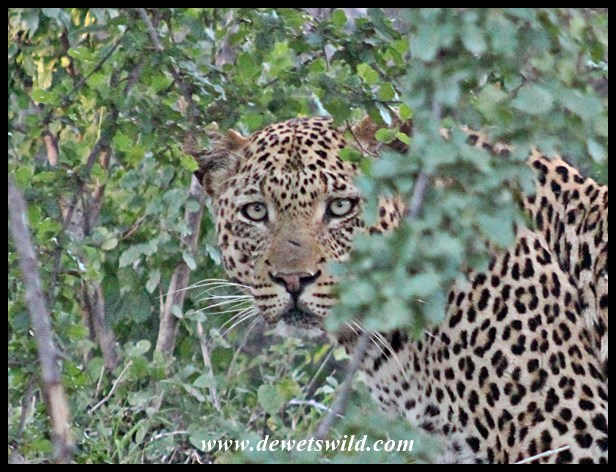
There was a reason I dedicated the previous two posts on de Wets Wild to Lower Sabie and Olifants, two of the most popular camps in the Kruger National Park. That is because I had the opportunity to visit both camps again earlier this week, and now that you have been introduced to both destinations we can all just sit back and enjoy some photos from this latest trip. Here’s hoping you enjoy the gallery as much as I enjoyed putting it together!


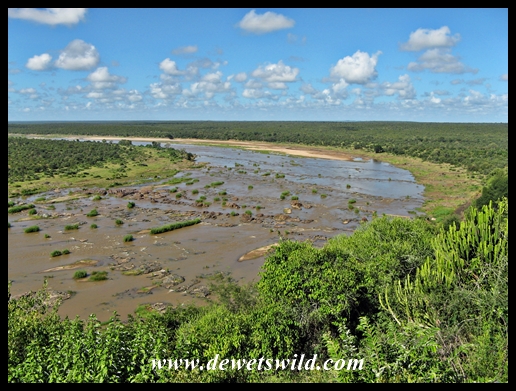
Olifants Rest Camp undoubtedly offers the best views of any of the Kruger National Park‘s camps, situated as it is on a cliff high above the Olifants River in the central regions of the Park. Many guests spend all day on their accommodation unit’s veranda, using their binoculars to scan the river below and the plains beyond for wildlife, or simply soaking in one of the grandest vistas in wild Africa.
Olifants was opened in June 1960, though it was closed for a 16 month period in the early 1970’s after a fire destroyed the reception, restaurant and shop. The cliff-top viewpoint near the restaurant is one of the most popular spots in the entire Park, and during the day is always packed with spectators enjoying the wildlife show along the river banks below. The camp offers guests a choice of 112 accommodation units, ranging from 2 and 3 bed bungalows to two luxurious and very exclusive guest houses that accommodate up to 8 guests each. Some of the accommodation units have been built right on the edge of the cliff, offering guests the most exquisite views, but you have to book a year in advance if you want to secure one of those. The two-bedroomed cottage number 14 is a personal favourite of ours. Olifants also offers guests a Mugg & Bean restaurant (itself with stunning views), a shop, filling station, small meeting room, swimming pool, picnic area for day visitors and guided activities.


Nearby, tiny Balule is a much more rustic camp offering accommodation in a small camping area and six very basic three-bed huts on the southern bank of the Olifants River. The huts were built in 1930 in the “Selby” style: a rondavel (round hut) without any windows, just a gap all around between the roof and wall for ventilation. The huts share a communal kitchen (with a paraffin freezer) and ablution block, and the same applies to the camping sites. Balule has no electricity and paraffin lamps are used to provide light at night. During the Apartheid years Balule was available only to non-white visitors.


Just outside Balule, a low level causeway crosses the Olifants River. The pontoon-crossing that operated over the river since 1929 was replaced by the causeway in 1937, but the old bridge was extensively damaged in the massive floods of January 2012 and had to be rebuilt. The high-span bridge across the same river, on the main tarred H1 route through the Park, lies about 5km due west from Balule and affords visitors the opportunity to stop and stretch their legs while enjoying the views up- and downstream. Both bridges are very popular with guests to Olifants, as they allow close-up views of so many of the river’s denizens.


South of Olifants, the roads initially follow the course of the river before leading down to the Satara-area. Nwamanzi offers more spectacular views over the Olifants, and the open plains south of the river host a huge number and variety of game and birds. Bangu waterhole and the Hlahleni stream crossing on the S90, as well as the Ngotso Weir on the S89, are especially rewarding spots to wait for the herds (and the predators that prey on them) to come and drink.


North of Olifants you enter the mopane-dominated northern plains of Kruger. There’s two general options of routes leading northwards from Olifants, both leading to Letaba Rest Camp. The quickest route follows the tarred H8 and H1-5 roads and is often very quiet game viewing-wise, especially once the road turns away from the river. The gravel S44, S93 and S46 roads follows the course of the Olifants and Letaba rivers through some very rocky terrain with several stream crossings and, apart from a lovely viewing point downstream from camp and the historic Von Wielligh’s Baobab, usually also offers lots more wildlife to see.


For scenic splendour alone, there’s no other camp in Kruger that can compete with Olifants. Combine that with the camp’s great facilities and excellent game viewing drives in the vicinity, and you’ll understand why it has become a firm favourite with many Kruger visitors.

Lower Sabie must be the most popular destination in the Kruger National Park. It is exceedingly hard to get a booking here if you don’t book a year in advance. In peak season, even just finding parking to visit the shop or restaurant can be a challenge, as visitors from all over the the southern sections of the Park flock to the camp. The camp’s location on the banks of the Sabie River, in an area of exceptionally high-quality grazing in the south-eastern corner of the Park, ensures that its surrounds is frequented by an astounding variety and number of herbivores and their attending predators, making for game-viewing heaven!
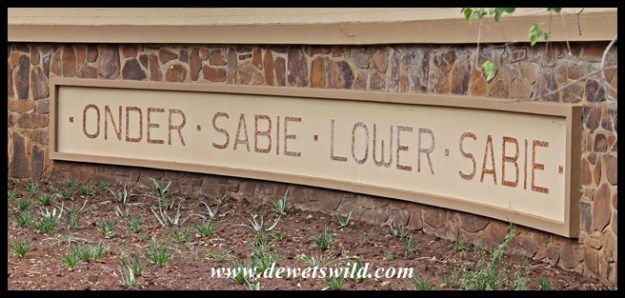
The Sabie River got its name from the Shangaan word “saba” meaning fear, probably due to the large number of enormous crocodiles that call the river home. The dam in front of the camp came about after the causeway across the river was built in 1987 (it had to be rebuilt higher after the floods in February 2000).
The first tourist accommodation at Lower Sabie was a 5-bedroom house converted from ranger Tom Duke’s quarters in 1930, but this was demolished again just two years later after becoming dilapidated. The only access to Lower Sabie was via Gomondwane from Crocodile Bridge until the road from Skukuza reached it in 1931. The next attempt at providing guest accommodation at Lower Sabie then commenced in 1936, when three buildings, built in a u-shape and each housing six bedrooms, were erected – these units are still used as accommodation to this day, but has been extensively renovated since. Over the years, more accommodation and a camping site was added to the camp, leading up to an extensive project to revamp and enlarge Lower Sabie in the early 2000’s. Today the camp provides overnight accommodation in 117 huts, bungalows, cottages and safari tents and has space for 34 caravans and tents in its camping area. Lower Sabie’s restaurant (Mugg & Bean), with its deck overlooking the Sabie River, is especially popular. The camp has a well stocked shop for groceries and curios, a fuel station, swimming pool for overnight guests and a day visitors picnic area near the gate. Along the river, in front of the bungalows south of the restaurant, lush lawns and deep shade provided by enormous trees is just the place to spend a lazy afternoon, surrounded by Lower Sabie’s prolific birdlife.


We can certainly recommend joining at least one of the guided activities on offer from Lower Sabie, as excellent sightings are almost guaranteed.


Sunset Dam is a brilliant spot just a kilometer from Lower Sabie, and as its name suggests is very popular with visitors whiling away the last minutes before they have to get back to camp in the evening. You can park your vehicle right on the water’s edge, allowing excellent photographic opportunities of hippos, crocodiles, wading birds and herds of game coming to quench their thirst.


Heading north from Lower Sabie along the H10 tarred route to Tshokwane, you’ll encounter the first highlight of this route just minutes after leaving camp. The causeway across the Sabie River is a favourite spot for many visitors, who flock here to enjoy glorious sunsets and an abundance of game and bird species attracted to the water. The plains between Lower Sabie and Tshokwane is home to incredible herds of zebra and wildebeest at the end of winter, and is also an excellent place to look for reedbuck, one of the rarer antelope that occurs in Kruger. Of course, with so many herbivores roaming around it stands to reason that the predators are not far behind. If you, like us, enjoy your game viewing with as little other traffic as possible, try the gravel S29, S122 and S128 loops that turn off the main road as alternatives to explore this area. Two other beautiful places not to be missed is Mlondozi Picnic Spot, overlooking a large dam from Muntshe mountain, and Nkumbe Viewpoint, which offers an exceptional view over the open plains of Kruger.


The tarred H4-2 Gomondwane Road leading south to Crocodile Bridge is another very productive route for game viewing, though we personally prefer taking the gravel loops running roughly parallel to the main road (S28 Nhlowa Road, S82 Mativuhlungu Loop, S130 Gomondwane Loop and S137 past Duke’s waterhole) as these carry a little less vehicle traffic.


The H4-1 road between Lower Sabie and Skukuza carries more traffic than any other road in Kruger, and not without reason. There’s an excellent chance of seeing all the “big 5” game animals and so much more along this route, which follows the course of the Sabie River, on just one drive. The vegetation along the portion of this road nearer Lower Sabie is much more open than the stretch between Nkuhlu and Skukuza, making for even better game viewing. Keep your eyes open for lions and leopards at the rocks at the Lubyelubye stream crossing about 5km from Lower Sabie, as this is one of their most reliable haunts. Also, don’t miss the short S79 gravel loop that crosses the Nwatimhiri causeway, which is another favourite spot for feline predators. Nkuhlu Picnic Spot is a great place to get out, stretch the legs and have a bite to eat (though beware the monkeys and baboons that hang around here, as they will attempt to steal your picnic if they get even the slightest chance!). The gravel S30 Salitje Road along the northern bank of the river is a wonderful alternative route back to Lower Sabie.


If all these photos did not convince you, allow us to reiterate: Lower Sabie IS game-viewing heaven! Remember to book early if you also want to enjoy all it has to offer.
 DeWetsWild