Tag Archives: wildlife

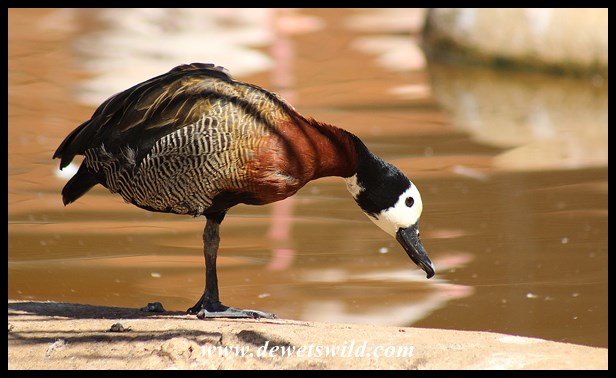
White-faced Whistling Duck

Dendrocygna viduata

Commonly found in vegetated freshwater habitats in open areas – lakes, swamps, large rivers, dams, estuaries, rice fields (can be a pest when they feed on young rice plants) and even sewage treatment installations, with mudbanks and sandbars for roosting, White-faced Whistling Ducks feed on grasses, seeds, buds, aquatic plants and algae, and aquatic invertebrates like worms, molluscs, insects and crustaceans. The sexes are quite alike, both weighing around 740g.

White-faced Whistling Ducks are most active at night, feeding from dusk to dawn, although they do become more diurnally active in winter. Outside of the breeding season White-faced Whistling Ducks often congregate in enormous flocks numbering several thousands – as many as 70,000 have been counted on river deltas in West Africa!

Breeding commences at the start of the wet season and lasts throughout, when they build their nests on dry ground in dense vegetation, mostly but not always near the water, and occasionally in loose groups or colonies. Pair bonds are very strong and they mate for life. Unusually for ducks, White-faced Whistling Duck males actively take part in the incubation of the eggs and care of the ducklings. The nest is a hollow lined with plant material, hidden in and under dense vegetation. The clutch consists of between 4 and 16 eggs, but normally about 7 to 11, and is incubated for about 4 weeks. Parents will feign a wing injury when predators approach, in order to distract its attention away from the ducklings. The ducklings grow quickly and start flying at about two months old, though they often stay with their parents until the next breeding cycle starts. Following the breeding season, adults undergo a three week period of flightlessness while they moult, keeping to densely vegetated wetlands during this time.

The IUCN estimates the global population of the White-faced Whistling Duck at as many as 2.8-million, and growing, and lists the species as being of least concern. It occurs widely and commonly in Madagascar, Sub-Saharan Africa, parts of South America and the Caribbean. In South Africa, this species is found along the coast in the Western and Eastern Cape, and throughout Kwazulu-Natal, the Free State, North West, Gauteng, Mpumalanga and Limpopo.


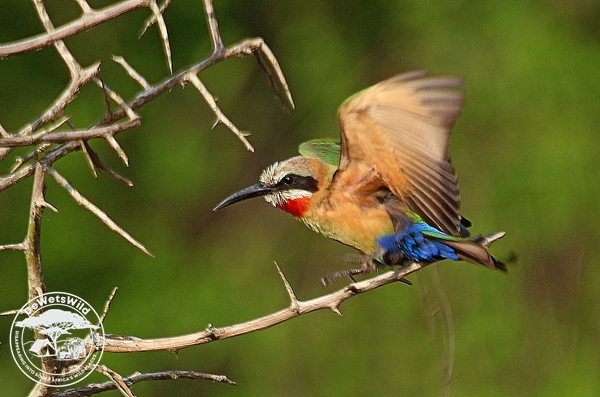
White-fronted Bee-eater

Merops bullockoides

White-fronted Bee-eaters inhabit wooded grasslands and savannas, mostly near large rivers or other reliable water bodies, where they feed mainly on flying insects caught on the wing – most notably honey bees, which make up about ¾ of their diet. They weigh between 30 and 40g.

White-fronted Bee-eaters have a complex and interesting social system. They roost and nest colonially (colonies can number between 20 and 300 birds), requiring large sandbanks in which to dig their tunnels, and will also utilise quarries and erosion ditches for this purpose. Each colony is made up of several distinct groups, known as clans, within which there are between 3 and 6 families made up of a monogamous breeding pair (mating for life) and between 1 and 5 non-breeding birds, usually offspring from previous broods, that will assist their parents to raise a brood. Breeding reaches a peak in spring and early summer. Nesting tunnels are 1-1.5m long with a chamber at the end and dug by both parents and their helpers at the onset of the breeding season. Females lay between 2 and 5 eggs, and cases have been noted of unattached females lying eggs in the nests of unrelated birds when they are not at their post. The eggs are incubated for three weeks by both parents and helpers, and the chicks then fledge at between 3 and 4 weeks old, after which their parents start teaching them to hunt.

The IUCN views the White-fronted Bee-eater as being of least concern, with a widespread, common and increasing population. In South Africa the species is distributed over most of the Free State, Kwazulu-Natal, Gauteng, North West, Limpopo and Mpumalanga and a few locations in the Northern and Eastern Cape into which it appears they are expanding their range of late. Outside of our borders, these bee-eaters are found in a wide area of East and Central Africa, avoiding the arid regions in the south-west.

Dark-capped Bulbul

Pycnonotus tricolor

The Dark-capped, or Black-eyed, Bulbul, occurs in savanna and woodland habitats with a reliable supply of fruiting trees and bushes, and is especially common in the gardens and parks of our towns and cities. They feed primarily on fruit, berries and seeds, but will also eat nectar, flower petals and small invertebrates (especially termites). Dark-capped Bulbuls are mostly seen singly, in pairs or in loosely associated small groups, and adults weigh between 30 and 48g.

Nests are cup-shaped formations of roots, grass and twigs placed among dense leaves in trees or bushes. In South Africa they breed almost through the year (except the harshest parts of winter), with a peak in the summer. The female incubates the clutch of 2-3 eggs for around two weeks while the male defends their territory and brings food back for her at the nest. The chicks leave the nest around two weeks after hatching, although they usually can’t fly by then and stick around their nesting tree for a while longer.

In South Africa the Dark-capped Bulbul is found in the Eastern Cape, Kwazulu-Natal, extreme eastern Free State, Mpumalanga, Limpopo, Gauteng and North West Provinces. It also occurs over most of Africa southwards from the Cameroon in the west and Ethiopia in the east, with the exception of the arid western parts of southern Africa. The IUCN considers the Dark-capped Bulbul to be a race of the Common Bulbul (P. barbarus) distributed over almost all of Sub-Saharan Africa, the Mediterranean coast of North Africa, and the Nile Valley, but it differs in having a conspicuously yellow vent compared to the white vent of the Common Bulbul.

Chinspot Batis

Batis molitor

The Chinspot Batis is a common inhabitant of savanna and woodland, and more recently also orchards and gardens, where it feeds almost exclusively on insects and spiders foraged from among the bark and leaves of trees and shrubs. They avoid forests and exotic plantations.

These very active little birds (adults weigh only about 12g) move around singly or in pairs, often in mixed groups together with other small insectivorous bird species.

Both sexes build the cup-shaped nest of shredded leaves bound together with spider web and camouflaged with lichen in a fork of a (often thorny) tree. Breeding takes place in spring and summer, when 1-4 eggs are incubated by the female for around 18 days. During this time the female rarely leaves the nest as the male supplies her with food. Both parents take care of the chicks, which leave the nest at around 16-18 days old but stay with their parents for another 6-14 weeks. The male defends the pair’s territory year round.

The Chinspot Batis occurs widely from Kenya (in the east) and Angola (in the west) southwards and is listed as being of least concern by the IUCN. In South Africa it can be found from the Eastern Cape, through Kwazulu-Natal, to Mpumalanga, Limpopo, Gauteng and the eastern parts of the North West Province.

Napi Wilderness Trail

And so on Sunday afternoon the time arrived. Ranger-guides Ronnie and Saul met us, and four fellow trailists, at the designated spot in Pretoriuskop for the start of our time on the Napi Wilderness Trail in the Kruger National Park. Excitedly we packed all our baggage into the trailer, ensuring that our cameras and binoculars stayed close at hand, and clambered into the open game viewing vehicle that would transport us into the Wilderness.

We had barely left camp when we encountered our first special sighting: a magnificent sable antelope bull – a prime specimen of one of the rarest species in Kruger! As good an omen as one could hope for at the start of such an epic adventure.

It took about an hour to reach the Napi Wilderness Trail’s base camp, our home for the next three nights. Located on a bend in the Biyamiti River between Pretoriuskop and Skukuza, the camp consists of four two-sleeper tents (with en-suite bathrooms!) with a central thatched “dining room” and cement slab for the obligatory nightly campfire. There’s no electricity (or cellphone reception) at the camp, with gas-powered geysers in the bathrooms and paraffin and solar lamps used for lighting. We also meet Armondo, the camp’s shy caretaker and talented cook.

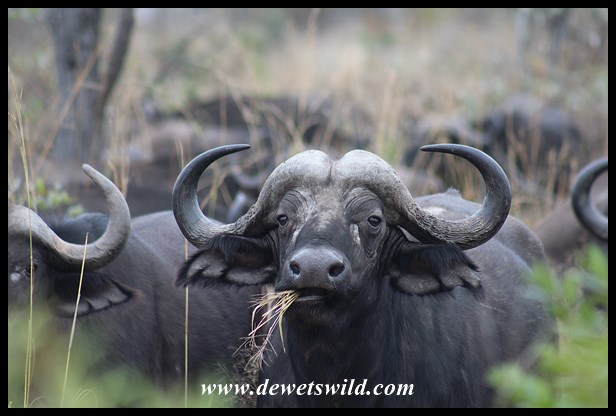
After a good night’s sleep we are guided out of camp by Ronnie and Saul just after sunrise (and a welcome rusk or two dipped in an even more welcome cup of coffee!). We cross a few dry stream beds, stand beside mud wallows and rhino dung middens, gape in awe at the enormous size of an elephant skull, watch astonished as Ronnie coax two dozen (maybe even more) tiny spiders from a communal nest, listen to him explain the intricacies of trapping egg-stealing snakes with the shell of a dead Giant African Land Snail and enjoy a picnic in the unexpected downpour of a winter rainstorm, all the while soaking in the Napi wilderness surrounding us. Heading back to camp we find our way blocked by a huge herd of one of Africa’s most dangerous animals; the African Buffalo, but under the safe guidance of the two rangers we’re free to admire these powerful creatures at close quarters until one cantankerous bull, separated from the herd and with the devil’s fire burning in his eyes, decides it is time for us to move on…

Relaxing back at home base we find out that the human guests are not the only ones waiting for Armondo to finish preparing lunch, as a pack of Dwarf Mongooses scurry around his kitchen hoping for a few scraps (that never came). We also find out that the camp is alive with birds and small reptiles, and that there’s also a wide variety of wildlife arriving at the small waterhole in front of camp to quench their first.

Our late afternoon is spent walking a short circuit around some of the enormous granitic outcrops, which is such a familiar sight in this part of the Kruger Park, before enjoying a glowing red African sunset from one of these special vantage points. Driving back to camp we pass the busy den of a clan of Spotted Hyenas, where the cute cubs have everyone on the vehicle smiling from ear to ear, and again find our road back in the darkness blocked by a herd of buffalo.

At night there’s just as much life inside as outside the Napi Wilderness Trail’s base camp. At least three species of owl frequent the camp, their distinct calls punctuating our fireside conversations, and walking around with a spotlight is sure to show up some interesting nocturnal bugs!

We heard lions roaring during the night, but I didn’t expect that we’d come across their fresh tracks as close to camp as we did the next morning. Our ranger-guides tried their best to follow the big cats, but they must have been aware that we were tracking them and only led us in circles. This strategy did however bring us close to another enormous herd of buffaloes – likely the lions were stalking the same herd when they became aware of us. Ronnie and Saul brought us to a small termite mound where we could stand and watch as the herd approached closer and closer. Being confronted by a throng of bellowing buffaloes, hundreds strong in number and probably less than 30 meters from us by the time we moved out of their way, surely must be my favourite memory of the Napi Wilderness Trail.

Lunchtime in camp is just another excuse to appreciate the plethora of wildlife species both inside and outside the camp’s low perimeter fence from a more relaxed position, and although there isn’t much sitting going on once you start following birds between the tents trying for decent photographs of them, it is still an utterly relaxing exercise!

Our final outing from the camp is a drive with expert guide Saul at the wheel to Transport Dam. We enjoy our sundowners in the presence of hippos, crocodiles and a menagerie of thirsty animals and birds before returning to camp, and a traditional braai (barbeque) prepared by Armondo, passing the hyena den again on the way.

After dinner we go in search of the camp’s owls again, and while the Pearl-Spotted Owlets only serenaded us with their calls without posing for photos, the African Scops Owls and African Barred Owlets were much more accommodating.

Come Wednesday morning and Armondo’s beating on his breakfast drum signaled that our time on the Napi Wilderness Trail has come to an end. After a hearty breakfast, with scrumptious freshly baked bread, we’re off back to Pretoriuskop and civilisation. Another sighting of a sable antelope and then a pride of lions feeding on a young buffalo helps to bring some consolation…

The 60km drive from Pretoriuskop down to Malelane Gate went far too quickly for our liking. Lucky for my sister she could join up with her husband at Malelane Gate for four more nights’ stay in the Park, but for me, my mom and brother it was time to head back to hectic Gauteng.

This was my third Wilderness Trail experience in the Kruger National Park; having previously participated in the Olifants and Sweni WIlderness Trails (follow the links to read about those trips). South African National Parks offers a total of seven Wilderness Trails and three Backpack Trails in the Kruger National Park, each three nights in duration and accommodating no more than 8 participants twice a week (commencing Wednesdays and Sundays), and guided by two knowledgeable rangers.
 

The night before we ventured into the Wilderness…

Earlier this month I was joined by my mother, sister and brother in the Kruger National Park, chiefly to participate in the Napi Wilderness Trail, one of several guided multi-day walking trails available in the Park.

However, with the trail only starting on Sunday afternoon, we weren’t going to let the weekend go to waste and got underway from Gauteng to Kruger in the wee hours of Saturday morning. Arriving at Kruger’s Malelane Gate around 07:30 allowed us time to enjoy a quick picnic breakfast and coffee before following a meandering route along the quieter gravel roads as we made our slow way to Lower Sabie, making frequent stops to appreciate the wildlife and scenery for which the Kruger Park is world renowned.

Our accommodation for the night was a basic but comfortable 4-bed hut located close to a communal kitchen and bathroom at Lower Sabie‘s eastern fenceline. These huts are surrounded by enormous trees and indigenous shrubbery frequented by a myriad of birds and small reptiles that are quite used to having humans poking lenses in their faces…

Our game drive for the afternoon took us first to Sunset Dam just outside the camp’s gates, then a quick detour across the causeway over the Sabie River, and then along the S28, S137 and H4-2 roads to the south of Lower Sabie, returning to camp just before the gates closed.

Walking around camp in the dark after dinner, looking for nocturnal wildlife with a flashlight, is a firmly entrenched tradition for the de Wets. Both inside and outside Lower Sabie, there’s always plenty to see, and we’re almost unwilling to go to bed for fear of missing out on something interesting!

Being one of the first vehicles to leave Lower Sabie when the gates opened at 06:00 on Sunday morning, we opted to take the main road to Skukuza before this hugely popular route gets too busy with traffic. A quick detour along the short Nwatimhiri causeway-loop rewarded us handsomly with a sighting of three young lions trying to hide, with limited success, in the thick riverine vegetation. Along the way we also popped into Nkuhlu Picnic Spot, Skukuza’s airport, the Skukuza Golf Club and Lake Panic birdhide, before heading for historic Pretoriuskop, all the time enjoying some more of the Kruger Park’s sights, sounds and smells.

After arriving at Pretoriuskop there’s more than enough time to pop into reception to complete all the necessary formalities for the Napi Trail and then take a gentle stroll through the camp appreciating the astounding variety of birdlife that occurs there.

Right on time (at 15:00) we were met at the designated spot by our two guides and group of four fellow trailists for the main event; the Napi Wilderness Trail (more about that wonderful experience in our next post, so stay tuned!).


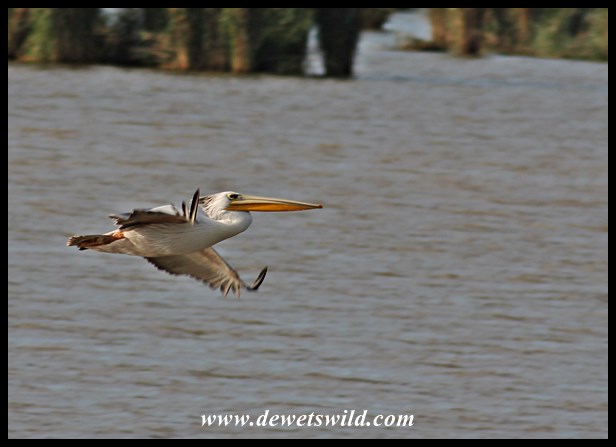
Pink-backed Pelican

Pelecanus rufescens

Pink-backed Pelicans inhabit a variety of large water bodies and wetlands, including dams, lakes, slow-moving rivers, marshes, lagoons, estuaries and sheltered bays. They are diurnal in habit and feed exclusively on fish and amphibians caught underwater in their large bill pouches. Although one of the smaller kinds of pelican, at a weight of up to 7kg with a wingspan of up to 2.9m, it is still a very large bird.

Although they normally forage singly or in small groups, Pink-backed Pelicans breed communally in colonies numbering from 15-500 pairs, often associating with other species of waterbird at these localities. Pairs are monogamous, and usually build their stick-platform nests in the tops of trees (rarely on the ground) and use them for several consecutive years. In South Africa they breed in the summer rainy season, though further north breeding has been recorded throughout the year. Both sexes incubate the clutch of 1-4 eggs for a period of around 35 days. There’s much squabbling among the nestlings, often leading to smaller chicks dying of starvation or falling from the nest. The chicks start flying at about 3 months old.

The Pink-backed Pelican occurs patchily and irregularly in the provinces of South Africa’s northeast, with the iSimangaliso Wetland Park‘s Lake St. Lucia and Nsumo Pan probably the most reliable spots for viewing this species in our country, hosting an estimated 600 – 900 individuals at one of only three known nesting sites of this species in the country. They’re considered vulnerable in South Africa, suffering due to wetland loss and degradation. North of our borders the Pink-backed Pelican occurs over most of Sub-Saharan Africa and parts of the Arabian Peninsula and is considered of least concern, with a stable population, by the IUCN.


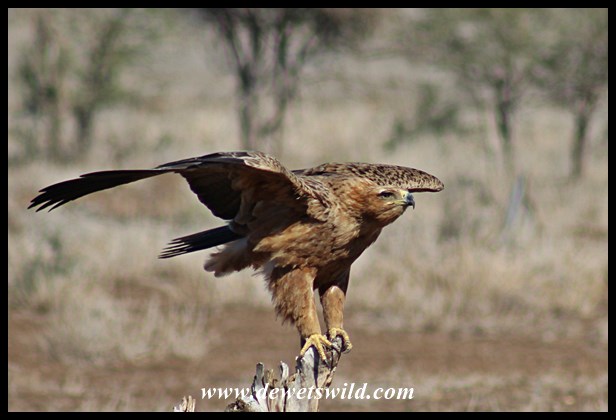
Tawny Eagle

Aquila rapax

A species of dry, open woodlands, savannas and semi-deserts, Tawny Eagles have a very wide prey base; hunting anything from amphibians to mammals up to the size of rabbits and young warthogs, and regularly feeding on roadkill or carrion or food stolen from other birds of prey. Tawny Eagles have a wingspan of up to 2m, and weigh up to 3kg.

These large eagles are mostly seen alone or in pairs as they are territorial and resident year-round. They breed on large nests built of sticks and bones on top of isolated trees or utility pylons. They’ll also take over the similarly constructed nests of other large birds like storks and vultures. In South Africa most pairs breed in winter. Clutches contain 1 – 3 eggs and is mainly incubated by the female for a month-and-a-half. For the first few days after hatching the female broods the chicks and the male brings back food to the nest for both her and the chicks. The chicks take their first flight at about 12 weeks old and remain with the parents for another 6 weeks or so thereafter.

Although the Tawny Eagle is still listed as “least concern”, the IUCN notes that its populations are declining over much of its African range, possibly due to persecution through poisoned carcasses and deliberate shooting. The largest part of the population occurs in Sub-Saharan Africa (with the exception of the equatorial forests and southern South Africa) and on the Indian subcontinent, with smaller populations in North Africa and the Arabian Peninsula. In South Africa, where they are considered vulnerable, Tawny Eagles are commonly encountered in the north of Kwazulu-Natal, the Lowveld of Mpumalanga and Limpopo (where there is an estimated 670 in the Kruger National Park), the Limpopo Valley and the Kgalagadi Tranfrontier Park, but seldom elsewhere, indicating that its populations in this country are now mostly confined to major conservation areas, as with many other large raptors.

African Jacana

Actophilornis africanus

Often seen walking across floating vegetation or the backs of hippos with its exceptionally long toes, the African Jacana is a species closely associated with permanent or seasonally flooded wetlands, pans, dams, ponds and rivers, with floating vegetation (especially waterlilies) and densely vegetated banks for cover. African Jacanas forage singly, in pairs or in family groups, sometimes gathering in small flocks, feeding on insects, worms, crustaceans and molluscs.

Male African Jacanas are highly territorial and, unlike most other kinds of birds, it is the male that is responsible for incubating the eggs and rearing the chicks – the female departs to find another mate as soon as the eggs have been laid, mating with several males over the course of the breeding season. While breeding has been recorded throughout the year there is a definite peak in the summer months. Three to five eggs are laid precariously on a platform of clammy plant material set down on floating vegetation, and incubated by the male alone for just over 3 weeks. The male then looks after the chicks for the next two months until they become independent. When they are small, the male picks up the chicks under his wings and carries them around. At an average of 140g, the male African Jacana is considerably more lightly built than the female (average 230g).

With a stable population, estimated at a million birds, distributed over most of Sub-Saharan Africa, the IUCN considers the African Jacana as being of least concern. In South Africa they occur widely and commonly in Gauteng, Limpopo, Mpumalanga and Kwazulu-Natal, is less commonly encountered in the Free State, North West, Western Cape and Eastern Cape provinces, and almost entirely absent from the Northern Cape.

African Black Duck

Anas sparsa

African Black Ducks are mostly found on shallow, fast-flowing, rocky streams and rivers, often in mountainous or wooded areas, though they do also utilise other natural and man-made water bodies nearby. They follow an omnivorous diet, feeding on aquatic plants, grain, fruits and berries, insects, fish eggs, crustaceans and tadpoles. African Black Ducks are diurnal, doing most of their foraging at dawn and dusk, and weigh around 1kg.

African Black Ducks are territorial throughout the year, each pair occupying a considerable stretch of river. They are usually seen singly or in pairs, rarely congregating in large numbers (when they do, it is usually unmated or immature birds without a territory gathering at a popular roost). The breeding season spans most of the year with a peak in autumn and winter in South Africa. The nest is a cup of plant material lined with down, usually built on the ground on islands and river banks near the water, and surrounded by dense grass, reeds or driftwood. The female is responsible for building the nest, incubating the eggs (of which there are between 4 and 11 in a clutch) and caring for the chicks. Incubation takes about 4 weeks, the ducklings fledge at between 2 and 3 months old, and then stay with their parents for another month or two.

Despite a decreasing population, caused by degradation of their preferred riverine habitats and hybridization with feral populations of the exotic Mallard, the IUCN lists the African Black Duck as being of least concern. They are widespread over much of southern, central and east Africa, and in South Africa occurs in all our provinces, though only patchily in the arid Northern Cape.