Tag Archives: wildlife

African Penguin

Spheniscus demersus

One of our most endearing birds and the only one of its kind resident on the continent, the African Penguin was previously known as the Jackass Penguin, thanks to its donkey-like braying. Adults weigh as much as 3.5kg and stand up to 70cm tall.

Penguins forage in the open ocean, either alone, in pairs or in small groups, and usually within 40km from their colony. When not caring for chicks at the colony, adults can stay out at sea for up to 5 days. They feed primarily on shoaling fish (like sardine and anchovy) and squid. African Penguins swim at speeds of around 7km/h, and can remain submerged for up to 2 minutes at a time.

African Penguins usually breed in tightly packed colonies, often at any time of the year with specific peak periods in different colonies. Pairs are monogamous and form lifelong bonds, with the male advertising and defending their small territory around the nest. Most colonies are on islands well out of reach of mammalian predators, while a handful are in safe and sheltered areas on the mainland. African Penguins prefer to breed in burrows dug in guano (seabird excrement valued as fertilizer) or sand, but as this has become very rare at some nesting colonies authorities have resorted to making artificial structures available for the purpose. When burrows (natural or artificial) is unavailable, they will nest on open ground but usually these attempts are far less successful in raising chicks. Clutches consist of one to three eggs, incubated for around 40 days by both parents. Chicks leave the nest at between 2 and 3 months old, but remain dependent on their parents for another two months or so thereafter. Newly independent juveniles often disperse as far as 2,000km away from the colonies where they hatched, but most return to their natal colonies again when they reach breeding age at about 4 years old. It is estimated that African Penguins can live to about 27 years in the wild.

African Penguins are restricted to the coasts of Namibia and South Africa. The IUCN classifies it as endangered, owing to a plummeting population as a result of depleting fish stocks (through overfishing and warming oceans) and pollution (most notable from oil spills). Scraping of guano, which destroyed the penguins’ nesting sites, and collection of eggs caused major declines in the population at the start of the 20th century. From a population counted in the millions in the early 1900’s, the total estimated population in 2015 stood at around 80,000 mature birds  (probably even fewer now) distributed at 29 breeding colonies (with an estimated 87% of the population breeding at just 8 localities). Boulders Beach, south of Cape Town and managed as part of the Table Mountain National Park, offers probably the most accessible viewing of the species.

Boulders Beach and Penguin Colony (Table Mountain National Park)

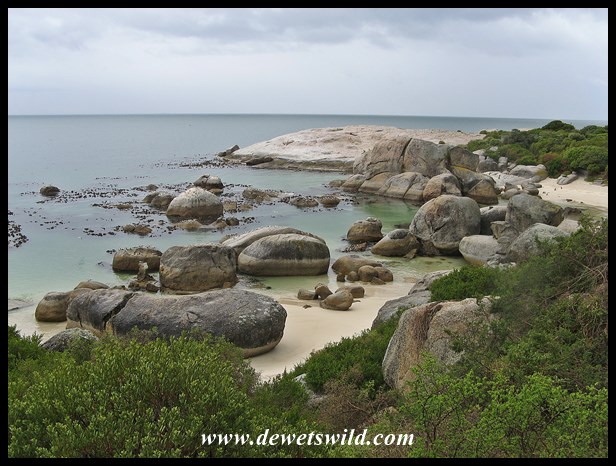
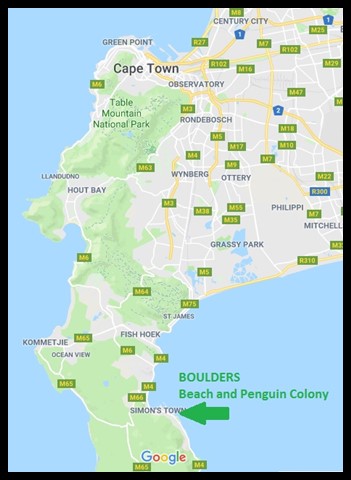
Boulders, a sheltered cove in the naval town of Simon’s Town, comprises a few small bays and beaches protected by enormous granite rocks, 540-million years old, from the pounding surf of the Atlantic Ocean in False Bay. It is one of the most popular attractions in the Table Mountain National Park.

In 1982, two pairs of African Penguins took the unusual step of settling and breeding on the mainland here at Boulders. Today, the colony has grown to number over 2,000 birds and offers probably the most accessible views of penguins to be had anywhere in the world. Visitors are urged not to get too close to the penguins and not to try and touch them, as they’ll not hesitate to nip a finger or nose with their razor sharp beaks if they feel threatened.

While pride of place obviously goes the the penguins, there’s a multitude of other wildlife – birds and mammals especially – that find a safe refuge at Boulders.

Wheelchair-friendly boardwalks erected at Foxy Beach allows visitors to get up close to the penguins, while swimming and sunbathing is popular at Boulders Beach. The two beaches are connected by a lovely walkway through indigenous bush known as Willis’ Walk. There is a curio shop at the visitor centre, and several restaurants, cafes and coffee shops nearby in Simon’s Town.

Boulders Beach and Penguin Colony is located in Simon’s Town, base of the South African navy south of Cape Town. Parking is available in Seaforth Road and Bellevue Road, both of which turn off the main Milner’s Point Road (M4) leading through town.

Cape of Good Hope (Table Mountain National Park)

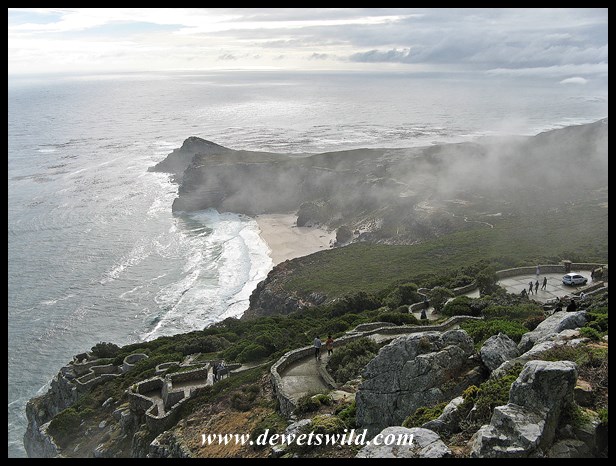
Archaeological investigations indicate that the Cape Peninsula, the mountainous promontory that stretches for over 50km from Table Mountain in the north to Cape Point in the south at Africa’s south-westernmost extremity, has been inhabited intermittently by humans since the Early Stone Age, roughly 600,000 years ago. First described as the “Cape of Storms” by Portuguese explorer Bartolomeu Dias, the first known European to navigate around the southern tip of Africa in March 1488, and then given the moniker “Cape of Good Hope” by King João II of Portugal as Dias’s “discovery” opened the possibility of an oceanic trade route to India and the Far East, the most flattering description for this stretch of rugged coastline came from English Admiral Sir Francis Drake in 1580, when he referred to it as “a most stately thing and the fairest cape we saw in the whole circumference of the earth“. Today, two “padrãos” – replicas of the limestone pillars erected by Portuguese explorers on their voyages to signify Portuguese and Christian sovereignty and erected in 1965, commemorate two of those erstwhile explorers: Dias and Vasco da Gama, the first to reach India from Europe around the African coast.

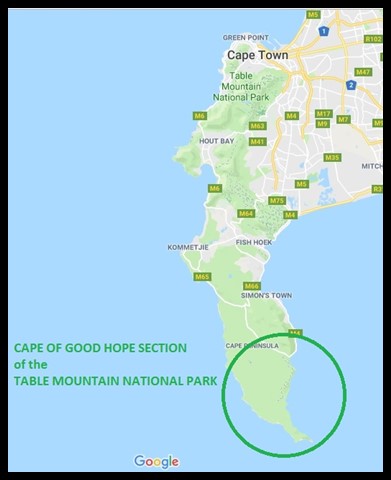
In 1939, the Cape of Good Hope Nature Reserve was established on the southern tip of the Cape Peninsula. In 1998, the reserve’s 7,750ha was incorporated into the Cape Peninsula National Park, which was renamed the Table Mountain National Park in 2004. The land area of the Park covers a total of almost 300km², with a further 975km² of the ocean protected in a marine reserve. Managing this National Park with Cape Town and its suburbs, a city of 3,7-million people, right on the doorstep must be a daunting task and with over 4-million visitors annually, the Table Mountain National Park is one of South Africa’s top tourist attractions.

Cape Point consists of dramatic sea cliffs, among the highest in the world, jutting into the Atlantic Ocean at the tip of the Peninsula. On a clear day the view from the top is nothing short of spectacular. The “Flying Dutchman” Funicular (named for Captain Hendrick van der Decken’s ghost ship still plying these waters in stormy seas) is available to take visitors up to the old lighthouse and viewpoints and back down, though there’s always the option of hiking the 800m distance.

Commonly described as Fynbos, the natural vegetation of the Table MountaIn National Park is an integral component of the Cape Floral Kingdom, which, with an amazing 9,004 plant species is the smallest of only 6 plant kingdoms recognized in the world and a UNESCO Natural World Heritage Site. There are over 2,285 indigenous flowering plant species on the Cape Peninsula – compare that to fewer than 1,500 species indigenous to the entire British Isles! Inside the Cape of Good Hope section of the Park alone, over 1,200 plant species have been identified.

The Cape Peninsula may be world renowned for its awesome scenery, but it is also home to a wide variety of birds (303 species on land and sea), mammals (58 terrestrial and 36 marine species) , reptiles (64 species), amphibians (17 species) and fish (including the Great White Shark), not to mention countless invertebrates.

Visitors may overnight inside the Cape of Good Hope section of the National Park at one of three cottages (Olifantsbos, Eland & Duiker) or on the Hoerikwaggo Cape of Good Hope Trail. An extensive network of tarred roads lead to several viewpoints and picnic sites, two of which have tidal pools as swimming in the sea at many of the beaches here is considered rather risky, while a restaurant and curio shops can be found at Cape Point.

We spent two nights at Eland Cottage at the Cape of Good Hope during our epic December holidays in eight of South Africa’s national parks.

The Cape of Good Hope section of the Table Mountain National Park lies to the south of the city of Cape Town, and can be approached either from the town of Kommetjie along the Atlantic seaboard (road M65), or through Simon’s Town on the False Bay coast (road M4 / M66).

Another quick nature fix at Rietvlei

Just as we were starting to experience withdrawal symptoms after spending almost a month exploring eight of our country’s beautiful national parks we were saved from the agony by a good friend who organised his birthday party at our local Rietvlei Nature Reserve yesterday.

Karoo Long-billed Lark

Certhilauda subcoronata

Karoo Long-billed Larks are usually encountered singly or in pairs. As their name suggest, these birds inhabit sparsely vegetated, rocky plains and hill slopes in the arid Karoo, and feed primarily on insects and seeds.

These rather large Larks (weighing 31-55g) breed mostly in spring and summer. Their nests are cups built of roots and twigs in hollows at the bases of shrubs and rocks in which 2-3 eggs are laid.

The Karoo Long-billed Lark occurs commonly in the drier western half of South Africa, specifically in the Northern, Western and Eastern Cape Provinces, extending into Namibia. The Karoo National Park is one of the best places to go looking for this species. With a a large and stable population, the IUCN considers the Karoo Long-billed Lark to be of least concern.

Karoo National Park

The Great Karoo, which covers much of South Africa’s western and central interior, is an arid region, rich in drought resistant plant and animal life. Since being settled by European stock farmers in the early 1700’s, large game was systematically eradicated from the area; the last lions for instance disappearing from the region in the 1820’s. In what is today the Karoo National Park, visitors will notice the rock-traps built to catch predators like brown hyena and leopard, with an easily accessible example right inside the rest camp, between the camping area and chalets. The Park came about when, in the 1970’s, the National Parks Board (today SANParks) and interested NGO’s realised that there was very little of the Karoo being formally protected and started looking for a suitable area to be proclaimed a National Park. Eventually a site just outside the town of Beaufort-West was decided upon, and officially proclaimed the Karoo National Park, 17,706 hectares in extent, in September 1979.

The Karoo’s history goes back much further than that though. Around 255-million years ago, the area was lush and covered in swamps, and sediments laid down then are today a rich source of fossils. This fascinating world is made accessible to the park’s visitors along the short (400m), paved Fossil Trail near the reception complex.

Since its proclamation, additional land was acquired and incorporated, and today the Karoo National Park covers an extensive area of 88,133 hectares. The peaks of the Nuweveld Mountains rise to over 1,900m above sea level, though most of the plains lie at and average of 850m above sea level. This is a harsh environment, with an average annual rainfall of just over 200mm (most of which falls in summer), winter temperatures dropping as low as -15°C (with frost and snowfall a common occurence) and summer temperatures soaring to over 40°C. Most of the vegetation consists of hardy grasses and woody shrubs, with extensive stands of thorny trees along the dry river courses, and about 864 recorded plant species!

After it was proclaimed, several species of animals that occurred here naturally were reintroduced, the most notable of which are over 700 Cape Mountain Zebra, Buffalo, Black Rhino and Lion. Today, the Park protects 62 species of mammal, 63 reptile species (including 5 kinds of tortoise), 10 kinds of amphibians and even a single species of indigenous fish, the Chubbyhead Barb.

More than 200 bird species have been recorded inside the Karoo National Park, several of which are endemic to this arid landscape.

For birdwatchers especially, the birdhide situated on the edge of the camp overlooking a reed-fringed waterhole is a real boon.

Overnight visitors have a choice of camping and accommodation (with breakfast included) available in the award-winning rest camp, which was opened in 1989. The camp also has a restaurant and little shop, as well as a very popular swimming pool. Near the campsite an old barn has been converted into an information centre, with interesting displays on the history of the Karoo and the National Park that carries its name. Two picnic sites, at Bulkraal and Doornhoek, cater to the needs of day visitors. Afsaal and Embizweni are more rustic cottages located along the Park’s extensive network of 4×4 trails. Visitors with less rugged vehicles are able to drive in comfort along the delightfully named Potlekkertjie and Lammertjiesleegte Loops, and the spectacular Klipspringer Pass.

The Karoo National Park was the first destination of our recent December 2017 holidays. It is a drive of roughly 1,000 km from our home in Pretoria to the Park’s entrance gate, conveniently located along the N1 highway about 6km south of Beaufort-West. The nearest international airport is in Cape Town, about 500km to the southwest.


Care for a Caracal?

This morning here at Mountain Zebra National Park we had the amazing privilege of seeing one of South Africa’s most elusive creatures, the Caracal, out on the hunt.

—–

If you enjoy de Wets Wild as much as we enjoy sharing our love for South Africa’s wild places and their denizens with you, please vote for us in the 2017 South African Blog Awards.

We’ve entered the categories for “Best Travel Blog” and “Best Environmental Blog”, and you are allowed to vote for us in both. Clicking on the badge below will bring you to the voting site. After voting, you’ll receive an e-mail requiring you to click on a link to confirm your votes.

Thank you very much for your support!

SA Blog Awards Badge

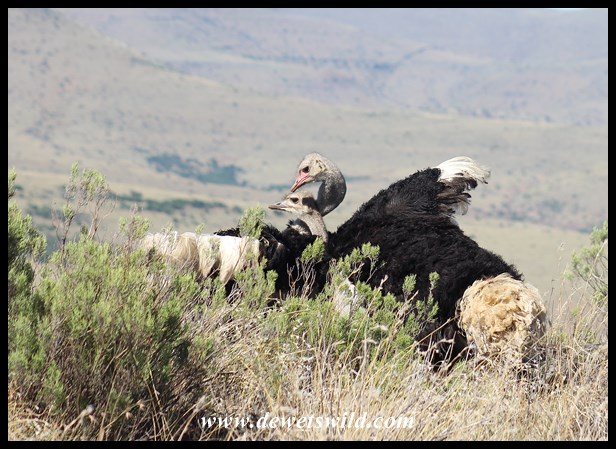
Ostrich Love in the Mountains

This morning we were treated to the spectacle of ostrich courtship and mating here at Mountain Zebra National Park.

—–

If you enjoy de Wets Wild as much as we enjoy sharing our love for South Africa’s wild places and their denizens with you, please vote for us in the 2017 South African Blog Awards.

We’ve entered the categories for “Best Travel Blog” and “Best Environmental Blog”, and you are allowed to vote for us in both. Clicking on the badge below will bring you to the voting site. After voting, you’ll receive an e-mail requiring you to click on a link to confirm your votes.

Thank you very much for your support!

SA Blog Awards Badge

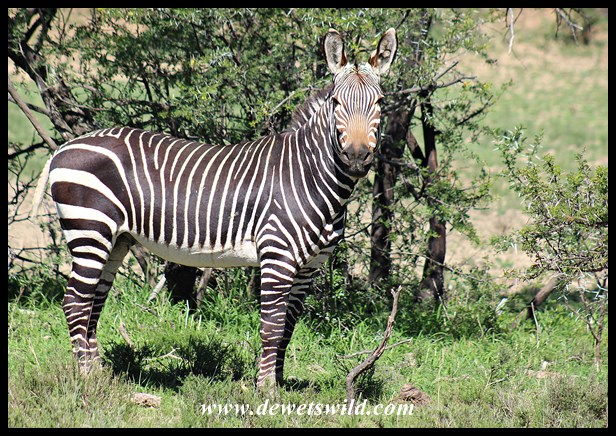
We’re at Mountain Zebra National Park now

Evening on the 27th of December 2017 finds us at Mountain Zebra National Park, where the battle to save the Cape Mountain Zebra from the brink of extinction was fought and won.

—–

If you enjoy de Wets Wild as much as we enjoy sharing our love for South Africa’s wild places and their denizens with you, please vote for us in the 2017 South African Blog Awards.

We’ve entered the categories for “Best Travel Blog” and “Best Environmental Blog”, and you are allowed to vote for us in both. Clicking on the badge below will bring you to the voting site. After voting, you’ll receive an e-mail requiring you to click on a link to confirm your votes.

Thank you very much for your support!

SA Blog Awards Badge

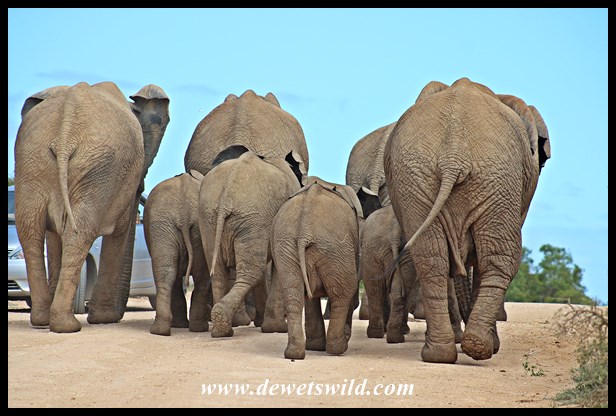
Seymore Butts

How many ellie bums can you fit in one picture? 😀

We had the pleasure of following this wide load on our drive through Addo Elephant National Park this morning.

—–

If you enjoy de Wets Wild as much as we enjoy sharing our love for South Africa’s wild places and their denizens with you, please vote for us in the 2017 South African Blog Awards.

We’ve entered the categories for “Best Travel Blog” and “Best Environmental Blog”, and you are allowed to vote for us in both. Clicking on the badge below will bring you to the voting site. After voting, you’ll receive an e-mail requiring you to click on a link to confirm your votes.

Thank you very much for your support!

SA Blog Awards Badge