Tag Archives: wildlife

Birthday celebrations at Rietvlei

Yesterday we celebrated Joubert’s ninth birthday at our local Rietvlei Nature Reserve, just a few kilometers from home. Combining family and friends, wildlife,  photography, a picnic and birthday cake just seems like the best way to celebrate the special day, don’t you agree?

Rietvlei is home to a small pride of lions housed in a 150-hectare enclosure in a corner of the reserve. Normally we wouldn’t support any “reserves” in which lions are kept in confined quarters nor any that offer “cub petting” as an attraction due to the very real possibility that these establishments are involved to a greater or lesser extent in the breeding of lions for the canned hunting and bone exporting business, despite their claims of “conservation” and “education”. Rietvlei’s lions however were rescued from exactly such circumstances, cannot be introduced to the wild and will live out their lives here. It was a special birthday treat for Joubert and his friends to visit Tau, Jarvis, Bassie and Tawane at their home.

Barberton Girdled Lizard

Smaug barbertonensis

A shy denizen of well-shaded, bouldered hills and mountains with plentiful crags and fissures, the diurnal Barberton Girdled Lizard feeds on invertebrates, frogs and small geckos. Excluding their tails, adults can measure up to 13cm in length. Females give birth to 2-6 babies in late summer. Considered by some authorities to be a subspecies of Warren’s Girdled Lizard (S. warreni), the Barberton Girdled Lizard has a very limited distribution around the borders of South Africa’s southern Mpumalanga and northern Kwazulu-Natal Provinces with eastern Swaziland, and is considered to be of least concern by the IUCN. Ntshondwe Camp in Ithala Game Reserve is a very reliable spot to search for these attractive lizards.

High time we went back to Ithala!

This past Women’s Day long weekend afforded us the opportunity to make a long overdue return visit to one of our favourite South African wild places – the Ithala Game Reserve in northern Kwazulu-Natal. We’ve been singing the praises of this little known yet exceptionally scenic reserve for as long as this blog’s been running and if you’d like to see all our posts about Ithala and learn more about it please follow this link.

While the weekend’s weather ranged from cold, wet and blustery to glorious sunshine, that didn’t curtail our explorations in the least. How could it, when the majestic scenery is so rewarding!?

And, when the sun came out, so did the butterflies and various kinds of reptiles!

Ithala has a rich variety of bird species and many of them are easily seen and photographed in Ntshondwe, the reserve’s main camp.

And of course, what would a “game reserve” be without a rich assortment of large animals? Ithala never disappoints in its variety of mammals, and especially the giraffes (Ithala’s emblem) were out in force!

We spent three nights at Ithala, staying in comfort in Ntshondwe’s chalet #20. Ithala’s a relaxed 6 hour drive on good tarred roads from our home in Pretoria.
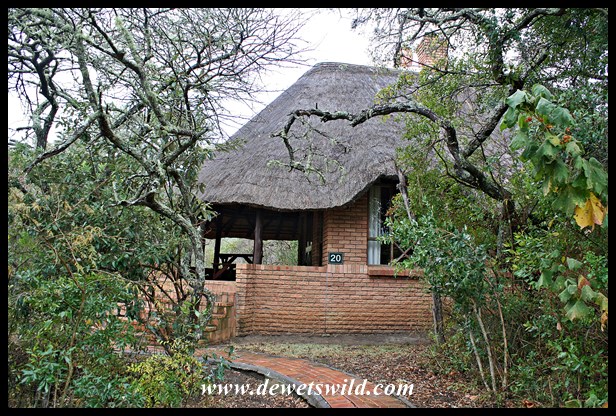
Ntshondwe Chalet #20, Ithala Game Reserve, August 2018
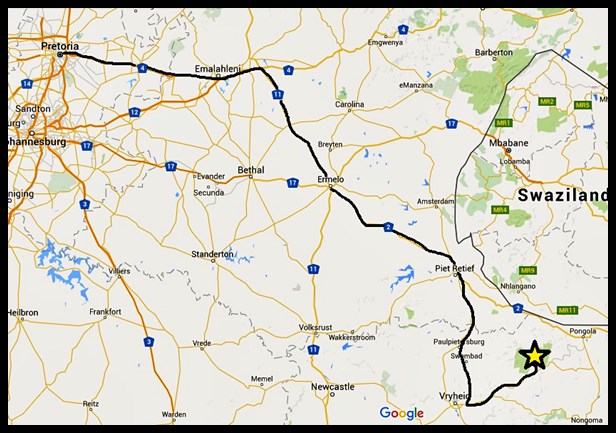
Pretoria to Ithala
(drawn with Google Maps)

Kalahari Scrub Robin

Cercotrichas paena

The Kalahari Scrub Robin inhabits arid and semi-arid, open habitats with scattered trees and bushes, particularly thorn-savannas, where it hunts on the ground for insects and spiders. Adults grow to a length of about 15 cm and weigh around 20g.

The breeding season for Kalahari Scrub Robins stretch from mid-winter to the end of summer, peaking around October and November. Their untidy nests are built of plant material and hair and placed low in shrubs. Pairs are monogamous and territorial, the male defending the nesting site with the female being solely responsible for incubating the clutch of 2-4 eggs for a period of 2 weeks. The chicks leave the nest about 2 weeks after hatching.

Apart from South Africa (Northern Cape, North West, Free State and Limpopo), the Kalahari Scrub Robin is found in Botswana, Namibia, Zimbabwe and marginally into Angola. The IUCN lists it as being of least concern.


Bibron’s Thick-toed Gecko

Chondrodactylus bibronii

Bibron’s Thick-toed Gecko, also known as Bibron’s Giant Gecko, is a nocturnal reptile occurring in South Africa’s Western, Eastern and Northern Cape, Free State and North West Provinces, and marginally into adjacent parts of Botswana and Namibia. Here it inhabits rocky outcrops and human habitations in Karoo and semi-desert scrublands. It feeds on a wide variety of insects, other invertebrates, and even smaller lizards, often hunting around the lights of buildings at night. They are often found in colonies but are territorial and aggressive to each other, the males especially so, and they will also readily bite to defend themselves against predators and humans. Bibron’s Gecko is one of the largest geckos in South Africa, growing to between 15 and 20cm in length (including the tail, which makes up about half their total length). Adult females typically lay two clutches of two eggs each per year, hiding them in crevices or under bark.

Burchell’s Sandgrouse

Pterocles burchelli

Burchell’s Sandgrouse is a denizen of arid savannas and is especially common in the sparsely vegetated, sandy Kalahari. These seed-eaters normally drink daily, usually 2-5 hours after sunrise, and is subject to localized movements to access food sources and waterholes. Adults weigh around 200g and are about 25cm long.

Burchell’s Sandgrouse move around in small flocks of up to 50, but are monogamous, solitary breeders. Their nests are simple scrapes in the ground, lined with dry plant material and usually placed next to some kind of vegetation. They nest from late autumn to early spring, usually laying 3 eggs. Both parents incubate the eggs and look after the precocial chicks. The adult birds’ breast feathers are adapted to absorb water, which is then flown back to the chicks.

The IUCN considers Burchell’s Sandgrouse to be of least concern. It is distributed over parts of Angola, Zambia, Zimbabwe, Namibia, Botswana and South Africa (Northern Cape, North West and Limpopo) and has benefited from farming enterprises sinking boreholes to provide water for livestock in otherwise inaccessible areas.

Shepherd’s Tree

Boscia albitrunca

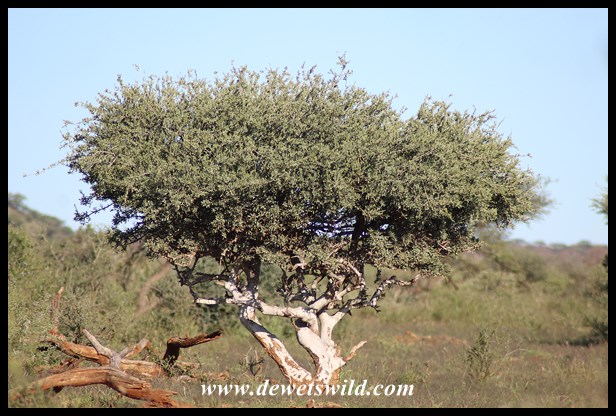
The Shepherd’s Tree, growing up to 7m tall, is one of the most important fodder trees where it occurs. It has a very high protein content in its evergreen leaves and both the flowers and fruits are eagerly eaten by birds and antelope. It is also incredibly valuable as a shade tree – it is said that even ground temperatures of 70°C is lowered to 21°C in the shade of a Shepherd’s Tree!  In South Africa, Shepherd’s Trees grow in the savanna regions from northern Kwazulu-Natal, through Mpumalanga, Limpopo, Gauteng, the North West and the Free State to the arid west of the Northern Cape. It is also found widely in Botswana, Namibia, Swaziland, Zambia and Zimbabwe.

The dried, ground roots of the Shepherd’s Tree can be used to make a kind of coffee, while fresh roots can be pounded and eaten as porridge. Its bark is used to brew traditional beer and the edible fruit is an ingredient in traditional dishes.

Bat-eared Fox

Otocyon megalotis

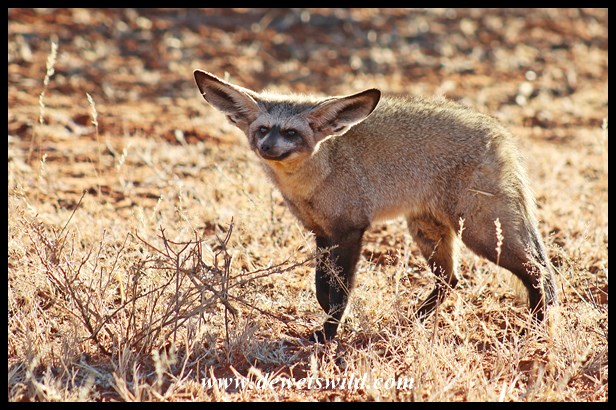
The Bat-eared Fox is probably the most attractive Canid occurring in South Africa. Adults weigh in the region of 4kg and stand up to 40cm high at the shoulder. They inhabit open, dry areas – scrublands, grassland, semi-desert and open savanna – where their favourite prey, the harvester termite, occurs. While termites constitute up to 80% – 95% of their diet, they also consume other insects and invertebrates, some small vertebrates, eggs and wild fruit that they come across. They find their prey underground using their exceptional hearing, for which the outsized ears come in very handy, and then dig it out with their front paws. They can survive without access to drinking water, sourcing enough for their needs from their food.

Bat-eared Foxes are active by day and night, warming up in the early morning sun and resting up in burrows (which they dig themselves or take over from other mammals) or deep shade during the heat of the day. They are usually seen in groups numbering from 2 – 13, consisting of an adult pair (that may remain together for life) and their offspring. The female gives birth to litters of 1-6 pups annually, usually in the rainy season. Both parents take an active part in raising the pups, with the male being more involved in their care than is the case with most other members of the dog family. The youngsters grow quickly and are fully grown by the time they’re 4 months old. Bat-eared Foxes may live from 6 to 12 years in the wild, being susceptible to various diseases and drought (due to the negative impact it has on their preferred prey) and featuring on the menu of all the larger carnivores.

Bat-eared Foxes occur in two discrete parts of the African continent – one population in East Africa (from Somalia and Sudan to Tanzania) and the other in the western parts of Southern Africa (South Africa, Namibia, Botswana, Zimbabwe and marginally into Angola, Zambia and Mozambique). Though they are occasionally hunted for their pelts or as perceived stock thieves, this is thankfully not a major threat and the IUCN considers the Bat-eared Fox to be of least concern. Mokala National Park and the Kgalagadi Transfrontier Park are excellent locations to find and photograph the Bat-eared Fox.

Karasburg Tree Skink

Trachylepis sparsa

The Karasburg Tree Skink is a close relative of the Striped Skink and was once regarded a subspecies of it. It grows to about 8cm long (excluding the tail) and occurs in a small area around the borders of Botswana, Namibia and South Africa’s Northern Cape, in and around the Kgalagadi Transfrontier Park, where it is frequently observed. These Skinks inhabit arid savanna habitats and, as their name suggests, are largely arboreal in habit. They feed mainly on insects and other invertebrates. Females give birth to three to nine live babies in summer.

White-backed Mousebird

Colius colius

The White-backed Mousebird is the smallest of the three species of mousebird occurring in South Africa, with adults weighing in at about 30-55g and growing to 31cm long (including the elongated tail). They inhabit coastal fynbos, arid savannas and thickets in semi-desert, usually near rivers, as well as orchards and gardens, where they feed on buds, flowers, fruits and berries, seeds, leaves and nectar, often leading to conflict with farmers and gardeners. They very rarely forage on the ground, and then usually it is to feed on seeding grasses.

White-backed Mousebirds are social birds, moving around in groups of 2 – 10 (occasionally up to 40) and often mixing with the two other species of mousebirds sharing parts of their range. They breed throughout the year, with a peak in spring and early summer. The nest is an unneat cup built of plant material by both sexes. Clutches of 1-6 eggs are incubated by both parents for 2 weeks, with the youngsters becoming independent within 3 weeks of hatching. Young birds from previous broods often assist in raising the latest clutch.

White-backed Mousebirds are considered of least concern by the IUCN, owing to a common and increasing population which is also expanding its distribution range. They occur only in parts of Botswana, Namibia and South Africa (provinces of the Eastern, Northern and Western Cape, Free State and North West).