The plains around Satara in the Kruger National Park is renowned as one of the best places in South Africa to see the most regal of cats, the Lion. It therefore wasn’t surprising that our visit in December 2021 yielded no less than twenty encounters with the Kings (and Queens) of the Jungle.
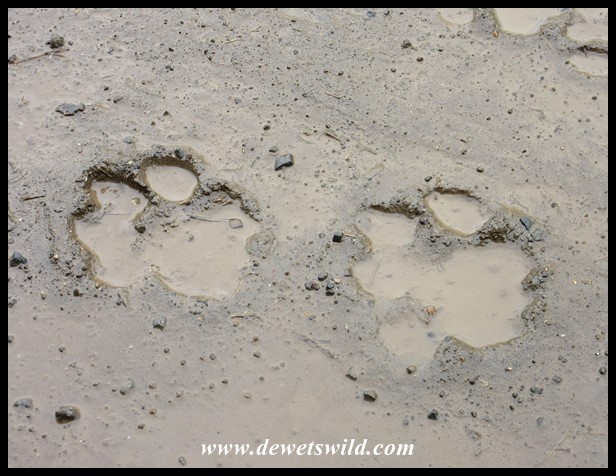
Finding fresh tracks like these in the early morning is really exciting, even if you don’t find the owners on the road.
Majestic they may be, but Lions are notoriously lazy too. Out in the midday heat they’re usually far more likely to be lying flat on their sides and deep in dreamland than moving around or hunting. Luckily we only had a few sightings like that, otherwise this post would not have been very exciting.

One of a group of four young males we found hiding near the Rockvale waterhole on the S36

One of a group of four young males we found hiding near the Rockvale waterhole on the S36 (photo by Joubert)

Lazy lioness at Shibotwana waterhole on the S100

A mating pair of lions causing a traffic jam at Nsemani Dam west of Satara

One of two big male lions that were snoozing next to the Gudzani stream east of Satara

A group of four lioness snoozing away the mid-day hours near Nwanetsi.
Being one of the first cars out of Satara when the gates open in the morning is often rewarded with wonderful lion sightings right on the road. Like this one, just 100 meters – I kid you not! – from Satara’s gate. As we left camp in the pouring rain two magnificent males came walking along the road from the left, straight towards us. Pretty soon the two had a large convoy following them as more cars departed from camp, so we opted to return to our campsite.

Big male lion at Satara’s gate (photo by Joubert)

Big male lion at Satara’s gate (photo by Joubert)

Big male lions in the road at Satara’s gate

Big male lions in the road at Satara’s gate

Big male lion in the road at Satara’s gate
Shortly afterwards, a roaring close-by alerted us to the presence of another lion next to the fence, and Joubert got this shot of a third male as it walked past the open gate to the camp. Perhaps I should be more worried about the boy’s fearlessness when it comes to our wild places and the creatures that live there. Turns out these three enormous lions are the brothers of Satara’s famous white lion and we’d see them a few more times before our time at Satara was at an end.
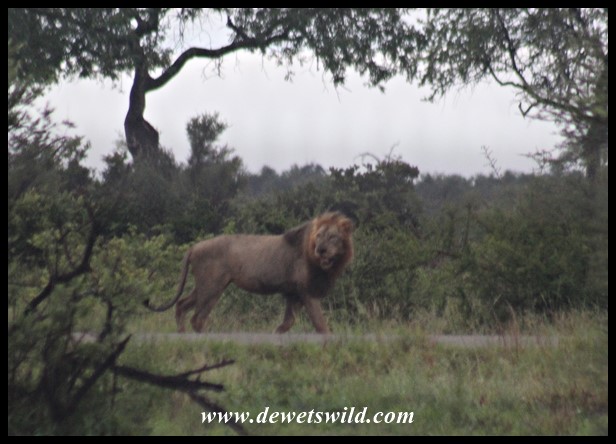
Joubert got this shot of a third male walking past Satara’s gate a while later
On Christmas morning we saw a few giraffe and zebra acting very nervous on the H6. While they were out of view at that time, we could deduce from the herbivores’ behaviour more or less where the predators lay hidden, and sure enough our wait paid off soon enough when the lions gave away their presence, ending any chance they had at a successful hunt. These young lions were part of a bigger pride of which we encountered various members on several occasions along the H6 near its junction with the H1-3 during our stay at Satara in December of 2021.

Hunting lions caught in the act

Hunting lions caught in the act

Hunting lions caught in the act

Hunting lions caught in the act
On the 27th of December we were the first car that morning to turn onto the H6 main road towards Nwanetsi, and less than a kilometer further along came across these three “teenage” lions right on the road.

Young lions claiming the road between Satara and Nwanetsi

Young lions claiming the road between Satara and Nwanetsi

Young lions claiming the road between Satara and Nwanetsi

Young lions claiming the road between Satara and Nwanetsi

Young lions claiming the road between Satara and Nwanetsi

Young lions claiming the road between Satara and Nwanetsi

Young lions claiming the road between Satara and Nwanetsi (photo by Joubert)

Young lions claiming the road between Satara and Nwanetsi (photo by Joubert)

Young lions claiming the road between Satara and Nwanetsi (photo by Joubert)
On New Year’s Day we had another encounter with some of the members of this pride, when we again came across them lounging on the H6 road to Nwanetsi.

Dangerous zebra crossing! Luckily the lions were more curious than hungry.

Young Lions on the H6 on the 1st of January 2022

Young Lions on the H6 on the 1st of January 2022

Young Lions on the H6 on the 1st of January 2022

Young Lions on the H6 on the 1st of January 2022

Young Lions on the H6 on the 1st of January 2022

Young Lions on the H6 on the 1st of January 2022 (photo by Joubert)

Young Lions on the H6 on the 1st of January 2022

Young Lioness winking at Joubert (photo by Joubert)

Young Lions on the H6 on the 1st of January 2022

Young Lions on the H6 on the 1st of January 2022

Young Lions on the H6 on the 1st of January 2022 (photo by Joubert)
As we left Satara on the 2nd of January 2022 to head home, this Lioness walked along with us a bit of the way. We were most grateful for the royal sendoff.

Lioness just outside Satara on the 2nd of January 2022

Lioness just outside Satara on the 2nd of January 2022

Lioness just outside Satara on the 2nd of January 2022 (photo by Joubert)

Lioness just outside Satara on the 2nd of January 2022 (photo by Joubert)
Later on the same day, just before Tshokwane, a young lion stepped into the road ahead, though he was off into the long grass again after just a brief moment.

Young Lion near Tshokwane (photo by Joubert)

Young Lion disappearing in the long grass
In the early morning of the 17th of December, as we were heading along the main road northwards, we encountered these two lovely males with their stylishly maintained (“mane”-tained?) manes heading towards the Mtomeni Spruit. Just look at how beautifully their manes have been blow-dried – not a hair out of place!

Big male lions (photo by Joubert)

Big male lions on the H1-4 north of Satara

Big male lions on the H1-4 north of Satara

Big male lions on the H1-4 north of Satara

Big male lion (photo by Joubert)

Big male lion, smiling for the camera (photo by Joubert)
It was at around 6am on the morning of the 18th of December, with the sun just nicely risen over the horizon, that we came across this small group of lions at the junction of the H7 and S106 on the way to Orpen. Two magnificent males attending to a single female, in all likelihood a trio in the throes of mating judging by the fresh scars both males were carrying on their faces and bodies. The female was the first to rise and lead the males, and all of us humans in our metal cocoons, on a walk along the H7 for about three kilometers before she was distracted by a herd of impalas and stalked off into the thickets. In the end we spent about three quarters of an hour in their company.

Two magnificent Lions and their mate at the junction of the S106 and H7 on the 18th of December 2021

Alert Lioness

Two magnificent Lions and their mate at the junction of the S106 and H7 on the 18th of December 2021

Black-backed Jackal keeping a nervous eye on all the Lions around him

The Lioness deciding it is time to go

Lioness leading the procession along the S106

Magnificent male Lion (photo by Joubert)

Magnificent male Lion

Magnificent male Lion

Magnificent male Lion

Magnificent male Lion (photo by Joubert)

One of the big male Lions crossing the S106 as he follows the female towards the H7

Black-backed Jackal having a staring contest with a lion

Magnificent male Lion

Magnificent male Lion

Magnificent male Lion (photo by Joubert)

One of the big male Lions following the female along the H7

Mighty lion

One of the big male Lions following the female along the H7 (photo by Joubert)

Two big male Lions following the female along the H7

Two big male Lions following the female along the H7

One of the big male Lions following the female along the H7

One of the big male Lions following the female along the H7 (photo by Joubert)

One of the big male Lions following the female along the H7 (photo by Joubert)

Lion lying next to the H7 and his throng of adoring admirers

The Lioness’ interest is piqued by a herd of impalas
Just before 4pm on the 21st of December, with the weather still stiflingly hot as we left Nwanetsi Picnic Site and turned onto the S41 gravel road, we came across two lionesses lying next to the road. They didn’t appreciate our attentions though and immediately got up and walked off. Someone should tell them that this is not the way to treat their adoring fans!

Lionesses on the S41 near Nwanetsi

Lionesses on the S41 near Nwanetsi (photo by Joubert)

Lionesses on the S41 near Nwanetsi

Lionesses on the S41 near Nwanetsi

Lionesses on the S41 near Nwanetsi

Lionesses on the S41 near Nwanetsi

Lionesses on the S41 near Nwanetsi

Lionesses on the S41 near Nwanetsi

Lionesses on the S41 near Nwanetsi

Lionesses on the S41 near Nwanetsi (photo by Joubert)

Lionesses on the S41 near Nwanetsi
On the 22nd of December we explored the roads around the Tshokwane Picnic Site. We found a pride of lions at a small waterhole on the S37 gravel drive very near to its junction with the main H1-3 road. They stayed in the general vicinity all day and we could return to them twice more before heading back to Satara.

Lions on the S37 near Tshokwane (photo by Joubert)

Lions on the S37 near Tshokwane (photo by Joubert)

Lions on the S37 near Tshokwane

Lions on the S37 near Tshokwane

Lions on the S37 near Tshokwane (photo by Joubert)

Lions on the S37 near Tshokwane

Lions on the S37 near Tshokwane (photo by Joubert)

Lions on the S37 near Tshokwane

Lions on the S37 near Tshokwane

Lions on the S37 near Tshokwane

Lions on the S37 near Tshokwane
On the 19th of December, while we were having breakfast at Nwanetsi, I realised that I left my insulin pens at Satara. This meant an adjustment to our planned route for the day in that we’d have to return to camp first. The unexpected detour turned out to be a real blessing in disguise though when we happened upon a pride of 8 lionesses about 5km from the H6’s junction with the H1-3.

Big pride of lionesses on the H6, 19 December 2021

Big pride of lionesses on the H6, 19 December 2021

Big pride of lionesses on the H6, 19 December 2021

Big pride of lionesses on the H6, 19 December 2021

Big pride of lionesses on the H6, 19 December 2021

Big pride of lionesses on the H6, 19 December 2021

Big pride of lionesses on the H6, 19 December 2021

Big pride of lionesses on the H6, 19 December 2021 (photo by Joubert)

Big pride of lionesses on the H6, 19 December 2021 (photo by Joubert)

Big pride of lionesses on the H6, 19 December 2021 (photo by Joubert)

Big pride of lionesses on the H6, 19 December 2021 (photo by Joubert)

Big pride of lionesses on the H6, 19 December 2021 (photo by Joubert)

Big pride of lionesses on the H6, 19 December 2021 (photo by Joubert)

Big pride of lionesses on the H6, 19 December 2021

Big pride of lionesses on the H6, 19 December 2021

Big pride of lionesses on the H6, 19 December 2021 (photo by Joubert)
The unfortunate forgetting of my insulin turned out to be even more of a boon when we arrived at a traffic jam where the main H1-3 road crosses the Nwanetsi River. The reason for the traffic jam was Satara’s White Lion and his brothers! While all we saw of the star of the show first time around was him fast asleep, he did co-operate a bit better when we returned to the scene later in the day.

Satara’s famous white lion and one of his brothers

Satara’s famous white lion (photo by Joubert)

One of the coalition lying in the road (photo by Joubert)

Satara’s famous white lion and one of his brothers (photo by Joubert)

Satara’s famous white lion (photo by Joubert)
When we left Satara at gate opening time (04:30) on the first morning of 2022, the air was filled with the nearby roaring of lions. We didn’t have to travel far before we saw two mighty Lions strolling towards us along the road, followed by a couple of cars. Yet again they were near the Nwanetsi Bridge and we immediately recognised that they were two of the four-brother coalition that includes the White Lion, affectionately known as “Casper” by many regular Kruger visitors. Of course we were wondering where “Casper” is, so we decided to join the cavalcade following his two brothers and see whether they’d lead us to him. Soon though both males took a game trail into the bush and disappeared from view in the long grass. Now we are driving up and down the one kilometre stretch between the Nwanetsi Bridge and the S100 turnoff when suddenly, out of the bush in the pitch dark, appears a third male – the third “normal” coloured Lion. Again we drive the short stretch beside him until he also heads of along the same trail the other males took earlier. The question now is whether the White male is ahead of or behind his brothers…

One of the current ruling Lion coalition around Satara

One of the current ruling Lion coalition around Satara

One of the current ruling Lion coalition around Satara (photo by Joubert)

One of the current ruling Lion coalition around Satara (photo by Joubert)

One of the current ruling Lion coalition around Satara (photo by Joubert)

One of the current ruling Lion coalition around Satara

One of the current ruling Lion coalition around Satara
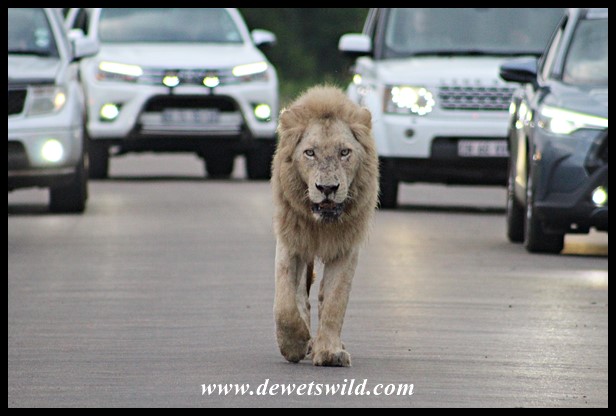
Again we slowly patrol up and down the same stretch of the road, hoping that the White Lion will also pop out of the bush like the ghost he’s named after. After 15 minutes he’s still not appeared and we start believing that he must have been in front of his brothers, and might actually already be on the road to Orpen in which direction we last saw his brothers headed. So we go around the corner, drive 2 or 3 km along the H7 road, but come out empty-handed again, and turn around to go scour the area around the Nwanetsi Bridge again. You would not believe the excitement in our car when we come around the turn to see the White Lion heading straight toward us, entourage in tow, exactly half-an-hour after we last had eyes on his brothers. Since we saw Satara’s White Lion two years ago, he has grown into a very impressive specimen. The oldest and largest of only three known wild White Lions in the world – all of them living in the Kruger National Park – and here he is walking just inches away from our vehicle. We reverse to stay alongside him as he strides down the road, and then let him pass when vehicles start arriving behind us. We couldn’t have asked for a better start to 2022…

Satara’s White Lion walking up to us, entourage in tow

Satara’s White Lion walking up to us, entourage in tow

Satara’s White Lion walking up to us, entourage in tow

Satara’s White Lion walking up to us, entourage in tow

Satara’s White Lion walking up to us, entourage in tow

Satara’s White Lion walking up to us, entourage in tow

Satara’s White Lion walking up to us, entourage in tow

Satara’s white lion up close

Satara’s white lion up close (photo by Joubert)

Satara’s white lion up close (photo by Joubert)

Satara’s white lion up close (photo by Joubert with a cellphone camera)

“Casper” the White Lion in our rearview camera

“Casper” the White Lion in our rearview mirror
With this post then ends the recollections of our epic December 2021 holiday at Satara in the Kruger National Park. We hope you enjoyed it along with us.











 DeWetsWild