It’s the autumn school holidays in South Africa and we’ve managed to escape Pretoria for a couple of days camping at beautiful Bontle in the Marakele National Park.
Yellow-billed Hornbill
Several groups of Banded Mongooses are to be seen in the Kwaggasvlakte section of the Park
Guinea-fowl Butterfly
Flap-necked Chameleon
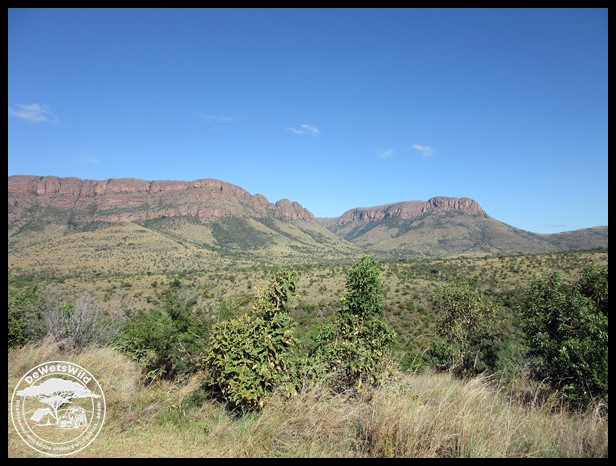
Marakele scenery
Our camping setup at Bontle in Marakele National Park, March 2023
African Dawn Bird & Wildlife Sanctuary, in the Thornhill area west of Gqeberha (formerly Port Elizabeth), developed from one man’s love of birds, taking in injured and orphaned wild birds and unwanted pet birds to look after them. Soon other animals were also ending up at Percy Hickman’s door, and in 1997 the numbers grew to such an extent that his sanctuary was opened to the public in order to help subsidize the cost of food and medical care for the animals. There’s a small restaurant on site as well as ample space for family picnics.
Hundreds of animals have passed through the sanctuary and been released back into the wild, but of course there are some that are either too badly impacted to be returned to the wild, or are exotic to our country, and these are housed in the sanctuary’s excellent facilities. Casual visitors are not allowed to pet or otherwise interact with the animals in their enclosures, but for people with time, effort and expertise to offer African Dawn has a well established volunteer programme in support of their conservation efforts.
African Dawn Bird & Wildlife Sanctuary
African Dawn Bird & Wildlife Sanctuary
Southern African Ground Squirrel
Namaqua Sandgrouse
Male Yellow-throated Sandgrouse
Hen and chicks pecking up crumbs at our picnic table
Indian Peacock
Indian Peafowl hen (photo by Joubert)
Indian Peafowl chick
Blue Duiker
Blue Duiker
Grey Crowned Crane
Blue Crane
Blue crane chick
Ostrich nest
Suni (photo by Joubert)
Common, or Grey, Duiker
Leprous Grasshopper
Serval (captive, photo by Joubert)
Cheetah
A one time cattle farm, most of African Dawn’s property is today a beautiful nature reserve where several kinds of animals indigenous to South Africa roam freely. Visitors traverse this section of the sanctuary in the comfort of their own vehicle, or along a hiking trail (advance booking is required for the latter). A wonderful feature at regular intervals along the drive is the signboards providing interesting information about the animals visitors pass on their way. Obviously the reserve staff know which areas the various animals prefer, as we encountered several species within view of the sign dedicated to them.
African Dawn Bird & Wildlife Sanctuary
African Dawn Bird & Wildlife Sanctuary
African Dawn Bird & Wildlife Sanctuary
Along the game drive route in African Dawn Bird & Wildlife Sanctuary there’s interesting signboards like these giving visitors more information about the animals they’re seeing
Looking for an interesting day out while visiting PE and surrounds? You can’t go wrong with a visit to African Dawn Bird & Wildlife Sanctuary, and you will be supporting them in their important work.
The Nuwejaars Wetlands Special Management Area is a collaboration among 25 different landowners and the community of Elim to protect their irreplaceable 460km² slice of the Agulhas Plain in the Overberg region of the Western Cape Province. By successfully marrying conservation and sustainable farming practices since 2002 this driven group of people is simultaneously protecting the complex ecosystem that sustains their livelihoods and doing their part to keep food on South African tables. The indigenous vegetation of the SMA is characterised as Lowland Fynbos, with around 1,850 species occurring here. Remaining pockets of this threatened plant community have been connected through corridors between the agricultural fields and invasive alien plants are continuously eradicated. Animals that were hunted to local extinction 150-200 years ago, among them buffalo, hippo, bontebok and eland, have been re-introduced, and the reserve already has a list of over 230 bird species that’ve been recorded.
Nuwejaars Wetland Special Management Area
Nuwejaars Wetland Special Management Area
Driving through the Nuwejaars Wetlands Special Management Area
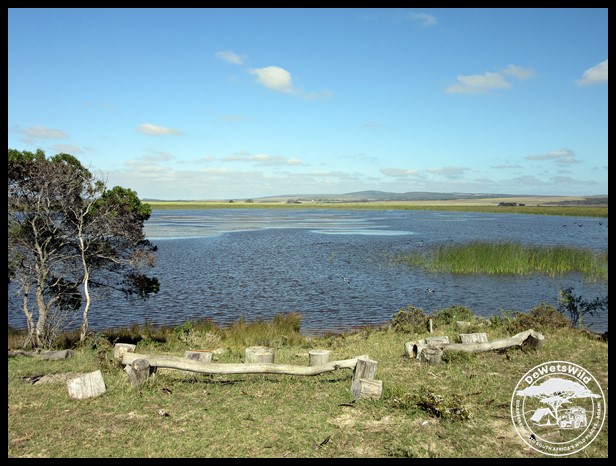
Waskraalvlei in the Nuwejaars Wetlands Special Management Area
Waskraalvlei in the Nuwejaars Wetlands Special Management Area
Unidentified little bloom emerging on the bank of the Waskraalvlei
Nuwejaars Wetland Special Management Area
A view over the Waskraalvlei in the Nuwejaars Wetlands Special Management Area
Pincushion
Lowland Fynbos on the Agulhas Plain
Protea
Brunia
Brunia
Canola field
Nuwejaars Wetland
An excellent way to experience the Nuwejaars Wetland is by joining one of the guided wildlife tours the organisation offers in the summer months. We did just that in December and were taken on a drive along the banks of the Waskraalvlei and onto the hill that looks out over it by Eugene Hahndiek, the SMA’s Conservation Manager for Game & Veld Management. So rich was the experience of sights, smells and sounds, not forgetting the fascinating information about the reserve, farms and ecology that Eugene shared with us, that we’ll definitely never travel through this area again without booking another tour. And as soon as DeWetsWild starts guided itineraries we’ll definitely include it in the package too. Anyone with a love for nature will come away from the 3-hour experience with a deep appreciation for the scale and importance of what the Nuwejaars Wetlands Special Management Area is trying to achieve.
Black-headed Heron
Spurwinged Geese flying over the Nuwejaars Wetland (photo by Joubert)
Kittlitz’s Plover
Red Hartebeest
African Fish Eagle in flight over the Nuwejaars Wetland
Cape Sugarbird (photo by Joubert)
Orange-breasted Sunbird on a Pincushion flower
Fallow Deer are exotics that roam widely over the Overberg landscape
Black-winged Kite using a fence to look for rodents in a canola field
African Marsh Harrier coursing over a canola field
African Marsh Harrier coursing over a canola field (photo by Joubert)
Cape Spurfowl
Herd of Black Wildebeest
Herd of Springbok
Blue cranes with their chick
Agulhas Long-billed Lark
Bontebok
Black Wildebeest race
Bontebok on the run
Yellow-billed Kite
One of the most inspiring projects that the NWSMA is involved in involves the breeding of zebras that resemble the extinct quagga (Equus quagga quagga), the southernmost subspecies of the plains zebra that was hunted to extinction in the late 1870’s, with the last specimen of this uniquely South African species of horse, a mare, dying in distant Amsterdam Zoo in 1883. Over a century later however it was realised, through DNA analysis, that the quagga was a localised race of the still extant plains zebra, and the Quagga Project came into being to try and bring them back through selective breeding. With each subsequent generation showing more and more quagga-like characteristics, one day we may again see true-to-form quaggas roaming their native country in vast numbers. At this point, the Nuwejaars Wetland boasts three viable breeding herds of remarkably quagga-like zebras, and seeing them was a highlight of our visit.
Bachelor “quaggas” at the Nuwejaars Wetlands
Bachelor “quagga” at the Nuwejaars Wetlands
Three bachelor “quaggas” at the Nuwejaars Wetlands
A herd of “quaggas” mixing with buffaloes – a sight not seen in this part of the world for hundreds of years!
A herd of “quaggas” mixing with buffaloes – a sight not seen in this part of the world for hundreds of years!
A herd of “quaggas” mixing with buffaloes – a sight not seen in this part of the world for hundreds of years!
A herd of “quaggas” mixing with buffaloes – a sight not seen in this part of the world for hundreds of years!
Three of the Nuwejaar’s Wetland’s prized “quaggas”
Three of the Nuwejaar’s Wetland’s prized “quaggas”
At 360km² in extent, De Hoop Nature Reserve is one of the largest conservation areas in our Western Cape Province. The reserve came into existence in 1957 following the purchase of the first two farms for the breeding of rare wildlife species. With the value of the reserve in protecting the ever more threatened biodiversity of the region realised, more land was continually added to its territory until 1991. In addition, a marine reserve extending 5km into the Indian Ocean along De Hoop’s 57km long protected coastline was declared in 1986. De Hoop is included in the Cape Floral Region World Heritage Site, inscribed in 2004.
The reserve protects extensive tracts of Fynbos heathland vegetation growing on plains and low lying limestone ridges, much transformed by agricultural activities outside the reserve, an immense 14km long wetland known as De Hoop Vlei, substantial dune fields and long white beaches interspersed by rocky shores. Of the roughly 1,500 plant species that occur in the area at least 40 species, and probably more, occur only in De Hoop. Including marine species, De Hoop and the adjacent marine reserve is home to 86 mammal species (including the largest single population of Bontebok anywhere in the world), 49 kinds of reptiles, 14 kinds of frogs and toads, at least 250 kinds of saltwater fish and more than 260 bird species – including the southernmost breeding colony of vultures (Cape Vultures) on the continent.
De Hoop Nature Reserve
Male Ostrich
Grey Rhebok (Bontebok in background)
Ostrich female with chicks
Eland
Cape Hare
Bontebok
Bokmakierie
Common Fiscal
Bontebok (photo by Joubert)
Cape Sugarbird
Cape Mountain Zebra
Cattle Egrets
White-throated Canary
Capped Wheatear
Cape Mountain Zebras
Namaqua Sandgrouse pair
Cape Mountain Zebras
Chacma Baboon
Conebush
Grey-backed Cisticola
Cape Mountain Zebra
Cape Spurfowl
African Spoonbill (photo by Joubert)
African Pipit (photo by Joubert)
Secretary Bird
Large-billed Lark
Cape Spurfowl (photo by Joubert)
Small herd of Grey Rhebok being accompanied by a female ostrich
Eland
Southern Rock Agama
Young Baboon
The De Hoop Vlei is an immense wetland fed by the Sout (Salt) River, cut off from the sea by a 2km wide field of white sand dunes. The vlei hosts an enormous number and variety of water birds.
View over De Hoop Vlei at Tierhoek
Black-crowned Night Heron
Tropical Bluetail damselfly
Dwarf Blue (photo by Joubert)
Male Ostriches
De Hoop Nature Reserve
De Hoop Vlei
De Hoop Vlei
Cape Shovelers
Great Crested Grebes
Red-knobbed Coots
Cape Shovelers
Southern Pochard (photo by Joubert)
Eland
Koppie Alleen is the most easily accessible beach in De Hoop Nature Reserve, and one of the most reliable spots in the country to watch Southern Right Whales which come here to calf and mate between June and November every year. Intertidal life thrives in the rock pools with their clear water – perfect for snorkeling – and the walk down to the beach from the parking area allows visitors to revel in the sight and smell of the fynbos vegetation.
The road to Koppie Alleen follows a line of partially vegetated, pure white sand dunes
Koppie Alleen
Diverse Fynbos vegetation on the slope at Koppie Alleen
One of around 1,500 Fynbos plant species finding protection at De Hoop
One of around 1,500 Fynbos plant species finding protection at De Hoop
Koppie Alleen
Koppie Alleen
African Oystercatcher (photo by Joubert)
Koppie Alleen Beach in De Hoop Nature Reserve
Rock pool – complete with whale rib – at Koppie Alleen
Koppie Alleen
White-breasted Cormorants
Grey-backed Cisticola
Koppie Alleen Beach in De Hoop Nature Reserve
The De Hoop Nature Reserve is managed by CapeNature and DeWetsWild can assist you with bookings in the accommodation and camping at Die Opstal (main camp) and Die Melkkamer across the vlei. It is wonderful to see wild animals and birds so tamely moving among the human visitors as here at De Hoop. There’s a restaurant and gift shop at the main accommodation complex, and fuel and supplies can be obtained in one of the nearby towns. Visitors to the western portion of the reserve have access to a limited gravel road network linking the entrance gate to the main visitor complex, the picnic area at Tierhoek, a couple of viewpoints over the wetland at De Mond, and Koppie Alleen. For the more energetic there’s numerous hiking and mountain bike trails leading from the main complex. Guided drives, walks and boat trips are also on offer.
View coming from Tierhoek towards Die Opstal
De Hoop Vlei seen from Die Opstal camp
Cape Mountain Zebra in the Opstal Camp
Bontebok lamb
Accommodation at Die Opstal in De Hoop Nature Reserve
Accommodation at Die Opstal in De Hoop Nature Reserve
Restaurant at Die Opstal in De Hoop Nature Reserve
Accommodation at Die Opstal in De Hoop Nature Reserve
Boat trips are available on the De Hoop Vlei
Cape Mountain Zebra in the Opstal Camp
The Potberg section of the reserve, about 20km away from the main complex, was incorporated into the reserve in 1978 and is a popular day hiking destination. Potberg is also the starting point for the very popular Whale Trail, taking hikers through beautiful mountain, fynbos and seaside scenery for 55km over five nights (spent in well equipped and recently upgraded accommodation) before ending at Koppie Alleen. An environmental education centre at Potberg caters to the needs of visiting school groups and youth clubs. The breeding colony of Cape Vultures on the Potberg Mountain is the last of its kind in the Western Cape and the enormous birds can usually be seen flying overhead.
Bontebok
Start of the hiking trails at Potberg
Baboons on the roof of the reception office at Potberg
Cape Vulture in flight
Cape Vultures and White-necked Ravens near Potberg
Bontebok herd (photo by Joubert)
Seeing that it was simply too hot to go hiking while we were at Postberg but it was still too early to head back to our farm cottage at Aloe Canyons, we decided to go and check out one of the other nearby attractions in the Overberg – one of the very few pontoon ferries still operating in South Africa, the one across the Breede River at Malgas.
The Pontoon Ferry over the Breede River at Malgas
The Pontoon Ferry over the Breede River at Malgas
Location of De Hoop Nature Reserve, roughly 260km (3 hours) east of Cape Town
Betty’s Bay is a quaint seaside village on South Africa’s south-western coastline, about 90km from Cape Town (part of the route follows the scenically spectacular R44 Clarence Drive along the False Bay coastline, offering superb whale-watching at the right time of year). The town’s most endearing residents – African Penguins – have lived at this address since 1982 in one of just three mainland breeding colonies of these charismatic birds. What used to be the Waaygat Whaling Station until the mid-1900’s is now the Stony Point Nature Reserve, a haven for not only the penguins but many other species of wildlife as well. Of archeological interest at Stony Point is a midden of abalone shells indicative of the lifestyle of Khoisan people dating back to before colonial times.
Stony Point Nature Reserve
Stony Point Nature Reserve
Looking out towards and beyond the watch tower that served the Waaygat Whaling Station
Looking out towards the watch tower that served the Waaygat Whaling Station
Stony Point Nature Reserve
Stony Point Nature Reserve
The stars of this show is undoubtedly the African Penguins, with about 2,000 breeding pairs of these endangered birds now at home here. The management authority have provided artificial nests made of fibreglass to the penguins as the site does not yet have the deep deposit of guano that penguins require to dig their nest burrows as is their natural habit.
African Penguins at Stony Point Nature Reserve
African Penguins at Stony Point Nature Reserve (photo by Joubert)
Young African Penguin at Stony Point Nature Reserve (photo by Joubert)
African Penguin at Stony Point Nature Reserve
African Penguins at Stony Point Nature Reserve
Moulting African Penguin at Stony Point Nature Reserve
African Penguins at Stony Point Nature Reserve
African Penguins at Stony Point Nature Reserve
African Penguin at Stony Point Nature Reserve
African Penguins at Stony Point Nature Reserve
African Penguins at Stony Point Nature Reserve
African Penguins at Stony Point Nature Reserve
African Penguin at Stony Point Nature Reserve (photo by Joubert)
African Penguin at Stony Point Nature Reserve
African Penguin at Stony Point Nature Reserve
African Penguin at Stony Point Nature Reserve
Besides the penguins four species of cormorant breed on the rocks of Stony Point, while many other kinds of sea, shore and land birds also find a home here and dassies, lizards and agamas vie for position to bathe in the sun on the rocks.
Egyptian Goose (photo by Joubert)
Cape Cormorants at Stony Point
Cape Cormorants at Stony Point
Cape Cormorants at Stony Point
Cape Cormorants at Stony Point
Cape Cormorants at Stony Point
Cape Girdled Lizard
Cape Girdled Lizard
Southern Rock Agama female
Cattle Egret
Cape Girdled Lizard
Southern Rock Agama male
Karoo Prinia
Rock Dassie (or Hyrax)
Rock Dassie (or Hyrax)
The Stony Point Nature Reserve is managed by CapeNature. An enclosed walkway leading through the colony, with informative displays along the way, allows visitors to view the penguins and other wildlife at close quarters without disturbing them. At the entrance to the walkway is a very popular restaurant operated by a local community organisation.
The Eastern Grey Squirrel is not indigenous to South Africa. It was imported from North America to the city of Cape Town, by way of Great Britain, in the late 1890’s. Thankfully it has not spread much further than Cape Town’s suburbs and surrounding towns in the years since, as it relies on the nuts of plants like oaks and pines that also are not found naturally in this country. In addition they’ve been recorded feeding on cultivated fruits from orchards and gardens, fungi, insects and eggs.
Eastern Grey Squirrels are usually encountered alone or as small family groups. They nest in holes in trees or construct their own nests – called dreys – in the forks of branches. While they’re very agile in trees they often forage on the ground. They’re also well known for hoarding food stores by burying it for later consumption. Litters of 1-4 kits are born at anytime of year and leave the nest when they’re about 2 months old. In the wild they may live to about 8 years old, though most die within two years of birth. Adults weigh around 550g and measure between 40 and 50cm in length, of which the tail accounts for roughly half.
Eastern Grey Squirrel at the Tokai Picnic Site (photo by Joubert)
Eastern Grey Squirrel at the Tokai Picnic Site (photo by Joubert)
Eastern Grey Squirrel at the Tokai Picnic Site
Eastern Grey Squirrel at the Tokai Picnic Site
Eastern Grey Squirrel at the Tokai Picnic Site
Eastern Grey Squirrel at the Tokai Picnic Site
Eastern Grey Squirrel at the Tokai Picnic Site
Eastern Grey Squirrel at the Tokai Picnic Site
Eastern Grey Squirrel at the Tokai Picnic Site
Eastern Grey Squirrel at the Tokai Picnic Site
One of the very best places to see these critters locally are in the Tokai Plantation, a spacious picnic area managed as part of the Table Mountain National Park.
Cecil John Rhodes, the man responsible for establishing the Eastern Grey Squirrel (and Chaffinch and Common Starling) in South Africa, is a controversial figure. A staunch proponent of British imperialism, he amassed an enormous fortune here at the southern end of Africa. As this isn’t a political blog we won’t delve into his legacy any further, but whether you despise or admire the man you cannot help but be impressed by the magnificent memorial erected for him on the slopes of Devil’s Peak (inside the Table Mountain National Park) in Cape Town after his death at the rather young age of 48 in 1902.
Kirstenbosch National Botanical Garden, 23 December 2022
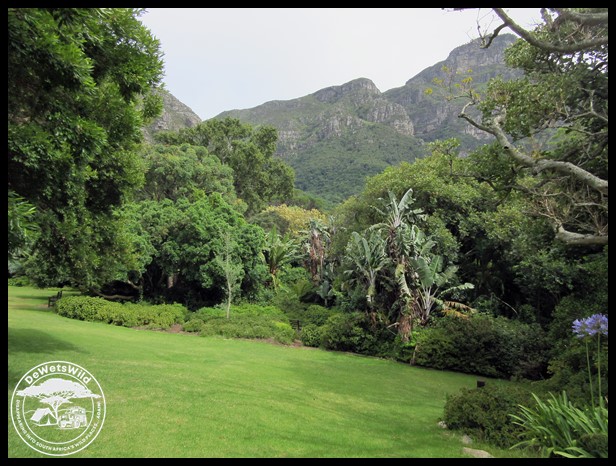
Located at the back (eastern side) of Table Mountain is one of the world’s greatest botanical gardens; Kirstenbosch. Kirstenbosch covers 528 hectares, of which only 36ha is cultivated garden and the rest is natural fynbos and forest inhabited by a wonderful diversity of fauna and flora on the mountain slopes.
Kirstenbosch National Botanical Garden, 23 December 2022
Kirstenbosch National Botanical Garden, 23 December 2022
Kirstenbosch National Botanical Garden
Kirstenbosch National Botanical Garden
Kirstenbosch National Botanical Garden
Kirstenbosch National Botanical Garden
Kirstenbosch National Botanical Garden
Kirstenbosch National Botanical Garden
Kirstenbosch National Botanical Garden
Kirstenbosch National Botanical Garden
Kirstenbosch National Botanical Garden
Kirstenbosch National Botanical Garden
Influenced by Harold Pearson, chair of Botany at the South African College, the government of the Union of South Africa established Kirstenbosch as the country’s first National Botanical Garden in May 1913. It was the first of its kind in the world to focus its efforts on protecting and showcasing a country’s native flora, the richness of South Africa’s unique fynbos vegetation coming to the world’s attention then already. Pearson died just three years later and was buried in the beautiful garden he worked so tirelessly for. The inscription on his gravestone speaks volumes.
Pearson’s grave in Kirstenbosch
Pearson’s grave in Kirstenbosch (photo by Joubert)
Pearson’s grave in Kirstenbosch (photo by Joubert)
Kirstenbosch exhibits an untold variety of indigenous South African plants both in the laid-out gardens and the extensive tract of natural vegetation on the slopes of the mountain. Before the COVID-19 pandemic, Kirstenbosch won the gold medal at the annual Royal Horticultural Society’s Chelsea Flower Show 37 times out of the 44 times it took part in the exhibition!
Pineapple Lily
Cape Chestnut tree
Cape Chestnut flowers
Mimetes species
Silver Tree
Dry King Protea flower
Unidentified bloom
Pincushion
Blue sceptre (Aristea capitata)
Showy Indigo (Indigofera jucunda) flowers
Kei Bauhinia flower
Golden Daisy Bush
Welwitschia
Kirstenbosch is incredibly rich in wildlife. More than 125 species of bird have been recorded here. Of the 34 species of mammal that’s been encountered in the garden you are most likely to see is the four-striped grass mouse, but even caracals roam here! The list of fauna in the garden is completed with the addition of 2 types of indigenous freshwater fish, 8 kinds of amphibians and 24 reptile species.
Cape White-eye
Cape Spurfowl
Cape Bulbul
Four-striped Grass Mouse
Cape Canary
Bronze Mannikin
Hadeda Ibis
Forest Canary
Swee Waxbill
Swee Waxbill (photo by Joubert)
Mantis
Cape Batis (photo by Joubert)
Female Southern Double-collared Sunbird
Egyptian Goose family (photo by Joubert)
Four-striped Grass Mouse
African Dusky Flycatcher
Immature male Southern Double-collared Sunbird
Kirstenbosch is open every day of the year. Visitors come here to picnic in the beautiful gardens and to hike, jog and cycle on the extensive network of trails that traverse the areas of “wild” vegetation. A highlight is the raised walkway through the tree tops in the arboretum, dubbed the “Boomslang” for its resemblance to the well known tree-living snake. For the price of your entry ticket, which can be purchased online in advance, you can join guided walking tours of the garden on weekdays. These last about 90 minutes. The conservatory is not to be missed – in this facility plants from more hot and arid parts of Southern Africa is displayed, including the remarkable Welwitschia mirabilis. There’s a restaurant, tea room and coffee shop on the premises and also a curio shop, a book shop and a nursery. On summer evenings musical performances by local and international acts draw many visitors to the garden, while the gardens are dotted by wonderful sculptures. Accommodation is available in the garden at the Kirstenbosch Manor House, where there’s also a small meeting venue available. A much larger conference centre is also available and is a popular venue for wedding receptions.
Cheetah sculpture by Dylan Lewis
Sculpture of a Cape Clawless Otter by Llewellyn Davies (photo by Joubert)
Pathway through the arboretum at Kirstenbosch
The “Boomslang” or Treetop Canopy Walkway
The “Boomslang” or Treetop Canopy Walkway
Welwitschia
While exploring the Table Mountain National Park and Cape Town during December 2022, we based ourselves at the Eland Cottage inside the Cape of Good Hope section of the Park. Eland Cottage has two lounges, a fully equipped kitchen, dining room, bathroom, three bedrooms, outside shower and lapa! In addition to Eland visitors to this part of the Park can also book the Duiker Cottage, similar to Eland, and Olifantsbos House – a luxury unit with an exclusive setting right on the beach. DeWetsWild will gladly assist you with bookings in these units, other accommodation options in the Table Mountain National Park, at one of five hotels in metropolitan Cape Town or at the Goudini Spa in the Cape Winelands if you are planning a visit to Cape Town and surrounds.
The Cape Fur Seal is the only seal that is native to the continent of Africa, being found from Namibia’s Atlantic coast to Gqeberha (formerly Port Elizabeth) on South Africa’s Indian Ocean coast (rarely further east to East Londen). They live in coastal waters, roaming up to 160km from the coastline, and prey mainly on schooling fishes like sardines and mackarel, octopuses, chokka (a type of squid), crabs, lobsters and other invertebrates. While hunting the seals can dive up to 200m deep and stay submerged for up to 8 minutes!
Cape Fur Seal breeding colonies are usually located on rocky islands and shores, though there are a few on sandy beaches. Bulls establish their territories from mid-October in preparation of the cows arriving about a month later, first to give birth to a single pup and then to mate with the “beach master” – the bull in control of that territory and the harem of cows in it – about a week later. The harems break up by end of December when all the females of reproductive age have been mated. The pups can’t swim until they’re about 3 months old and are prone to drowning after being struck of the rocks by freak waves or being caught by land-based predators like jackals and hyenas. Adult bull seals, at 2.4m in length and up to 360kg in weight, are much bigger than the cows who weigh up to 115kg. They may live to about 18-21 years of age in the wild, though even adults may fall prey to sharks and killer whales.
Cape Fur Seals
Seal solony on offshore rocks at Cape Columbine
Seal solony on offshore rocks at Cape Columbine
Cape Fur Seal playing offshore at Yzerfontein
Young Cape Fur Seal on the beach at Tsaarsbank
Cape Fur Seal swimming in the Langebaan Lagoon
Seal colony at the Cape of Good Hope
Seal colony at the Cape of Good Hope
Cape Fur Seals in Hout Bay harbour
Cape Fur Seals in Hout Bay harbour
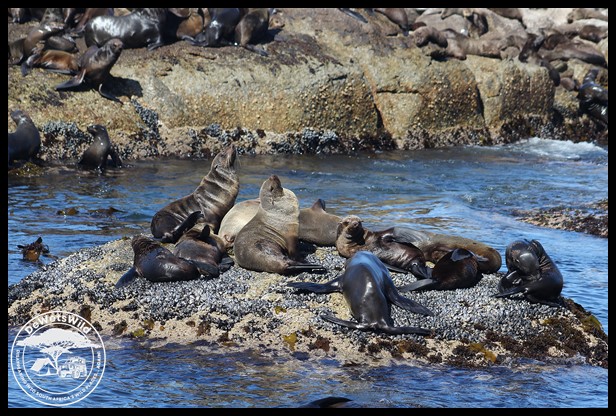
Seal colony on Duiker Island
Seal colony on Duiker Island
Seal colony on Duiker Island
Seal colony on Duiker Island
Seal colony on Duiker Island
Seal colony on Duiker Island
Seal colony on Duiker Island
Seal colony on Duiker Island
Seal colony on Duiker Island
Seal colony on Duiker Island
Seal colony on Duiker Island
Seal colony on Duiker Island
Seal colony on Duiker Island
Seal colony on Duiker Island
Seal colony on Duiker Island
Seal colony on Duiker Island
Seal colony on Duiker Island
Seal colony on Duiker Island
Seal colony on Duiker Island
Seal colony on Duiker Island (photo by Joubert)
Seal colony on Duiker Island (photo by Joubert)
Seal colony on Duiker Island
Seal colony on Duiker Island (photo by Joubert)
Cape Fur Seals in Hout Bay harbour
Cape Fur Seal in Hout Bay harbour (photo by Joubert)
Cape Fur Seal in Hout Bay harbour (photo by Joubert)
Cape Fur Seals
Cape Fur Seal tearing a drowned cormorant chick apart
Cape Fur Seal tearing a drowned cormorant chick apart
Several operators use the Hout Bay harbour near Cape Town to conduct sight-seeing tours of about an hour to the large seal colony at Duiker Island. During our December 2022 tour of the Western Cape we booked ourselves on the Calypso operated by Circe Launches for one such trip, and found the company a thoroughly professional outfit that we’d gladly recommend and certainly use again ourselves.
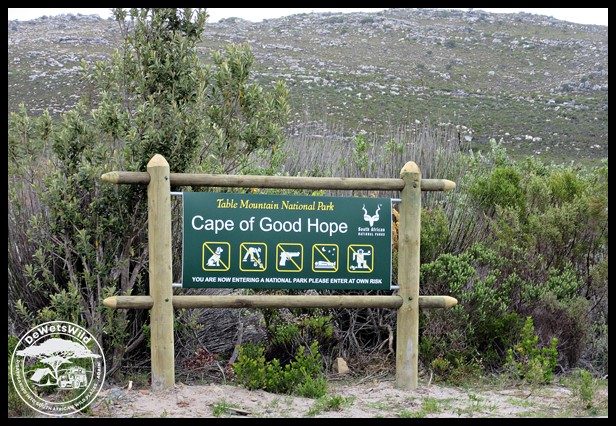
Cape Town is a city more richly endowed with scenic splendour than most others in the world, and almost all of the most beautiful spots in and around the city are protected in the Table Mountain National Park. And while Table Mountain itself is undoubtedly worthy of its spot among the wonders of the natural world, it is in the Cape of Good Hope section of the national park that visitors can get the most authentic taste of the Cape Peninsula’s other natural wonders, of which there are many!
Bordjiesrif
Bordjiesrif
Bordjiesrif
Da Gama cross
Bordjiesrif
Bordjiesrif
Small waterhole on the way to Bordjiesrif
Buffels Bay
Buffels Bay
Buffels Bay
The Flying Dutchman Funicular is a convenient way to travel up to the Cape Point lighthouse
Cape Point
Cape Point – just look at that clear water!
Cape Point
Looking out over the Cape of Good Hope
Olifantsbos beach
Platboom beach
Ostrich on the Platboom beach
Smitswinkel Bay at sunrise
Herd of Bontebok at Olifantsbos Beach
Monterey Cypresses (exotic) on the Cape of Good Hope
The Cape Peninsula is world renowned for its rich variety of unique plants – about 2,300 species are found here and many of them occur nowhere else on earth.
Bontebok lying in a sea of Cape Snow
Cape Snow
Cape Snow
Kelp
Kelp
Pincushion
Pincushion
Sour Fig with Honey Bee
Vygies
Mimetes species
Unidentified species from the genus Psoralea
Unidentified Fynbos blooms
Cape (Pink) Everlasting (Phaenocoma prolifera)
More than 300 bird species have been recorded in the Table Mountain National Park and the Cape of Good Hope section of the Park is an excellent place in which to search for most of them.
African Oystercatcher
Pied Avocet
Cape Bunting
Cape Canary
Cape Spurfowl
Cape Sugarbird
Familiar Chat
Familiar Chat
Common Greenshank
Grey-winged Francolin
Hartlaub’s Gull
Karoo Prinia
Kelp Gull
Red-winged Starling (photo by Joubert)
African Sacred Ibis
Swift and Sandwich Terns
Sandwich Tern
Speckled Mousebird
Swift Tern
Swift Tern (photo by Joubert)
White-fronted Plover
There may not be any of the famed “Big 5” African animals roaming freely over the Cape Peninsula these days, but there’s still a very rich and diverse population of insects, reptiles, amphibians and mammals that inhabit the area along with all those birds.
Baboon
Black Girdled Lizard
Black Girdled Lizard
Bontebok
Bontebok
Bontebok
Bontebok on the beach at Buffelsbaai in the Table Mountain National Park
Bontebok on the beach at Buffelsbaai in the Table Mountain National Park
Bontebok on the beach at Buffelsbaai in the Table Mountain National Park
Seal colony at the Cape of Good Hope
Common Dotted Border
Common Dotted Border
Eland
Eland
Marbled Leaf-toed Gecko
Red Hartebeest
While exploring the Table Mountain National Park and Cape Town during December 2022, we based ourselves at the Eland Cottage inside the Cape of Good Hope section of the Park. Eland Cottage has two lounges, a fully equipped kitchen, dining room, bathroom, three bedrooms, outside shower and lapa! In addition to Eland visitors to this part of the Park can also book the Duiker Cottage, similar to Eland, and Olifantsbos House – a luxury unit with an exclusive setting right on the beach. DeWetsWild will gladly assist you with bookings in these units, other accommodation options in the Table Mountain National Park, at one of five hotels in metropolitan Cape Town or at the Goudini Spa in the Cape Winelands if you are planning a visit to Cape Town and surrounds.
Welcome to Eland Cottage
Eland Cottage, Cape of Good Hope, Table Mountain National Park, December 2022
Eland Cottage’s “backyard”
Pincushion bush and a setting sun
Sunset at Eland Cottage
At Simonstown, just a stone’s throw north of the Cape of Good Hope, is the Boulders Beach where African Penguins breed right at the urban edge. Have a read here if you’d like to know more about this special place. While we again spent a few moments with the penguins at Boulders during our December 2022 trip to Cape Town we will soon tell you more about another colony of these charismatic birds that you should seriously consider also including in your visit to the Western Cape.
Phosphate mining near Langebaan on South Africa’s West Coast unearthed a rich find of fossils belonging to some 200 different kinds of animals dating back to about 5-million years. At this time the area looked very different from what it does today, with the sub-tropical riverine forests and wooded savanna roamed by relatives of today’s elephants, short-necked giraffes, hippos, three-toed horses, hyenas, sabre-toothed cats and even an African bear! The West Coast Fossil Park is a declared national heritage site and the visitor centre and a preserved portion of the actual dig site gives a fascinating glimpse into this prehistoric world. A small curio shop and restaurant is also available on the premises. There’s an extensive network of hiking and mountain bike trails available at the fossil park for those interested in experiencing the fauna and flora that currently occur in this part of our country.
Entrance to the West Coast Fossil Park
West Coast Fossil Park
Displays of actual fossils in the West Coast Fossil Park
Displays of actual fossils in the West Coast Fossil Park
Displays of actual fossils in the West Coast Fossil Park
Displays of actual fossils in the West Coast Fossil Park
Displays of actual fossils in the West Coast Fossil Park
Interesting information on display at the fossil bed
Interesting information on display at the fossil bed
The wonderfully done Sivatherium sculpture is the focal point of the visitor centre
The wonderfully done Sivatherium sculpture is the focal point of the visitor centre
The wonderfully done Sivatherium sculpture is the focal point of the visitor centre
One of several interesting dioramas on display in the visitor centre
Not everything at the West Coast Fossil Park has turned to rock – this is a dark-morph Common Buzzard flying over the centre











 DeWetsWild