Tag Archives: outdoors

Terrestrial Brownbul

Phyllastrephus terrestris

The Terrestrial Brownbul is a shy inhabitant of forests and thickets, skulking in the undergrowth where it turns over the leaf litter looking for insects and other invertebrates, small reptiles, fruit and seeds.

Outside of the breeding season they form small groups of up to six individuals, but during the breeding season, which spans the spring and summer months, Terrestrial Brownbuls form monogamous, territorial pairs. Both parents build the flimsy cup-shaped nest in which a clutch of two or three eggs are incubated over a two week period. The chicks become independent very soon after fledging. Adult Terrestrial Brownbuls measure around 21cm in length and weigh approximately 36 grams.

The Terrestrial Brownbul is found over much of southern and eastern Africa, with an isolated population in southern Angola. In South Africa they’re found in suitable habitat from the Garden Route, along the Eastern Cape coast into Kwazulu-Natal, the Lowveld and escarpment of Mpumalanga and Limpopo and into the Waterberg region. We’ve had our best encounters with this otherwise secretive bird at Jack’s picnic spot in the Addo Elephant National ParkThe IUCN lists the Terrestrial Brownbul as being of least concern.

Yellowwood Trees

Podocarpus-species

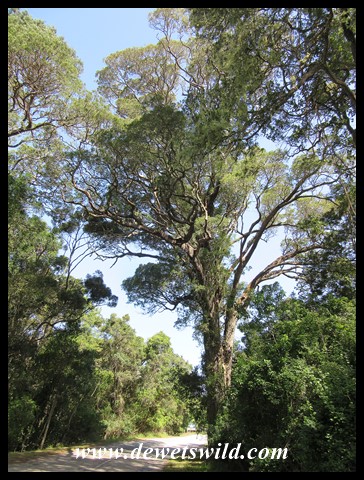
Even though South Africa is not rich in indigenous coniferous trees, arguably some of our most impressive trees fall into this category. Colloquially known as Yellowwoods, four species are found in South Africa and they are all protected in legislation.

1. The Outeniqua Yellowwood, Podocarpus (Afrocarpus) falcatus, is our tallest indigenous tree, growing to 60m and even taller in height – these enormous specimens are estimated to be more than a thousand years old! Sadly the majority of these most impressive trees were lost in rampant logging during the 1800’s. It is also known as the Bastard Yellowwood in the other African countries where it occurs. The IUCN lists it as being of least concern.

2. Henkel’s Yellowwood, Podocarpus henkelii, and also known as the Natal and Drooping-leaf Yellowwood, has a more restricted distribution and is mainly found in the forests of the Drakensberg in the Eastern Cape and Kwazulu-Natal. It can grow up to 30m tall and has a very recognisable pyramid-shaped growth form. The IUCN considers it to be an endangered species.

3. The Real Yellowwood or Broad-leaved Yellowwood, Podocarpus latifolius, is our officially designated national tree, and is considered to be of least concern by the IUCN. The Real Yellowwood grows to 35m tall.

4. The Breede River Yellowwood, Podocarpus elongatus, is the smallest of the four species found in South Africa and often appears more a multi-stemmed shrub than a tree, growing as wide as it does in height. It seldom grows taller than 6m, though some sheltered specimens have been measured at around 20m in height. It too is not considered to be in any danger in the opinion of the IUCN, though it occurs only in a relative small corner of the country in the winter rainfall region of the Western Cape province.

Occurring in coastal, riverine and montane forests, our Yellowwoods are slow-growing, evergreen trees that grow naturally in the moist south and east of the country. Yellowwoods are dioecious, which means there are separate male and female trees. You probably figured out that the wood is yellowish in colour, with that of the Outeniqua and Real Yellowwoods prized for making high-quality furniture, floors and ceilings. The Yellowwoods are also beautiful border or specimen plants in gardens, though they never attain their full potential size outside their native forests (which might be a good thing, come to think of it!). Various kinds of birds and animals consume the ripe fruit.

Yellowwoods are ancient trees, having been endemic to the super continent of Gondwana before it broke up into Africa, India, South America, Australia and their associated islands.

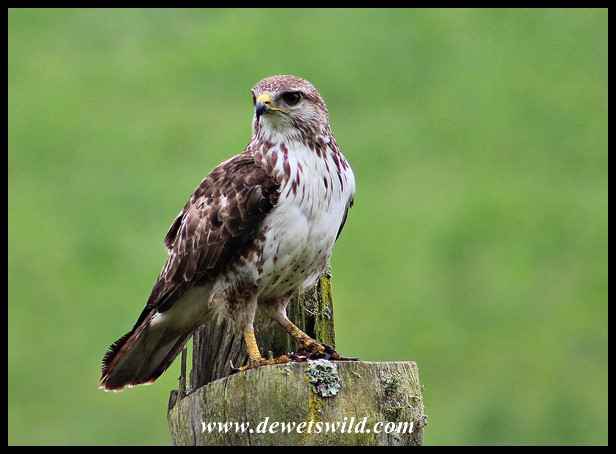
Forest Buzzard

Buteo trizonatus

As its name suggests, the Forest Buzzard is an inhabitant of temperate forests and, of late, exotic plantations, where it hunts inside and on the edges of the forest and in clearings for small mammals, birds, reptiles, amphibians and insects, often swooping down from a favourite perch.

Forest Buzzards are usually seen singly or in pairs. Pairs form monogamous bonds and defend a territory against other adults of their kind. Their nests are large stick platforms constructed high above the ground in tall trees. The female lays two eggs in the spring, with the first hatched chick often severely bullying the second, frequently leading to the death of the second through malnutrition. The chick takes its first flight when about 7 weeks old but usually stays with the parents for another 4 months or so before becoming independent. Adults weigh around half a kilogram, with the female being slightly bigger than the male.

The Forest Buzzard is endemic to South Africa. It’s natural distribution is confined to mountainous forests from Cape Town in the west, along the southern coast and adjacent interior through the Western and Eastern Cape Provinces into Kwazulu Natal, and then along the Drakensberg range into Mpumalanga and Limpopo as far north as the Soutpansberg. It would appear that it visits the more northern reaches of this range mainly outside the breeding season. Due to its limited distribution, dependence on threatened habitats and low population (estimated at no higher than 6,700 mature individuals in total) the IUCN lists the Forest Buzzard as being near-threatened. In our experience, the various sections of the Garden Route National Park is the best place to find these beautiful but elusive raptors.

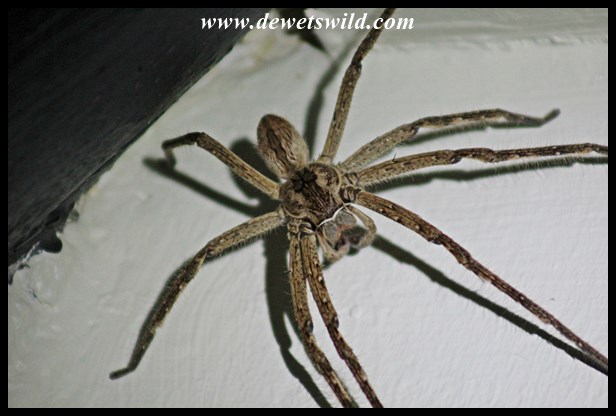
Rain Spiders and Rain Spider Wasps

Rain Spiders (Palystes-species)

When first confronted with the monstrously-sized Rain Spider I don’t think any person could be blamed for flinching. These arachnids can attain a leg span of up to 11cm, with their bodies alone growing to 4cm in length, and unusually for spiders both sexes are about equal in size. Their sizable fangs easily pierce human skin, but while a bite is painful and could cause a bit of swelling and itching it is not venomous.

Rain Spiders are nocturnally active predators that by nature hide and hunt in vegetation but often enters into huts and houses to prey on insects attracted by lights. It’s believed, though not conclusively proven, that finding Rain Spiders indoors is a good omen for rainfall in the days ahead. Being such formidable hunters they not only prey on other invertebrates but will even catch reptiles and amphibians.

Females may lay up to 300 eggs in large egg sacs, roughly the size of a tennis ball or even larger and constructed from leaves, twigs and silk, during the summer months. The female protects both the egg sac and newly emerged spiderlings, which hatch around three weeks after laying, and as a result it is usually gardeners that fall foul of the protective mother’s fangs when they’re out enjoying their hobby. Rain Spiders usually live for about two years.

Spiders of the genus Palystes are found in Africa, Asia and Australia. We have twelve distinct species in South Africa, of which P. superciliosus and P. castaneus are the most commonly encountered (though not easily distinguished by an untrained eye like mine).

Rain Spider Wasp (Tachypompilus ignitus)
The Rain Spider Wasp is a specialist hunter of Rain Spiders occurring in South Africa and Zimbabwe. When hunting, the female wasp paralyses the spider with a sting and then carries it’s victim to its nest where an egg is laid on the spider before the nest is sealed up. When the wasp larvae hatches it feeds on the still living spider, keeping the vital organs for last so that the spider can be a source of fresh food as long as possible. Once its larder is used up, the larvae pupates and emerges as an adult wasp – which feeds innocently on nectar. Rain Spider Wasps themselves are quite large and adults measure almost 5cm in length.

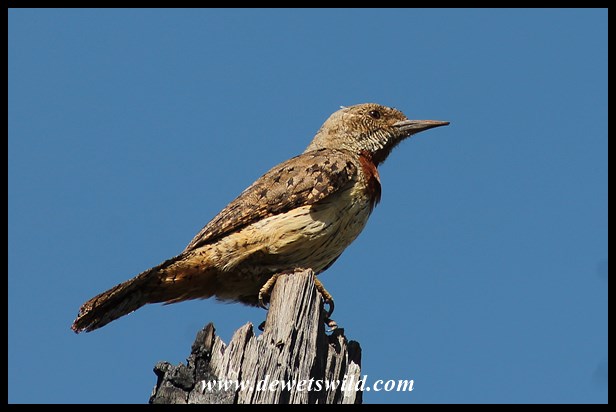
Red-throated Wryneck

Jynx ruficollis

A member of the woodpecker family, the Red-throated Wryneck is a specialist species tied closely to moist grasslands with a meagre scattering of trees. They feed mainly on the ground, dining exclusively on ants and termites, licking them up with an exceptionally long and sticky tongue.

Red-throated Wrynecks are usually encountered singly or in pairs. The breed in cavities in trees (either natural or crafted by barbets and woodpeckers) through the spring and summer seasons. Both parents take turns to incubate the clutch of 1-6 eggs over a two week period, with the chicks remaining in the nest for about a month after hatching and then becoming independent soon after fledging.

The Red-throated Wryneck has a very patchy distribution over sub-Saharan Africa. The IUCN considers the species to be of least concern, siting a growing population, especially in South Africa where exotic trees planted in the grassland biomes have created opportunity for expansion of both its range and numbers. In our country they are found over most of the Eastern Cape, Free State, Gauteng, Mpumalanga and Kwazulu-Natal, extending marginally into the Limpopo Province.

Autumn Mountain Moments (part 2)

We made it safely back to Pretoria and I think before anyone noticed we were missing. We enjoyed a glorious morning in the Golden Gate Highlands National Park, bringing to a close a wonderful, if whistle-stop, visit to one of our favourite destinations.

Autumn Mountain Moments (part 1)

Pssst…

We sneaked out of Pretoria at five this morning and headed for a quick weekend breakaway at the beautiful Golden Gate Highlands National Park.

Cinnamon-breasted Bunting

Emberiza tahapisi

Cinnamon-breasted Buntings, or to call them by a previous colloquial name Rock Buntings, inhabit stony and rocky slopes and hillsides, rocky outcrops, dry rocky streambeds, bare stony patches and even abandoned quarries and borrow-pits in woodland, savanna and grassland, and are regularly seen foraging on road verges. They are mainly seed-eaters but include a fair number of insects in their diet, and require regular access to drinking water.

Usually encountered singly, in pairs or small groups of three or four, it is highly unusual to find larger congregations of Cinnamon-breasted Buntings. They breed during spring and summer, forming monogamous pairs that build cup-shaped nests at the base of grass tufts or next to a rock. Clutches of 2-4 eggs are incubated by both parents over a 2 week period. Both parents feed the chicks at the nest until they fledge about two weeks after hatching, and the chicks remain with their parents for another month or so thereafter before moving off. Fully grown, Cinnamon-breasted Buntings weigh about 15g and measure 15cm in length.

The Cinnamon-breasted Bunting has a wide distribution throughout sub-Saharan Africa, with the exception of deserts and the equatorial forest. In South Africa they’re found over most of the eastern half of the country. The IUCN considers the species to be of least concern.

World Wildlife Day 2021

What better excuse to take another look at the 83 species of South African wildlife that we featured here at de Wets Wild in the past year than World Wildlife Day?

Summertide Diary: Exploring iSimangaliso (final instalment)

22 January 2021

It’s our last full day in the iSimangaliso Wetland Park and it’s one of those beautiful mornings that you can only experience out in wild Africa. Clear skies, golden light, inspiring scenery and beautiful creatures along the Grassland Loop all conspired to make us want the moment to last forever.

Heading back to camp after our breakfast at the lookout point near Mission Rocks, from where we could see both the Indian Ocean to the east and Lake St. Lucia to the west while drinking our morning coffee, we couldn’t help but reflect on why this is one of our favourite corners of South Africa.

Seeing as it may be some time before we see the sea again we opted to spend our final afternoon in the iSimangaliso Wetland Park on the beach at Cape Vidal.

Cape Vidal beach at low tide

23 January 2021

Sadly our time at Cape Vidal in the iSimangaliso Wetland Park, and with it our Summertide Ramble through the Western Cape, Eastern Cape and Kwazulu-Natal, has come to an end. The 30km to the Bhangazi Gate goes by far too quickly for our liking, despite some good sightings along the way, and with heavy hearts we tackle the road back to Pretoria…

A huge thanks to each and every one of you that joined us for our daily recollections of this most memorable trip!

Map of the eastern shores section of the iSimangaliso Wetland Park (from https://isimangaliso.com/)