The Kruger National Park is experiencing one of the worst droughts in recorded history, and the Satara area of the Park seems to be the worst affected of all.
Of course, this has a tremendous impact on the water dependent hippopotamus. While there are still substantial pools of water remaining in man-made dams, stream and the large rivers, the lack of rain has meant that the available grazing around these water sources has been drastically denuded, causing the hippos to have to travel further and further to satisfy their considerable daily food requirement. For the first time I can remember, we encountered hippos spending the heat of the day out in the open veld, miles away from the nearest water.

The normal view of hippos, lazing in a pool of water on the Sweni River

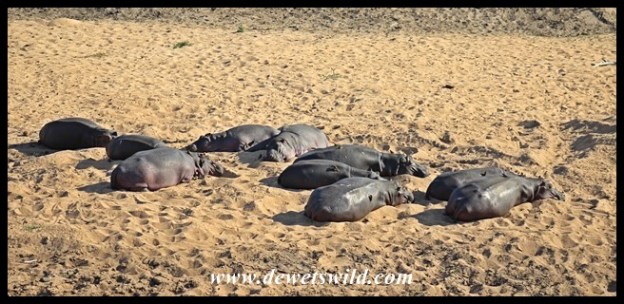
Hippos lazing on a sandbank in the Nwaswitsontso River

Hippos setting off at dusk in search of grazing

Hippos lying out in the open veld – a first for us

Hippos lying out in the open veld – a first for us

Hard to see hippos looking so thin
On the second day of our winter 2016 visit, we noticed a hippo that had succumbed to the drought lying in a pool in the Nwanetsi River, just a few kilometers from Satara along the S100-road. Knowing that the carcass would soon start attracting predators intent on an easy meal, we decided to visit the sighting again that evening. Sure enough, we arrived to find a fairly large crocodile tearing at the bloating body. When the rest of the hippo pod occupying the pool started moving closer, we thought we were going to see them attack the crocodile to try and defend their fallen comrade. Bot nothing. They plodded past, barely giving the unfolding events a passing glance, almost as if resigned to the fact that they too will likely meet their end in this fashion, and leaving the crocodile to go about his gory business…

Crocodile feeding on hippo carcass in the Nwanetsi River near Satara

Crocodile feeding on hippo carcass in the Nwanetsi River near Satara

Crocodile feeding on hippo carcass in the Nwanetsi River near Satara

Crocodile feeding on hippo carcass in the Nwanetsi River near Satara

Crocodile feeding on hippo carcass in the Nwanetsi River near Satara

Crocodile feeding on hippo carcass in the Nwanetsi River near Satara

Crocodile feeding on hippo carcass in the Nwanetsi River near Satara

Crocodile feeding on hippo carcass in the Nwanetsi River near Satara

Crocodile feeding on hippo carcass in the Nwanetsi River near Satara

Crocodile feeding on hippo carcass in the Nwanetsi River near Satara

Crocodile feeding on hippo carcass in the Nwanetsi River near Satara

Crocodile feeding on hippo carcass in the Nwanetsi River near Satara
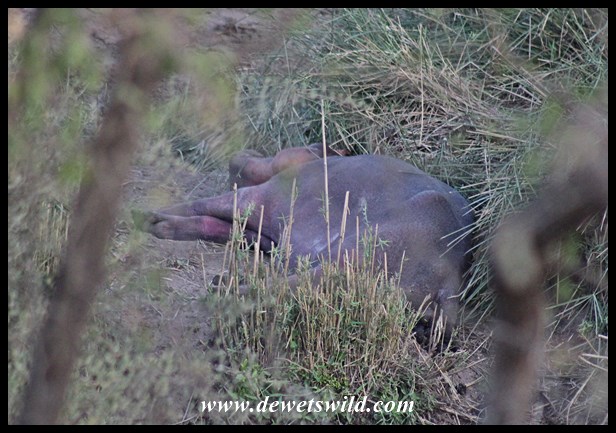
Harrowing as it was to witness, we had to remind ourselves that drought, and the deaths of the animals too old or weak to cope with the demands made by the difficult circumstances, is a part of the natural cycle in a wilderness like Kruger. We passed the same pool in the Nwanetsi again on our last afternoon at Satara, only to find that another emaciated member of this particular herd of hippos had lost the battle.










 DeWetsWild