Category Archives: South African Wildlife

The inhabitants of South Africa’s wild places

Mauritian Tomb Bat

Taphozous mauritianus

When we found a small colony of Mauritian Tomb Bats on the outside walls of the reception office at the Hluhluwe-Imfolozi Park’s Nyalazi Gate, it presented a good opportunity to learn a bit more about this seldomly seen creature.

Mauritian Tomb Bats are quite large for insectivorous bats, weighing as much as 36g and up to 11cm long. They occur in the moist savanna areas of north-eastern South Africa, further north into Central and East Africa, as well as on a few of the islands of the Indian Ocean. By day they roost in small, loosely associated groups on the shaded walls of buildings or on tree trunks, and not in caves or tombs as their name might suggest. At night they forage for moths and other nocturnal invertebrates, which they catch and eat in flight.

Most females raise a single baby at a time, though some do give birth twice annually. Dependent young cling to the mother as she flies around and at their roost, but as soon as they can fly themselves they become autonomous.

The IUCN considers the Mauritian Tomb Bat of “Least Conservation Concern” owing to its wide distribution, large population, and tolerance for habitat change.

Bush Blackcap

Lioptilus nigricapillus

Our December 2016 visit to Thendele in the Royal Natal National Park afforded us our first opportunity to photograph the Bush Blackcap, a rarely seen endemic South African bird with a very limited distribution along the Eastern Escarpment.

These small birds occur singly or in pairs in the dense canopy of mountain forests and their verges, moving down to coastal forests (and lush gardens) during winter. Breeding takes place in summer. They feed on fruits, berries and insects. The IUCN considers them “near threatened” due to a small population size (estimated at most around 5,000) and threats to their forest habitat.

Drakensberg Dwarf Chameleon

Bradypodion dracomontanum

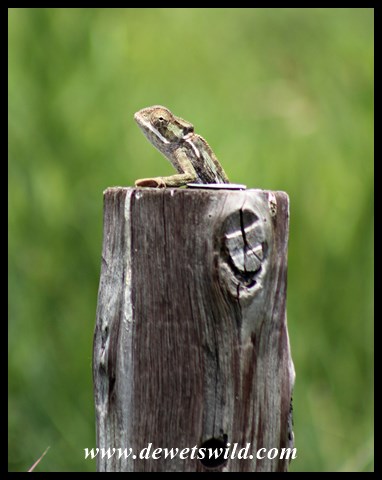
Just as we arrived at Royal Natal National Park in the Drakensberg for our visit in December, Joubert noticed this laid-back little chameleon resting an elbow on a fence post in the campsite at Rugged Glen.

drakensberg-dwarf-chameleon

Turns out he (or she) is a Drakensberg Dwarf Chameleon, a species found only in the Drakensberg mountain range in Kwazulu-Natal Province, where they inhabit sheltered forests and bushes in alpine vegetation at altitudes of between 1,500 and 2,500m and feed on small insects. They grow to a length of only about 14cm. Interestingly, dwarf chameleon females give birth to between 5 and 20 live young that develop in eggs inside the female (known as ovivivipary).

Baboon antics in Glen Reenen

People will always find the primates entertaining, and the baboon troops in Golden Gate Highlands National Park is no exception. However, when they come foraging between the accommodation units and in the camping site at Glen Reenen Rest Camp they can really cause havoc. They’ll inspect every open window to see what’s inside a car, tent or hut, and will help themselves to whatever they find that even vaguely resembles food, while the naughty little ones can cause quite a lot of damage to property and structures with their rough-and-tumble play.

Ground Woodpecker

Geocolaptes olivaceus

Glen Reenen Rest Camp in the Golden Gate Highlands National Park is one of the best places in the country to go searching for the Ground Woodpecker, a bird that occupies open, rocky hillsides in arid scrubland, fynbos and grasslands and occurs only in upland parts of South Africa, Swaziland and Lesotho.

With a length of 30cm and a weight up to 130g, this is the largest woodpecker in South Africa. They can usually be found in pairs or small family groups, and unlike other, more well-known, woodpeckers search for food (mostly ants) on the ground and among rocks rather than in trees. They are always to be found near water, and usually very conspicuous thanks to their load calls and habit of using high vantage points to watch for danger. Most breeding takes place in early spring, when 3 eggs are laid in nesting chambers at the end of tunnels excavated in vertical soil banks. Some of these tunnels are occupied year-round and not only during the nesting season.

Ground Woodpeckers are common over most of their range and not currently considered to be under any threat to their survival, as their preferred habitat is mostly inaccessible and largely unsuited to human habitation or agriculture.

The Victor and the Vanquished (Duel at first light – the series)

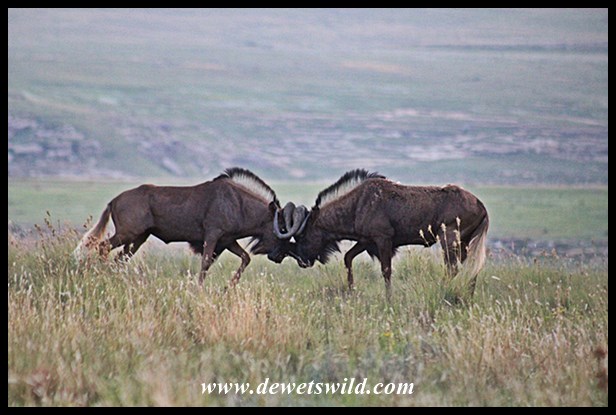
Early into our December holidays, we came upon two black wildebeest bulls squaring off in a territorial tussle near the Basotho Cultural Village in the Golden Gate Highlands National Park. At the onset they appeared evenly matched, sometimes wrestling each other right to the ground with their horns interlocked, entirely oblivious to the human spectators. Reasonably quickly one triumphed and sent his rival running, the entire fight lasting all of one exhilarating four minute long round.

Golden Gate has a substantial population of black wildebeest, and is one of the best places to go searching for these endemic South African creatures.

African Sacred Ibis

Threskiornis aethiopicus

These easily recognisable, medium-sized birds (1-2kg) are extremely gregarious, flying and roosting in large flocks, and can be found near inland and coastal wetlands of all description, including sewerage works. Their natural diet consists of insects, worms, crustaceans, molluscs, fish, frogs, eggs, nestlings and carrion, and they are often to be found on the outskirts of towns scavenging at rubbish dumps and abattoirs. African Sacred Ibisses start breeding at the onset of the rainy season, in mixed-species colonies of up to 2000 pairs. Nests, in which 2 to 3 eggs are laid, consist of sticks and branches and are built in reeds or trees or on the ground on rocky islands.

Thanks to a wide distribution across most of Sub-Saharan Africa, and a large though probably declining population (200,000 to 450,000), the IUCN considers the African Sacred Ibis to be of Least Concern. The species is a common resident in most parts of South Africa, local numbers often swollen in summer by individuals migrating southwards from the equator, and have been introduced to Europe, the USA (Florida) and Taiwan. They are now extinct in Egypt, where they were once considered a sacred symbol of one of the Egyptian deities, and often mummified.

Southern Bald Ibis

Geronticus calvus

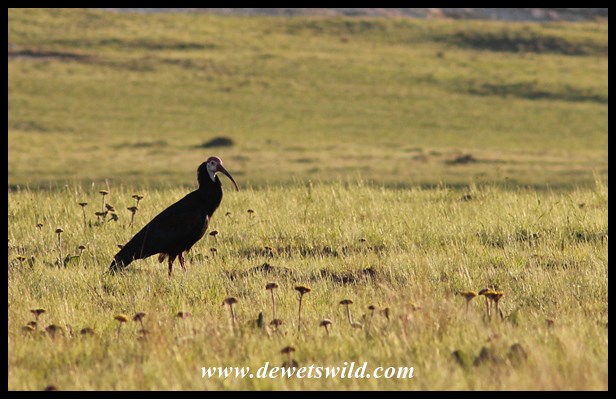
The Southern Bald Ibis is an endemic Southern African bird that occurs in high rainfall, high altitude, short grasslands, and has a special preference for areas where recent burns occurred. It will also forage in recently ploughed fields and cultivated pastures. These birds feed on insects and other invertebrates, usually foraging in small flocks though at times up to 100 can congregate together. Bald ibisses breed in colonies on ledges on high cliffs, laying 2 or 3 eggs that are incubated for four weeks in nests built of sticks and grass. They weigh about a kilogram and are about 80cm long from head to tail.

The IUCN considers the Southern Bald Ibis conservation status “vulnerable”, owing to its limited distribution and ongoing destruction of its habitat for agriculture and forestry. They occur only on the central highlands of South Africa, Lesotho and Swaziland, with an overall population of perhaps 8,000 to 10,000 birds, with around 2,000 breeding pairs occurring in 200 or so colonies. In our experience, good places to go looking for the Southern bald Ibis would be Golden Gate Highlands National Park, the reserves of the uKhahlamba Drakensberg Park, Ithala Game Reserve, and Chelmsford Nature Reserve.


Hamerkop

Scopus umbretta

The Hamerkop is a unique bird that is found only in Africa and Madagascar. Their name is Afrikaans for “Hammer Head”, in reference to their oddly shaped heads. These medium-sized birds weigh about 500g and reach a length of 50cm. Hamerkops are diurnal birds, mostly seen in mated, territorial pairs or family groups. Their diet consists of amphibians, small fish, crabs and other water-inhabiting invertebrates, and thus they are to be found at aquatic habitats such as lakes, dams, marshes, estuaries, seasonal pans, streams and rivers.

Hamerkop nests are enormous structures, often over 1.5m wide and able to support a man’s weight, built of sticks and twigs over the course of many months, in big trees or on cliffs, with a small side entrance to a tunnel leading to the nesting chamber deep inside. Although the Hamerkop pair may use the same nest for many seasons their nests are often take over by small mammals and other birds, mostly owls. They breed throughout the year, laying between 3 and 7 eggs that are incubated by both parents for around 4 weeks, with the chicks then leaving the nest about two months after hatching.

There are many traditional beliefs about the Hamerkop in Africa, such as that it heralds the death of a family member or that it can attract lightning. The Hamerkop has a wide distribution in Madagascar and sub-Saharan Africa, with a large, stable population, and is therefore considered of least conservation concern by the IUCN. They occur all over South Africa where suitable habitat is to be found, and are thus more common on the wetter eastern sides of the country than in the arid west.

African Woolly-necked Stork

Ciconia microscelis (episcopus)

Woolly-necked Storks (weight ∼ 1.8kg) inhabit a wide range of wetland habitats, ranging from the banks of rivers, streams, lakes, dams and ponds to estuaries and mangrove swamps, where they subsist on a diet of frogs, fish, crabs, insects, molluscs and worms. They are normally seen singly or in pairs, although they will at times congregate in large flocks when migrating or at favourite roosting sites. Woolly-necked Storks breed in solitary pairs, mostly at the end of the dry season, in nests built of sticks in tall trees, often over water and regularly used by the same pair year after year.

The Woolly-necked Stork has a wide distribution across Africa and with a stable population is considered of least conservation concern by the IUCN. In South Africa they are considered near-threatened, being found only in the Lowveld of Limpopo and Mpumalanga (where around 80 occur in the Kruger National Park) and the north of Kwazulu-Natal (where Umlalazi Nature Reserve is an excellent location to go looking for them)