Category Archives: South African Wildlife

The inhabitants of South Africa’s wild places

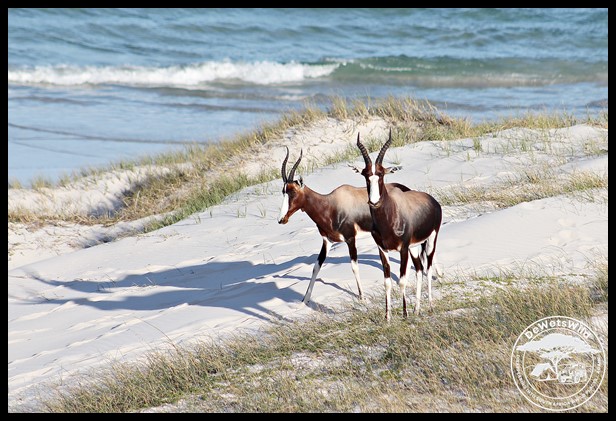
Bontebok

Damaliscus pygargus pygargus

The Bontebok is a medium-sized antelope endemic to a small piece of South Africa’s southern coast and adjacent interior, stretching from Caledon in the west to Mossel Bay in the east, and from the Langeberg Mountains southwards to the ocean both east and west of Cape Agulhas. Considered abundant in early colonial times, hunting, competition for grazing with domestic stock and loss of habitat almost drove it to extinction. The IUCN considers the Bontebok’s conservation status as “Vulnerable” due to its restricted distribution, fragmented and transformed habitat, low numbers and the threat of hybridisation with the closely related (at subspecies levelBlesbok. The effort to save the Bontebok from extinction became a national priority in the 1930’s with the proclamation of the Bontebok National Park (read here for more). While there may now be as many as 3,500 Bontebok in the country, many of these are on private properties both within and outside their historical range and may possibly be hibridised, with only approximately 700 or so individuals tested for genetic purity and occurring at four formally protected areas (of which Bontebok National Park is one) within the historic distribution of the species. The Cape of Good Hope section of the Table Mountain National Park is another good place to see Bontebok, but that population is considered to be outside their natural distribution range.

Bontebok are almost exclusively grazers, showing a preference for areas of short grass and recently burnt veld, usually in open, undulating areas with good visibility in the heathland (fynbos and renosterveld) that cover their limited distribution range. They are dependent on easily accessible water sources and stay within 1.5km from a reliable supply, especially in the dry season. Thickets are important as refuges from cold weather. Bontebok stand around a meter high at the shoulder and weigh around 60kg.

From about the age of 5 years, adult Bontebok rams establish small territories (4 to 30 hectares) which they mark with dung heaps and defend throughout the year, and in which they attempt to keep breeding herds consisting of ewes and lambs for as long as possible so as to mate with any receptive females. The females in the breeding herds, which number between 6 and 30 animals, maintain a strict hierarchy. Young rams, and older males displaced from their territories, roam together in bachelor herds which are often even bigger than the breeding herds. The rutting season peaks from January to March, with most lambs being born in September and October. Ewes give birth to single lambs weighing around 6kg that can run with the herd within an hour of birth!

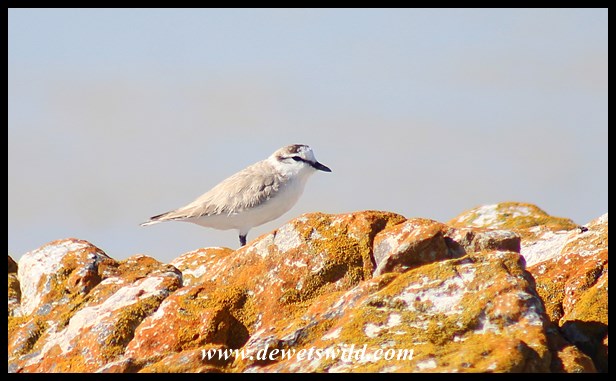
White-fronted Plover

Charadrius marginatus

Usually seen in pairs or small flocks, the White-fronted Plover is a small (50g, wingspan 40cm) wading bird inhabiting mudflats, sandy beaches, and the shorelines of estuaries, large lakes and rivers, where it feeds on worms, snails, insects and crustaceans.

White-fronted Plovers nest in shallow scrapes in the sand, often quite exposed and usually far above the high-water mark. Pairs are monogamous and often stay together, in the same area, for many years. Nesting has been recorded throughout the year, but there is a definite peak in the spring and summer. Clutches consist of 1-3 eggs and are incubated by both parents for around a month. When threatened at the nest, the parents will cover the eggs with sand before fleeing. The precocious chicks feed themselves from birth and fledge when they are about 6 weeks old.

In South Africa, White-fronted Plovers occur all along the coast and along the rivers of the Lowveld. North of our borders, and south of the Sahara, the White-fronted Plover occurs along the Atlantic and Indian Ocean coastlines as well as most of the larger inland wetlands and rivers. While loss of habitat is causing the population of this species, currently estimated at around 100,000 birds, to decline, the IUCN considers it to be of Least Concern.

Cape Cormorant

Phalacrocorax capensis

The Cape Cormorant is strictly a marine species, usually foraging in large flocks within 10km from the coastline and very seldomly venturing inland to feed in freshwater environments. Two kinds of pelagic schooling fish, the anchovy and pilchard (sardine), form the staple of the Cape Cormorant’s diet and are pursued under water to depths of over 30m. Adults weigh as much as 1,6kg, with a wingspan of around a metre.

Cape Cormorants nest in large, densely packed colonies, often mixed with other kinds of seabirds and mainly on rocky islands and outcrops in the sea, inaccessible cliffs along the coast, or shipwrecks. They breed throughout the year, with a peak in spring and summer. Pairs are monogamous, with the males fighting for the best nest spots. Nests are built of seaweed and sticks. Clutches consist of 1-5 (rarely up to 7) eggs and are incubated by both parents for 3 to 4 weeks. Chicks fledge when they are about 9 weeks old and are then cared for by the parents for several more weeks.
The Cape Cormorant occurs along the entire coastline of Namibia and South Africa and only marginally into Angola and Mozambique, with some venturing as far north as the mouth of the River Congo. They are most common along the Atlantic (west) coast, with less than 1% of the breeding population occurring east of Cape Agulhas. The IUCN classifies the Cape Cormorant as Endangered, due to a massive decline in their population over the past 30 years brought on by overfishing, oil pollution and disease outbreaks. The total population is currently estimated at about 230,000 mature individuals, and still in decline.

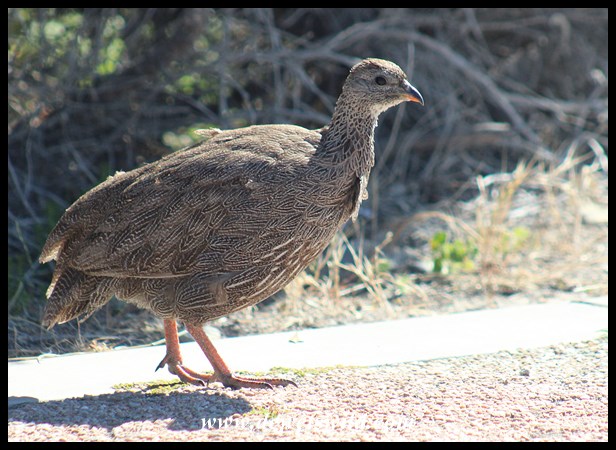
Cape Spurfowl

Pternistis capensis

Cape Spurfowl, also known as Cape Francolin, inhabits areas of fynbos, heathland and semi-arid scrub, usually near a reliable water source, and also utilises nearby orchards, vineyards, cultivated fields, pastures and suburban parks and gardens. It has an omnivorous diet, feeding primarily on seeds, fallen fruits and berries and a wide variety of invertebrates. Male Cape Spurfowl are quite a bit bigger than the females and may weigh up to a kilogram.

The breeding season for Cape Spurfowl commences in early spring but stretches right through to the end of summer. The nest is a simple scrape in the ground, hidden among vegetation, in which the female incubates a clutch of 1-4 eggs for around 3 weeks. Larger clutches of up to 14 eggs have been recorded, but are thought to be of multiple females laying in the same nest.

The Cape Spurfowl’s distribution is mainly centred on South Africa’s Western Cape Province, extending into adjacent areas of the Eastern and Northern Cape, and reaching southern Namibia along the course of the Orange River. With a common and stable population, the IUCN considers the Cape Spurfowl to be of least concern.

Cape Grey Mongoose

Galerella pulverulenta

The Cape, or Small, Grey Mongoose is a commonly encountered small carnivore, thanks to its diurnal habits, They occupy a wide variety of habitats, ranging from semi-desert scrub to mountains and coastal thickets, and subsist on a diet of rodents, birds, reptiles, amphibians, invertebrates, carrion and wild fruits.

Weighing in at between 500 and 1,250g, with a length of up to 75cm (excluding the tail), the Cape Grey Mongoose is usually solitary, and moves through their small home range along well used pathways. At night they lie up in thickets, piles of rocks or in tunnels dug by other animals. These sites are also used as dens where females give birth to litters of 1-3 young, mostly between August and December. They have a natural life expectancy of about 8 years.

The Cape Grey Mongoose occurs only in South Africa (Kwazulu-Natal. Free State, Eastern Cape, Northern Cape and Western Cape), and marginally into Lesotho and Namibia. Thanks to a common, stable population the IUCN evaluates it as being of least concern.

Cape Sugarbird

The Cape Sugarbird is endemic to the fynbos regions of the Western and Eastern Cape, where it feeds mainly on nectar, especially of Protea-species (and as such is a major pollinator of these plants), and insects. It is also seen in gardens, especially in the summer. With its long-tail, the male Cape Sugarbird can grow to up to 44cm in length, weighing up to 50g.

Cape Sugarbirds breed mainly in autumn and winter, to coincide with the Protea flowering season. Pairs are monogamous, with the male aggressively defending the nesting site while the female builds the cup-shaped nest of dead leaves and dry grass, usually among the leaves of a Protea-bush. The female incubates the clutch of 1 or 2 eggs alone, for a period of up to 3 weeks. Chicks leave the nest at about 18 days old, and then stay with their parents for only another 3 weeks before attaining independence.

While the IUCN considers the Cape Sugarbird to be of least concern, they are at long term risk due to habitat loss brought on by development and invasion of their habitat by alien plants.

Hartlaub’s Gull

Chroicocephalus hartlaubii

Hartlaub’s Gull is a gregarious species that forages, roosts and nests in large flocks. They occur in coastal areas – inshore waters less than 50m deep, estuaries, lagoons, beaches and harbours, and rarely venture further than 20km from land. Their natural diet relies in a large part on marine invertebrates associated with beached kelp, supplemented with fruits, eggs and small fish.  They also frequent sewerage works, rubbish dumps and abattoirs for easy pickings.

Breeding takes place at anytime of the year, though some localities show distinct peaks in nesting activity at varying times of the year. Breeding colonies are established on flat, rocky islands, coastal pans, in harbours and even on top of buildings, where the nests are small hollows of matted plant material. Pairs are monogamous and aggressively defend a small patch around their nest. Clutches of one to three eggs are incubated by both parents for just short of 4 weeks. Chicks attain adulthood at around two years of age. Hartlaub’s Gull is closely related to the Grey-headed Gull, with which it sometimes interbreeds.

Hartlaub’s Gull occurs only in Namibia and South Africa (Northern, Western and Eastern Cape), where they are considered to be common and increasing their population. With about half of the estimated 30,000 adults in the population occurring in and around the Cape Peninsula, Table Mountain National Park is a good place to look for Hartlaub’s Gull. The IUCN lists the species as being of least concern, despite noting threats to their breeding success rate.

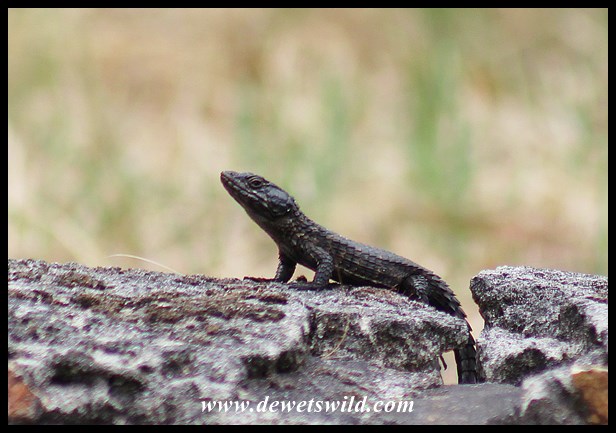
Black Girdled Lizard

Cordylus niger

Black Girdled Lizards occur only on Table Mountain, the Cape Peninsula and around Saldanha Bay, where they inhabit rocky outcrops in the fynbos and shelter in small cracks and crevices. When threatened they will use their prickly tail to cover the rest of their body and inflate themselves so that it should be very difficult to extract them from their hiding place. Black Girdled Lizards grow to between 7 and 9cm in length and are usually seen alone, except when mating. They are diurnal and do not hibernate, although they are much less active in cold weather. Black Girdled Lizards feed primarily on insects. This is an ovoviviparous species, meaning that the female keeps the fertilized eggs inside her body and then gives birth to live young when the eggs hatch inside her. One to three young are born during autumn and must be immediately self-sufficient, as there is no parental care.

The IUCN classifies the Black Girdled Lizard as “Near Threatened” due to their extremely limited distribution and threats from development and the pet trade, despite an apparently numerous population.

African Penguin

Spheniscus demersus

One of our most endearing birds and the only one of its kind resident on the continent, the African Penguin was previously known as the Jackass Penguin, thanks to its donkey-like braying. Adults weigh as much as 3.5kg and stand up to 70cm tall.

Penguins forage in the open ocean, either alone, in pairs or in small groups, and usually within 40km from their colony. When not caring for chicks at the colony, adults can stay out at sea for up to 5 days. They feed primarily on shoaling fish (like sardine and anchovy) and squid. African Penguins swim at speeds of around 7km/h, and can remain submerged for up to 2 minutes at a time.

African Penguins usually breed in tightly packed colonies, often at any time of the year with specific peak periods in different colonies. Pairs are monogamous and form lifelong bonds, with the male advertising and defending their small territory around the nest. Most colonies are on islands well out of reach of mammalian predators, while a handful are in safe and sheltered areas on the mainland. African Penguins prefer to breed in burrows dug in guano (seabird excrement valued as fertilizer) or sand, but as this has become very rare at some nesting colonies authorities have resorted to making artificial structures available for the purpose. When burrows (natural or artificial) is unavailable, they will nest on open ground but usually these attempts are far less successful in raising chicks. Clutches consist of one to three eggs, incubated for around 40 days by both parents. Chicks leave the nest at between 2 and 3 months old, but remain dependent on their parents for another two months or so thereafter. Newly independent juveniles often disperse as far as 2,000km away from the colonies where they hatched, but most return to their natal colonies again when they reach breeding age at about 4 years old. It is estimated that African Penguins can live to about 27 years in the wild.

African Penguins are restricted to the coasts of Namibia and South Africa. The IUCN classifies it as endangered, owing to a plummeting population as a result of depleting fish stocks (through overfishing and warming oceans) and pollution (most notable from oil spills). Scraping of guano, which destroyed the penguins’ nesting sites, and collection of eggs caused major declines in the population at the start of the 20th century. From a population counted in the millions in the early 1900’s, the total estimated population in 2015 stood at around 80,000 mature birds  (probably even fewer now) distributed at 29 breeding colonies (with an estimated 87% of the population breeding at just 8 localities). Boulders Beach, south of Cape Town and managed as part of the Table Mountain National Park, offers probably the most accessible viewing of the species.

Karoo Long-billed Lark

Certhilauda subcoronata

Karoo Long-billed Larks are usually encountered singly or in pairs. As their name suggest, these birds inhabit sparsely vegetated, rocky plains and hill slopes in the arid Karoo, and feed primarily on insects and seeds.

These rather large Larks (weighing 31-55g) breed mostly in spring and summer. Their nests are cups built of roots and twigs in hollows at the bases of shrubs and rocks in which 2-3 eggs are laid.

The Karoo Long-billed Lark occurs commonly in the drier western half of South Africa, specifically in the Northern, Western and Eastern Cape Provinces, extending into Namibia. The Karoo National Park is one of the best places to go looking for this species. With a a large and stable population, the IUCN considers the Karoo Long-billed Lark to be of least concern.