Category Archives: South African Wildlife

The inhabitants of South Africa’s wild places

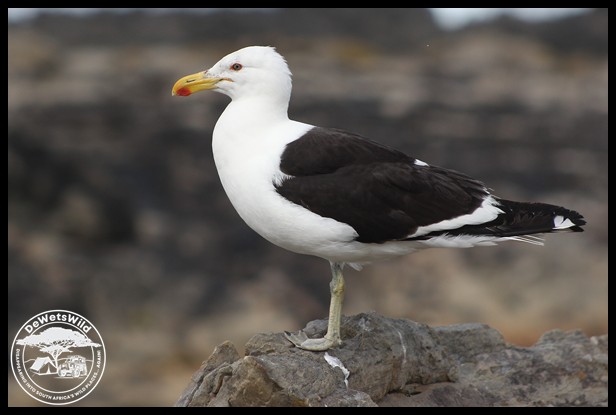
Kelp Gull

Larus dominicanus vetula

One of the most familiar seabirds in South Africa, Kelp Gulls inhabit a wide range of habitats along or near the coast, including harbours, bays, lagoons, estuaries, dams, lakes, rivers, streams and rocky and sandy beaches. They’ll also scavenge in large numbers at dump sites, food factories, abattoirs and sewerage works and have been recorded following fishing trawlers up to a 100km from the coast. Their natural diet is composed of marine invertebrates, fish, the chicks and eggs of other birds, small vertebrates, and carrion.

Adult Kelp Gulls have a wingspan of up to 1.4m, and weigh around 1kg.

Kelp Gulls are a gregarious species, occurring in large flocks throughout the year and breeding colonially during the southern spring and summer. Nesting colonies are usually located in hard to reach places, such as cliffs, rocky islands, exposed reefs, sandbanks and even on top of shipwrecks or buildings, where the bulky nest consists of dried plants, seaweed. twigs, shells, feathers and small stones. They’re very protective of their nests and will dive-bomb and defecate on any perceived threat, including humans. Pairs are monogamous and usually stay together through several breeding seasons. Clutches are usually made up of 2 to 4 eggs, which are incubated for about 4 weeks by both parents. Kelp Gull chicks fledge when they’re about two months old but stay with their parents for up to 6 months. They reach adulthood at between 3 and 4 years of age.

With an expanding population estimated at as many as 4,3-million, and a distribution range that spans much of the southern hemisphere, the IUCN considers the Kelp Gull of least concern. The race occurring in South Africa, also known as the Cape Gull, is considered to be a seperate species by some authorities and numbers at least 20,000 breeding pairs. They occur along the entire South African coastline and adjacent interior, though in lower densities along the coastline of Kwazulu-Natal than in the Eastern, Western and Northern Cape.

Knysna Turaco

Tauraco corythaix

The Knysna Turaco, or Knysna Lourie, is a very colourful bird inhabiting the evergreen montane and riverine forests of southern and eastern South Africa (from the Garden Route through the Eastern Cape and Kwazulu-Natal to the escarpment of Mpumalanga and Limpopo), extending marginally into Swaziland. Knysna Louries feed mainly on fruit, with seeds and insects making up only a small proportion of its diet. The IUCN lists it as being of least concern although it may be locally impacted by uncontrolled deforestation.

Often heard long before it is seen (its loud kok-kok-kok call being a familiar sound in the forests it inhabits), these beautiful birds are commonly encountered in the Garden Route National Park, though getting decent photographs of them in their dense and dark habitat can prove tricky! Adult Knysna Turacos grow to a length of 46cm and weigh up to 350g.

Both parents are involved in building the nest, which is little more than a flimsy platform of sticks and twigs among dense foliage, and incubating the clutch of one or two eggs for just over 3 weeks. The chicks grow quickly, start practicing to fly before they are a month old, and stay with their parents until they’re about 3 months old. Their breeding season stretches almost throughout the year, but peaks from September to December.

African Oystercatcher

Haematopus moquini 

The African Oystercatcher occurs only along the coastline of Namibia and South Africa (mainly the Cape Provinces and only sporadically into Kwazulu-Natal) where they frequent the intertidal zone on rocky and sandy beaches, estuaries, lagoons and coastal wetlands looking for molluscs (mostly mussels and limpets) and other aquatic invertebrates.

With an average weight of around 730g, females are slightly larger than males. Adults have a wingspan of about 80cm.

While non-breeding individuals can congregate in flocks of up to 200 birds, especially at roosts, breeding pairs of African Oystercatchers are territorial and monogamous and may stay together for as long as 25 years. They breed in spring and summer, with a peak over December and January, which makes them especially vulnerable to disturbance by holiday makers. Nests are located on rocky islands or beaches and is little more than a bare scrape above the high-water mark. Despite the meagre appearance of the nest the eggs are extremely well camouflaged. Both parents take turns to incubate the clutch of 1-3 eggs for between 4 and 5 weeks, with the chicks leaving the nest as soon as they are a day or so old. Chicks fledge when they are about 6 weeks old but can remain with their parents for up to 6 months.

Today, the IUCN considers the African Oystercatcher as being of least concern, with an increasing population size thanks to improved conservation measures (such as banning 4×4 driving on beaches). It is estimated that there is now around 6,700 of them, which is probably about double the number that existed in the 1970’s, and their conservation status could recently be upgraded from “near-threatened”. Birdlife South Africa has designated the African Oystercatcher as the 2018 Bird of the year – good places to see them is the Agulhas, Garden Route and Table Mountain National Parks.

Angulate Tortoise

Chersina angulata

The most commonly encountered tortoise in the thickets, fynbos and karoo scrub of South Africa’s south-western corner, Angulate Tortoises show a marked preference for sandy areas, and feed on grasses, annuals and succulents. They drink water through their nostrils! Adult male Angulate Tortoises are noticeably larger than the females, grow to as much as 30cm in length and can weigh up to 1.5kg, which is unusual as females are bigger than males in most other tortoise species.

Adults are usually solitary, except when mating, and have small home ranges of up to only 2 hectares. Angulate Tortoises are diurnal, often hiding under vegetation, among rocks or in holes in the ground during the hottest parts of the day or in bad weather. To escape danger they will retract their head, neck and limbs into the shell and will squirt the contents of its bowels if picked up.

Both sexes reach breeding age at between 10 and 12 years old. During the mating season, which spans spring and summer, males will engage in intense fights for dominance and try to flip each other over (with some effort they are normally able to get back on their feet). After mating, females can delay fertilisation until favourable environmental conditions prevail, which is normally just after rain has softened the soil. She then digs a small hole, lies a single egg weighing between 20 and 25g, fills the hole back up and taps the soil down with her shell. Under favourable conditions females can lay up to 6 eggs in a season. Incubation takes 90 to 200 days, depending on ambient temperatures, and when the tiny hatchlings emerge they weigh only 8-12g.

The Angulate Tortoise is commonly seen in parts of the Eastern, Western and Northern Cape Provinces, as well as in southern Namibia. The IUCN considers it as being of least concern as it is very numerous with few significant threats (such as habitat destruction and the illegal pet trade) to its continued survival. They are unfortunately very prone to dying in wildfires. The Angulate Tortoise has a life expectancy in the wild of around 30 years.

Bontebok

Damaliscus pygargus pygargus

The Bontebok is a medium-sized antelope endemic to a small piece of South Africa’s southern coast and adjacent interior, stretching from Caledon in the west to Mossel Bay in the east, and from the Langeberg Mountains southwards to the ocean both east and west of Cape Agulhas. Considered abundant in early colonial times, hunting, competition for grazing with domestic stock and loss of habitat almost drove it to extinction. The IUCN considers the Bontebok’s conservation status as “Vulnerable” due to its restricted distribution, fragmented and transformed habitat, low numbers and the threat of hybridisation with the closely related (at subspecies levelBlesbok. The effort to save the Bontebok from extinction became a national priority in the 1930’s with the proclamation of the Bontebok National Park (read here for more). While there may now be as many as 3,500 Bontebok in the country, many of these are on private properties both within and outside their historical range and may possibly be hibridised, with only approximately 700 or so individuals tested for genetic purity and occurring at four formally protected areas (of which Bontebok National Park is one) within the historic distribution of the species. The Cape of Good Hope section of the Table Mountain National Park is another good place to see Bontebok, but that population is considered to be outside their natural distribution range.

Bontebok are almost exclusively grazers, showing a preference for areas of short grass and recently burnt veld, usually in open, undulating areas with good visibility in the heathland (fynbos and renosterveld) that cover their limited distribution range. They are dependent on easily accessible water sources and stay within 1.5km from a reliable supply, especially in the dry season. Thickets are important as refuges from cold weather. Bontebok stand around a meter high at the shoulder and weigh around 60kg.

From about the age of 5 years, adult Bontebok rams establish small territories (4 to 30 hectares) which they mark with dung heaps and defend throughout the year, and in which they attempt to keep breeding herds consisting of ewes and lambs for as long as possible so as to mate with any receptive females. The females in the breeding herds, which number between 6 and 30 animals, maintain a strict hierarchy. Young rams, and older males displaced from their territories, roam together in bachelor herds which are often even bigger than the breeding herds. The rutting season peaks from January to March, with most lambs being born in September and October. Ewes give birth to single lambs weighing around 6kg that can run with the herd within an hour of birth!

White-fronted Plover

Charadrius marginatus

Usually seen in pairs or small flocks, the White-fronted Plover is a small (50g, wingspan 40cm) wading bird inhabiting mudflats, sandy beaches, and the shorelines of estuaries, large lakes and rivers, where it feeds on worms, snails, insects and crustaceans.

White-fronted Plovers nest in shallow scrapes in the sand, often quite exposed and usually far above the high-water mark. Pairs are monogamous and often stay together, in the same area, for many years. Nesting has been recorded throughout the year, but there is a definite peak in the spring and summer. Clutches consist of 1-3 eggs and are incubated by both parents for around a month. When threatened at the nest, the parents will cover the eggs with sand before fleeing. The precocious chicks feed themselves from birth and fledge when they are about 6 weeks old.

In South Africa, White-fronted Plovers occur all along the coast and along the rivers of the Lowveld. North of our borders, and south of the Sahara, the White-fronted Plover occurs along the Atlantic and Indian Ocean coastlines as well as most of the larger inland wetlands and rivers. While loss of habitat is causing the population of this species, currently estimated at around 100,000 birds, to decline, the IUCN considers it to be of Least Concern.

Cape Cormorant

Phalacrocorax capensis

The Cape Cormorant is strictly a marine species, usually foraging in large flocks within 10km from the coastline and very seldomly venturing inland to feed in freshwater environments. Two kinds of pelagic schooling fish, the anchovy and pilchard (sardine), form the staple of the Cape Cormorant’s diet and are pursued under water to depths of over 30m. Adults weigh as much as 1,6kg, with a wingspan of around a metre.

Cape Cormorants nest in large, densely packed colonies, often mixed with other kinds of seabirds and mainly on rocky islands and outcrops in the sea, inaccessible cliffs along the coast, or shipwrecks. They breed throughout the year, with a peak in spring and summer. Pairs are monogamous, with the males fighting for the best nest spots. Nests are built of seaweed and sticks. Clutches consist of 1-5 (rarely up to 7) eggs and are incubated by both parents for 3 to 4 weeks. Chicks fledge when they are about 9 weeks old and are then cared for by the parents for several more weeks.

The Cape Cormorant occurs along the entire coastline of Namibia and South Africa and only marginally into Angola and Mozambique, with some venturing as far north as the mouth of the River Congo. They are most common along the Atlantic (west) coast, with less than 1% of the breeding population occurring east of Cape Agulhas. The IUCN classifies the Cape Cormorant as Endangered, due to a massive decline in their population over the past 30 years brought on by overfishing, oil pollution and disease outbreaks. The total population is currently estimated at about 230,000 mature individuals, and still in decline.

Cape Spurfowl

Pternistis capensis

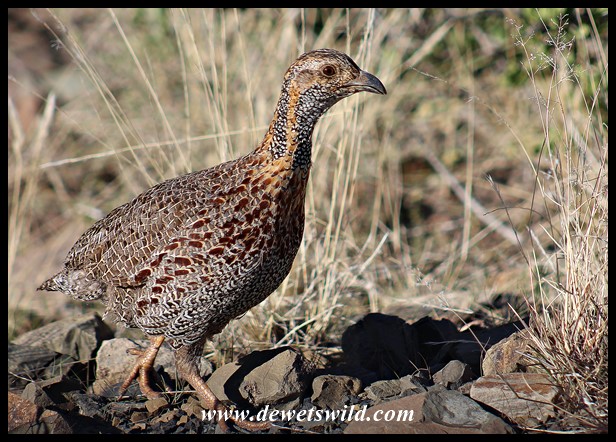
Cape Spurfowl, also known as Cape Francolin, inhabits areas of fynbos, heathland and semi-arid scrub, usually near a reliable water source, and also utilises nearby orchards, vineyards, cultivated fields, pastures and suburban parks and gardens. It has an omnivorous diet, feeding primarily on seeds, fallen fruits and berries and a wide variety of invertebrates. Male Cape Spurfowl are quite a bit bigger than the females and may weigh up to a kilogram.

The breeding season for Cape Spurfowl commences in early spring but stretches right through to the end of summer. The nest is a simple scrape in the ground, hidden among vegetation, in which the female incubates a clutch of 1-4 eggs for around 3 weeks. Larger clutches of up to 14 eggs have been recorded, but are thought to be of multiple females laying in the same nest.

The Cape Spurfowl’s distribution is mainly centred on South Africa’s Western Cape Province, extending into adjacent areas of the Eastern and Northern Cape, and reaching southern Namibia along the course of the Orange River. With a common and stable population, the IUCN considers the Cape Spurfowl to be of least concern.

Cape Grey Mongoose

Galerella pulverulenta

The Cape, or Small, Grey Mongoose is a commonly encountered small carnivore, thanks to its diurnal habits, They occupy a wide variety of habitats, ranging from semi-desert scrub to mountains and coastal thickets, and subsist on a diet of rodents, birds, reptiles, amphibians, invertebrates, carrion and wild fruits.

Weighing in at between 500 and 1,250g, with a length of up to 75cm (excluding the tail), the Cape Grey Mongoose is usually solitary, and moves through their small home range along well used pathways. At night they lie up in thickets, piles of rocks or in tunnels dug by other animals. These sites are also used as dens where females give birth to litters of 1-3 young, mostly between August and December. They have a natural life expectancy of about 8 years.

The Cape Grey Mongoose occurs only in South Africa (Kwazulu-Natal. Free State, Eastern Cape, Northern Cape and Western Cape), and marginally into Lesotho and Namibia. Thanks to a common, stable population the IUCN evaluates it as being of least concern.

Cape Sugarbird

The Cape Sugarbird is endemic to the fynbos regions of the Western and Eastern Cape, where it feeds mainly on nectar, especially of Protea-species (and as such is a major pollinator of these plants), and insects. It is also seen in gardens, especially in the summer. With its long-tail, the male Cape Sugarbird can grow to up to 44cm in length, weighing up to 50g.

Cape Sugarbirds breed mainly in autumn and winter, to coincide with the Protea flowering season. Pairs are monogamous, with the male aggressively defending the nesting site while the female builds the cup-shaped nest of dead leaves and dry grass, usually among the leaves of a Protea-bush. The female incubates the clutch of 1 or 2 eggs alone, for a period of up to 3 weeks. Chicks leave the nest at about 18 days old, and then stay with their parents for only another 3 weeks before attaining independence.

While the IUCN considers the Cape Sugarbird to be of least concern, they are at long term risk due to habitat loss brought on by development and invasion of their habitat by alien plants.