Category Archives: South African Wildlife

The inhabitants of South Africa’s wild places

Karoo Korhaan

Heterotetrax vigorsii

As its name suggests, the Karoo Korhaan is a species that favours arid scrublands, preferring areas with a good ground cover and stony ground where its camouflage renders it very difficult to detect. It has also recently adapted to parts of the fynbos-biome as well the as planted croplands in that area. They follow an omnivorous diet, consuming flowers, fruit, leaves, bulbs and a wide range of invertebrates. Adult Karoo Korhaans weigh up to 2kg, with males quite a bit larger than the females.

These small bustards move around in pairs or small groups of up to 5. Breeding attempts have been recorded through most of the year, but summer appears to be the peak breeding season for the Karoo Korhaan. Pairs are monogamous and stay together throughout the year. The nest is a shallow scrape in the ground, usually hidden between shrubs and rocks. They lay a single egg, incubated by the female alone. Chicks leave the nest soon after hatching to forage along with their parents.

Thanks to a large and apparently increasing population and no apparent threats despite most of the population occurring outside formal conservation areas, the IUCN considers the Karoo Korhaan to be of Least Concern. They occur only in southern Namibia and parts of the Northern, Western and Eastern Cape Provinces in South Africa.

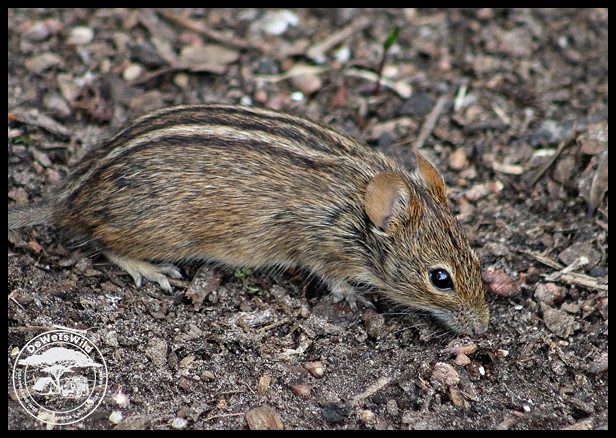
Bush Karoo Rat

Myotomys (Otomys) unisulcatus

The Bush Karoo Rat occurs in the drier parts of South Africa’s south-west (Northern, Western and Eastern Cape) and marginally into extreme southern Namibia. Their preferred habitat is areas with good vegetation coverage, such as that found along drainage lines, in the arid Karoo scrublands and semi-desert of the west coast. They feed on the seeds, berries, flowers, leaves and bulbs of a wide variety of plants (up to 60 species have been recorded for some populations), with succulents providing their required water intake. Including their relatively short tails, Bush Karoo Rats grow to an average of 24cm in length and weigh around 125g.

Bush Karoo Rats are mainly diurnal in nature, living in family groups numbering up to 11 rats that share a “lodge” – a large structure built of sticks, twigs, grass, kelp, bones, fur, and even shells and human litter, usually in or under the protection of a thorny bush. From the lodge a network of paths used to gather food radiate into the surrounding vegetation, with family members often bringing food back to store at the lodge. They will also readily climb into trees and bushes to reach food and to sun themselves. Bush Karoo Rats breed throughout the year, with litters of 1-5 young born after a 38 day gestation. They have a short life expectancy of less than 2 years in the wild.

The IUCN lists the Bush Karoo Rat as being of least concern, describing it as abundant in suitable habitat.

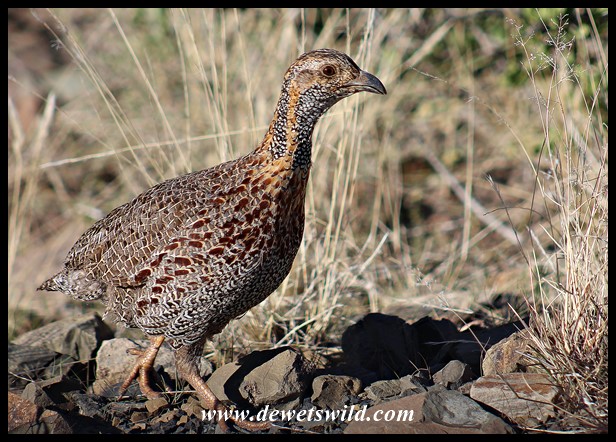
Grey-winged Francolin

Scleroptila afra

A fairly common inhabitant of fynbos and mountain grasslands and scrub to elevations as high as 2750m above sea level, Grey-winged Francolins move around in groups of up to 25 birds, but more usually between 3 and 8. Insects and bulbous plants make up the majority of its diet. Adults grow to 33cm with a weight of up to 520g.

The breeding season in Grey-winged Francolins spans spring and summer, reaching a peak between August and November. Females lie 4-8 eggs, though nests with up to 15 eggs have been noted and must be the result of 2 or more females sharing a nest. The hen incubates the eggs for 3 weeks and the chicks start moving around with their parents soon after hatching.

The Grey-winged Francolin occurs only in Lesotho and South Africa, where it is distributed through most of the Western and Eastern Cape and into portions of the Northern Cape, Free State, Kwazulu-Natal and Mpumalange where suitable habitat is found. The IUCN considers the Grey-winged Francolin of least concern despite it being a popular hunting bird in parts of its range.

Double-banded Courser

Smutsornis africanus

The mainly nocturnal Double-banded Courser inhabits rocky and sparsely vegetated semi-arid scrublands and grasslands as well as desert plains, where they subsist on a diet comprised of insects, particularly ants and termites. Adults weigh up to 100g and have a wingspan of about 45cm.

Double-banded Coursers are usually seen singly or in pairs, with larger groups of adults being a very rare occurrence. This species breeds throughout the year with a peak in the summer months. No nest is built and instead the well camouflaged single egg is laid directly on the ground, surrounded by pebbles, plant material or antelope droppings. Both parents take short turns to incubate the egg over a period of 3 weeks. The chick fledges when it is 5 to 6 weeks old.

The IUCN considers the conservation status of the Double-banded Courser as of least concern, with a stable population. The species occurs in two seperate parts of the African continent: one in East Africa and the other in the arid west of Southern Africa. In South Africa they are found in the Northern, Western and Eastern Cape, Free State and North West Province.

Namaqua Sand Lizard

Pedioplanis namaquensis

Without their tails, Namaqua Sand Lizards grow to around 5cm and weigh only about 4g. They inhabit arid savannas, scrubland and semi-deserts, and specifically open sandy or gravelly areas. These diurnal lizards are extremely active, constantly dashing around at great speed in search of food, which is mainly small insects. At night and during cold spells they stay in burrows dug at the base of bushes. Females lie 3-5 eggs in early summer. Namaqua Sand Lizards occur from the Eastern Cape Province northwards through South Africa’s arid western parts, as well as Botswana and Namibia to southern Angola.

White-browed Sparrow-Weaver

Plocepasser mahali

The White-browed Sparrow Weaver is a dominant and conspicuous inhabitant of drier woodlands, thornveld, savannas and grasslands. They usually move around in small flocks of 4-10 birds, feeding on a wide variety of fruit, seeds, leaves and insects on the ground. Adults grow to 19cm in length and weigh around 50g.

White-browed Sparrow-Weavers nest in small colonies, building untidy grass nests in taller trees (including exotics) or artificial structures (like utility poles), in which they stay throughout the year. Families of White-browed Sparrow-Weavers aggressively defend their territories against intruding neighbours. Each bird in the group has its own nest, and only the dominant, monogamous, pair in the group breed. While breeding has been recorded throughout the year in response to rain, there is a definite peak in the warm summer months. Sleeping nests can be identified by having two entrances, while breeding nests have a single opening. The dominant female is responsible for incubating the clutch of 1-3 eggs for 2 weeks but the entire group assists her in the feeding of the chicks as they grow. The chicks fledge when they’re about 3 weeks old.

The IUCN describes the White-browed Sparrow-Weaver as being common to abundant and lists it is “least concern“. They occur from Ethiopia south to Angola and South Africa. In South Africa, White-browed Sparrow-Weavers are found mainly in the drier north-western parts of the country – the provinces of the Northern Cape, North West, Free State, Gauteng and Limpopo and parts of Mpumalanga and the Eastern Cape – and it would appear that they are expanding their range and increasing their numbers.

Cape Bulbul

Pycnonotus capensis

The Cape Bulbul is endemic to South Africa, and specifically the Northern, Western and Eastern Cape Provinces. The IUCN lists the Cape Bulbul as being of least concern, and describes it as common to abundant. They inhabit thorny thickets in the semi-arid Karoo, fynbos, coastal scrub and dune forest, have adapted extremely well to suburban parks and gardens, and feeds mainly on fruit, supplemented with nectar, seeds and invertebrates. Adults are about 20cm long and weigh around 40g.

Cape Bulbuls are active and noisy birds, generally seen in pairs or small groups, and breed throughout the spring and summer months. The female is solely responsible for the building of the nest (a sturdy cup of plant material placed on the outer branches of a tree or shrub) and incubating the clutch of 2-5 eggs for a period of two weeks. Both parents provide food to the chicks, which leave the nest at about two weeks old, without yet being able to fly. The chicks fledge a few days later, and then become fully independent at about 7 weeks old.

Swift Tern

Thalasseus (Sterna) bergii

The Swift Tern, or Greater Crested Tern, usually inhabits the shallow tropical and sub-tropical waters of lagoons, estuaries, bays, harbours and open beaches where it feeds mainly on fish (up to 90% of its diet) as well as squid, crustaceans and insects. Adults have a wingspan of up to 1.2m and weigh up to 430g.

These terns are gregarious birds, nesting and roosting in fairly large and dense colonies, often mixed with gulls and cormorants, usually on offshore islands, reefs or sandbanks and occasionally on top of buildings. Nests are shallow scrapes in the bare sand or on rocks and often quite exposed. The breeding season in Swift Terns stretches from late summer through winter to early spring. Pairs are monogamous. Clutches consist of 1 or 2 eggs and are incubated for around 4 weeks by both parents. Chicks fledge at a little over a month old, but don’t become fully independent until they’re about 5  months old.

The IUCN considers the Swift Tern to be of least concern, estimating the total population at around a million birds, with an enormous distribution stretching from Namibia and South Africa along the Indian Ocean coasts of Africa, the Middle East and Asia, and into the Pacific Ocean far to the north-east of Australia. They occur along the entire South African coastline, though about 80% of the local population, estimated in the region of 25,000 birds and increasing, is found in the Western Cape during the breeding season.

Kelp Gull

Larus dominicanus vetula

One of the most familiar seabirds in South Africa, Kelp Gulls inhabit a wide range of habitats along or near the coast, including harbours, bays, lagoons, estuaries, dams, lakes, rivers, streams and rocky and sandy beaches. They’ll also scavenge in large numbers at dump sites, food factories, abattoirs and sewerage works and have been recorded following fishing trawlers up to a 100km from the coast. Their natural diet is composed of marine invertebrates, fish, the chicks and eggs of other birds, small vertebrates, and carrion.

Adult Kelp Gulls have a wingspan of up to 1.4m, and weigh around 1kg.

Kelp Gulls are a gregarious species, occurring in large flocks throughout the year and breeding colonially during the southern spring and summer. Nesting colonies are usually located in hard to reach places, such as cliffs, rocky islands, exposed reefs, sandbanks and even on top of shipwrecks or buildings, where the bulky nest consists of dried plants, seaweed. twigs, shells, feathers and small stones. They’re very protective of their nests and will dive-bomb and defecate on any perceived threat, including humans. Pairs are monogamous and usually stay together through several breeding seasons. Clutches are usually made up of 2 to 4 eggs, which are incubated for about 4 weeks by both parents. Kelp Gull chicks fledge when they’re about two months old but stay with their parents for up to 6 months. They reach adulthood at between 3 and 4 years of age.

With an expanding population estimated at as many as 4,3-million, and a distribution range that spans much of the southern hemisphere, the IUCN considers the Kelp Gull of least concern. The race occurring in South Africa, also known as the Cape Gull, is considered to be a seperate species by some authorities and numbers at least 20,000 breeding pairs. They occur along the entire South African coastline and adjacent interior, though in lower densities along the coastline of Kwazulu-Natal than in the Eastern, Western and Northern Cape.

Knysna Turaco

Tauraco corythaix

The Knysna Turaco, or Knysna Lourie, is a very colourful bird inhabiting the evergreen montane and riverine forests of southern and eastern South Africa (from the Garden Route through the Eastern Cape and Kwazulu-Natal to the escarpment of Mpumalanga and Limpopo), extending marginally into Swaziland. Knysna Louries feed mainly on fruit, with seeds and insects making up only a small proportion of its diet. The IUCN lists it as being of least concern although it may be locally impacted by uncontrolled deforestation.

Often heard long before it is seen (its loud kok-kok-kok call being a familiar sound in the forests it inhabits), these beautiful birds are commonly encountered in the Garden Route National Park, though getting decent photographs of them in their dense and dark habitat can prove tricky! Adult Knysna Turacos grow to a length of 46cm and weigh up to 350g.

Both parents are involved in building the nest, which is little more than a flimsy platform of sticks and twigs among dense foliage, and incubating the clutch of one or two eggs for just over 3 weeks. The chicks grow quickly, start practicing to fly before they are a month old, and stay with their parents until they’re about 3 months old. Their breeding season stretches almost throughout the year, but peaks from September to December.