Category Archives: South African Wildlife

The inhabitants of South Africa’s wild places

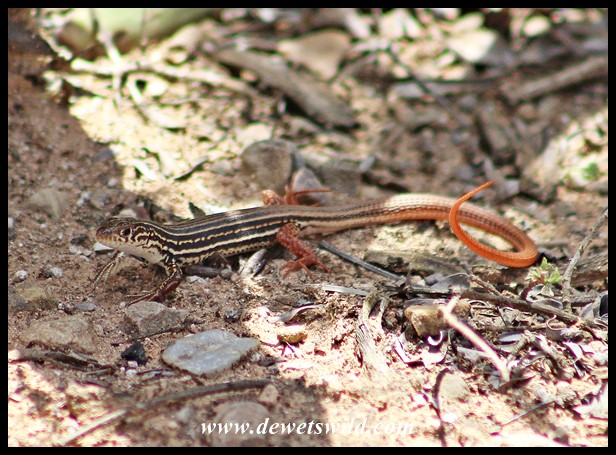
Albany Sandveld Lizard

Nucras taeniolata

The Albany Sandveld Lizard, also known as the Striped Sandveld Lizard, is a lizard species endemic to South Africa – in fact, it is found only in a corner of our Eastern Cape Province that includes the Addo Elephant National Park, a few nearby conservation areas, and the agricultural and urban land in between. The IUCN considers it to be of least concern.

Excluding the exceptionally long tail, this attractive lizard measures 7cm at most in length. It is secretive in nature and inhabits various thicket vegetation types. They feed on insects and seem especially fond of termites.

We were visited by this friendly fellow while having a picnic in the Addo Elephant National Park.

World Wildlife Day 2022

In celebration of World Wildlife Day we take a look back at the 86 species of South African wildlife we featured in detail here at de Wets Wild during the past year.

Satara Summer 2021 – African Cuckoos

Another bird that we encountered much more frequently during our December 2021 visit to the Kruger National Park than on any previous visit is the African Cuckoo. Perhaps their exceptional numbers this time around is thanks to an explosion of caterpillars following good early rains.

Cuculus gularis

The African Cuckoo inhabits savanna and woodland habitats and feeds almost exclusively on caterpillars; only rarely does it include anything else, like other insects, eggs or small birds, in its diet. They are usually solitary.

As with the other members of the family the African Cuckoo is a brood parasite, relying specifically on the fork-tailed drongo to raise its brood. After mating the male African Cuckoo will distract the fork-tailed drongo parents from their nest while the female Cuckoo gets rid of any drongo eggs already in the nest and replaces them with one of her own. The Cuckoo egg hatches about 17 days later and the newly hatched chick immediately sets about pushing any other chicks or eggs from the nest. It is then cared for by its adoptive drongo-parents, growing rapidly until it fledges about three weeks after hatching. Even after the chick leaves the nest it is still cared for by the drongos for several weeks. Fully grown they measure about 32cm in length and weigh around 105g, so by the time they leave their foster parents the chicks are much bigger than them.

African Cuckoos spend the spring and summer months from August to April in southern Africa, migrating here from equatorial Africa to breed. In South Africa during that period they can be found in all the northerly provinces, being absent only from the Eastern and Western Capes and most of the Northern Cape and Free State. They’re found across most of Sub-Saharan Africa for at least a part of the year. According to the IUCN the African Cuckoo is of least concern.

African Cuckoo

Black-crowned Night Heron

The Black-crowned Night Heron isn’t necessarily a rare bird, but because it is so shy and retiring, and nocturnal, is not seen very often and not very obliging for photographs. During our December 2021 visit to the Kruger National Park, we found a juvenile where the S41-road crosses the Nwanetsi stream. In the early morning it was often quite willing to sit in the open for a photo or two, and one one occasion we even got to see one of its parents flying back home on an overcast morning.

Nycticorax nycticorax

The Black-crowned Night Heron is a nocturnal bird whose habitat requirements are closely linked to slow-moving water with lush growth of emergent vegetation. As these habitats are often fleeting in this part of the world many of our local populations are nomadic in response to rainfall patterns through the region. Their prey ranges from insects and other invertebrates to fish and amphibians and even small reptiles, birds and mammals. As their name suggests these herons are active from dusk to dawn, hiding in dense vegetation by day.

Black-crowned Night Herons often breed colonially, with others of their kind or even other species of water birds. Adults form monogamous pairs with both partners participating in the nest building, incubating the clutch of 2-8 eggs (that take between 3 and 4 weeks to hatch) and rearing the chicks, who fledge at around 7 weeks of age. Breeding can take place at any time of year but reaches a peak in our wetter summer months. Fully grown they measure around 56cm in length and weigh approximately 630g.

Occurring widely but sparsely all over South Africa where there is suitable habitat, the Black-crowned Night Heron’s distribution stretches far beyond our borders to every other continent except Antarctica and Australia. The IUCN considers it to be of least concern.

During a visit to the iSimangaliso Wetland Park in March 2022 we found a slightly older Black-crowned Night Heron and its parents near Cape Vidal.

Black-crowned Night Herons

Another special sighting of this bird was one we saw flying over De Hoop Vlei during broad daylight during a visit to De Hoop Nature Reserve in December 2022.

Southern Carmine Bee-eaters

The Southern Carmine Bee-eater is a regular summer visitor to South Africa, so they are not entirely unfamiliar to us. We have however not seen them in such numbers before as we have during our December 2021 visit to the Kruger National Park.

Merops nubicoides

The beautiful Southern Carmine Bee-eater is a bird that lives in open woodland and savannah habitats, often found near open water, and that feeds exclusively on insects, most of which they catch in flight and usually much bigger than the fare enjoyed by most other bee-eaters. They’re often seen hunting near to large mammals and ground birds – often using them as a perch – catching the insects these bigger animals disturb into flying. They’re attracted to veld fires for similar reasons.

Southern Carmine Bee-eaters breed in huge colonies numbering up to a thousand pairs, where each monogamous pair excavates a nest-tunnel up to 3.5m deep into earthen banks, usually along rivers and gullies. The clutch of 1-6 eggs take 2 weeks to hatch and the chicks then leave the nest when they’re around 3 weeks old. When not breeding they are less gregarious and more dispersed. Southern Carmine Bee-eaters are the largest of the family occurring in Africa, measuring around 25cm in length (excluding the elongated tail feathers) with a weight of about 62g.

In South Africa, Southern Carmine Bee-eaters are found mainly in the provinces of Mpumalanga and Limpopo, and marginally into Gauteng and North West, with most birds arriving locally by December and departing again by March. Interestingly the majority of birds arrive to breed in our northern neighbours Zambia, Zimbabwe and the Okavango region of Botswana from August to November, with the chicks already fledged by the time they then move further southwards to other parts of Botswana and South Africa’s northern provinces. At the onset of our autumn season they then return northwards to countries as far afield as the DRC and Tanzania. Only in a very narrow band crossing parts of Angola, Zambia, Malawi and Mozambique are they resident throughout the year. The IUCN lists the Southern Carmine Bee-eater as being of least concern.

Greater Painted-Snipe

The Greater Painted-Snipe is not a bird that we get to see very often, much less photograph, so we were thrilled to have several wonderful sightings of this elusive bird along the S90 and S89 roads between Satara and Olifants when we visited the Kruger National Park in December 2021.

Rostratula benghalensis

Among Greater Painted-Snipes it is the female which is the dominant sex. She is bigger, boasts the bolder plumage and leaves the incubation of the eggs and rearing of the chicks entirely to the male. Shy birds that inhabit flooded grasslands, marshes and other muddy wetlands where they skulk among the reeds and other emergent vegetation, the Greater Painted-Snipe searches for the insects and other invertebrates that forms the bulk of its diet by probing in the mud with its elongated bill. They are usually seen singly or in pairs, with family groups encountered during and shortly after the breeding season.

Female Greater Painted-Snipes mate with 2-4 males in a breeding season, which spans the period September to March in our part of the world, leaving the males to incubate the clutch of 2-5 eggs over a period of almost 3 weeks. The chicks leave the nest before they’re a day old, moving around with their father who feeds them for the first ten days of their life. The chicks can fly when they’re a month old but remain with their father for another month or two before becoming fully independent. Fully grown Greater Painted-Snipes measure around 25cm in length and weigh approximately 120g.

Greater Painted-Snipes are very sparsely distributed over South Africa, with the Kruger National Park seemingly the most reliable place to find this species in our country and especially so during periods of above-average rainfall. Beyond our borders they’re found over most of Sub-Saharan Africa, in Madagascar, the Nile Delta, and in Asia from the Indian subcontinent to Japan and while the IUCN considers it to be of least concern overall, in South Africa it is listed as Near-Threatened due to the loss of suitable habitat.

Clouded Mother-of-Pearl Butterfly

This wonderful present came my way while I was taking a walk through Satara Rest Camp on Christmas Day last year when we were visiting the Kruger National Park for our summer holiday. Looking this butterfly up in my guide book i thought “What a beautiful name for a beautiful butterfly!

Protogoniomorpha (Salamis) anacardii

The Clouded Mother-of-Pearl is a medium-sized butterfly with a wingspan of up to 7cm. They prefer dense habitats ranging from coastal and montane forests to riverine galleries, and in South Africa are found through coastal Kwazulu-Natal and into the Lowveld and escarpment of Mpumalanga and Limpopo. Adults are seen throughout the year though their numbers reach a peak in late summer and early autumn. Their flight may seem ungainly but they’re exceptionally quick when troubled – this one gave me quite the walk-around through camp trying to take its picture. Clouded Mothers-of-Pearl love sitting exposed on prominent perches such as leaves and flowers, apparently basking in the sun – behaviour this one also displayed at least long enough so I could get a few photographs.

While visiting Cape Vidal in the iSimangaliso Wetland Park in March 2022 we again encountered this beautiful butterfly, though this time a really tattered specimen.

Satara Summer 2021 – Brown-backed Tree Frog

A very interesting frog that we have never seen before, that is until our December 2021 visit to Satara in the Kruger National Park, is the Brown-backed Tree Frog, and these two individuals might also have remained hidden if they didn’t betray their presence with their call near where we were standing.

Leptopelis mossambicus

In South Africa, the Brown-backed Tree Frog is found in northern Kwazulu-Natal and the Lowveld and escarpment of Mpumalanga and Limpopo. They’re also found in Eswatini (previously Swaziland), eastern Zimbabwe, central and southern Mozambique and the extreme southern tip of Malawi. The IUCN lists it as being of least concern.

The Brown-backed Tree Frog inhabits moist savannas, coastal forest and mangrove swamps. During the dry season these frogs remain underground for up to 6 months, buried in the soil about a foot deep. With the first rains of summer they emerge to breed. The males then climb into bushes, reeds, shrubs and trees, up to about 1.5m high, and usually close to open water, from where they call to attract females. During this time the males may become involved in fights with one another. During mating the females deposit the fertilised eggs underneath dead leaves near the water’s edge. Here the eggs remain, developing slowly, until the next good spate of rain, during which the tadpoles wriggle out the eggs and to the water, where they then complete their metamorphosis. Adults measure about 6cm in length. Brown-backed Tree Frogs feed on a wide variety of invertebrates.

Satara Summer 2021 – Eastern Olive Toad

Another amphibian that we regularly encountered during our nocturnal walks though Satara in December 2021 is the Eastern Olive Toad, whose loud calls made it quite easy to find them.

Sclerophrys (Bufo) garmani

The Eastern Olive Toad occurs patchily from Ethiopia to South Africa and is considered to be of least concern according to the IUCN. It is a savanna species preferring areas with relatively high rainfall, and thus in South Africa is found in northern Kwazulu-Natal, eastern Mpumalanga and most of the Limpopo Province. By day these toads shelter under rocks and logs, in dense vegetation or termite mounds and around houses. They feed on almost any kind of invertebrate.

Females are considerably larger and measure almost 12cm long when fully grown. Breeding usually takes place in temporary pans and marshes, though they’ll also use garden ponds and farm dams, during spring and summer. Females may lay several thousand eggs, which hatch within 24 hours. The tadpoles complete their metamorphosis in 2 to 3 months.

These photographs of Eastern Olive Toads were not taken during our recent visit to the Kruger National Park in December 2021:

Satara Summer 2021 – Banded Rubber Frog

Whenever we experienced a rain shower during our December 2021 visit to the Satara area of the Kruger National Parkand this was a regular occurrence – the high-pitched calls of Banded Rubber Frogs quickly filled the air. Once the rain subsided we’d go looking for them around the camp and usually found at least a few individuals.

Phrynomantis bifasciatus

Banded Rubber Frogs occur from southern Somalia to Angola and South Africa. In our country specifically they’re found from northern Kwazulu-Natal, through Mpumalanga, Limpopo and Gauteng to the North West Province. The IUCN considers the species to be of least concern.

Banded Rubber Frogs inhabit savanna habitats, where they hide under rocks and logs, inside tree trunks or termite mounds, tunnels dug by other animals and even in and around houses and drains. They feed mainly on ants and termites, but will also include other invertebrates in their diet.  They breed in temporary pools and pans and other similarly shallow watery habitats after the first rains have fallen. Females lay between 300 and 1,500 eggs, which hatch after 4 days, in a mass of “jelly” that surrounds each egg, usually attached to emergent vegetation in the water. The tadpoles are gregarious and if they have sufficient food may complete their metamorphosis in 1½ to 3 months. Adults grow to about 6cm long.

Banded Rubber Frogs rarely jump, preferring to walk or run. When threatened they stiffen their legs and inflate their bodies, showing off their bright warning colouration to great effect. These warning colours should be heeded, for the Banded Rubber Frog can secrete cardiotoxic poisons through their skin which, if it gets into the skin or bloodstream in sufficient quantities can cause humans to experience painful swelling, nausea, headaches, and difficulty breathing. The poison can be deadly to smaller creatures.

These photographs of Banded Rubber Frogs were taken during a previous visit to Satara in 2019: