Category Archives: South African Wildlife

The inhabitants of South Africa’s wild places

Rattling Cisticola

Cisticola chiniana

The Rattling Cisticola occurs in savannas, especially those dominated by thorny trees and bushes, and woodland. It feeds mainly on insects and other invertebrates, but have also been observed taking nectar from aloes.

Rattling Cisticolas are usually seen in monogamous pairs or family groups, and breed in spring and summer. They construct ball-shaped nests near the ground in a shrub or tuft of grass. The female takes sole responsibility for incubating the clutch of 2-5 eggs for 2 weeks, with the chicks leaving the nest about the same length of time after hatching. Adults are approximately 15cm long and weigh around 16g.

According to the IUCN the Rattling Cisticola is of least concern, and it occurs from Ethiopia southwards. In South Africa it is commonly found through most of Kwazulu-Natal, in Mpumalanga, Limpopo, Gauteng, North West, the eastern reaches of the Northern Cape and the north-western parts of the Free State, often being one of the most numerous bird species where they’re found.

Bushveld Gardenia

Gardenia volkensii

The Bushveld Gardenia is a small to medium-sized shrub or tree growing to a height of up to 10m and with its spreading branches often reaching down to the ground. The large, white flowers (older flowers turn yellow) have a sweet aroma and are carried from July to December. They open at night and are probably pollinated by moths. The leaves of the Bushveld Gardenia are browsed by a wide range of animals, including giraffes and kudus. The hard fruit ripen between December and April and are favoured by primates, antelope and elephants.

In traditional medicine the Bushveld Gardenia is used to treat intestinal parasites, while the hard wood is used for carving ornaments and utensils.

The Bushveld Gardenia grows in savanna and open woodland and in South Africa occurs through much of Kwazulu-Natal, Mpumalanga, Limpopo, Gauteng and North West Province.

Grey-backed Camaroptera

Camaroptera brevicaudata

Many authorities, including the IUCN and Birdlife International, consider the Grey-backed Camaroptera to be the same species as the Green-backed Camaroptera (Camaroptera brachyura), and hybrids between the two are recorded from time-to-time. In South Africa the Grey-backed Camaroptera occurs mainly in the North West Province, Gauteng and Limpopo, where it inhabits thickets and riverine vegetation in the savanna biome and feeds on a wide variety of invertebrates. These are shy birds, usually encountered singly or in pairs, that rarely ventures from low, dense vegetation.

Their nests are constructed of living leaves woven and stitched together into a ball shape low to the ground in dense foliage. The nesting season stretches through spring and summer and into early autumn, with clutches of 2-4 eggs being incubated over a two week period. The chicks leave the nest when they’re approximately two weeks old – even before they can fly. Fully grown, the Grey-backed Camaroptera weighs around 10g and measure about 12cm long.

Large-leaved Rock Fig

Ficus abutilifolia

Seen growing on rocky outcrops and cliffs from northern Kwazulu-Natal through Mpumalanga and Limpopo to North West Province (and beyond our borders as far afield as Guinea in the west and Somalia in the north-east), the Large-leaved Rock Fig is an easily noticed and impressive tree not necessarily for its size but because it is capable of flourishing in apparently precarious locations and of splitting rocks with its roots. These trees seldom grow taller than 5m, though their roots can stretch up to 60m deep!

In keeping with many other kinds of fig, the Large-leaved Rock Fig is pollinated by wasps. Ripe fruit are much sought after by frugivorous birds, bats and primates (humans included!), and antelope and wild pigs are very fond of figs that have fallen to the ground. Though their use in a garden is limited due to the strong and expansive roots, these trees work excellently as bonsai.

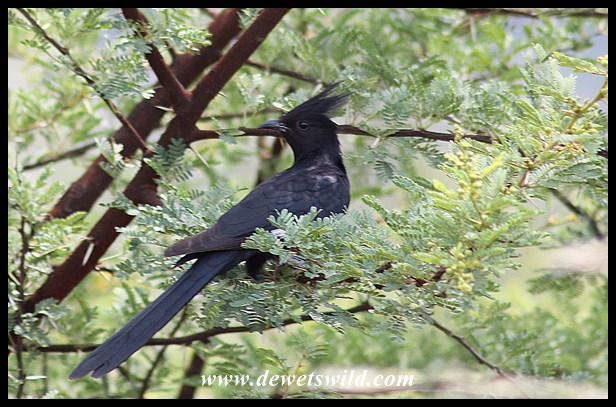
Meves’s Starling

Lamprotornis mevesii

A bird of riverine forests and floodplains with mature woodland, the Meves’s Starling (or Longtailed Starling) subsists on a diet of insects, fruits and flowers, foraged mostly on the ground. Adults measure approximately 34cm long, including the very long tail, and weigh around 75g.

These striking birds breed in spring and summer, building their nests inside cavities in trees – often using the same nest in successive years. The female takes sole responsibility for incubating the clutch of 3-5 eggs, which usually takes just short of 3 weeks, but both parents are involved in rearing the chicks, which fledge when they’re about 3 weeks old.

Meves’s Starling has a limited distribution in southern Africa – from Zambia and Malawi south to the Limpopo Valley on the border of South Africa with Botswana and Zimbabwe, meaning that the Mapungubwe National Park and the Pafuri region of the Kruger National Park is the most accessible locations in our country to go looking for them. The IUCN lists this species as being of least concern.

Black-faced Waxbill

Estrilda erythronotos

The Black-faced Waxbill is a tiny finch (12cm in length and weighing only about 10g), living in dry, thorny savannas with ready access to reliable waterholes and perennial streams. They feed mainly on seeds, supplementing their dietary intake with small invertebrates, berries, flowers and nectar.

Black-faced Waxbills are usually seen in pairs or small groups. During the breeding season, which peaks in late summer, pairs hold small territories and build together at the ball-shaped grass-nest, which has a long entrance tunnel at the bottom, well hidden in the tops of thorny trees. Both parents incubate the clutch of 2-6 eggs, which hatch within two weeks. The chicks leave the nest when they’re about 3 weeks old and stay with their parents for another two weeks or so before becoming fully independent.

The Black-faced Waxbill occurs in two separate parts of Africa, the one in East Africa stretching from Tanzania to Somalia and the other in Southern Africa (mainly South Africa, Namibia, Botswana and Zimbabwe extending marginally into Zambia and Angola). In our country specifically they are commonly found in the western half of Limpopo, the North West Province, Gauteng, the northwestern Free State and eastern reaches of the Northern Cape. The IUCN considers the Black-faced Waxbill to be of least concern.

Limpopo Ramble 2022: Yellow-spotted Rock Dassie

A fact that is not well-known, even among South Africans, is that our country is home to two different kinds of Dassie, or Hyrax, that live mainly in rocky terrain. We’ve already featured the species most people are acquainted with, the Rock Dassie (Procavia capensis), which is widely distributed throughout all our provinces. By contrast, in this country the Yellow-spotted Rock Dassie occurs only in our northernmost province, Limpopo, and often in mixed communities of both species numbering from a few to more than a hundred. The rugged Mapungubwe National Park is an excellent place to see them.

Heterohyrax brucei

Like their better known relatives, Yellow-spotted Rock Dassies are herbivores that feed on a wide variety of plant material, with leaves forming the bulk of their diet. They are fairly independent of drinking water. Yellow-spotted Rock Dassies are also diurnal and love basking in the sun. They’re excellent at climbing around in trees, which they do mostly for feeding as they’d usually take cover among the rocks in case of danger. One of the group is always on sentry duty while the rest feed.

The basic social unit of a colony of Yellow-spotted Rock Dassies consist of a dominant, territorial male with a harem of adult females and their young. They breed throughout the year, females usually giving birth to 2 babies. Adult Yellow-spotted Rock Dassies weigh between 1.5kg and 3.5kg and measure between 30cm and 50cm in length. They seldom live to older than 11 years in the wild, and usually much shorter.

With its distribution extending northwards well beyond Limpopo Province all the way to Sudan, the IUCN considers the Yellow-spotted Rock Hyrax to be of least concern.

Yellow-spotted (left) and Rock Dassie (right) sharing the sun in Mapungubwe

Limpopo Ramble 2022: Eastern Rock Sengi

During our recent visit to Marakele National Park, while enjoying the magnificent view from the Lenong Viewpoint, we spied a little Eastern Rock Sengi basking in the early morning sun – a habit they are particularly fond of – behind a fence surrounding one of the communication towers also built atop the mountain. While the fence is a rather irritating obtrusion in these photo’s of ours, it is probably because of it that the Sengi felt comfortable enough to be out and about, safe in the knowledge that neither us humans nor any other predator could reach it!

Elephantulus myurus

The Sengis, or Elephant Shrews, (order Macroscelidea) are a family of 20 small, insectivorous mammal species occurring only in Africa. While they’re superficially very shrew-like they are in fact not related to shrews at all (and they are in fact more closely related to elephants, even if their “trunks” aren’t nearly as long and prehensile), which is why the scientific community is trying to move away from the old moniker in favour of Sengi, a name based in indigenous African languages.

The Eastern Rock Elephant Shrew, or Sengi then, occurs widely in South Africa’s northern and eastern provinces and throughout Zimbabwe, extending into portions of Lesotho, Eswatini, Botswana and Mozambique south of the Zambezi. The IUCN considers it to be of least concern.

As suggested by its name, the Eastern Rock Sengi is always found in close association with rocky areas where they hide in cracks and tiny caves among the boulders. Here they subsist on a diet that consist of insects (mainly ants and termites) and other invertebrates, though they will also eat seeds. They are diurnal, very rarely venturing out in the dark. They are also very alert and nervous, usually dashing for cover at the slightest disturbance.

Eastern Rock Sengi’s are mainly solitary and seen in pairs only while they breed during spring and summer. Females usually give birth to twins after a two-month long gestation. The young are very well developed and can move around with their mother soon after birth. Fully grown, Eastern Rock Sengi’s measure about 26cm long (of which the tail is more than half) and weigh approximately 60g. They have a very short lifespan and may live to only around 18 months of age in the wild.

Limpopo Ramble 2022: Pel’s Fishing Owl

Now, searching for the Pel’s Fishing Owl can make you feel like Indiana Jones searching for some long lost artefact only to be thwarted at every turn. We have spent many, many hours over the years slowly driving through prime habitat in search of this elusive bird and have always come off second best.

Upon arrival at Mapungubwe National Park on the 25th of June, and while completing the usual formalities at the entrance gate, I enquired about whether there had been any recent sightings of Fishing Owls in the Park and whether we might book a special guided drive to search for them in case there was. Without hesitation the kind receptionist picked up the phone, and minutes later we were being escorted down to the banks of the Limpopo River by Leonard Luula, one of the excellent guides at Mapungubwe.

Leonard’s expert eye quickly picked out the bird that has eluded us for so long sitting in a tall riparian tree. We were ecstatic.

We went back to the same area early the following day and were very grateful to see the owl once again before it shuffled out of view along its perch to behind the screen of leaves.

Scotopelia peli

As its name suggests, the Pel’s Fishing Owl subsists on a diet of fish (and the occasional frog, crab and even baby crocodile!) which it catches at night by swooping down over the water to snatch its prey from it. They live in riverine forests on the banks of large rivers and swamps.

Pel’s Fishing Owl usually nests in deep cavities or old hamerkop nests in tall trees near the water’s edge, mainly during the months of summer and autumn. The female incubates the clutch of two eggs for around 5 weeks while being provided food by the male. Both eggs usually hatch, but only one chick survives to fledging as the parents feed mainly the stronger chick and neglect the weaker, which dies of starvation within a few days of hatching. The chick remains in the nest for almost 10 weeks and is dependent on its parents for up to 9 months months after fledging. Due to it taking so long to raise a chick, pairs generally breed only every second year.

Pel’s Fishing Owl is the second largest owl on the African continent (after Verreaux’s Eagle-Owl). Adults have a wingspan of around 1.5m, sit about 60cm tall, and weigh approximately 2kg. Their call can be heard up to 3km away.

While overall Pel’s Fishing Owl is considered to be of least concern, it is listed as endangered in South Africa, with a population estimated at only between 70 and 100 mature individuals. Here, these enigmatic birds are found in the north of Kwazulu-Natal, along large Lowveld rivers – notably the Olifants and Luvuvhu – and along the course of the Limpopo on the border with Zimbabwe and Botswana. Thankfully, most of this restricted range is covered by formal protected areas, such as the iSimangaliso Wetland Park, Kruger National Park and of course Mapungubwe National Park. They are very sensitive to human disturbance and threatened by habitat loss. Beyond our borders, Pel’s Fishing Owls are found widely, if somewhat patchily, over much of sub-Saharan Africa.

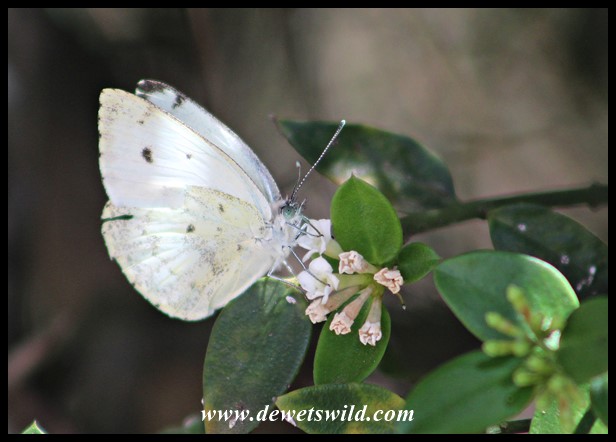
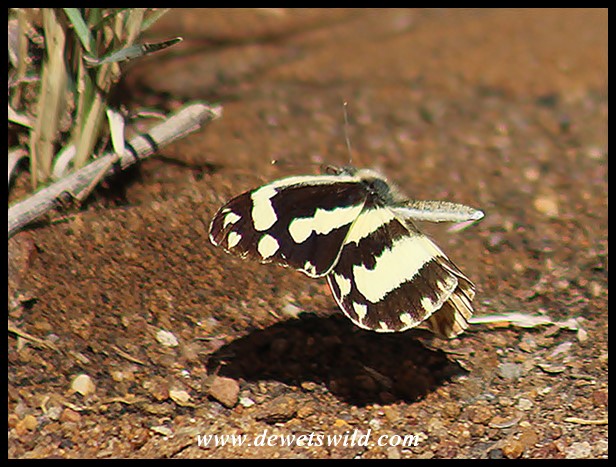
Banded Gold Tip Butterfly

Teracolus (Colotis) eris

The Banded Gold Tip is a common and widespread butterfly that can be found in corners of all South Africa’s provinces. While reaching their highest densities in forest and savanna, they have a wide habitat tolerance, avoiding only succulent karoo, fynbos and mountain grasslands. They’re very fond of settling on flowers, fluttering rapidly around them before landing, are fast fliers and usually don’t fly higher than 2m off the ground. Adults have a wingspan of between 4 and 5cm and are on the wing year-round, their numbers peaking in autumn. The larvae feed on the leaves of shepherd’s bushes.

This post was scheduled to publish while we are exploring two of South Africa’s national parks during the South African winter holidays. We will respond to comments on our return. Stay safe and well!