Category Archives: Mpumalanga Province

Our experiences in the reserves of Mpumalanga, South Africa

Satara Summer 2021 – Challenging Cheetah Camouflage

See if you can spot the female Cheetah in this photograph. We spotted her on the 15th of December a few kilometers south of Satara. With her were two cubs; they were even more difficult to see. This was the first of 5 Cheetah sightings during our December 2021 visit to the Kruger National Park

Four days later we had a decent enough sighting of a group of four young Cheetahs hunting close to Nwanetsi. They didn’t stick around for photos very long though before their fleeing prey forced them to follow deeper into the bush.

Our next Cheetah sighting, on Christmas Eve, was another very challenging one. While this individual lay perfectly out in the open about 150m from the road that spotted pelt is excellent camouflage.

On Boxing Day, late afternoon while heading back to camp along the H6 road, we found two Cheetah brothers sitting in the rain intently staring into the distance. Just what they were looking at we never figured out as we eventually had to depart in order not to be locked out of camp.

Our next and final Cheetah sighting was also in pouring rain on the 31st of December, this time along the S37 road leading to Tshokwane from Nwanetsi; a group made up of a female with 4 fairly large cubs who would take turns to sit up in the rain and keep a watchful eye while the others kept their eyes shut against the pelting drops.

The Cheetah is endangered, not only in South Africa but across the whole continent, where its range has been drastically diminished. South Africa is home to at least 1,100 of these beautiful animals, with about 370 living in Kruger National Park and adjacent reserves. For us to have seen five different groups during our 3 week visit to the Park was extremely lucky! The Endangered Wildlife Trust is again calling on citizen scientists to submit photos of Cheetahs (and Wild Dogs) taken during visits to the Kruger Park to their 5th Cheetah Census, and while Joubert and I didn’t really get useful images on this trip we hope we can encourage other visitors with more luck to participate in this important project.

Satara Summer 2021 – A not-so-wild African Wild Cat

One of Satara Rest Camp’s features are a habituated African Wild Cat (perhaps more than one) that patrols the camp after dark, reminiscent of the pre-historic days when these cats first associated with humans and gave rise to the domestic tabbies that share human households the world over today. Even though we kept our distance, her regular visits to our campsite and bungalow was a welcome facet of our evenings in camp during our December 2021 visit to Satara in the Kruger National Park.

Satara Summer 2021 – Admiration for Elephants

It is estimated that there are over 30,000 African Elephants in the Kruger National Park (SANParks annual report, 2020-2021, p48) and as a result visitors to the Park can bargain on regular encounters with these charismatic animals. That certainly was the case when we visited in December 2021, and as they are among our favourite animals you will hear no complaints from us.

Could there be anything cuter than a baby Elephant!? Judging by the number of tiny calves in each of the herds we encountered the Kruger Park’s Elephant population is very healthy and still growing!

There are few things in wild Africa as imposing as an Elephant bull

When encountering a bull Elephant in musth on the road, it is wise to give them a wide berth. In this state Elephant bulls are very irritable and down right aggressive, making for some exciting and memorable encounters. With their elevated testosterone levels these bulls simply ooze self-confidence and I simply love that assertive swagger that goes with it. On the 19th of December this bull made us reverse for quite a few kilometers along the H6-road between Satara and Nwanetsi.

It took only one mock charge from this musth bull we encountered along the very narrow and winding S147 Ngotso Loop to convince us to vacate his vicinity.

When bulls in musth meet they are bound to get involved in serious fights for dominance and mating rights. These bulls clashed just outside the Tshokwane Picnic Site – it is the roofs of the Ranger Post that you can see in the background of some of these images.

On Christmas morning, just a few minutes away from Nwanetsi, these two younger bulls provided great entertainment. They seemed to be in the throws of fighting, but one of the combatants kept trying to keep a tree between him and his adversary. It was funny seeing how the one would push down the tree only for the other to try and re-plant it between them before the argument would move to a different tree or bush where the whole sequence would be repeated. Eventually one’s nerves gave in and he tried high-tailing out of the area as quickly as he could, but the other would not have any of that and followed at speed.

Older bulls often carry very impressive ivory; long and thick. We are always delighted to see these icons of Kruger.

We encountered this particularly impressive one-tusked fellow on three separate occasions during our December 2021 visit to the Kruger National Park.

Some bull Elephants with notable tusks are given names by the Park staff. This is Kukura, a tusker first recorded in 2015 and monitored since then by the rangers and researchers in the Kruger National Park.


Satara Summer 2021 – The River Horses

The Hippopotamus is a perennial favourite with visitors to South Africa’s wild places. Generally regarded as “jolly”, probably because of their portly bodies, hippos are actually extremely aggressive and dangerous and noted for killing more people in Africa than any other wild mammal.

Especially when they are out of the water, and feel their escape to their aquatic abode blocked, hippos become very aggressive. One morning near Balule we encountered an enormous Hippo bull sauntering back to the water of the Olifants River, and we were happy that he chose to follow a game trail back instead of walking along the road!

When they feel threatened, hippos will often rush back to the water and beware anything caught in their way. We saw this cow and calf returning in a hurry to the pool at the Sweni Hide near Nwanetsi – the speed with which they smashed into the water was amazing!

It’s often difficult to determine whether hippos are playing or fighting – both look equally serious to us human onlookers. Joubert got this pair going at it in the Gudzani Dam near Satara.

Satara Summer 2021 – Beware The Buffalo!

The grasslands of the central Kruger Park supports several very large herds of African Buffalo, as well as numerous old bulls relegated to solitary lives. Encounters with Buffaloes are always exciting, for even when they’re in the best of moods they still look at you as if you are overdue on money owed to them. Though this is mostly for show and probably as much to satisfy their curiosity as it is a threatening posture (we’ve rarely been charged by buffalo while in a vehicle), these powerful animals deserve their dangerous reputation and should be treated with respect.

Satara Summer 2021 – Fascinated with Spotted Hyenas

Spotted Hyenas are probably the most numerous large predator in the Kruger National Park, with a population estimated at around 7,000. While many people still hold on to incorrect beliefs that the Spotted Hyena is a cowardly scavenger, amongst other insults, we know better and are always excited when we get a chance to spend time with these fascinating carnivores.

For the entire duration of our December 2021 visit to the Satara area of the Kruger National Park a large pack of Hyenas maintained a den site about 3km to the north of the camp, along the H1-4 road. We regularly encountered these Hyenas, of all sexes and ages, while setting out or returning to camp and seldom left them without more photographs to add to the album.

This little family was a different story however. Along the Ngotso stream one very hot day early into our visit we came across a Spotted Hyena female with the two most lovable cubs imaginable. Though we looked for them in the same vicinity on several occasions later on we weren’t lucky to see them again.

Just south of Tshokwane, where the main road to Lower Sabie turns off, as we were heading home on the 2nd of January, we noticed a big female Hyena standing next to a culvert. In Kruger Spotted Hyenas make good use of these man-made tunnels as dens. Sure enough, as we brought our vehicle to a halt first one, then a second and then a third little head popped out from underneath the road to inspect the strange creature humming on top of their home.

So often when we encounter Spotted Hyenas they are on the move with a single-minded sense of purpose. This very big individual came running from the front at great speed along the road to Tshokwane one morning, only to disappear into the bush before we could even turn the car around.

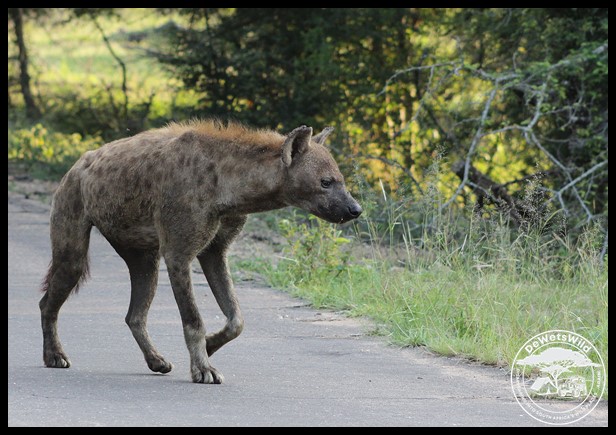
While they’re not always doing it on the trot, it happens very often that we find a Hyena, like this one near Balule, striding along the road to pass us as if it didn’t even notice us.

Spotted Hyenas are great opportunists. We found this one hanging around a herd of impalas that included lots of newborn lambs along the S126 Sweni Road.

At the Vutomi Dam, west of Tshokwane, we saw two Spotted Hyenas enjoying a refreshing dip in a muddy pool on a hot day before they headed off into the veld.

One morning, near the turnoff to Olifants Rest Camp, we found a very nervous Spotted Hyena with the tip of its nose hanging by a thread.

Soon after we found four more Hyenas, which were very excited, patrolling up and down the road as if they were looking for something. Perhaps they were looking for the Hyena with the hurt nose. They ran along the road and then stopped at some invisible scent marks, growling and grunting loudly and scent marking in the same spot before running off to the next one. This was fascinating behaviour we have never observed before, and whoever they were looking for would have done well to stay out of this posse’s way!

When we passed the same way several hours later the matriarch of the group was still patrolling up and down the same stretch of road. How is that for dogged perseverance!?


Satara Summer 2021 – Jaunting with Jackals

The plains around Satara is usually one of the best regions of the Kruger National Park for regular encounters with Black-backed Jackals, and that certainly was the case again when we visited in December 2021.

In the first few days after we arrived at Satara we were lucky to spend some time with a pair of Black-backed Jackals and their small puppies that were using a den just outside the camp’s north-west corner. The parents must have moved their den later because we didn’t get to see the family again later in our stay.

Another pair of baby jackals were to be seen on the H6 road and these lively puppies were responsible for lots of smiles. One morning we found them playing with every kind of dung that was lying on the road near them – I wondered what their parents thought of their smelly breath and fur!

Black-backed Jackals are great at making the most of every opportunity. We found this jackal scrounging around for grubs in elephant dung one morning on the S90.

While Black-backed Jackals are commonly encountered around Satara, the other kind of jackal that occurs in the Kruger National Park – the Side-striped Jackal – is a much rarer find. We only had one fleeting glimpse of one individual during our three week trip to Satara.

Side-striped Jackal


Satara Summer 2021 – Mingling with Antelope

The Kruger National Park is home to 21 different kinds of antelope – more than any other protected area in our country. Along with zebras and warthogs they form the staple prey for the majority of the large predators in the Park.

The Satara area of the park, which we visited in December 2021, hosts the largest concentrations of Blue Wildebeest in Kruger. Most Wildebeest calves are born at this time of the year, when the summer rains bring a flush of green fodder for the lactating cows.

Bushbuck aren’t seen around Satara all that often; the veld is generally too open for their liking in this part of the Park and any sightings are likely to be along the stream courses where the riverine vegetation provides the cover and browse they need.

The S36 road linking Satara and Orpen to the picnic spots at Muzandzeni and Nhlanguleni is usually reliable for finding Common Duikers, and if you are lucky these shy little antelope may stand still for a second or two so you can take a picture.

It is a real pity that the Impala is so numerous in Kruger that most visitors seem to not even spare them a second glance. They are actually really athletic and beautiful antelope.

Joubert got these photographs of two impala rams sparring.

The birth of Impala lambs are timed to occur en masse at the end of November and into early December. The lambs congregate into a “creche” within the herd when they’re at rest, but can often be seen running and chasing each other around – seems they have boundless energy.

In the evening of the 31st of December, along the Sweni Road (S126), we encountered a huge herd of Impalas. They were on the move, relinquishing the open plain where they were feeding for denser bush in which to spend the night. We spent several minutes with the herd as they walked off until the whole plain was abandoned.

Owing to the general scarcity of suitable rocky habitats around Satara, our only Klipspringer sighting of the entire 3 weeks we spent in that part of the Kruger Park was at an outcrop to the south of Tshokwane.

Three Klipspringers near Tshokwane

The open, thorny savanna around Satara supports a high density of the magnificent Greater Kudu and they can easily be seen along any of the roads that radiate from the camp.

By contrast, the Nyala is rarely encountered in this part of the Park and while they’re sometimes seen along the course of the Nwaswitsontso River south of Satara we had to go north to the banks of the Olifants River this time around to see this impressive bull.

Nyala bull

The Steenbok is the small antelope seen most often around Satara – they find the open grasslands perfectly to their liking.

The less I say about the expression on these Steenbokkies’ faces after mating, the better probably…

The Tsessebe is one of the rarest antelope in the Kruger National Park, and is not found near Satara. We undertook a day’s outing north to the Mopani area of the Park specifically to go looking for them, and luckily did not return to Satara with nothing to show for our effort.

Another large antelope you would defnitely encounter when visiting Satara is the Waterbuck. They’re quite numerous along the courses of the Nwanetsi and Gudzani streams to the east of the camp.

Satara Summer 2021 – Raptors Rule The Skies

Protected places like the Kruger National Park is becoming the last strongholds for many birds-of-prey, the undeniable masters of the skies. Any visit to the Kruger is sure to provide regular encounters with a wide variety of meat-eating birds, and in summer even more so as many species migrate here to escape from the winter in the northern hemisphere.

Not all birds-of-prey boast the size and muscle of the big Eagles. Some, like the Falcons, Kestrels, Kites and Harriers make up for what they lack in brawn by being exceedingly fast, nimble and stealthy.

Of course no one’s going to deny the absolute majesty of the Eagles. No wonder they’ve been featured in religion, folklore and heraldry for centuries.

If the Eagles rule the sky during the day then it belongs to the Owls at night. Of course this makes them much harder to see, and photograph, but we were lucky on a few occasions.

Vultures fulfill a vital role in the ecosystem, efficiently cleaning away any leftovers remaining after the large predators have had their fill of a carcass, and in a place like Kruger National Park with healthy populations of all Africa’s large carnivores there’s certainly lots of work for the Vultures. Sadly these birds are all highly endangered outside our country’s large protected areas.


Satara Summer 2021 – African Cuckoos

Another bird that we encountered much more frequently during our December 2021 visit to the Kruger National Park than on any previous visit is the African Cuckoo. Perhaps their exceptional numbers this time around is thanks to an explosion of caterpillars following good early rains.

Cuculus gularis

The African Cuckoo inhabits savanna and woodland habitats and feeds almost exclusively on caterpillars; only rarely does it include anything else, like other insects, eggs or small birds, in its diet. They are usually solitary.

As with the other members of the family the African Cuckoo is a brood parasite, relying specifically on the fork-tailed drongo to raise its brood. After mating the male African Cuckoo will distract the fork-tailed drongo parents from their nest while the female Cuckoo gets rid of any drongo eggs already in the nest and replaces them with one of her own. The Cuckoo egg hatches about 17 days later and the newly hatched chick immediately sets about pushing any other chicks or eggs from the nest. It is then cared for by its adoptive drongo-parents, growing rapidly until it fledges about three weeks after hatching. Even after the chick leaves the nest it is still cared for by the drongos for several weeks. Fully grown they measure about 32cm in length and weigh around 105g, so by the time they leave their foster parents the chicks are much bigger than them.

African Cuckoos spend the spring and summer months from August to April in southern Africa, migrating here from equatorial Africa to breed. In South Africa during that period they can be found in all the northerly provinces, being absent only from the Eastern and Western Capes and most of the Northern Cape and Free State. They’re found across most of Sub-Saharan Africa for at least a part of the year. According to the IUCN the African Cuckoo is of least concern.

African Cuckoo