One would be forgiven for expecting that the most memorable experience of a visit to the Kruger National Park would entail one of the big, charismatic mammals exhibiting some or other fascinating behaviour: a pride of lions making a kill, an elephant cow giving birth or a thousand-strong herd of buffalo stampeding to a waterhole, for instance. However, as I found out during my solo visit to the Kruger Park at the end of May, a bounty of beautiful butterflies can easily make those hairy-and-scary creatures fade into the background! In both Pretoriuskop and Skukuza Rest Camps I found blooming Lowveld Bittertea bushes (Gymnanthemum coloratum) and the surrounding gardens and lawns attended by literally hundreds of butterflies of at least 28 different species! They kept me busy and entertained for quite some time and I hope this gallery of pictures convey at least a sense of this awesome experience.

African Leopard

African Leopard

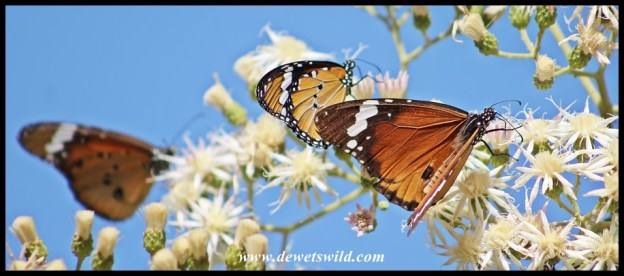
African Monarch butterfly

African Monarch butterflies and an incoming wasp

African Monarch butterflies

Common Smoky Blue

African Migrant (female form florella)

Black-striped Hairtail

Blue Pansy

Common Diadem (male)

Common Hottentot Skipper (male)

Common Orange Tip (male)

Dancing Acraea

Layman butterfly

Layman butterfly

Layman butterfly

Spotted Joker

Spotted Joker

Squinting Bush Brown

Striped Policeman

Two-pip Policeman (butterfly)

Two-pip Policeman

Common (or Eastern) Scarlet

Robust Hoppers

Robust Hopper

Lowveld Grass Yellow

Sulphur Orange Tip

Ant-heap White

African Common White

Brown Veined White

Two-pip Policeman

Common Dotted Border

Common Dotted Border

Window Acraea

Light Red Acraea

Lowveld Grass Yellow

Dusky Acraea (butterfly)

White-barred Acraea

Yellow Pansy
Of course, the butterflies were not the only insects making good use of the proliferation of winter flowers, and various other insects, most notably bees and wasps, were to be seen in attendance. A few dragonflies and birds then also made use of the opportunity to catch an easy meal on the wing.

Swarm of honey bees

Carpenter Bee

Carpenter Bee

Dangerously armed wasp

Colourful wasp

Just look at the stinger on that wasp!

Julia Skimmer Dragonfly
Two weeks later we returned to the Kruger Park, this time to Shingwedzi Rest Camp about 280km north of Skukuza. Here we found fewer butterflies – perhaps winter had set in now, with nighttime temperatures especially being on the cold side – but there were still enough of them flitting around to keep us thoroughly engaged while spending the midday hours in camp.

Autumn-leaf Vagrant

Broad-bordered Grass Yellow in flight

Brown-veined White

African Veined White slurping nectar from an Impala Lily flower

African Veined White slurping nectar from an Impala Lily flower

Common Orange Tip (male)

Lowveld Grass Yellow

Small Orange Tip (female)

Small Orange Tip (male)

Speckled Sulphur Tip

Topaz Spotted Blue

Veined Tip

Veined Tip

Zebra White
I’d like to dedicate this post to a great friend to de Wets Wild and the biggest butterfly fundi I know – AJ Vosse of “Ouch My Back Hurts” .












 DeWetsWild