The first place we went to after arriving at the uMkhuze Game Reserve on the 19th of March (well, after we checked into our chalet in Mantuma Camp) was the Kumasinga Hide; in our opinion one of the best photographic hides available in any of South Africa’s public reserves. Before our trip we had planned to spend a day in the hide if conditions seemed right, so when Joubert got these photographs of European Bee-eaters splashing in the waterhole our minds were made up.

European Bee-eaters bathing at Kumasinga (photo by Joubert)

European Bee-eaters bathing at Kumasinga (photo by Joubert)

European Bee-eaters bathing at Kumasinga (photo by Joubert)

European Bee-eaters bathing at Kumasinga (photo by Joubert)

European Bee-eaters bathing at Kumasinga (photo by Joubert)
On the 21st of March, a public holiday in South Africa, we set out from Mantuma Camp at 5am when the gates opened and headed straight for Kumasinga Hide, only about 4km out of camp. We arrived in the pitch dark and settled in for the day ahead. Not long after, Marilize made sure we each had a bowl of porridge and a hot cup of coffee to set the day off to a great start.

Kumasinga Hide in the dark

Kumasinga Hide in the dark

Joubert in a dark Kumasinga Hide
Slowly the sunrise started to light the scene in front of us while birdsong started to fill the air.

Early morning at Kumasinga

Early morning at Kumasinga
With it still quiet at the waterhole but with a beautiful glow to the morning I used the opportunity to take a few pictures of the hide.

Our Duster parked beneath a Black Monkey Thorn at Kumasinga Hide

Entrance to the walkway at the parking area for Kumasinga Hide

First stretch of the walkway to the hide

The ablutions are primitive but clean and functional

Walking towards the hide

The outside of the hide building

Inside Kumasinga Hide

Looking out from Kumasinga Hide

I took this photo of the outside of the hide a bit later in the day
Shortly after I took my seat again, the birds started arriving for their morning drink.

Cape Glossy Starlings and a Cape Turtle Dove

Brown-hooded Kingfisher

Brown-hooded Kingfisher (photo by Joubert)

Red-faced Mousebirds

Three-banded Plover

Red-billed Oxpeckers and Cape Glossy Starlings

Early morning at Kumasinga Hide

Cape Turtle Dove

Red-faced Mousebird and Dark-capped Bulbul

Red-faced Mousebird taking off while a Cape Glossy Starling drinks

Red-faced Mousebirds, Cape Glossy Starling and Black-collared Barbet

Pink-throated Twinspot

White-browed Scrub Robin

Rudd’s Apalis
Just before 8am the first mammals (apart from us) arrived on the scene, but didn’t venture down for a drink.

Impala herd

Slender Mongoose (photo by Joubert)

Slender Mongoose (photo by Joubert)
For more than the next hour-and-a-half it was mostly birds providing the entertainment, with the star of the show undoubtedly being a glamorous Purple-crested Turaco.

Green Wood-hoopoe

Green Wood-hoopoe (photo by Joubert)

Striped Skink

Yellow-fronted Canaries

Little Swift (photo by Joubert)

Little Swift (photo by Joubert)

Red-billed Oxpeckers

Thick-billed Weaver female

Purple-crested Turaco

Purple-crested Turaco

Purple-crested Turaco (photo by Joubert)

Purple-crested Turaco

Purple-crested Turaco

Purple-crested Turaco

Purple-crested Turaco (photo by Joubert)

Purple-crested Turaco (photo by Joubert)

Marsh Terrapins

Brown-veined White
By now it was 09:30 and the day started to heat up. Two Nyala bulls put in an appearance at opposite sides of the waterhole, making it difficult for Joubert and me, and a few other photographers who were in the hide at the time, to decide where to focus.

Nyala bull

Nyala bull

Nyala bull

Nyala bull

Nyala bull
A lone Blue Wildebeest bull arrived as well, but didn’t stay long.

Blue Wildebeest (photo by Joubert)

Blue Wildebeest

Blue Wildebeest
A troop of Vervet Monkeys entered the stage from the left and passed all along the edge of the waterhole to the other side.

Vervet Monkey at Kumasinga

Vervet Monkey at Kumasinga

Vervet Monkeys admiring their reflections

Vervet Monkey at Kumasinga (photo by Joubert)

Vervet Monkey at Kumasinga (photo by Joubert)

Vervet Monkey at Kumasinga (photo by Joubert)
One of the Nyala bulls had a special act in store for us. He proceeded to a particular spot on the edge of the waterhole and thoroughly covered his horns with mud. Perhaps the show was more for the benefit of other nyalas than for us.

Nyala bull horning the mud

Nyala bull horning the mud

Nyala bull horning the mud (photo by Joubert)

Nyala bull horning the mud (photo by Joubert)

Nyala bull horning the mud (photo by Joubert)
His performance completed, the Nyala vacated the stage for the herd of Impalas that had finally mustered the courage for a drink of water.

Impala herd

Impalas and Red-billed Oxpeckers drinking

Impala

Impalas playing (photo by Joubert)
The next actor on the Kumasinga platform really got the attention of every person in attendance with his surprise appearance. We’re going to keep a few photos of this very confiding Eastern Natal Green Snake on the backburner until the next post on de Wets Wild.

Eastern Natal Green Snake at Kumasinga Hide, 21 March 2022

Eastern Natal Green Snake at Kumasinga Hide, 21 March 2022

Eastern Natal Green Snake at Kumasinga Hide, 21 March 2022
An animal that usually sticks around only for a second or two before slipping away, especially when they see a camera it seems, is the Slender Mongoose. What a wonderful opportunity to see this one so calmly going about its business all around the waterhole.

Slender Mongoose

Slender Mongoose

Slender Mongoose

Slender Mongoose

Slender Mongoose

Slender Mongoose

Slender Mongoose

Slender Mongoose

Slender Mongoose (photo by Joubert)

Slender Mongoose

Slender Mongoose (photo by Joubert)
Despite the clouds building up the mid-day heat was oppressive and a seemingly constant stream of Nyalas and Impalas were now making their way to the water.

Mid-day at Kumasinga Hide

Nyala ewe and lamb

Nyala ewe and lamb

Nyala ewe and lamb

Nyala ewes (photo by Joubert)

Impala ewe with a heavy load of red-billed oxpeckers

Impalas drinking (photo by Joubert)

Impala ewe that’s had enough of free-loading Red-billed Oxpeckers (photo by Joubert)

Acrobatic Impala (photo by Joubert)

Dancing Impala (photo by Joubert)

Acrobatic Impala (photo by Joubert)

Peering out of Kumasinga Hide
Another magnificent Nyala bull strode confidently down to the water and, after quenching his thirst, went to the same spot the other bull did earlier and proceeded to attack the mud in the same fashion.

Nyala bull

Nyala bull

Nyala bull (photo by Joubert)

Nyala bull

Nyala bull horning the mud

Nyala bull horning the mud

Nyala bull horning the mud

Nyala bull horning the mud (photo by Joubert)

Nyala bull horning the mud

Nyala bull horning the mud

Nyala bull horning the mud

Nyala bull with horns covered in mud
This younger bull tried to imitate the master’s strange behaviour on a different patch of land.

Young nyala bull also horning the ground (photo by Joubert)

Young nyala bull also horning the ground (photo by Joubert)

Young nyala bull also horning the ground (photo by Joubert)

Young nyala bull also horning the ground (photo by Joubert)
Several birds also came down to the water for a drink in the heat of the day, and Joubert got some excellent practice taking photographs of birds in flight thanks to a pair of Fork-tailed Drongos regularly splashing into the waterhole to cool off.

Cape Turtle Dove (Photo by Joubert)

Fork-tailed Drongos (photo by Joubert)

Fork-tailed Drongo (photo by Joubert)

Fork-tailed Drongo (photo by Joubert)

Fork-tailed Drongo (photo by Joubert)

Fork-tailed Drongo

Fork-tailed Drongo (photo by Joubert)

Fork-tailed Drongo (photo by Joubert)

Fork-tailed Drongos (photo by Joubert)

Fork-tailed Drongo (photo by Joubert)

Fork-tailed Drongo (photo by Joubert)

Purple-crested Turaco

Purple-crested Turaco

Purple-crested Turaco

Purple-crested Turaco

Purple-crested Turaco

Thick-billed Weaver female

Grey Waxbill

Little Bee-eater

Sombre Greenbul
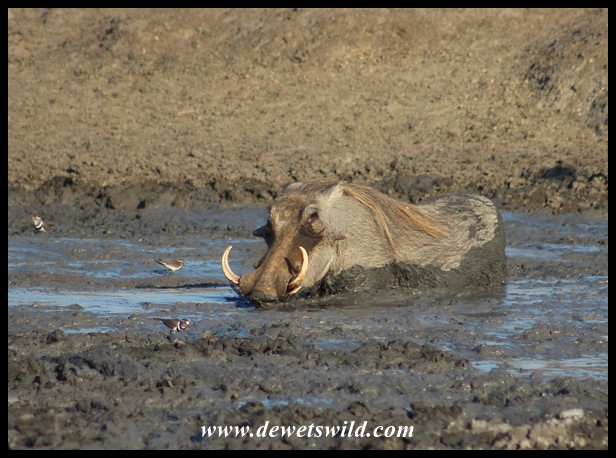
Next, a family of Warthogs arrived noisily and, after drinking, also cooled down in the waterhole as if they didn’t have a care in the world.

Warthog siblings

Warthog family

Warthog sow

Warthogs wallowing

Warthogs wallowing

Warthogs wallowing
Around 1pm another big Nyala bull, strutting his stuff for all his rivals, had his drink and then proceeded to, as the others before him, cover his horns with mud at the designated spot.

Nyala bull in dominance display

Nyala bull in dominance display

Nyala bull in dominance display

Nyala bull

Nyala bull horning the mud

Nyala bull horning the mud

Nyala bull horning the mud

Nyala bull horning the mud

Nyala bull

Nyala bull horning the mud

Nyala bull horning the mud

Nyala Bull in stiff-legged dominance display
Shortly after the flock of European Bee-eaters came around the waterhole again, allowing Joubert another chance to get shots of them as they cooled down in the dark water.

European Bee-eater (photo by Joubert)

European Bee-eater (photo by Joubert)

European Bee-eater (photo by Joubert)

European Bee-eater (photo by Joubert)

European Bee-eater (photo by Joubert)

European Bee-eater (photo by Joubert)

European Bee-eater (photo by Joubert)

European Bee-eater (photo by Joubert)

European Bee-eater (photo by Joubert)
Traffic at the waterhole gradually decreased as the afternoon wore on…

Purple-crested Turaco

Purple-crested Turaco

Purple-crested Turaco

Male Eastern Blacktail Dragonfly

Common Waxbill

Common Waxbill

Sombre Greenbul

Sombre Greenbul

Sombre Greenbul

Sombre Greenbul

Sombre Greenbul
but our slithery friend paid us another visit!

Eastern Natal Green Snake at Kumasinga Hide, 21 March 2022

Eastern Natal Green Snake at Kumasinga Hide, 21 March 2022

Eastern Natal Green Snake at Kumasinga Hide, 21 March 2022

Eastern Natal Green Snake at Kumasinga Hide, 21 March 2022
By dusk only the Marsh Terrapins were still around to keep us company.

And by the time darkness fell, and a leopard started rasping behind us (in the same general direction as the car!) it was time for us to head back to camp.
















 DeWetsWild