Outside of the reception office at Skukuza in the Kruger National Park is a beautiful pond, which by night is transformed into a stage for dozens of frogs of various kinds. For us it has become a tradition to visit the pond every night we spend in Skukuza to admire the sights and sounds of animals that are becoming ever more rare in the modern world.
We’d love for you to join DeWetsWild on a guided tour of the Kruger National Park or to help you arrange a self-guided visit. Don’t hesitate to reach out!
The Kruger National Park has a healthy Leopard population and the Skukuza-area of the Park is renowned for excellent encounters with these big cats, especially if you know where and when to look for them. During our short visit earlier in January we had three memorable Leopard sightings to share with you.
We were still readying our cameras at the Malelane Gate shortly after arriving when some kind folks told us about this Leopard lazing in a tree just a few kilometers into the Park on the way to Skukuza. We were grateful it was still in the same spot when we got there – starting your visit with a Leopard sighting is a very good omen of things to come!
Lazy Leopard in a tree near Malelane in the Kruger National Park
Lazy Leopard in a tree near Malelane in the Kruger National Park (photo by Joubert)
Lazy Leopard in a tree near Malelane in the Kruger National Park
Our next Leopard encounter was with this individual of whom we caught only a quick glimpse along the main road leading to Lower Sabie from Skukuza before it melted away in the lush summer vegetation.
In January the Park’s Rest Camps open their gates at 04h30 in the morning, with there then being still quite a while before first light. Skukuza’s gates had just been swung open and we joined the first few cars heading out when this brute of a Leopard male stepped out onto the road at the 4-way crossing not even a kilometer further. In our wild places an early start to the day is often handsomely rewarded!
Leopard just outside Skukuza in the early morning
Leopard just outside Skukuza in the early morning
Leopard just outside Skukuza in the early morning (photo by Joubert)
Leopard just outside Skukuza in the early morning (photo by Joubert)
Leopard just outside Skukuza in the early morning (photo by Joubert)
We’d love for you to join DeWetsWild on a guided tour of the Kruger National Park or to help you arrange a self-guided visit. Don’t hesitate to reach out!
Even if Spotted Hyenas were not the most numerous large predator around Skukuza Rest Camp in the Kruger National Park – and I think they are – they’re definitely the most frequently encountered, a fact borne out yet again by the many rendezvous we had with these fascinating creatures during our visit to the Skukuza-area earlier in January.
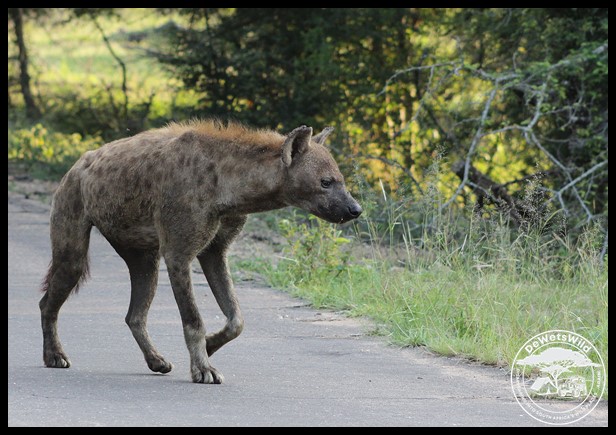
Spotted Hyena near Leeupan, north-east of Skukuza Rest Camp
On a night drive from camp, following the course of the Sabie River, we crossed paths with several clans all searching for food.
We paid frequent visits to a Hyena den just a few kilometres south of the camp, where the many curious cubs kept us well entertained. These encounters were definitely in the “cute and cuddly” category.
Adult female Spotted Hyena at their den near Skukuza
Spotted Hyena cub at their den near Skukuza
Spotted Hyena cub at their den near Skukuza (photo by Joubert)
Spotted Hyena cub at their den near Skukuza (photo by Joubert)
Spotted Hyena cubs at their den near Skukuza (photo by Joubert)
Spotted Hyena cub at their den near Skukuza (photo by Joubert)
Spotted Hyena cub at their den near Skukuza
Spotted Hyena cubs at their den near Skukuza
Spotted Hyena cubs licking at a puddle of aircon water in the road at their den near Skukuza (photo by Joubert)
Spotted Hyena cub at their den near Skukuza (photo by Joubert)
Spotted Hyena cub at their den near Skukuza (photo by Joubert)
Spotted Hyena cub at their den near Skukuza (photo by Joubert)
We were awed by their tenacity when we spent time with this group of four Hyenas who were following the hunting wild dogs we shared with you a few days ago. While they couldn’t keep up with the pace of the painted wolves they were not put off, hoping that if they stayed on the spoor of the dogs they would catch up with them and could steal their meal. As it turned out the kill was quickly consumed by the wild dogs and the hyenas were left without a morsel by the time they arrived, but I am sure this will not prevent them trying again!
Spotted Hyena following a pack of wild dogs on the hunt
Spotted Hyena following a pack of wild dogs on the hunt
Spotted Hyena following a pack of wild dogs on the hunt
Spotted Hyenas following a pack of wild dogs on the hunt (photo by Joubert)
Spotted Hyena following a pack of wild dogs on the hunt (photo by Joubert)
Spotted Hyena following a pack of wild dogs on the hunt (photo by Joubert)
Spotted Hyena following a pack of wild dogs on the hunt (photo by Joubert)
Spotted Hyena following a pack of wild dogs on the hunt (photo by Joubert)
Definitely the scariest run-in with a Spotted Hyena during this latest trip was with an individual who popped into the Tshokwane Picnic Spot while we were having breakfast. Luckily he didn’t stay long and moved off again without using those powerful jaws on any of the humans.
Spotted Hyena inspecting Tshokwane Picnic Spot in the Kruger National Park (photo by Joubert)
Spotted Hyena inspecting Tshokwane Picnic Spot in the Kruger National Park
Spotted Hyena inspecting Tshokwane Picnic Spot in the Kruger National Park
Spotted Hyena inspecting Tshokwane Picnic Spot in the Kruger National Park
We’d love for you to join DeWetsWild on a guided tour of the Kruger National Park or to help you arrange a self-guided visit. Don’t hesitate to reach out!
We’ve just returned from another wonder-filled visit to the Kruger National Park, where as always we had great luck and enjoyed the most memorable experiences. One of those was this encounter with a pack of African Wild Dogs hunting along the Sand River while we followed behind until they caught, killed and devoured a young Impala early yesterday (11 January 2024) morning. This video – not for sensitive viewers – was taken by Joubert.
We’d love for you to join DeWetsWild on a guided tour of the Kruger National Park or to help you arrange a self-guided visit. Don’t hesitate to reach out!
Join us for a look back at the wonderfully wild South African destinations we visited during 2023. May 2024 be a blessed year for you and your family, memorable for all the best reasons.
Jakhalsfontein Guest Farm
Our camping setup at Bontle in Marakele National Park, March 2023
Chalet #1 in Lilydale Rest Camp
Hut #107 in Pretoriuskop Rest Camp, Kruger National Park (June 2023)
Hut #46 in Lower Sabie Rest Camp, Kruger National Park (June 2023)
Tent #10 in Tamboti Tented Camp, Kruger National Park (June 2023)
Guest House, Shingwedzi Research Camp, Kruger National Park, June 2023
Buffelshoek Camp, Manyeleti Nature Reserve, September 2023
Ndzhaka Camp, Manyeleti Nature Reserve, September 2023
Twanana Research Camp, Kruger National Park, September 2023
House #32, Kudu Private Nature Reserve, October 2023
The beach at the estuary of Lake Saint Lucia
Cape Vidal at low tide
Western Shores section of the iSimangaliso Wetland Park
Rest Hut #3, Mantuma Rest Camp, uMkhuze Game Reserve, November 2023
Colleague and friend Hannes and I might only have had two days in the Kruger National Park before we moved on to the Manyeleti Nature Reserve (of which I will start telling you in the next installment) recently, but we still had some terrific sightings around Mopani Rest Camp – even more than we could’ve expected, and we had some pretty high hopes!
The charm of the Kruger Park really lies in the amazing diversity of habitats, plants and wildlife that finds sanctuary there.
Hill covered by Bushveld Candelabra Euphorbias next to the Tsendze River
A closer look at the Bushveld Candelabra Euphorbias growing on a hill near Shipandani Hide
African Civet
Blue Wildebeest at Mooiplaas
Black-backed Jackal looking for a little shade at Tihongonyeni
Steenbok ram in close-up portrait
Black-backed Jackal and Blue Wildebeest at Mooiplaas
Plains Zebra
Giraffe
Waterbuck
Klipspringer
Sharpe Grysbok near Mopani
No matter the weather or the time of year, the Kruger National Park is always a slice of heaven for bird-watchers!
African Scops Owl
Chinspot Batis in Mopani
Chestnut-backed Sparrowlark
Wahlberg’s Eagle
Kittlitz’s Plover
Grey-backed Sparrowlark
African Hawk-Eagles
Cardinal Woodpecker
African Green Pigeon
Black-backed Puffback
Black-headed Oriole
Southern Ground Hornbill
Seeing a Ground Hornbill trying to snatch something from between some mopane branches was a very entertaining sighting!
Buffaloes roam the north of the Kruger National Park in enormous herds, but there are also many old bulls that have broken away from the breeding groups and can be quite disagreeable!
Buffalo Calf
Buffalo Bull
Buffalo Bull
Buffalo Cow
Buffalo Cow
You know that I can never get enough of Elephants, and in the north of the Kruger Park there’s ample opportunity to enjoy these magnificent creatures, so I still have a few more photo’s and a video to share!
Elephant feeding on mopane leaves near Tihongonyeni
The very noticeable “grass notch” shows that this elephant is left-handed!
These feet were made for walking
Elephant bulls walking away from Tihongonyeni Waterhole
Of course the large predators also get us very excited, even for people who visit the Park fairly regularly like we do. We’ll be remembering our two leopard sightings – one while we had just driven into the Park, and the other the following day – every time we pass those spots in future!
Leopard up a tree near Phalaborwa Gate
Leopard in a tree on the bank of the Tsendze River south of Mopani
September is generally regarded as the start of the spring season in South Africa, but with the rainy season still weeks away and temperatures starting to climb higher as the days grow longer, it is a very dry period of the year in most of the northern parts of the country. In our wild places, like the Kruger National Park, animals are seen congregating at or near the few remaining sources of water. The Mopani area of the Park is well served by several reliable waterholes and here visitors to the Park can expect interesting sightings of birds and animals taking turns at the water’s edge.
A Steenbok drinking from a puddle in the Ngobeni streambed
Elephants on the banks of the Letaba River
Mopani is situated on a hill overlooking the large Pioneer Dam, making this the most prominent of the area’s water sources. Visitors can get close to the water along the trail through the camp or at the Pioneer Hide.
White-faced Whistling Ducks
Black-winged Stilts
Goliath Heron
African Jacana
Yellow-billed Stork
Black Crake
Lazy Hippos
Juvenile Black Crake
White-faced Whistling Ducks
Squacco Heron at Pioneer Dam
Wood Sandpiper
Big Nile Crocodiles makes Pioneer Dam a dangerous place
Immature African Fish Eagle
Marico Sunbird
Another large body of water in this section of the Kruger Park is Grootvlei Dam, more distantly located from Mopani along the S50 gravel road to Shingwedzi.
Elephant bull drinking from Grootvlei Dam
Plains zebras drinking from Grootvlei Dam
African Fish Eagle at Grootvlei Dam
Black-winged Stilt
Flock of Cut-throat Finches at Grootvlei Dam
Enormous Nile Crocodile at Grootvlei Dam
Grootvlei Dam harbours many Nile Crocodiles
Watch this short video of a big Elephant bull drinking from Grootvlei Dam on a hot September morning:
On the way to Grootvlei visitors can make a detour first to the Mooiplaas waterhole, where a drinking trough is fed by a windpump and reservoir, and then along the Nshawu Marsh where several springs provide water even in drought years. Both these places are also well frequented by large predators waiting for thirsty herbivores to ambush.
Elephants at Mooiplaas Waterhole
Elephant at Mooiplaas Waterhole
Elephant herd walking away from Mooiplaas Waterhole
A lion in the light of early morning, searching the Nshawu Marsh for easy pickings
Elephants, plains zebras and a giraffe around one of the springs in the Nshawu Marsh
Because Mooiplaas (meaning “pretty farm”) is so close to Mopani, we love whiling away the last few minutes before the gates close there, and that’s exactly what we did when this herd of Elephants were having their sundowners.
South Africa’s Kruger National Park is renowned for wonderful encounters with African Elephants, and our quick visit last week proved no exception. We were based in the Mopani region of the Park, where mopane shrubs and trees dominate the plains and elephants congregate in their numbers near permanent water sources, like the Tihongonyeni waterhole. It was on our way to Tihongonyeni late one morning that these two bulls decided to make use of a flimsy shadow cast over the road by a big tree to rest their tired legs. Every time we ventured closer to try and sneak past on the verge of the road, the bull nearer to us would give a warning step or two in our direction, trunk outstretched, and so I’d back up again. Eventually we waited half-an-hour before the two eventually allowed us, with a shake of the head and a toss of the trunk as if they’d grown tired of our meekness and just wanted to be rid of us, to pass them.
Impressive tusker near Tihongonyeni
African Elephant bull near Tihongonyeni waterhole in Kruger
African Elephant bulls near Tihongonyeni waterhole in Kruger
African Elephant bulls near Tihongonyeni waterhole in Kruger
Here’s a short video of an encounter we’ll remember fondly when passing that way again in future.
I have just returned from a visit to the Lowveld and in particular the Kruger National Park and Manyeleti Game Reserve with Hannes Rossouw Photography. The following photographs are just a little appetiser of what you can look forward to in the next few posts on DeWetsWild.
Leopard up a tree near Phalaborwa Gate
Sharpe Grysbok near Mopani
Elephant at Mooiplaas Waterhole
Elephant herd walking away from Mooiplaas Waterhole
Plains zebras drinking from Grootvlei Dam
Elephant bull drinking from Grootvlei Dam
Impressive tusker near Tihongonyeni
Elephant feeding on mopane leaves near Tihongonyeni
Squacco Heron at Pioneer Dam
African Scops Owl
Buffalo Calf
Buffalo Bull
Leopard in a tree on the bank of the Tsendze River south of Mopani
African Civet
Blue Wildebeest at Mooiplaas
Young Nyala bull at Ndzhaka Camp in the Manyeleti Nature Reserve
Young leopard in Manyeleti Nature Reserve
Young leopard in Manyeleti Nature Reserve
Young lion in Manyeleti Nature Reserve
A big male Lion in the Manyeleti Nature Reserve
Playful Wild Dog pups in Manyeleti Nature Reserve
Wild Dog in the Manyeleti Nature Reserve
Cheetah after being chased up a tree by Wild Dogs in the Manyeleti Nature Reserve