Category Archives: Kruger National Park

On our way to the wilderness – day 3

Just before sunrise on the 17th of August – Joubert’s final day as an eleven-year old – we headed out of Skukuza towards Pretoriuskop, driving along the Napi Road and intent on visiting every one of the waterholes along the way.

Just past Transport Dam we have the first big-ticket highlight of our morning: a cheetah on the hunt! Unfortunately the cheetah caught its steenbok prey at an awkward angle behind our vehicle and immediately carried it into the long grass away from the road, so these are basically the only photos we have of a most thrilling sighting!

Just a few kilometers past the scene of the cheetah kill we encountered a pack of very excited spotted hyenas in and next to the road. It appeared that an interloper was coming a bit too close to their den, causing quite a stir among the resident cubs.

At Shitlhave Dam this grey old Buffalo bull posed for some pictures.

While it was quiet along the Voortrekker Road towards Afsaal, with the day heating up nicely it was easy to decide where to head next: all along the Biyamiti River in the general direction of Crocodile Bridge and Lower Sabie. As expected, lots of animals and birds where congregating along the dwindling stream of water to quench their thirst.

Nearing Lower Sabie we felt compelled to cross the causeway over the Sabie River, and then back again (as most everyone visiting this part of the Park is wont to do) before heading into camp.

The last stretch of our route today again followed the course of the Sabie River back to Skukuza, through a part of the Kruger National Park famous for its teaming wildlife.

And so the sun set on another extremely rewarding day in the Kruger National Park. The next day would be Joubert’s twelve birthday – more on that in the next installment!

Not for sensitive viewers: a vicious Baboon assault

It was the afternoon of the 16th of August 2021 and Joubert and I were parked on the shores of Sunset Dam, just outside Lower Sabie in the Kruger National Park, enjoying the serene scenes playing out all around us as a myriad of birds and animals, including a troop of Chacma Baboons, mingled at the water’s edge.

Baboons peacefully foraging on the shore of Sunset Dam

Suddenly there was a frightful commotion as the baboons started screaming in alarm. Almost immediately we noticed a young baboon, shrieking to high heaven, being chased by two slightly older “teenage” baboons. This in itself was not abnormal, as there is often disagreements in a baboon troop, and peace usually returns quickly after the necessary discipline has been dispatched. The young baboon rushed into the muddy water at the dam’s edge, eliciting even more worried squeals from its mother as Sunset Dam is home to some monster crocodiles.

However, as soon as one of the “teenage” baboons got hold of the youngster, it was clear that this attack was much more sinister. We have no idea about their motive, but judging by the viciousness of their bites to the skull, neck and throat and the very rough way they tried to pull the younger baboon apart limb from limb, there was no doubting that the two teenagers were intent on killing their unfortunate target. At one stage early into the encounter an adult, perhaps the mother of the younger one, tried to intervene but this proved only a temporary reprieve – instead of running away the badly injured youngster tried to hide in the mud again where he was soon cornered once more.

By now the attack had gone on for about four minutes. Probably as was to be expected, the fracas attracted the attentions of a large crocodile that was hitherto lying dead still on the bank. With the tables likely to be turned on them within a second, the attacking baboons let go of their quarry and ran for safety.

The youngster that was so viciously mauled also scampered away, heading over the road towards the Sabie River, and out of our sight. His attackers apparently also lost track of him, as they searched every bush in the general vicinity looking for the young baboon without success.

One of the murderous baboon “teenagers” passing by us as he looks for their victim. (photo by Joubert)

Whether the little one could’ve survived its injuries we’ll never know, nor whether the murderers managed to track him down and finish the job… This definitely was one of the most harrowing experiences we’ve ever had in the bush.


Fish Eagle caught in the act

The call of the African Fish Eagle is so evocative of Africa’s wild places, and seeing one is always a special treat, high on the wish-list of many safari-goers. Especially when you get the chance to see it in action; gracefully descending with claws outstretched to snatch a fish from just below the water’s surface and then majestically soaring away with its prize grasped in its talons. The stuff nature documentaries are made of.

During our mid-August trip to the Kruger National Park, Joubert and I were lucky to see a Fish Eagle catch a sharp-tooth catfish from the waters of the Sabie River just downstream from Lower Sabie Rest Camp. While this particular individual won’t score a perfect ten for the execution – that splash-down would have had the Olympic audience snickering, and thank goodness for that sandbank! – it nevertheless was an amazing sighting. Most of these photographs were taken by Joubert.

A memorable encounter with Sable Antelope

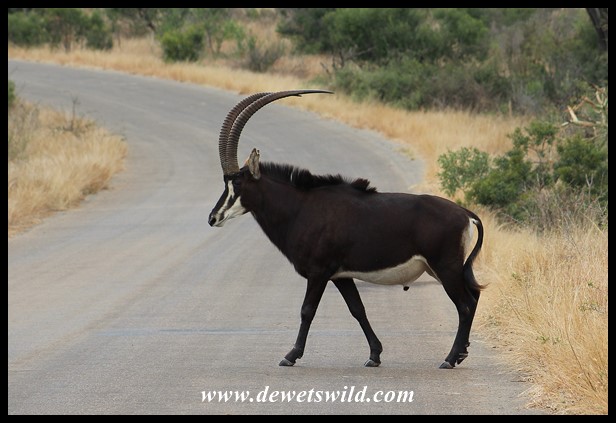
As mentioned in our previous post, the chief reason why Joubert and I decided to spend the first morning of our August trip to the Kruger National Park around Mlondozi Picnic Site was the recent sightings of a beautiful herd of sable antelope in that vicinity. Being one of our favourite antelope we couldn’t let the opportunity go by without going to see whether we can find the herd as well. Only on our second circuit around Muntshe Mountain and along the Mnondozi stream were we rewarded with the encounter we were hoping so dearly for. Without a doubt the best sighting I have had of Sable Antelope in over 30 years. As they crossed the road one-by-one we counted 25 individuals ranging from the magnificent bull to the long-eared calves.

On our way to the wilderness – day 2

Joubert and I were the first people out the gate at Skukuza on our first morning in the Kruger National Park when we visited last week. In the week before our arrival other visitors were bragging on the Park’s social media pages with their sightings of a big herd of sable antelope north of Lower Sabie, and as these rare and beautiful antelope are a favourite of ours, our route for the morning took us along the Sabie River and then in the general direction of the Mlondozi Picnic Spot. Along the way we had the joyful encounter with the young elephant knight we showed you two days ago.

By the time we reached Mlondozi, we hadn’t yet found the sables we came looking for. We were planning on having brunch at the picnic spot, but it was packed with other visitors and not a single table was available. We spent a few minutes enjoying the view, getting pictures of the birds and animals, and waiting for a table to clear, but eventually decided to rather move along.

We decided to use the extra time we had available due to the postponed lunch to do another circuit around Muntshe Mountain, and how wonderfully that turned out! We found the sables, and had probably the best sighting of these magnificent antelope I had in 30+ years! More about that soon, I promise.

Extremely satisfied with our morning, we headed for Lower Sabie where, just before the camp, we had a quick sighting of a leopard and enjoyed the abundant life that always congregate at the causeway over the Sabie River.

In contrast to Mlondozi, the picnic site at Lower Sabie was deserted, and Joubert and I could lunch in peace surrounded only by birds and butterflies.

By the time we finished lunch it was still too early to head back to Skukuza, so we drove south in the direction of Crocodile Bridge for a few kilometers along the main road, returning along the gravel Mativuhlungu Loop to Lower Sabie. Stopping at the causeway over the river again we were rewarded with a clear, though distant, view of an African Fish Eagle swooping down to snatch a catfish from the water. We’ll share that full sequence of pictures with you another day this coming week.

Just outside Lower Sabie, on the way to Skukuza, Sunset Dam is always a great place to stop and sit for a while, just soaking in the sights and sounds of the bush. On this occasion however the usual serenity of the place was shattered when a pair of teenage male baboons savagely attacked a much younger baboon at the water’s edge, seemingly intent on killing it. Baboons are always fascinating to watch, but I definitely have never experienced such a disturbing glimpse into their behaviour before. We’ll share some pictures from this harrowing sighting this coming Saturday, but please be warned!

It’s just a 45km drive, but with so much to see along the way it still took us 3 hours to get back to Skukuza and we made it back into camp with just a minute or two to spare before the gates closed. Our last sighting of the day was a pack of African Wild Dogs guarding the scraps of their kill against a bunch of vultures – what more could we ask for after such a wonderful day!?

Before ending off, I have to show you these photographs of a family of white rhinoceros we came across on day 2 of our trip to the wilderness. I won’t disclose when and where we saw them though so as not to tip off any poachers.


Sir Elephant

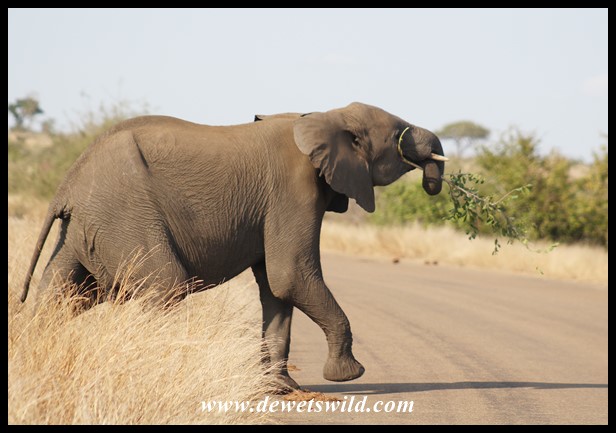
This young elephant, wielding his “mighty” branch like a medieval knight would his sword, gave us some great entertainment when Joubert and I visited the Kruger National Park last week. He intimidated us with his fierce strokes, and we yielded, but then an elderly couple in another vehicle did not pay him the necessary respect and he went into an even more brutal display for their benefit. Lucky for them he stepped on his own sword, and snapped it, so he stepped back into the long grass at the side of the road…

… where he picked up another branch just as the next vehicle – a campervan – drew closer.

Sir Elephant picking a new sword (photo by Joubert)

Most of these photographs were taken by Joubert

On our way to the wilderness – day 1

Before dawn on the 15th of August ’21, Joubert and I had the Duster packed and were ready to set off for the Kruger National Park. The whole route from Pretoria to Malelane Gate we drove under overcast skies, with thick mist and occasional drizzle.

Signing in at Malelane was a breeze and in no time at all we were on our way to Skukuza. With Afsaal picnic site packed to the brim with visiting people when we arrived we decided to give it a miss. We enjoy the Park packed with animals of all description much more than jostling with other picnickers for a spot at a table.

Right at Skukuza’s gates we found this elegant nyala bull – only to find that he wasn’t as elegant as first impressions suggested…

At Skukuza’s reception our check-in went just as smoothly and pretty quickly we were unpacked and settled into our bungalow, allowing us a chance to stretch our legs and gawk at Skukuza’s resident birds.

By the time we hit the road for our afternoon game drive there was only about three hours left before the gates would close, so we stuck to the roads around camp and along the Sabie River.

After our braai (barbeque) – what else would two South African men be eating when they’re forced to feed themselves than “pap en wors” (maize meal porridge with barbequed sausage) – and before going to bed, we walked around camp with our torch looking for nocturnal creatures.

We think this might be a baby Turner’s Thick-toed Gecko (photo by Joubert)

On Sunday we’ll tell you about day two as we prepared to tackle the Sweni Wilderness Trail from Joubert’s birthday.

A Wilderness Birthday

Parents often anguish about the perfect gift to give their children on their birthdays. This year however, for us anyway, things couldn’t have worked out better in preparation for Joubert’s 12th birthday.

You see, the minimum age requirement to join one of the wilderness trails in the Kruger National Park is 12 years. Joubert has been wanting to go on a trail for almost as long as he can walk. When a late cancellation then became available on the Sweni Trail, the most popular of all the trails in the Kruger Park, right on his birthday, there was just no way we could pass on the opportunity, even if it means he’ll have to work very hard to catch up his missed school work this coming week.

Joubert and I spent the past week in the Kruger National Park, half of it on the trail. This first set of photographs were all taken in the days leading up to his wilderness birthday.

Of course, there’s a bunch of stories to be told – and you can be sure that we will – but as a little teaser, Joubert was 12 years and 1 day old when these lions took offence at us invading their territory ON FOOT. We will tell you all about it soon.


The bloody fight that never was

At the end of our Satara Summer, on the way to the Kruger National Park’s Orpen Gate from where we were to head back home to Pretoria, we were lucky to see a lone Cheetah resting in the shade of a small thorn tree. Having stopped for a last photo or two, it was Marilize who noticed a Spotted Hyena heading straight towards the Cheetah. Knowing just how hateful the relationship between Africa’s large predators are, we were sure we were probably going to witness a tremendous fight when the two meat-eaters meet, especially when the Cheetah noticed the Hyena, snarled at it viciously, and got up to defend its turf. But turns out this Hyena was not a fighter; he walked straight past the Cheetah as if it wasn’t even there, and not paying the cheetah’s tantrum any attention whatsoever. It was rather amusing seeing the Cheetah standing by himself, looking decidedly confused, as the Hyena disappeared from view…

Waiting hours for a glimpse at a White Lion

White Lions are exceedingly rare and especially so in the wild. Several zoos, “safari parks” and circuses around the world house White Lions, but these are often horribly inbred. These lions are not albinos, instead being the result of a mating between two lions carrying a recessive gene for white (leucistic) fur instead of the usual tawny colouration. Naturally White Lions are only ever found, from time to time, in South Africa’s Lowveld, where the Kruger National Park and a few renowned private nature reserves are situated. As far as wild White Lions are concerned, at present, there are known to be two young white cubs in the same pride that roam around Orpen in western Kruger and the adjacent Timbavati reserve, and a single young male born to a pride near Satara and fairly wide-roaming since he and his brothers were ejected from their natal pride.

It is this latter individual that we came across on the 3rd of January 2020, the final full day of our Satara Summer. Having fairly often visited the Kruger National Park my entire life, it was always my, hitherto unfulfilled, wish to see a truly WILD White Lion, so you will appreciate just how excited we were at this opportunity! It was an exceedingly hot day, and on hot days lions are seldom very active. So we sat for hours in our vehicle in the blazing sun, waiting, hoping, that he might get up, and move around just a little, so that we can get more than just a glimpse. He obliged, for a minute or two only, to move from the large tree where he was lying with his three brothers to a smaller shrub a few meters away. That was it. He didn’t move again until we had to leave to get back to camp before the gates closed. But we were thrilled and grateful for the chance to see such an enigmatic animal.

While they can not be considered wild, there is a pride of White Lions on view at the Rhino & Lion Nature Reserve near Johannesburg.