The last photo taken today – sunset over the dry bed of the Shingwedzi River.
(You can click on the photo for a bigger view)

The last photo taken today – sunset over the dry bed of the Shingwedzi River

The last photo taken today – sunset over the dry bed of the Shingwedzi River.
(You can click on the photo for a bigger view)
Follow the leader!

These two gentlemen and their entourage greeted us at the gate as we were leaving Shingwedzi for our afternoon drive today,
Lovely warm weather here at Shingwedzi today, and lots of time to visit all the waterholes in the surrounding area – this one being Red Rocks to the south-west of the camp.
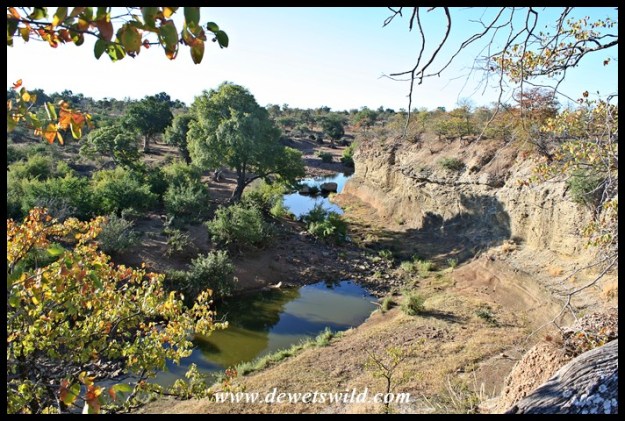
It’s 21:30 and I am sitting next to the fence at Shingwedzi Rest Camp in the Kruger National Park, listening to the sounds of lions, at least one leopard, hippos, zebras, impalas baboons and elephants breaking the silence of the night while Marilize and Joubert are already sound asleep in the tent behind me. Today is the first day of our long awaited winter visit to Shingwedzi, and we’ll try to do a daily update when cellular signal allows.


The Southern Double-collared Sunbird occurs only in South Africa (all provinces excluding Gauteng, the Free State and North West) and marginally into Swaziland and southern Namibia. They inhabit coastal and arid scrublands, fynbos, woodland, plantations and temperate forests and are usually seen singly, in pairs or family groups. They feed on nectar, fruit and small invertebrates. Adults are about 12cm long and weigh approximately 8g.
The peak breeding season for the Southern Double-collared Sunbird stretches from mid-winter to spring, though there are records from the rest of the year as well. Their nests are oval-shaped balls of grass, other soft plant materials and spiderweb built by the female without any assistance from the male. Clutches contain 1-3 eggs and are also incubated solely by the female over a 2-week period, but both parents feed the chicks which leave the nest by the time they are 3 weeks old. The youngsters become independent about a month after leaving the nest.
The IUCN regards the Southern Double-collared Sunbird as being of least concern.


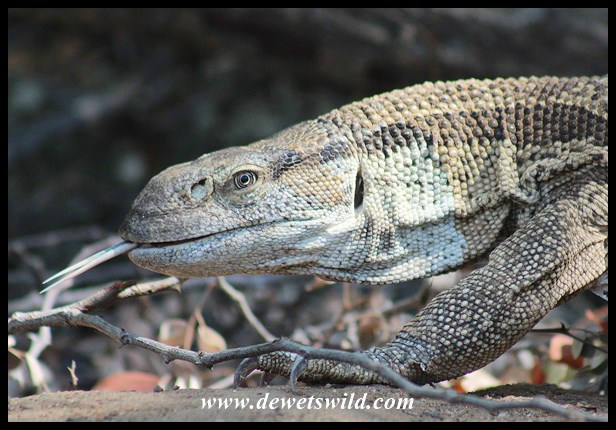
The Rock Monitor, also known as the White-throated Monitor, at a total length of up to two meters, with males weighing as much as 17kg (average is about half that, and males are much bigger than females), is one of our biggest lizards (just slightly shorter, but heavier, than the closely related Water Monitor). They occur all over South Africa, with the exception of the southwestern Cape and very arid western parts of the Northern Cape, inhabiting arid scrublands, grasslands and savanna. It also occurs widely through the rest of southern, central and east Africa as far north as Ethiopia.
Rock Monitors are diurnal predators, feeding on anything small enough to overpower (mainly invertebrates and smaller reptiles) and carrion. At night they hole up in burrows, under or between rocks, or in large holes in trees. They also hibernate in these places during cold winters. Rock Monitors mate in early spring, wit the female laying clutches of up to 50 eggs in termite mounds or holes dug in soft soil. While incubation periods of about 4 months have been recorded in captivity, the eggs normally take much longer to hatch in the wild, with many clutches also being lost entirely to opportunistic predators like the Banded Mongoose.
When threatened, Rock Monitors will defend themselves with powerful lashes from their tails, failing which it will sham death in the hope that the attacker will lose interest and move on.


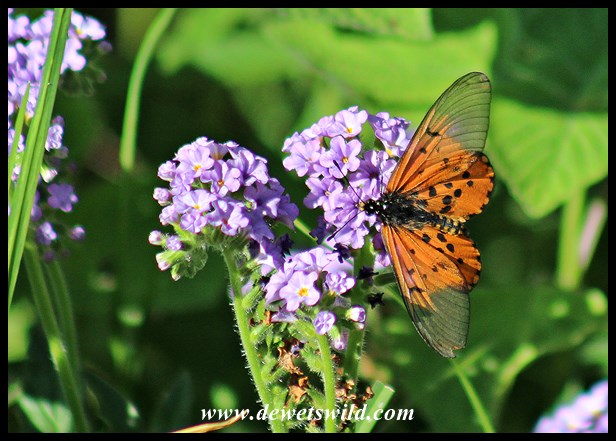
As its name implies, the Garden Acraea is a commonly seen butterfly of South African gardens, though its natural habitat preference is for woodland and forested areas in which their larval food plants of choice (mainly Wild Peach and Passion Flowers) occurs. Seen throughout the year, though more commonly in spring and summer, they fly low and slow, relying on their foul taste to deter predators. Adults have a wingspan of around 5cm, with females being slightly larger than males. Garden Acraeas are found along the southern Cape coast, through the Eastern Cape, Free State, Kwazulu-Natal and Gauteng to the North-West, Limpopo and Mpumalanga Provinces.


The evergreen Common Sugarbush grows up to 4m high (rarely up to 8m), growing on the slopes of rocky, grassy hills and mountains up to 2,100m above sea level and often forming extensive, dominant stands, especially on south-facing slopes. The Sugarbush bears its large flower heads in spring and summer – these are so rich in nectar that they’re the reason for this shrub’s common name. In South Africa, the Common Sugarbush is found in Kwazulu-Natal and on the Highveld and is the most widely distributed member of the genus Protea. There’s also an isolated population on the border between Zimbabwe and Mozambique.


I’ve just returned from a quick three-night solo visit to the Kruger National Park, and have some really memorable sightings to share with you. As the three of us will be heading back to Kruger again later in the month for a longer visit, I’ll be keeping you in suspense till we return – here though a little teaser-gallery just to wet your appetite for things to come!


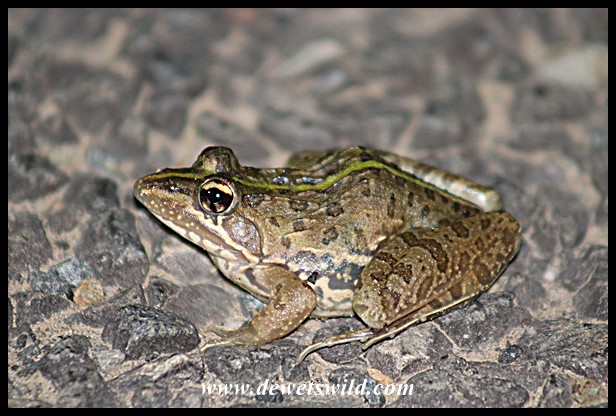
The Common River Frog, also known as Delalande’s River Frog, lives on the banks of streams and other permanent watersources in grasslands, bushveld and forests – they’ve also taken up residence in garden ponds and water features in the urban setting. When in danger of being seen, especially by day, these frogs quickly jump back in the water to hide in the mud. The males’ lovely croaks can be heard by day and night throughout the year. Depending on temperatures and availability of food the complete development and metamorphosis of the tadpoles of the Common River Frog takes between 9 and 12 months. Adults grow to 9cm in length.
Common River Frogs occur in all South African provinces, even in the arid Northern Cape along the Orange River.


 DeWetsWild