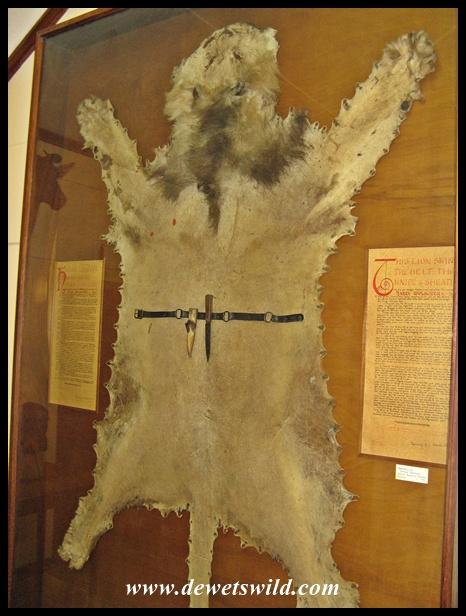
Among the valuable historical items on display in the Stevenson-Hamilton Memorial Library at Skukuza in the Kruger National Park, is the skin of the lion that attempted to make a meal of the legendary ranger, Harry Wolhuter, and the tiny knife that put an end to its plan.
“It is probable that the lion would have grasped me by the head, and then this book would assuredly never have been written! “
Ranger Wolhuter recounted the story in his memoirs, “Memories of a Game Ranger”, published in 1948:
“In August, 1903, I was returning from one of my usual patrols on the Olifants. On the second day after leaving the camp my objective was a certain waterhole en route, at which I intended spending the night, when we reached it we found that the pool was dry. It was now about 4 p.m., and the only thing to be done was to push on to the next water-hole which was about twelve miles distant. Accompanying me were three police boys driving the donkeys which carried all my possessions, and three dogs; the latter all rough “Boer” dogs, very good on lions. I instructed the boys that I would ride ahead along the path to the next water-hole and they were to follow. I then started to go ahead along the trail, and of the dogs “Bull” escorted me; the bitch “Fly”, and a mongrel-terrier, remaining with the boys.
Although it became dusk very soon I continued to ride along the path – as I had often travelled that route by night during the Boer War to avoid the heat of the summer sun. I gave no thought to lions, as I had never before encountered these animals in those parts. Most of the herbage had been recently burnt off, here and there a patch of long grass remained. While riding through one of these isolated patches I heard two animals jump up in the grass in front of me.
It was by now too dark to see, but I imagined that the animals in question were a pair of reedbuck, as this had always been a favourite locality for these antelope. I expected them to run across the path and disappear; but instead, and to my surprise, I heard a running rustle in the grass approaching me. I was still riding quietly along when the two forms loomed up within three or four yards, and these I now recognised as two lions, and their behaviour was such I had little doubt but that their intentions were to attack my horse. Although, of course, I had my rifle (without which I never moved in the veld) there was not time to shoot, and as I hastily pulled my horse around I dug the spurs into his flanks in a frantic effort to urge him to his best speed to get away in time; but the approaching lion was already too close, and before the horse could get into its stride I felt a terrific impact behind me as the lion alighted on the horse’s hindquarters.
What happened next, of course, occupied only a few seconds, but I vividly recall the unpleasant sensation of expecting the crunch of the lion’s jaws in my person. However, the terrified horse was bucking and plunging so violently that the lion was unable to maintain its hold, but it managed to knock me out of the saddle. Fortune is apt to act freakishly at all times, and it may seem a strange thing to suggest that it was fortunate for myself that I happened to fall almost on top of the second lion as he was running around in front of my horse, to get hold of it by the head. Had I fallen otherwise, however, it is probable that the lion would have grasped me by the head, and then this book would assuredly never have been written! Actually, the eager brute gripped my right shoulder between its jaws and started to drag me away, and as it did so I could hear the clatter of my horse’s hooves over the stony ground as it raced away with the first lion in hot pursuit; itself in turn being chased by my dog “Bull”.
Meanwhile, the lion continued dragging me towards the neighbouring Metsimetsi Spruit. I was dragged along on my back, being held by the right shoulder, and as the lion was walking over me his claws would sometimes rip wounds in my arms and I was wearing a pair of spurs with strong leather straps, and these acted as brakes, scoring deep furrows in the ground over which we travelled. When the ‘brakes’ acted too efficiently the lion would give an impatient jerk of his great head, which added excruciating pain to my shoulder, already deeply lacerated by the powerful teeth. I certainly was in a position to disagree emphatically with Dr. Livingstone’s theory, based on his own personal experience, that the resulting shock from the bite of a large carnivorous animal so numbs the nerves that it deadens all the pain; for, in my own case, I was conscious of great physical agony; and in addition to this was the mental agony as to what the lion would presently do with me; whether he would kill me first or proceed to dine off me while I was still alive!
Of course, in those first few moments I was convinced that it was all over with me and that I had reached the end of my earthly career.
But then as our painful progress still continued, it suddenly struck me that I might still have my sheath knife! I always carried this attached to my belt on the right side. Unfortunately, the knife did not fit too tightly in its sheath, and on two previous occasions when I had had a spill from my horse while galloping after game during the Boer War it had fallen out. It seemed almost too much to expect that it could still be safely there after the recent rough episodes. It took me some time to work my left hand round my back as the lion was dragging me over the ground, but eventually I reached the sheath, and, to my indescribable joy, the knife was still there! I secured it, and wondered where best first to stab the lion. It flashed through my mind that, many years ago, I had read in a magazine or newspaper that if you hit a cat on the nose he must sneeze before doing anything. This particular theory is, of course, incorrect; but at the time I seriously entertained the idea of attempting it, though on second thoughts I dismissed the notion, deciding that in any case he would just sneeze and pick me up again – this time perhaps in a more vital spot!
I decided finally to stick my knife into his heart, and so I began to feel very cautiously for his shoulder. The task was a difficult and complicated one because, gripped as I was, high up in the right shoulder, my head pressed right up against the lion’s mane, which exuded a strong smell (incidentally, he was purring very loudly, something after the fashion of a cat – only on a far louder scale – perhaps in pleasant anticipation of the meal he intended to have) and this necessitated my reaching with my left hand holding the knife across his chest so as to gain access to his left shoulder. Any bungling, in this manoeuvre, would arouse the lion, with instantly fatal results to myself!However, I managed it successfully, and knowing where his heart was located, I struck him twice, in quick succession, with two back-handed strokes behind the left shoulder, the lion let out a furious roar, and I desperately struck him again: this time upwards into his throat. I think this third thrust severed the jugular vein, as the blood spurted out in a stream all over me. The lion released his hold and slunk off into the darkness. Later I measured the distance and found that he had dragged me sixty yards. Incidentally, it transpired later that both first thrusts had reached the heart.
The scene, could anyone have witnessed it, must have been eerie in the extreme, as, in the darkness, I staggered to my feet, not realising how seriously I had wounded the lion whose long-drawn moans resounded nearby. I thought first to frighten him off with human voice and shouted after him all the names I could think of, couched in the most lurid language. Suddenly I remembered the other lion that had chased my horse. It was more likely that it would fail to catch the horse, once the latter was at a full gallop, and then, what was more probable, it would return to its mate and find me there, quite unarmed except for my knife – as of course my rifle had been flung into the long grass when I fell off my horse.
At first I thought of setting the grass alight to keep away the second lion; and, getting the matchbox from my pocket, I gripped it in my teeth, as of course my right arm was quite useless, not only on account of the wound from the lion’s teeth in my shoulder, but also because it claws had torn out some of the tendons about the wrist. I struck a match and put it to the grass, but as there was by now a heavy dew the grass would not burn – fortunately, of course, as it turned out, else my rifle would have been burnt.My next idea was to climb into a tree and thus place myself beyond the lion’s reach. There were several trees in the vicinity, but they all had long stems, and with my one arm I was unable to climb them. Presently, however, I located one with a fork near the ground, and after a great deal of trouble I managed to climb into it, reaching a bough, some twelve feet from the ground, in which I sat. I was now commencing to feel very shaky indeed, both as a result of the shock I had sustained, and loss of blood; and what clothes I had left covering me were saturated with blood, both my own and that of the lion, and the effect of the cold night air on the damp clothing considerably added to my discomfort, while my shoulder was still bleeding badly. I realised that I might faint, from loss of blood, and fall off the bough on which I was sitting, so I removed my belt and somehow strapped myself to the tree. My thirst was terrible: and I would have offered much for a cup of water. One consoling reflection was that I knew my boys would find me as I was not far from the path.
Meanwhile I could still occasionally hear the lion I had stabbed grunting and groaning in the darkness, somewhere close by; and presently, resounding eerily over the night air, I heard the long-drawn guttural death-rattle in his throat – and felt a trifle better then as I knew that I had killed him. My satisfaction was short-lived, however, as very soon afterwards approaching rustles in the grass heralded the arrival of the second lion which, as I had surmised, had failed to catch my horse. I heard it approach the spot where I had got to my feet and from there, following my blood-spoor all the time, it advanced to the tree in which I sat. Arriving at the base of the tree, it reared itself up against the trunk and seemed to be about to try to climb it. I was overcome with horror at this turn of affairs, as it appeared as if I had got away from one lion, only to be caught by the other: the tree which harboured me being quite easy to climb (had it not been so I could never have worked my way up to my perch), and not absolutely beyond the powers of a determined, hungry lion! In despair I shouted down at the straining brute, whose upward-turned eyes I could momentarily glimpse reflected in the starlight, and this seemed to cause him to hesitate.
Fortunately, just then, my faithful dog “Bull” appeared on the scene. Never was I more grateful at the arrival of man or beast! He had evidently discovered that I was no longer on the horse, and was missing and had come back to find me. I called to him, and encouraged him to go for the lion, which he did in right good heart, barking furiously at it and so distracting its attention that it made a short rush at the plucky dog, who managed to keep his distance.
And so this dreadful night passed on. The lion would leave the tree and I could hear him rustling about in the grass, and then he would return, and the faithful “Bull” would rush at him barking, and chase him off, and so on. Finally he seemed to lie up somewhere in the neighbouring bush.
Some considerable time later, perhaps an hour, I heard a most welcome sound: the clatter of tin dishes rattling in a hamper on the head of one of my boys who was at last approaching along the path. In the stillness of the night one can hear the least sound quite a long way off in the veld. I shouted to him to beware as there was a lion somewhere near. He asked me what he ought to do and I told him to climb into a tree. I heard a rattling crash, as he dropped the hamper, and then silence for a while. I then asked him if he was up a tree, and whether it was a big one: to which he replied that it was not a tall tree but that he had no wish to come down and search for a better one as he could already hear the lion rustling in the grass near him! He informed me that the other boys were not so far behind, and I then told him all that had happened – a recital of events which, to judge by the tone of his comments, did little to reassure him of the pleasantness of his present situation! After a time, which seemed ages, we heard the little pack of donkeys approaching along the path, and I shouted instructions to the boys to halt where they were, as there was a lion in the grass quite near, and to fire off a few shots to scare him. This they did, then as they approached to the tree in which I sat, I told them first of all to make a good fire, which did not take long to flare up, as some form of protection in case the lion returned: and then they assisted me down from the tree. It was a painful and laborious business, as I was very stiff and sore from my wounds, and I found the descent very much harder than the ascent.
The first question I asked my boys was whether they had any water in the calabash which they always carried with them. They replied that it was empty, and so the only thing for us to do was to set out for the next waterhole, which was about six miles further ahead. Before leaving, they searched unsuccessfully for my rifle in the long grass. To arm myself I took one of the boys’ assegais, and then, with the donkeys, we set forth. Before leaving the place we took some firebrands from the fire and threw them into the veld in the direction where the lion had disappeared: nonetheless, he followed us for a long way, and we could hear him now this side of the path, now that; but we had three dogs with us now, and they barked repeatedly at him, successfully keeping him off.
At last we came to one of my old pickets of the Steinacker days where the huts were still standing. Here, formerly, there had always been a large pool of water, so I sent two of the boys with the canvas nosebag which was the only utensil we took for carrying water. My disappointment can be measured when they returned to report that the pool was dry, for you must remember that not a drop had passed my lips since the previous day. I said that I must have water, or I would die, and told them to take a candle from among my baggage, place it in a broken bottle and with this rough lantern to go and search for water. They were two good natives, and off they set once more. They seemed to be away for hours but when they did finally return they had the nosebag half full of muddy fluid; and this they set on the ground in front of me. It was pretty filthy-looking stuff: still it was water; and I knelt down beside it and drank until I could drink no more – leaving a little with which they could wash my wounds. They proved to be too awkward and clumsy over the latter job, however, and after a few minutes I could bear it no longer, and ordered the boys to desist. Actually the wounds received no dressing of any kind (I could not see the largest wound, which was on my back) until I reached Komatipoort – four days later!
I then told the boys to unroll my blankets so that I could lie down. My arm was so painful that I instructed them to strap it to one of the poles in the roof of the hut, thinking thereby to ease the pain, but it did no good, and afterwards I had it undone again. I need hardly add that there was no sleep for me that night, and next morning I was in a raging fever; and though I had walked six miles on the previous evening, I was unable to walk – or even stand – now.
We remained over in the camp that day and I sent the boys back to skin the dead lion. I instructed them to return to the tree in which they had found me, follow the blood-spoor until they came to the place where I had stabbed the lion, and then follow its blood-spoor for a short distance when they would find its carcass. I could observe that they were a bit dubious about the reality of my having actually killed the lion (though they had politely refrained from hinting their scepticism) as it was an unheard of thing for a man to kill a lion with a knife. All my orders were obeyed, and in due course they returned with the skin, skull and some meat, and the heart to show me where I had pierced it with the knife. They also brought with them my horse which had later returned to the scene of the accident. It is strange that the horse should have returned, after the terrible fright it had sustained, but I put this down to the companionship between horse and man in the veld. The bridle was broken, but the saddle was intact: in fact I am using the same saddle today, forty years later! The boys brought the horse to the door of my hut where I crawled to see him. He was badly clawed on the hindquarters, and we rubbed a little salt into the wound (I should have done the same to mine at the time) and this certainly seemed to stop septic poisoning setting in as a result of the lion’s claws. The horse recovered completely, but, though it was a valuable animal – being salted – and a good shooting horse, he was of no further use to me afterwards as he remained so nervous that the sight of a mere buck in the veld was sufficient to make him attempt to bolt. I was obliged, therefore, to part with him – much to my regret.
My boys told me that when they opened up the lion they found the stomach empty, which proves that it had not had a meal for some days, and accordingly must have been very hungry. It would not have been long before that lion and his mate made a meal of me – in spite of the fact that I was pretty skinny and hard at the time!
The skin of the lion, and the knife with which I had saved my life, are still in my possession. The knife is the ordinary butcher’s “sticking” type with a six-inch blade of the “Pipe Brand,” manufactured by T. Williams of Smithfield, London, who specialised in butcher’s knives, etc., and this reminds me of a rather amusing tale. Not many years after my adventure with the lion in 1903, I happened to be in London: and, since good knives were scarce in South Africa then and I wanted to bring some back with me, I visited Mr. William’s shop in order to acquire some more of the type that had proved to be such a reliable friend. There was a typical “bright young gentleman” behind the counter, and when I requested him to show me some “stick” knives, he looked me up and down somewhat disdainfully – evidently rather sceptical as to whether I had it in me to be a butcher! – before passing a knife across the counter for my inspection. His apparent uncertainty about myself was even more evident when I informed him that I wanted a dozen of these, but after a little persuasion he let me have them. I told the salesman that they were very good knives: that, in fact, I had actually once killed a lion with one of them! This evidently confirmed his worst suspicions for, with a distinctly withering expression of the eye he retorted: “Yes they are good. They will also kill a sheep, you know!” As I left the shop I could not help wondering whether that bright young lad was not already feverishly searching the columns of the Police Gazette to see whether any mad gangster had been holding up people and murdering them with sticking knives! I may add that, shortly after the affair with the lion, I received from Mr. Williams himself (who had been informed about the incident), a most beautiful knife, made in his workshop. This knife, of course, I still proudly treasure, is about six inches long and contains about twelve different implements: in fact, as a friend to whom I was once showing it remarked, all it requires to complete it is a small forge and anvil. I may as well conclude this digression by recounting how I came by the original knife with which I killed the lion.
One day, when I was in Komatipoort, I visited the shop of a friend, and on the counter was a big Dutch cheese, beside which lay the knife used for cutting it. I picked up the knife and examined it, as I was always interested in sheath knives. This one, I observed, was the famous “Pipe Brand,” and far too good a knife to be wasted on cutting! So I removed my own knife from its sheath on my belt, laid it alongside the cheese, and put the “Pipe Brand” knife in its place. This wicked theft was never noticed as the two knives were almost identical in form and size; and my friend never suspected until I told him years later, suggesting that “fair exchange was no robbery.”
But to get back to my story! My boys told me that the best treatment for the wounds caused by the lion was to bathe them in the soup formed as a result of boiling its skull, but I remarked that though this treatment might prove effective with the natives, it would not be suitable for a white man.
I knew that there were some native kraals not more than four miles away, so sent one boy off to commandeer assistance in order that I could be carried by machila, in relays of four bearers, to Komatipoort. Having collected the necessary number of natives, I instructed them how to make the machila with my blanket, and early in the morning we set out on a five days march to Komati. My wound now became septic, I had a fever, and was in great pain. I could, of course, eat nothing and took only water which I consumed in great quantities: two of the natives being occupied solely in carrying it in calabashes, which they replenished whenever we passed any. By the time we finally reached Komatipoort my arm and shoulder were swollen to enormous size, and were smelling so badly that I had to lie with my face turned the other way. On my arrival at Komati, Dr. Greeves attended me, but he had no morphia to deaden the pain which by now was excruciating. Next day my friend, W. Dickson, who you will remember had been with me in Steinacker’s Horse, accompanied me by train to Barberton Hospital, where I received every care and attention.
I remained on my back for many weeks, and at one period the doctor despaired for my life. Once again, however, a sound constitution saw me through, and although I have never since had full use of my right arm I consider myself exceedingly fortunate in not having lost it altogether. As it is, I can still, with difficulty, lift it high enough to pull the trigger! After some months I was able to return to M’timba to continue my duties. I once again began to hunt lions; and as I had an old score to wipe out, I think I did so with interest! The chief souvenirs of my grim adventure, the skin of the lion, skull, and the knife concerned (the latter has never been used since) are preserved in my house, ad they have all been photographed many times.
The faithful and plucky dog “Bull,” who played so great a part in preventing the other lion from climbing the tree and pulling me down, was eventually killed in combat with a baboon, though the baboon also died as a result of the fight. The old bitch “Fly,” after presenting me with several good litters of puppies, was finally killed by a leopard. Each of them, in common with many other unrecorded dogs and horses – faithful and staunch companions of the men in the veld – played their part in the achievement of the present-day world famous Kruger National Park, and all of them deserves their small tribute.”
“Relic” is the theme for this week’s WordPress Photo Challenge
-24.995833
31.591944